Fleet management and safety assessment of delivery systems
UAT 457 UAS for Transportation and Autonomous Delivery
Lesson
By the end of this module you will be able to
- Compute how many aircraft and batteries are needed from daily demand, cycle time and availability
- Plan tracking of flight hours, battery cycles and maintenance intervals across the fleet
- Assess ground risk on a delivery route with the SORA 2.5 steps through to a SAIL
- Analyse delivery-system failures with FMEA and choose risk-reduction measures
- Check a delivery operation against the main CAAT requirements for people, aircraft, permission and BVLOS operation, and keep evidence that stays valid
Why this matters
One drone that flies well on demonstration day is not yet a delivery system. The Doi Mok network must fly 15 trips every day, including days when one aircraft is in for maintenance, a battery has worn out and it rains in the morning. The question changes from “can it fly?” to “how many aircraft and batteries, how are they looked after, and is the whole system safe enough?” This module covers the last two topics of the course description, fleet management and safety assessment of the delivery system. Their results form a key part of a Specific-category application and of the end-of-term mini-project.
Fleet management
Fleet management, from the aircraft and mission side, means having enough serviceable aircraft and batteries for the work every day. It covers:
- Fleet size: the number of aircraft, batteries and payload sets needed
- Availability: the share of time an aircraft is ready to fly, after maintenance, waiting for parts and bad-weather days
- Continued airworthiness: tracking flight hours, cycles and maintenance intervals for each aircraft and component; ASTM F2909 sets requirements for this for lightweight unmanned aircraft (ASTM International, 2019)
- Battery management: charge cycles, internal resistance and retirement criteria
- Configuration management: firmware version, parameters and payload fitted on each aircraft must match what was tested
- People and roles: operators supervising several aircraft at once, inspectors and packers
Software that assigns jobs to aircraft in real time, automated docking and charging stations, and system KPIs are covered in modules 6–10 of this course; inspection and maintenance methods were covered in UAT 303.
How many aircraft and batteries?
Each trip occupies an aircraft for the flight time plus ground time for battery swap, loading and pre-flight checks. Divide total daily aircraft-hours by the hours one aircraft can serve, the operating window times availability , and round up. For batteries, use Little’s law : the average number of items in a system equals the arrival rate times the time each item spends in it (Little, 1961). A battery is “in the system” from take-off until it finishes charging.
Example 1 Fleet size for the Doi Mok network
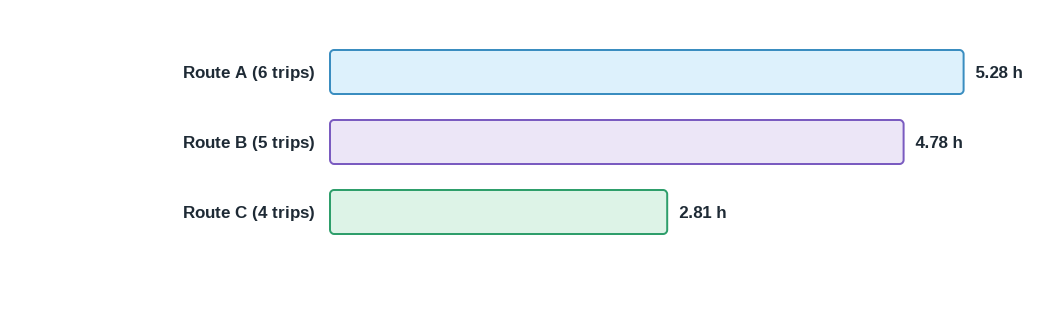
Daily demand (assumed): route A 6 trips, B 5, C 4. Round-trip flight time uses 22 m/s plus a fixed 6 minutes; ground time is 15 minutes; the window is 10 hours a day; availability is 0.80. After flight a battery cools for 30 minutes and then charges for 90.
import math
routes = {"A": (21.0, 6), "B": (24.0, 5), "C": (14.0, 4)}   # (straight-line km, trips per day)
v, overhead, turn = 22.0, 6.0, 15.0        # m/s, minutes, minutes
window_h, avail = 10.0, 0.80               # operating hours, availability
busy_min, trips, fly_min = 0.0, 0, 0.0
for name, (d, n) in routes.items():
    f = 2 * d * 1000 / v / 60 + overhead
    busy_min += n * (f + turn)
    fly_min += n * f
    trips += n
    print(f"route {name}: {n} trips x ({f:.1f} min flight + {turn:.0f} min ground)")
need = busy_min / 60 / (window_h * avail)
print(f"aircraft-hours {busy_min / 60:.1f} h, aircraft needed {need:.2f} -> {math.ceil(need)}")
lam = trips / window_h                     # trips per hour
w_batt = fly_min / trips + 30 + 90         # minutes a battery is busy
print(f"{trips} trips/day, mean flight {fly_min / trips:.1f} min; batteries busy L = {lam:.1f}/h x {w_batt / 60:.2f} h = {lam * w_batt / 60:.1f}")
route A: 6 trips x (37.8 min flight + 15 min ground)
route B: 5 trips x (42.4 min flight + 15 min ground)
route C: 4 trips x (27.2 min flight + 15 min ground)
aircraft-hours 12.9 h, aircraft needed 1.61 -> 2
15 trips/day, mean flight 36.5 min; batteries busy L = 1.5/h x 2.61 h = 3.9The day’s work takes 12.9 aircraft-hours and one aircraft serves 8 hours, so at least 2 aircraft are needed. Route A takes the most time because it has the most trips, not because it is the longest. Little’s law says about 3.9 batteries are busy on average, but the morning peak needs more than average, so the team allocates 4 per aircraft, 8 in total. These averages do not say whether morning samples reach the lab within 2 hours; trip-by-trip scheduling needs a scheduling tool, covered in modules 6–10 of this course.
Tracking flight hours and maintenance intervals
Reliability-centred maintenance holds that maintenance intervals should come from how each component actually fails, not from habit (Nowlan & Heap, 1978). In practice an organisation starts from the manufacturer’s intervals and adjusts them from recorded data. When the fleet flies every day, you need to know in advance when each aircraft is due, and avoid having all of them down at once.
Example 2 Maintenance and battery intervals
The manufacturer specifies a major check every 50 flight hours and battery retirement at 300 cycles (assumed). Work is split evenly between the two aircraft, and the 8 batteries rotate evenly.
fh_day = fly_min / 60 / 2                  # flight hours per aircraft per day
n_batt = 8
cycles_day = trips / n_batt
print(f"each aircraft {fh_day:.1f} flight h/day, 50 h check every {50 / fh_day:.0f} days")
print(f"each of {n_batt} batteries: {cycles_day:.2f} cycles/day, 300 cycles in {300 / cycles_day:.0f} days")
each aircraft 4.6 flight h/day, 50 h check every 11 days
each of 8 batteries: 1.88 cycles/day, 300 cycles in 160 daysEach aircraft is due a major check about every 11 days. If both start together they fall due on the same day, leaving too few aircraft. The team staggers the second aircraft by about half an interval and considers a third as a spare when demand grows. Each battery does 1.88 cycles a day and reaches 300 cycles in about 160 days, so replacement batteries must be budgeted every six months, and packs with abnormally high internal resistance should be retired early.
Safety assessment of the delivery system
The Doi Mok flights are beyond visual line of sight and lower goods, so they are outside the general conditions and need authorisation under the CAAT 2026 notification, which requires a risk assessment with the application (Civil Aviation Authority of Thailand, 2026). CAAT also has guidance document CAAT-GM-UAS-PDRA101 for BVLOS operations that fit a predefined risk assessment (Civil Aviation Authority of Thailand, 2025). The team must check whether the mission fits one of its cases; if not, a full assessment with the SORA method is needed, covered in UAT 401 Module 4 and applied here to a delivery route. Check the latest versions of the notification and guidance before every application.
Ground risk on the route
SORA 2.5 finds the intrinsic ground risk class (iGRC) from the aircraft’s maximum dimension and maximum speed and the highest population density in the footprint, which covers the operational volume plus the ground risk buffer. Mitigations then reduce it; for example M2, reducing the effects of impact (such as an aircraft parachute), lowers it by 1 with medium-robustness evidence. The result is combined with the air risk class (ARC) in the SAIL table (Joint Authorities for Rulemaking on Unmanned Systems, 2024). Our VTOL has a 2.6 m wingspan and a 30 m/s maximum speed, so it falls in the 3 m / 35 m/s column.
Example 3 Choosing a corridor by SAIL
Route C has two corridor options. One passes through the town near the base, with a highest footprint density of 1,800 people/km²; the other bypasses the town, at most 350 people/km² (assumed). Both use an aircraft parachute with medium-robustness evidence (M2, minus 1), and we assume ARC-b after the air risk assessment.
rows = [5, 50, 500, 5000, 50000]          # upper bounds of density bands (people/km2)
igrc_3m = [3, 4, 5, 6, 7]                 # iGRC, 3 m / 35 m/s column, SORA 2.5 Table 2
sail_b = {3: "II", 4: "III", 5: "IV", 6: "V", 7: "VI"}   # SAIL with ARC-b, Table 7
def igrc(density):
    for top, g in zip(rows, igrc_3m):
        if density < top:
            return g
for name, dens in (("via town", 1800), ("around town", 350)):
    g0 = igrc(dens)
    g1 = g0 - 1                           # M2 medium robustness, minus 1
    print(f"{name:12s} density {dens:5d}/km2  iGRC {g0}  with M2 medium {g1}  ARC-b  SAIL {sail_b[g1]}")
via town density 1800/km2 iGRC 6 with M2 medium 5 ARC-b SAIL IV
around town density 350/km2 iGRC 5 with M2 medium 4 ARC-b SAIL IIIThe corridor through town gives SAIL IV; the bypass gives SAIL III. A lower SAIL means the operational safety objectives (OSOs) need lighter evidence, so documentation, testing and training cost less. The bypass is longer and uses more energy, so the energy budgets of Modules 2 and 3 must be checked again. The parachute also changes how the aircraft falls, so the ground risk buffer must be recomputed.
Failure analysis with FMEA
SORA looks at risk to people on the ground and to other aircraft, but a delivery system has many other failures that hurt nobody yet make the mission fail, such as delivering a box to the wrong site or a sample warming until it cannot be tested. Failure modes and effects analysis (FMEA) goes through each component or step to ask how it can fail, with what effect, and how the failure would be detected (International Electrotechnical Commission, 2018). Severity , occurrence and detection difficulty are each scored 1–10 and multiplied into a risk priority number (RPN) for ranking. IEC 60812 warns that the RPN is only a ranking aid: equal values can mean very different things, and high-severity items always need attention even with a low RPN.
Example 4 Ranking delivery-system failures
The team brainstorms five items and scores S, O and D (assumed).
fmea = [
    ("line snags on a tree", 8, 4, 3),
    ("hook releases in the air", 7, 2, 6),
    ("box above 8 C on arrival", 6, 4, 2),
    ("lost C2 link over the ridge", 7, 5, 2),
    ("wrong box handed to wrong site", 6, 3, 5),
]
for item, s, o, d in sorted(fmea, key=lambda r: -r[1] * r[2] * r[3]):
    print(f"RPN {s * o * d:3d}  S{s} O{o} D{d}  {item}")
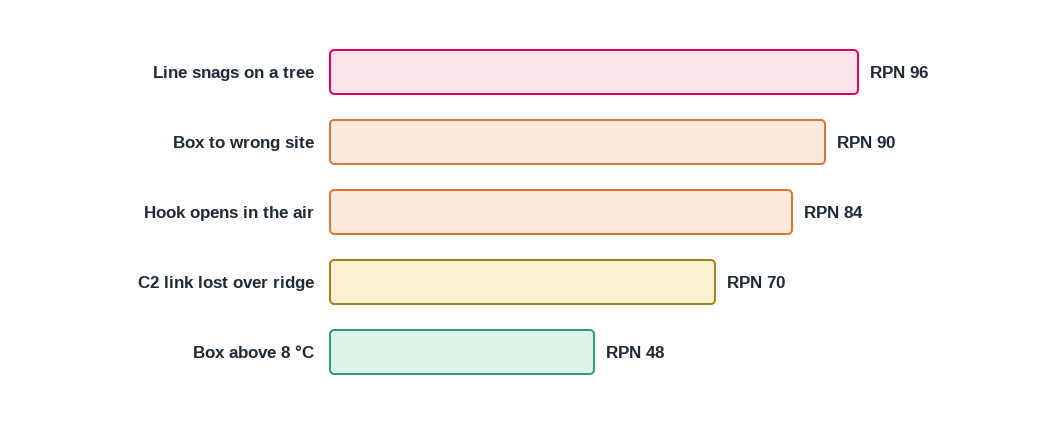
RPN 96 S8 O4 D3 line snags on a tree
RPN 90 S6 O3 D5 wrong box handed to wrong site
RPN 84 S7 O2 D6 hook releases in the air
RPN 70 S7 O5 D2 lost C2 link over the ridge
RPN 48 S6 O4 D2 box above 8 C on arrivalA winch line snagging on a tree has the highest RPN (96); the measures are choosing lowering points by the Module 3 criteria and fitting an automatic line cutter. A box delivered to the wrong site scores 90, though nobody is hurt, because it is hard to detect ( = 5); the measure is a code on each box that the recipient scans before opening. A hook opening in the air is unlikely but hard to detect and serious, so it needs a double lock and a hook-status signal. Losing the link behind the ridge is the most frequent ( = 5) and needs a backup link and a lost-link procedure tested in SITL. After the measures, rescore the items and keep the table in the safety management system, which under ICAO Doc 9859 must review risks continuously (International Civil Aviation Organization, 2018).
The whole risk management process is a continuous loop of identifying, analysing, evaluating, treating, and monitoring and reviewing, as in ISO 31000 (International Organization for Standardization, 2018). Whenever a route is added, the aircraft model changes or an abnormal event occurs, revisit the energy budget, the SAIL and the FMEA.
Complying with safety requirements: from rule to evidence
A SORA assessment says how safe the operation is; compliance shows that the operator meets the rules that apply, with evidence an inspector can read. The team keeps a compliance register: each requirement, its source, the evidence and the date the evidence expires.
| Group | Requirement | Source |
|---|---|---|
| People | A registration letter and a Specific-category privilege for the aircraft type (rotorcraft, aeroplane, powered-lift or lighter-than-air); training evidence at most one year old when applying; a privilege lasts four years and renewal is requested at least 30 days before it ends | CAAT 2026 notification, Articles 5 to 10 |
| Permission | The CAAT Director permits the flight beforehand. The application gives the purpose, date, time and area with coordinates, the aircraft registration number, the procedures, the remote pilots and third-party liability insurance of at least 1 million baht per occurrence that is in force; CAAT may ask for an operations manual and a risk-management manual and set conditions | Articles 20 to 22 |
| Operation | If the mission fits PDRA101: operations manual, training, emergency response plan and interface documents; flights within 80% of the maximum control range; visibility of at least 5 km, no cloud below 300 m, forecast wind of at most 25 knots (gusts excluded), no flying near thunderstorms; operational and pilot logs | PDRA101 |
Aircraft registration and marking (Articles 13 to 18), dropping or lowering goods (ROA.3115) and UN 3373 packaging from Module 1 join the same register. Evidence expires, so the register is a living file. The notification took effect on 17 May 2026, and its Amendment No. 2 adds a transitional route, until 1 March 2027, for holders of an earlier registration letter (Civil Aviation Authority of Thailand, 2026; 2025).
Example 5 Checking the register before applying
The team applies on 1 December 2026 for a permission running to 10 July 2027. Pilot A trained on 10 March 2026 and holds rotorcraft and powered-lift privileges; pilot B trained on 20 November 2025 and holds rotorcraft only. The VTOL fixed-wing counts as powered-lift (the Thai term means vertical take-off and landing aircraft; CAAT must confirm). Two insurance policies are on offer, the manufacturer’s control range is 28 km and the control station is at the base (all assumed).
from datetime import date
# compliance check before applying (all data assumed; rules from the CAAT 2026 notification and PDRA101)
apply_on, period_end, c2_range_km = date(2026, 12, 1), date(2027, 7, 10), 28.0
pilots = {"A": (date(2026, 3, 10), {"rotorcraft", "powered-lift"}), "B": (date(2025, 11, 20), {"rotorcraft"})}   # training date, privileges
policies = {"hospital cover": (500_000, date(2027, 3, 31)), "new cover": (2_000_000, date(2028, 1, 10))}       # limit per occurrence, end date
route_km = {"A": 21.0, "B": 24.0, "C": 14.0}                      # straight-line distance from the control station
aircraft_type = "powered-lift"                                    # the VTOL fixed-wing; CAAT to confirm the class
rows = []
for p, (trained, types) in pilots.items():
    valid_to = trained.replace(year=trained.year + 1)             # training evidence at most one year old at the application
    rows.append((f"pilot {p} training", apply_on <= valid_to, f"usable until {valid_to}"))
    rows.append((f"pilot {p} privilege", aircraft_type in types, "holds " + ", ".join(sorted(types))))
for name, (limit, until) in policies.items():
    rows.append((f"insurance, {name}", limit >= 1_000_000 and until >= period_end, f"{limit:,} baht, until {until}"))
for r, d in route_km.items():
    rows.append((f"route {r}", d <= 0.8 * c2_range_km, f"{d} km against {0.8 * c2_range_km:.1f} km allowed"))
for what, ok, why in rows:
    print(f"{what:25s} {'ok  ' if ok else 'FAIL'} {why}")
print(sum(not ok for _, ok, _ in rows), "blocking items")
pilot A training ok usable until 2027-03-10
pilot A privilege ok holds powered-lift, rotorcraft
pilot B training FAIL usable until 2026-11-20
pilot B privilege FAIL holds rotorcraft
insurance, hospital cover FAIL 500,000 baht, until 2027-03-31
insurance, new cover ok 2,000,000 baht, until 2028-01-10
route A ok 21.0 km against 22.4 km allowed
route B FAIL 24.0 km against 22.4 km allowed
route C ok 14.0 km against 22.4 km allowed
4 blocking itemsFour items block the application. Pilot B’s training evidence ran out on 20 November 2026, eleven days before the application, and B has no powered-lift privilege, so B needs new training (a new one-year clock) and a privilege for this type. The hospital’s cover has half the minimum limit and ends before the period; the new policy passes. Route B lies 24.0 km from the station, beyond the 22.4 km that 80% of 28 km allows: the options are a longer control range proven by the manufacturer or flight data and approved by the chief remote pilot, a station closer to the route, or another aircraft. A clean check does not grant permission; it shows only that nothing the team could have found itself blocks the application.
Module lab
Lab: fleet size and safety file (leading into the mini-project)
- Set the daily demand for the network your group has designed since Module 1, then compute the number of aircraft and batteries with the code in Example 1, for normal demand and for 50% more
- Build a three-month table of flight hours, maintenance intervals and battery cycles with the code in Example 2, staggered so the aircraft are never all down together
- Draw the corridor’s risk footprint on a map, find the highest population density from public data, and compute iGRC, final GRC and SAIL with the code in Example 3 for at least two corridor options
- Build an FMEA of at least 8 items covering aircraft, payload equipment, delivery points and tracking; propose measures and rescore after them
- Combine the results of Modules 1–5 into one delivery-system design file for presentation in week 15
Common mistakes
Watch out
- Sizing the fleet from the daily average, ignoring peaks and availability
- Letting all aircraft fall due for maintenance together, leaving none serviceable that day
- Not logging battery cycles and internal resistance, so you cannot tell which packs to retire
- Using average population density instead of the highest value in the whole footprint
- Claiming a GRC reduction for a parachute without test evidence, and not recomputing the buffer
- Looking only at RPN, missing high-severity items with a low RPN
- Assessing once for the application and never reviewing when the system changes
- Applying with expired or mismatched evidence, such as old training records, a privilege for the wrong aircraft type or insurance that ends before the permission period
Summary
- Fleet management covers fleet size, availability, continued airworthiness, batteries, configuration and people’s roles
- Aircraft needed ; average busy batteries from Little’s law
- Track flight hours and battery cycles, stagger maintenance, and budget replacements in advance
- SORA 2.5 gives a SAIL from the highest footprint population density, aircraft size and speed, mitigations and ARC; corridor choice can lower the SAIL a lot
- FMEA ranks delivery-system failures by , but always look at severity and review continuously as in ISO 31000
- Compliance means a register of each requirement with its source, its evidence and the date the evidence expires; check it before every application and every flight day
Check your understanding
- 20 trips a day, each 40 minutes of flight and 20 minutes on the ground, a 10-hour window and 0.75 availability: how many aircraft?
- 12 trips in 8 hours, each battery busy 2.5 hours per trip: how many batteries are busy on average?
- An aircraft in the 3 m column with a highest density of 40 people/km²: what is the iGRC?
- S = 9, O = 2, D = 3 and S = 3, O = 6, D = 3: what are the RPNs, and which deserves attention first?
- Why does moving the corridor around the town mean checking the energy budget again?
Answers
- hours, divided by gives 2.67, rounded up to 3 aircraft
- trips per hour, batteries
- 40 is in the band below 50; in the 3 m column the iGRC is 4
- Both have RPN 54, but the first has severity 9 and should get measures first, because its consequences are far worse
- The bypass is longer and may cross different terrain, so cruise and climb energy increase and the computed margin may no longer be enough, especially with a headwind
Key formulas
| Number of aircraft needed | |
| Little law | |
| Risk priority number in FMEA |
Key references
- Little, J. D. C. (1961). A proof for the queuing formula: L = λW. Operations Research, 9(3), 383–387. link
- ASTM International. (2019). Standard specification for continued airworthiness of lightweight unmanned aircraft systems (ASTM F2909-19). link
- Nowlan, F. S., & Heap, H. F. (1978). Reliability-centered maintenance (AD-A066579). United Airlines for the Office of the Assistant Secretary of Defense. link
- Joint Authorities for Rulemaking on Unmanned Systems. (2024). JARUS guidelines on Specific Operations Risk Assessment (SORA), main body, edition 2.5 (JAR-DEL-SRM-SORA-MB-2.5). link
- สำนักงานการบินพลเรือนแห่งประเทศไทย. (2569). ประกาศ กพท. เรื่อง หลักเกณฑ์และวิธีการในการอนุญาตให้ผู้บังคับหรือปล่อยอากาศยานซึ่งไม่มีนักบิน ประเภทอากาศยานที่ควบคุมการบินจากภายนอก ที่มีน้ำหนักไม่เกิน 25 กิโลกรัม ปฏิบัติแตกต่างไปจากเงื่อนไขที่กำหนด พ.ศ. 2569 (มีผล 17 พฤษภาคม 2569). link
- สำนักงานการบินพลเรือนแห่งประเทศไทย. (2569). ประกาศ กพท. เรื่อง หลักเกณฑ์และวิธีการในการอนุญาตให้ผู้บังคับหรือปล่อยอากาศยานซึ่งไม่มีนักบิน ประเภทอากาศยานที่ควบคุมการบินจากภายนอก ที่มีน้ำหนักไม่เกิน 25 กิโลกรัม ปฏิบัติแตกต่างไปจากเงื่อนไขที่กำหนด (ฉบับที่ 2) พ.ศ. 2569. link
- สำนักงานการบินพลเรือนแห่งประเทศไทย. (2568). แนวปฏิบัติในการขอปฏิบัติการบินอากาศยานซึ่งไม่มีนักบินโดยใช้การประเมินความเสี่ยงที่เป็นไปตามเงื่อนไขที่กำหนดสำหรับการบินเกินกว่าระยะสายตา (CAAT-GM-UAS-PDRA101 ปรับปรุงครั้งที่ 00). link
- International Civil Aviation Organization. (2018). Safety management manual (Doc 9859, 4th ed.). link
- International Electrotechnical Commission. (2018). Failure modes and effects analysis (FMEA and FMECA) (IEC 60812:2018). link
- International Organization for Standardization. (2018). Risk management – Guidelines (ISO 31000:2018). link
- สำนักงานการบินพลเรือนแห่งประเทศไทย. (2568, 15 ธันวาคม). ข้อกำหนดของสำนักงานการบินพลเรือนแห่งประเทศไทย ฉบับที่ 114 ว่าด้วยการเดินอากาศและการทำการบินของอากาศยาน การป้องกันความเสียหายต่อบุคคลและทรัพย์สินบนภาคพื้น และแผนการบิน (Thailand Civil Aviation Regulation, Air Navigation Service Part Rules of the Air, TCAR ANS Part ROA, Revision 01, 17 พฤศจิกายน 2568). ราชกิจจานุเบกษา, 142 (ตอนพิเศษ 390 ง), 54. link
- World Health Organization. (2026). Guidance on regulations for the transport of infectious substances 2025-2026: Applicable as from 1 October 2025. WHO. link
Further reading
Study the assigned knowledge units in advance, review media and take the module quiz
In class / field
Lab or field practice from worksheets with a safety checklist
Learning evidence: Checked worksheets and quiz results