Landing or hand-off methods and mission tracking
UAT 457 UAS for Transportation and Autonomous Delivery
Lesson
By the end of this module you will be able to
- Compare landing, winch lowering and parachute drop in time, energy, space and risk
- Compute parachute descent speed, wind drift and the swing period of a box on a line
- Design touchdown-confirmation logic from line tension before releasing
- Define what to track during a mission and compute cross-track error and estimated time of arrival
- Turn abnormal events into triggers, actions and owners, and choose a landing site from the energy each site needs
Why this matters
The most dangerous part of drone delivery is usually not the cruise but the last few metres, where the drone comes close to people, buildings, trees and wires. The hand-off method decides how close the rotors get to people, how much space is needed, how much energy is used and in what state the box reaches the recipient. Throughout the flight, the operator must know where the drone is, whether it is still in the corridor, when it will arrive and whether the contents are still cold. This module covers both: landing or hand-off methods, and mission tracking.
Three hand-off methods
| Method | Principle | Advantages | Limitations | In the Doi Mok network |
|---|---|---|---|---|
| Landing | The drone lands, stops its motors, staff take the box | Simple, no swinging load, return goods on the same trip | Needs a clear pad; rotors come close to people | A and B have pads |
| Winch lowering | The drone hovers high and lowers the box on a line | The drone stays high; little ground space needed | Swinging box, line may snag, long hover | C on the ridge |
| Parachute drop | The box is released from height while passing | Fast, no hover | Box must survive impact, landing point scatters, needs a large reception area | Backup for non-fragile supplies when roads are cut |
Precision landing allows landing on a small pad. ArduPilot supports several sensors, such as infrared beacons or AprilTag targets detected by a camera, and states centimetre-level accuracy when landing or hovering over a target (ArduPilot Dev Team, n.d.-c). Procedures must allow staff to approach only after the drone has disarmed.
Winches in ArduPilot can be controlled from the transmitter or with the DO_WINCH command in automatic missions; the system estimates deployed line length and prevents over-retraction (ArduPilot Dev Team, n.d.-a, n.d.-b). A hook or gripper is released with the DO_GRIPPER command (ArduPilot Dev Team, n.d.-d).
Dropping needs a check with CAAT, because ROA.3115 of CAAT Regulation No. 114 allows dropping objects from an aircraft in flight only in accordance with CAAT regulations and any air traffic services clearance (Civil Aviation Authority of Thailand, 2025), and it suits only goods that survive impact. Patient specimens should not be dropped, even in triple packaging that passes the 1.2 m drop test (World Health Organization, 2026), because impact and temperature may spoil the results.
Parachute descent speed
Once the canopy is fully open and the box falls at constant speed, drag equals weight, so , where is the canopy drag coefficient and its area (Benson, n.d.). While falling, the wind carries the box sideways about . A bigger canopy falls more slowly and hits more gently, but drifts further.
Example 1 Comparing the three methods at Pha Tang
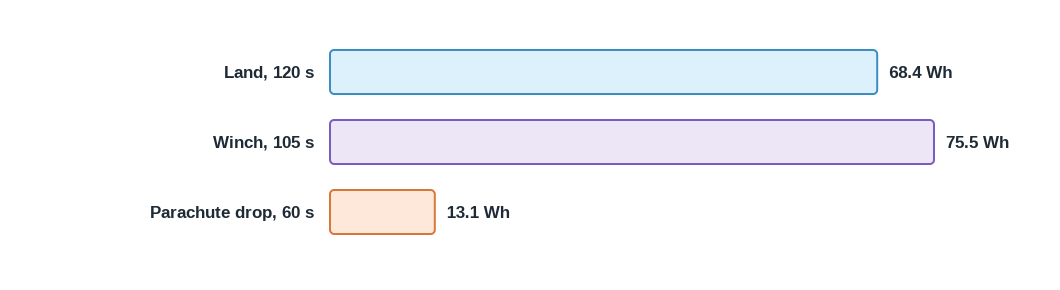
Hover power at 1,000 m is 2,587 W and cruise power 785 W from Module 2. Landing: 15 s transition, 40 s to descend 40 m, 30 s on the ground with motors stopped, 20 s climb, 15 s transition · Winch: 15 s transition, 75 s lowering and reeling in, 15 s transition · Drop: an extra 60 s circuit to line up for release. Box plus parachute 2.3 kg, canopy diameter 1.2 m, = 1.5, below the typical value of about 1.75 that NASA gives, to stay on the safe side; release at 60 m in a 5 m/s wind (assumed).
import math
g, rho = 9.81, 1.112                        # air density at 1,000 m
p_hover, p_climb, p_cruise = 2587, 2587 + 18.0 * g * 2 / 0.52, 785
# steps of each method: (time s, power W)
methods = {
    "land": [(15, p_hover), (40, p_hover), (30, 0), (20, p_climb), (15, p_hover)],
    "winch": [(15, p_hover), (40 + 15 + 20, p_hover), (15, p_hover)],
    "parachute drop": [(60, p_cruise)],
}
for name, steps in methods.items():
    t = sum(s for s, _ in steps)
    e = sum(s * p for s, p in steps) / 3600
    print(f"{name:15s} {t:4d} s  {e:5.1f} Wh")

m_box, cd, d_chute, h_drop, wind = 2.3, 1.5, 1.2, 60.0, 5.0
area = math.pi * (d_chute / 2) ** 2
v_d = math.sqrt(2 * m_box * g / (cd * rho * area))
t_fall = h_drop / v_d
print(f"parachute: descent {v_d:.2f} m/s, fall {t_fall:.1f} s, drift {wind * t_fall:.0f} m, impact energy {0.5 * m_box * v_d ** 2:.0f} J")
print(f"free fall from 0.5 m: {math.sqrt(2 * g * 0.5):.2f} m/s")
land 120 s 68.4 Wh
winch 105 s 75.5 Wh
parachute drop 60 s 13.1 Wh
parachute: descent 4.89 m/s, fall 12.3 s, drift 61 m, impact energy 28 J
free fall from 0.5 m: 3.13 m/sLanding uses slightly less energy than the winch because the motors stop while waiting on the ground, but it needs a pad and brings the rotors down to people. The winch takes 75.5 Wh and 105 s, but the drone stays 40 m up throughout. The parachute drop uses least energy, but the box descends at 4.89 m/s for 12.3 s and drifts about 61 m in the wind, not counting the forward throw from the drone’s speed before the canopy opens, so a large, people-free reception area is needed. If the winch lowers the box to 0.5 m and lets go, it hits the ground at about 3.13 m/s.
Swing of a box on a line
A box hanging under the drone moves separately from it. When the drone accelerates or stops, the box swings like a pendulum, with period when the suspension point is still, the line does not stretch and the angle is small (Serway & Jewett, 2018). Long lines swing slowly, and if the autopilot or gusts push in rhythm near that period, the swing grows.
Example 2 Swing period by line length
for line in (5, 10, 20, 40):
    period = 2 * math.pi * math.sqrt(line / g)
    print(f"line {line:2d} m: period {period:5.2f} s")
line 5 m: period 4.49 s
line 10 m: period 6.34 s
line 20 m: period 8.97 s
line 40 m: period 12.69 sOn a 40 m line one swing takes 12.69 s, so the 15 s settling wait in Example 1 is only about one swing. The team lowers fast at first, then slows when the box is a few metres above the ground, holds the drone as still as possible, and sets a maximum wind for lowering. If the box swings beyond the 5 m obstacle-free radius set in Module 3, lowering must stop and the line be reeled in.
Confirming touchdown before release
Line length cannot say for sure that the box is on the ground, because ground height under the drone is uncertain. A good system uses the sudden drop in line tension when the box rests on the ground. The logic must reject noise, for example by requiring several consecutive samples below the threshold, and must have a way out when things go wrong: if the line snags on a branch, cut or release the line rather than let it pull the drone down.
Example 3 Detecting touchdown from line tension
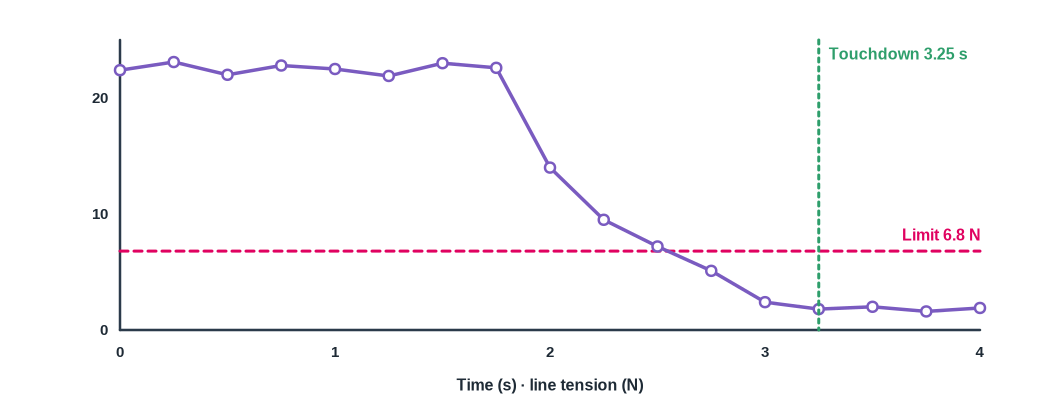
A tension sensor reports every 0.25 s (assumed data). The box weighs 2.3 kg. The team declares touchdown when tension stays below 30% of the box weight for 3 consecutive samples.
tension = [22.4, 23.1, 22.0, 22.8, 22.5, 21.9, 23.0, 22.6, 14.0, 9.5, 7.2, 5.1, 2.4, 1.8, 2.0, 1.6, 1.9]
dt, w_box = 0.25, 2.3 * g
limit = 0.3 * w_box
below = 0
for i, t in enumerate(tension):
    below = below + 1 if t < limit else 0       # count consecutive samples below the limit
    if below == 3:
        print(f"limit {limit:.1f} N; touchdown confirmed at {i * dt:.2f} s (sample {i}), release hook")
        break
limit 6.8 N; touchdown confirmed at 3.25 s (sample 13), release hookTension starts falling at 2 s as the box begins to touch and tilt, but the system confirms at 3.25 s, after three consecutive values below 6.8 N. Waiting these 0.75 s prevents releasing the hook because of a brief jerk from a gust. In real work the threshold must be tested with several boxes and surfaces: grass, concrete and sloping ground.
Mission tracking
Mission tracking means knowing the status of every trip in time to intervene before problems grow, and keeping evidence afterwards. What to track falls into three groups:
| Group | Data | Used for |
|---|---|---|
| Aircraft | Position, altitude, ground speed, heading, flight mode, battery, C2 and GNSS signal quality | Checking it is in the corridor, has enough energy and a good link |
| Goods | Hook and winch status, box temperature | Confirming delivery and that the goods stayed in their temperature range |
| Mission | Departure time, estimated arrival, sender, recipient, box ID | Alerting the destination to be ready and keeping hand-off evidence |
Aircraft data comes from the autopilot’s telemetry, covered in UAT 207. Others need the drone’s position too: Remote ID makes the drone broadcast its identity and position in flight under ASTM F3411 (ASTM International, 2022), and in UAS traffic management (UTM) the service supplier checks that the flight stays within the volume of its filed plan (conformance monitoring) under ASTM F3548 (ASTM International, 2021). UTM and Remote ID are covered in detail in UAT 402.
For specimens, the hand-off evidence is the chain of custody: who sent, who received, when, and whether the seal was intact. The recipient checks the condition and confirms it under the lab’s procedure. Tracking screens, alerting systems and data links with hospital systems are covered in modules 6–10 of this course.
Staying in the corridor and estimating arrival
In a local frame with the base at (0, 0) and the destination at , the unit vector along the track is . The along-track distance of a point is , and the cross-track error is (positive means right of the direction of flight). Estimated time of arrival is remaining distance divided by the latest ground speed.
Example 4 Checking tracked positions
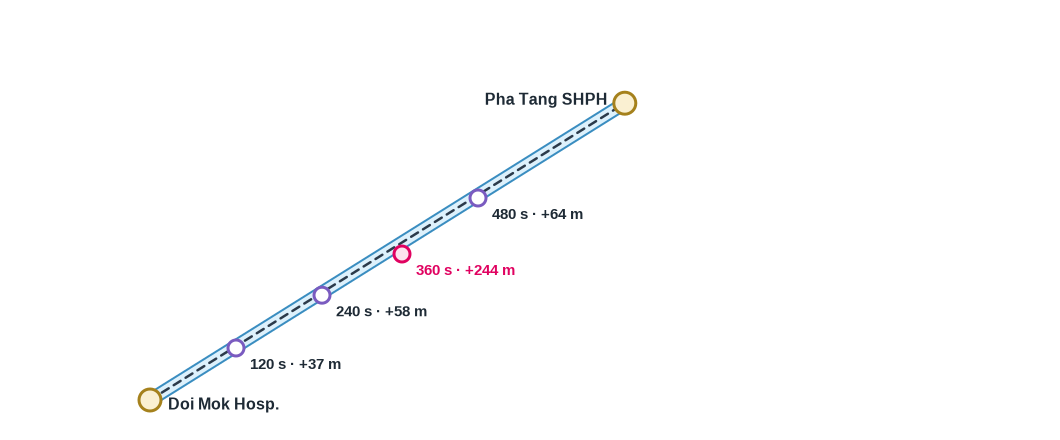
Destination C is at (11.87, 7.42) km from the base; the corridor extends 150 m each side (assumed). Positions arrive every 120 s (assumed data).
c = (11.87, 7.42)                            # position of C (km) from the base
length = math.hypot(*c)
ux, uy = c[0] / length, c[1] / length
fixes = [(120, 2.15, 1.30), (240, 4.30, 2.62), (360, 6.30, 3.65), (480, 8.20, 5.05)]
for t, x, y in fixes:
    along = x * ux + y * uy
    cross = x * uy - y * ux
    flag = "ALERT" if abs(cross) > 0.15 else ""
    print(f"t {t:3d} s: along {along:5.2f} km, cross {cross * 1000:+5.0f} m {flag}")
(t1, x1, y1), (t2, x2, y2) = fixes[-2], fixes[-1]
gs = math.hypot(x2 - x1, y2 - y1) * 1000 / (t2 - t1)
left = length - (x2 * ux + y2 * uy)
print(f"ground speed {gs:.1f} m/s, {left:.2f} km to go, ETA {left * 1000 / gs / 60:.1f} min")
t 120 s: along 2.51 km, cross +37 m
t 240 s: along 5.03 km, cross +58 m
t 360 s: along 7.28 km, cross +244 m ALERT
t 480 s: along 9.63 km, cross +64 m
ground speed 19.7 m/s, 4.37 km to go, ETA 3.7 minAt 360 s the drone is 244 m right of the track, beyond the 150 m edge. The system must alert the operator, who checks the cause at once, for example a stronger crosswind than forecast or a navigation problem. By 480 s the drone is back inside (64 m). The latest ground speed is 19.7 m/s with 4.37 km to go, so it arrives in about 3.7 minutes; this goes to Pha Tang so staff are ready. An excursion must be logged and reported even if the drone returns to the corridor on its own.
Receipt evidence: sent, arrived, acknowledged and accepted
A message saying “sent” does not mean “in the recipient’s hands”. A tracking system usually records several events that look alike but mean different things: sent (logged on the sender’s side), arrived (the box touched down or reached the locker), the recipient acknowledged the message, and the recipient counted the goods and checked their condition. Only the last one can close a delivery, because real receipt means counting the goods against the waybill, noting any discrepancy or damage on it, and issuing a goods received note (GRN) for what was received (WFP Logistics Cluster, 2022). An acknowledgement only says the recipient saw the message; it adds no boxes and does not confirm good condition.
Another common slip concerns the reported quantity. It should be a cumulative total (“counted 2 boxes so far”), not an increment. When the recipient corrects a report, the new one replaces the old one in the count, but the old one stays in the history. If every report is added together, boxes are counted twice.
Example 5 Closing a delivery from receipt evidence
The waybill lists 2 boxes of medicine (assumed). The recipient first reports a cumulative 1 box, then corrects it to 2. The system logs an acknowledgement, and the recipient reports the condition of the goods later.
declared = 2                                  # boxes on the waybill (assumed)
log = [  # (time, who, kind, value) in the order recorded (assumed)
    ("09:41", "system",    "sent",      None),
    ("09:52", "recipient", "count",     1),         # boxes counted so far (cumulative)
    ("09:58", "recipient", "count",     2),         # corrected cumulative count
    ("10:01", "system",    "ack",       "count at 09:58"),
    ("10:10", "recipient", "condition", "intact"),
]
added = sum(v for _, _, k, v in log if k == "count")           # wrong: treats each report as new boxes
counts = [v for _, _, k, v in log if k == "count"]
received = counts[-1]                                           # the latest cumulative report replaces older ones
condition = next((v for _, _, k, v in reversed(log) if k == "condition"), "unknown")
acked = any(k == "ack" for _, _, k, _ in log)
print(f"adding the reports: {added} boxes (wrong); latest cumulative report: {received} of {declared}")
print(f"acknowledged: {acked}, condition: {condition}")
for cond in (condition, "unknown"):   # "unknown" = no condition report yet
    closed = received == declared and cond == "intact"
    print(f"condition {cond:7s} -> delivery {'closed' if closed else 'open'}")
adding the reports: 3 boxes (wrong); latest cumulative report: 2 of 2
acknowledged: True, condition: intact
condition intact -> delivery closed
condition unknown -> delivery openAdding every report gives 3 boxes, which is wrong because it exceeds the waybill. The latest cumulative report is 2 of 2. The acknowledgement has happened but does not close the job. What closes it is a complete count together with a report that the condition is intact. With no condition report yet, the delivery stays open even though the count is complete, and someone must follow up with the recipient. All figures are assumed.
Abnormal events: decide before you fly
Tracking says something is wrong; it does not say what to do, and a supervisor watching several flights has seconds, not minutes. The response must be decided before the trip. An abnormal event is any departure from the plan that the crew or the system must handle in flight: a lost link, a weak battery, degraded navigation, a gust above the limit, a failed hand-off, another aircraft in the same airspace. CAAT’s guidance for BVLOS operations under a predefined risk assessment (PDRA101) asks the operations manual to describe abnormal procedures, among them loss of the command-and-control link, degraded navigation, unsettled weather and the steps after an accident. It also separates emergency procedures, which recover the aircraft or cancel the mission, from the emergency response plan (ERP), which manages the consequences for everyone involved (Civil Aviation Authority of Thailand, 2025).
Each event becomes a trigger (a number that can be measured), an action and an owner. Actions form a ladder from mild to severe: warn, hold, divert, return, land where the aircraft is and, only where designed and approved, terminate. PX4 uses this order, runs the more severe action when several failsafes trigger, and for most failsafes holds position for a set time first so a pilot can step in (PX4 Autopilot, n.d.). ArduPilot’s battery failsafe has two levels, for example RTL when low and Land when critical (ArduPilot Dev Team, n.d.-e), and its ground-station failsafe acts when no heartbeat arrives for FS_GCS_TIMEOUT seconds, 5 by default (ArduPilot Dev Team, n.d.-f).
| Event | Trigger (assumed) | First action | Owner |
|---|---|---|---|
| Energy low for the plan | Energy left minus the cost of the best reachable site under 10 Wh | Divert (Example 6) | Mission software, battery failsafe as backstop |
| Link lost | No heartbeat for 5 s | Continue to the next rally point, or hold, as set for the phase | Autopilot |
| Navigation degraded | Health monitor fails past its grace period (module 8) | Slow down, then divert to the nearest dock | Mission software |
| Line snagged or hook fault | Tension stays high after the release command | Cut or release the line, climb and return | Winch controller |
These failsafes see only voltage, capacity or link time; they do not know the terrain, so “return to base” can be the worst choice when the climb home costs more energy than is left. The mission software therefore costs each landing site with the cruise energy per kilometre and climb energy per metre of Module 2 and the terrain profile of Module 3. The rule here: keep the sites reachable with 10 Wh to spare, take the lowest ground risk, then the least energy needed.
Example 6 Where to land after a battery fault
A cell-voltage monitor declares a fault with 100 Wh of usable energy left (assumed) at km 4, 8 or 12. Candidate sites: the base pad H at km 0 (ground risk 1), a pasture E1 at km 6 (risk 1) and a school field E2 at km 12 (risk 3), with risk running from 1 (low) to 3 (high) as assumed. Pha Tang is excluded because it has no room to land.
import math
# which landing sites can the drone still reach after a fault? (Module 2 and 3 values; sites and risks assumed)
km = [0, 2, 4, 6, 8, 10, 12, 14]
terrain = [420, 520, 760, 1020, 1180, 1090, 1010, 960]    # m MSL, Module 3 profile (flight altitude = terrain + 100 m)
wh_per_km = 785 / 22.0 / 3.6                              # cruise energy per km, Module 2
wh_per_m = 18.0 * 9.81 / 0.55 / 3600                      # energy per metre climbed: 18.0 kg, cruise efficiency 0.55
def hover_w(h):                                           # Module 2 hover power at elevation h
    rho_h = 1.225 * (1 - 2.25577e-5 * h) ** 4.25588
    return (18.0 * 9.81) ** 1.5 / math.sqrt(2 * rho_h * 4 * math.pi * 0.33 ** 2) / 0.52
sites = {"H": (0, 1), "E1": (6, 1), "E2": (12, 3)}        # name: (km, ground risk 1 low to 3 high)
left_wh, spare_wh = 100.0, 10.0                           # usable energy left at the fault; energy kept in hand (assumed)
def need(a, b):
    i, j = km.index(a), km.index(b)
    nodes = list(range(i, j + 1)) if j >= i else list(range(i, j - 1, -1))
    climb = sum(max(terrain[q] - terrain[p], 0) for p, q in zip(nodes, nodes[1:]))
    return abs(b - a) * wh_per_km + climb * wh_per_m + hover_w(terrain[j]) * 55 / 3600   # plus a 55 s landing
for fault in (4, 8, 12):
    wh = {s: need(fault, pos) for s, (pos, _) in sites.items()}
    reach = sorted((sites[s][1], wh[s], s) for s in wh if left_wh - wh[s] >= spare_wh)   # lowest risk, then least energy
    needs = ", ".join(f"{s} {w:.1f}" for s, w in wh.items())
    print(f"km {fault:2d}: needs {needs} Wh -> reachable {[r[2] for r in reach]}, choose {reach[0][2] if reach else 'land at once'}")
km 4: needs H 78.1, E1 82.6, E2 156.3 Wh -> reachable ['H', 'E1'], choose H
km 8: needs H 117.7, E1 59.4, E2 79.2 Wh -> reachable ['E1', 'E2'], choose E1
km 12: needs H 172.5, E1 114.2, E2 39.5 Wh -> reachable ['E2'], choose E2Going home is the usual default, but at km 8, on the ridge crest, it needs 117.7 Wh against 100 Wh left, so a drone set to RTL would fall short; the pasture 2 km behind, downhill, needs only 59.4 Wh. At km 4 both H and E1 are reachable, and H wins on margin (21.9 Wh against 17.4 Wh) because reaching E1 means climbing 260 m. At km 12 only the school field is reachable, with risk 3. The rule has no good answer there, which is what a safety assessment should reveal: add or move an emergency site, shorten the plan so a low-risk site stays in reach, or agree beforehand where inside the field to come down. Every diversion goes into the log and the ERP. Apart from the Module 2 and 3 values the figures are assumed.
Module lab
Lab: test the hand-off and track the mission
- Configure a winch or gripper in ArduPilot SITL, write a mission with a DO_WINCH or DO_GRIPPER command at the delivery point, and record the time of each step
- In a closed area under CAAT conditions within visual line of sight, lower a dummy box from low height on two line lengths and time the swing against the code in Example 2
- If a tension sensor is available, log tension while lowering onto grass and concrete, then tune the threshold in Example 3 so touchdown is confirmed correctly on both
- Take positions from a real or SITL flight log, compute cross-track error and arrival time with the code in Example 4, and write a chain-of-custody record for one box
Common mistakes
Watch out
- Letting staff approach before the drone has disarmed; the rotors may spin up
- Confirming touchdown from line length alone, although ground height is uncertain
- Having no way to cut or release a snagged line, so it pulls the drone down
- Dropping fragile goods or specimens by parachute, and ignoring wind drift
- Releasing the hook or reeling in while the box is still swinging hard
- Tracking position only, not box temperature and hand-off status, so there is no evidence when a test result looks wrong
- Leaving the failsafe at return to base without checking that the energy left can get home over the terrain
Summary
- Landing, winch lowering and parachute drop trade space, energy, time and distance from people
- A parachute descends at and drifts about
- A box on a line swings with period ; slow down near the ground and wait for it to settle
- Confirm touchdown from line tension below a threshold for several consecutive samples, and have a way out if the line snags
- Mission tracking covers aircraft, goods and mission; cross-track error drives alerts, and arrival time prepares the recipient
- Decide the response to abnormal events before flight: each event has a measurable trigger, an action on the ladder from warn to terminate, and an owner; choose the landing site by reachable energy and ground risk, not by habit
Check your understanding
- A 1.5 kg box, canopy area 1.0 m², = 1.5, air density 1.2 kg/m³: how fast does it descend?
- Released from 50 m at 5 m/s descent in a 4 m/s wind: about how far does the box drift?
- What is the swing period on a 15 m line?
- Why wait for several consecutive low-tension samples before releasing?
- Track from (0, 0) to (10, 0) km; the drone is at (4, −0.2) km. What is the cross-track error and on which side?
Answers
- m/s
- Fall time s, drift m
- s
- To avoid releasing at the wrong moment because of a brief drop in tension, such as a gust lifting the box or a jerk, which could drop the box from height
- , so km, 200 m right of the direction of flight (flying along +x, the right side is −y)
Key formulas
| Steady parachute descent speed | |
| Wind drift | |
| Swing period of a box on a line | |
| Cross-track error | |
| Estimated time of arrival |
Key references
- ArduPilot Dev Team. Precision landing and loiter. ArduPilot Copter documentation. link
- ArduPilot Dev Team. Daiwa winch. ArduPilot Copter documentation. link
- ArduPilot Dev Team. Mission command list. ArduPilot Copter documentation. link
- ArduPilot Dev Team. Servo gripper. ArduPilot Copter documentation. link
- Benson, T. (n.d.). Velocity during recovery. Beginner's guide to rockets. NASA Glenn Research Center. link
- Serway, R. A., & Jewett, J. W. (2018). Physics for scientists and engineers (10th ed.). Cengage.
- สำนักงานการบินพลเรือนแห่งประเทศไทย. (2568, 15 ธันวาคม). ข้อกำหนดของสำนักงานการบินพลเรือนแห่งประเทศไทย ฉบับที่ 114 ว่าด้วยการเดินอากาศและการทำการบินของอากาศยาน การป้องกันความเสียหายต่อบุคคลและทรัพย์สินบนภาคพื้น และแผนการบิน (Thailand Civil Aviation Regulation, Air Navigation Service Part Rules of the Air, TCAR ANS Part ROA, Revision 01, 17 พฤศจิกายน 2568). ราชกิจจานุเบกษา, 142 (ตอนพิเศษ 390 ง), 54. link
- ASTM International. (2022). Standard specification for remote ID and tracking (ASTM F3411-22a). link
- ASTM International. (2021). Standard specification for UAS traffic management (UTM) UAS service supplier (USS) interoperability (ASTM F3548-21). link
- World Health Organization. (2026). Guidance on regulations for the transport of infectious substances 2025-2026: Applicable as from 1 October 2025. WHO. link
- WFP Logistics Cluster. (2022). Goods flow management. In Logistics operational guide. World Food Programme. link
- สำนักงานการบินพลเรือนแห่งประเทศไทย. (2568). แนวปฏิบัติในการขอปฏิบัติการบินอากาศยานซึ่งไม่มีนักบินโดยใช้การประเมินความเสี่ยงที่เป็นไปตามเงื่อนไขที่กำหนดสำหรับการบินเกินกว่าระยะสายตา (CAAT-GM-UAS-PDRA101 ปรับปรุงครั้งที่ 00). link
- PX4 Autopilot. Safety (failsafe) configuration. PX4 user guide (main). link
- ArduPilot Dev Team. Battery failsafe. ArduPilot Copter documentation. link
- ArduPilot Dev Team. GCS failsafe. ArduPilot Copter documentation. link
Further reading
Study the assigned knowledge units in advance, review media and take the module quiz
Suspended loads, winches and item delivery
UTM, U-space และ Remote ID
M09 Delivery: from the request to verifiable hand-over evidence
S5 Delivery and hand-over: when requests exceed confirmed resources
In class / field
Lab or field practice from worksheets with a safety checklist
Learning evidence: Checked worksheets and quiz results