Drone spraying and spreading, calibration and law
UAT 465 UAS Technology for Smart Farming and Precision Agriculture
Lesson
By the end of this module you will be able to
- Compute each zone's required flow rate from application rate, swath and speed
- Adjust speed when flow exceeds the pump's capacity
- Check the mass and centre of gravity of the loaded system at full and empty tank
- Assess granular spreading uniformity with catch trays and CV, screening the tray rows first
- Measure spray drift following ISO 22866 and set a buffer zone from the drift decay curve
- Follow Thai law, standards and safety for drone spraying
- Set the seed and granular-fertiliser rate with a ground catch test
- Compute the effective capacity and field efficiency of a spraying job
Why this matters
A good prescription map is useless if the drone cannot spray the rates it asks for, or spreads fertiliser in thick and thin stripes. And spraying agrochemicals without proper standards puts operators, neighbours and the environment at risk and breaks the law. This module connects the prescription map to real operations.
Flow rate by zone
Application rate (litres per rai) times the area the drone covers per minute gives the flow the pump must deliver. A variable-rate sprayer changes flow as it passes each zone, but pumps and nozzles have limits; if a zone needs more than the limit, the drone must slow down there.
Example 1 Can the pump keep up in every zone?
Foliar liquid fertiliser at 1.5, 2.0 and 2.5 L per rai in the high, mid and low zones; 6 m swath; 5 m/s; the pump delivers at most 2.6 L/min.
# foliar liquid fertiliser rate by zone (L per rai), 6 m swath, 5 m/s, pump maximum 2.6 L/min
rates = {"high": 1.5, "mid": 2.0, "low": 2.5}
swath, speed, pump_max = 6.0, 5.0, 2.6

rai_per_min = swath * speed * 60 / 1600
for z, r in rates.items():
    q = r * rai_per_min
    msg = "" if q <= pump_max else f" > pump, slow to {pump_max / r / (swath * 60 / 1600):.2f} m/s"
    print(f"zone {z:4s}: {r} L/rai -> {q:.2f} L/min{msg}")
zone high: 1.5 L/rai -> 1.69 L/min
zone mid : 2.0 L/rai -> 2.25 L/min
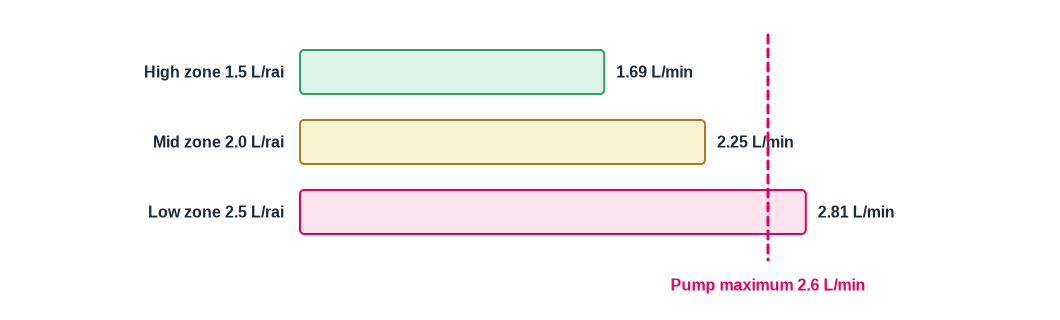
zone low : 2.5 L/rai -> 2.81 L/min > pump, slow to 4.62 m/sAt 5 m/s the drone covers 1.125 rai per minute. The high and mid zones need 1.69 and 2.25 L/min, within the pump’s limit, but the low zone needs 2.81 L/min, above it. The mission must slow to 4.62 m/s in the low zone; otherwise the zone that needs the most fertiliser gets less than prescribed.
Droplet size depends on the nozzle and pressure. ANSI/ASABE S572.3 classifies nozzles by droplet spectrum: fine droplets cover leaves well but drift easily. ISO 23117-1:2023 sets environmental requirements for unmanned aerial spraying systems, including drift control. How to measure drift and set buffer zones is covered in “Measuring spray drift and setting buffer zones”.
Mass and centre of gravity as the load changes
A spraying or spreading drone does not keep one mass for the whole sortie. The tank is full at take-off and nearly empty at landing, so both the total mass and the centre of gravity (CG) change throughout. The CG of the whole system is the mass-weighted average of every component’s position, . The manufacturer’s manual for each model gives the maximum mass and the acceptable CG range. Check the whole system (aircraft, batteries, tank or spreader module, and the material) at every load level that will really occur, not just the tank mass. Liquid sloshing in a part-filled tank also shifts the CG in flight, so the manual comes first. This calculation is not a certificate that the system can fly.
Example: moving the tank further out, is the CG still in range?
The empty aircraft with batteries weighs 24 kg, and its CG is taken as the reference . The tank holds 30 L of plain water (about 1 kg per litre; a real product needs the density from its label or a measurement) and sits ahead of the reference. The acceptable CG range is assumed to be ±4 cm, for practice only; the real values are in the model’s manual.
DRY_KG, TANK_L, WATER_KG_PER_L = 24.0, 30, 1.0      # sample figures
WINDOW_M = 0.04                                      # sample CG window: +/-4 cm about the reference
FRACTIONS = (1.0, 0.0)

def cg(offset_m, fraction):
    liquid = TANK_L * WATER_KG_PER_L * fraction
    total = DRY_KG + liquid
    return total, liquid * offset_m / total          # dry aircraft CG is the reference (x = 0)

for offset in (0.06, 0.12):                          # tank centre ahead of the reference
    for f in FRACTIONS:
        total, x = cg(offset, f)
        ok = "inside" if abs(x) <= WINDOW_M else "OUTSIDE"
        print(f"tank at +{offset:.2f} m, {f:>4.0%} full: mass {total:5.1f} kg  CG {x * 100:+5.1f} cm  {ok}")
tank at +0.06 m, 100% full: mass 54.0 kg CG +3.3 cm inside
tank at +0.06 m, 0% full: mass 24.0 kg CG +0.0 cm inside
tank at +0.12 m, 100% full: mass 54.0 kg CG +6.7 cm OUTSIDE
tank at +0.12 m, 0% full: mass 24.0 kg CG +0.0 cm insideWith the tank 6 cm out, the CG stays in range at both load levels. With the tank 12 cm out, the full-load CG is +6.7 cm, outside the range. A CG that passes with an empty tank therefore proves nothing. Any change of tank position, material or module must be re-checked, with the old configuration kept so it can be restored. Flight time must come from the manual or from a test with the real load; the Wh printed on a battery is not a certified flight time.
Uniformity of granular spreading
Drones spread granules with a spinning disc: fertiliser falls thickly under the drone and thins towards the edges, so neighbouring passes must overlap correctly to be uniform. This spacing is the effective swath width. Ohio State University Extension (Colley and colleagues, 2018) advises setting pass spacing equal to the effective swath width and cites the catch-tray test procedure of ASABE S341.4. Uniformity is measured by the CV of the amounts caught in the trays.
Example 2 How far apart should passes be?
Trays are placed every 1 m across the flight line; after one pass the granules in each tray from −4 to +4 m are weighed, then the CV is computed for neighbouring passes overlapped at different spacings. The team’s (assumed) rule is CV below 15%.
import statistics as st
# granules caught in trays every 1 m across one pass (grams), from -4 to +4 m
single = [3, 7, 12, 14, 18, 16, 10, 5, 2]

def cv_at(spacing):
    """overlap neighbouring passes at the given spacing and return the CV over one interval"""
    total = []
    for x in range(spacing):
        s = 0
        for k in range(-3, 4):                  # several neighbouring passes
            i = x - k * spacing + 4
            if 0 <= i < len(single):
                s += single[i]
        total.append(s)
    return st.stdev(total) / st.mean(total) * 100

for sp in (5, 6, 7):
    print(f"lane spacing {sp} m: CV {cv_at(sp):5.1f}%")
lane spacing 5 m: CV 6.6%
lane spacing 6 m: CV 15.0%
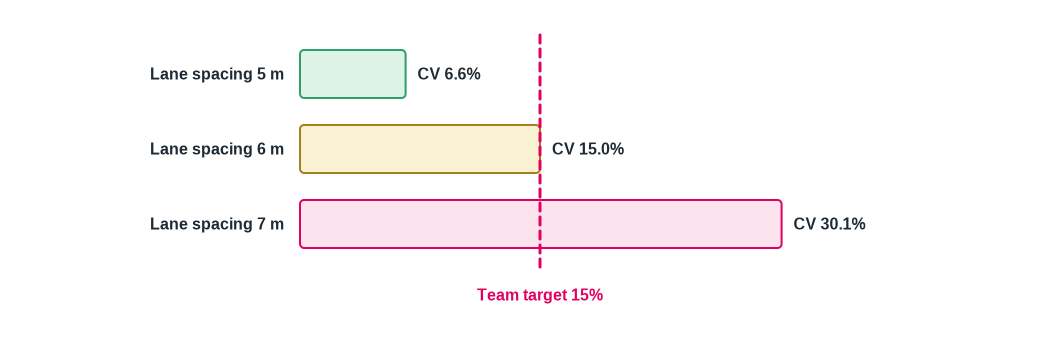
lane spacing 7 m: CV 30.1%A 5 m spacing gives CV 6.6%, clearly passing. 6 m gives 15.0%, right at the limit. 7 m gives 30.1%, which would show as dark and pale green stripes in the field. The team sets 5 m spacing even though it means more flying. The result applies only to the fertiliser and height tested; a different product or height needs a new test.
Before computing the CV, screen the tray rows. A tray not yet weighed (a blank) is not 0 g. A negative value or a unit other than g is held for checking. A tray ID that appears twice is held, both rows, and at least two trays are needed for a sample SD. When the mean is 0 the CV is undefined because it divides by zero; it is not 0% and it does not pass a limit. Held rows go on the open-items list with a reason; do not fill them with 0, do not pick the first or last row yourself, and do not pool different test runs or materials. Also, a CV speaks only about uniformity relative to the mean: a material ten times lighter spread the same way gives the same CV, so it says nothing about the application rate, and a CV that passes the team’s limit does not certify the effect on the crop or the spray drift.
Measuring spray drift and setting buffer zones
The US Environmental Protection Agency (US EPA) defines spray drift as the movement of pesticide droplets or dust through the air, during or soon after application, to any site other than the intended area. For cane fields next to irrigation canals or houses, drift is the main risk of spraying work. Drift increases with:
- Droplet size Small droplets fall slowly and travel far on the wind (ANSI/ASABE S572.3). Wang and colleagues (2020) tested a spray drone with spinning-disc nozzles in the field and found that drift increased with wind speed and with smaller droplets
- Wind and release height The higher the drone flies and the stronger the wind, the longer droplets stay airborne and the further they go
- Temperature inversions At dawn or dusk the air near the ground can be cooler than the air above, so the air does not mix and fine droplets hang and move a long way. A Virginia Tech publication (Vulchi and colleagues, 2026) recommends measuring air temperature at two heights, near the ground and about 2.5 to 3 m up; if the upper reading is warmer, an inversion is present, and spraying should wait until the sun has warmed the ground
How drift is measured ISO 22866:2005 sets out the principles of field drift measurement. In short: spray a low-toxicity tracer instead of the real product; place horizontal collectors above the crop or on the ground downwind, at least at 5 m and 10 m from the edge of the sprayed area, with further distances at multiples of 5 m; use at least two collectors at each distance; report the result as a percentage of the amount applied to the field; repeat at least three times; and record wind and temperature on a weather mast beside the field. The standard gives detailed protocols for ground sprayers but states that its principles also apply to aircraft. ISO 23117-1:2023 sets environmental requirements specifically for unmanned aerial spraying systems.
A buffer zone is a strip left unsprayed between the field and a sensitive area such as a canal, houses or a neighbour’s vegetable plot. Its width should come from drift measured under the team’s real spraying conditions; if the product label or an authority specifies a distance, always use whichever is wider.
Example 3 The canal is 12 m away: how wide must the buffer be?
The team sprays water with a tracer along the field edge, with the wind blowing from the field towards the canal, at the working speed and height. Collectors are placed at 5, 10, 15, 20 and 30 m. Two settings are tested: fine droplets (VMD 100 µm) and coarser droplets (VMD 200 µm). The team’s (assumed) rule is that no more than 1% of the application rate may reach the canal (all data assumed).
import math
# drift deposit on collectors downwind (% of the applied rate), mean of 3 replicate passes
dist = [5, 10, 15, 20, 30]                      # m from the downwind edge of the sprayed strip
drift = {"fine (VMD 100 um)": [8.0, 3.1, 1.4, 0.6, 0.12],
         "coarser (VMD 200 um)": [3.5, 1.1, 0.40, 0.16, 0.03]}
LIMIT = 1.0                                     # acceptable deposit at a sensitive area (% of rate)
CANAL = 12                                      # m to the canal downwind

for name, y in drift.items():
    ly = [math.log(v) for v in y]               # fit ln(drift) = a + b * distance
    mx, my = sum(dist) / len(dist), sum(ly) / len(ly)
    b = sum((x - mx) * (v - my) for x, v in zip(dist, ly)) / sum((x - mx) ** 2 for x in dist)
    a = my - b * mx
    buffer = (math.log(LIMIT) - a) / b
    at_canal = math.exp(a + b * CANAL)
    print(f"{name}: halves every {math.log(0.5) / b:.1f} m, "
          f"{at_canal:.2f}% at the canal, below {LIMIT}% beyond {buffer:.1f} m")
fine (VMD 100 um): halves every 4.2 m, 2.34% at the canal, below 1.0% beyond 17.1 m
coarser (VMD 200 um): halves every 3.7 m, 0.80% at the canal, below 1.0% beyond 10.8 mDrift falls exponentially with distance, halving about every 4 m with fine droplets. The canal, 12 m from the field edge, would receive about 2.3%, above the limit, so the buffer must be at least about 17 m: another strip about 5 m wide inside the field must be left unsprayed. With coarser droplets the canal receives about 0.8% and the buffer needed drops to about 11 m, which passes but leaves only about 1 m of margin. The team therefore does both: it sprays the canal-side strip with coarser droplets and leaves a 5 m strip inside the field unsprayed as a margin for gusts, managing that strip by other means. The result applies only to the wind speed, height and nozzles tested; stronger wind or a higher flight needs a new measurement.
Law, standards and safety
- Department of Agriculture operating standard In December 2024 the Department of Agriculture launched a standard operating procedure (SOP) manual for agricultural spraying with unmanned aircraft and an identity card for contracted drone applicators of agricultural hazardous substances. Contract applicators should be trained and carry this card. According to the Department’s information and press reports, contract applicators of agricultural hazardous substances must complete the Department’s course and hold permission to possess hazardous substances under the Hazardous Substances Act B.E. 2535, and formal enforcement against drone contractors is planned for 2027; check the announcement in force
- Flight and radio drones must be registered and flown under CAAT conditions (CAAT-GM-UAS-002), and radio equipment registered with the NBTC
- Product labels use the rate and method on the label; if the label does not cover drone application, check the manufacturer’s and the Department of Agriculture’s guidance
- Operator safety wear protective equipment when mixing and filling, and rinse tanks at designated points
- Community and environment keep buffers from homes, water and neighbouring fields; stop in strong wind or if people enter the area
The liquid and granular fertilisers in this course are not hazardous substances, but teams doing contract work usually also spray pesticides, so they must train to the same standard.
Seeding and setting the spreading rate with a catch test
A drone can broadcast seed as well as granular fertiliser. Setting the rate works as in spraying, but the quantity is mass: to apply kg per rai at swath (m) and speed (m/s), the feeder must deliver kg per minute. The number set on the gate cannot tell you the real rate, because every lot flows differently, so calibrate with a catch test: run the feeder on the ground for a fixed time (propellers removed, or the drone strapped down) and weigh what comes out. Ohio State University’s guide for fertiliser spreaders asks for a result within 5% of the target (Colley et al., 2018, FABE-561).
Example 4 Setting a seed rate of 12 kg per rai
The target is 12 kg per rai (assumed; the real figure comes from an agronomist), a 5 m swath from Example 2 and 5 m/s. The feeder runs on the ground for 30 s, three times.
# Seed rate: what the feeder must deliver, then a ground catch test (assumed figures)
target, swath, speed = 12.0, 5.0, 5.0            # kg per rai (assumed), m, m/s
need = target * swath * speed * 60 / 1600        # kg/min the feeder must deliver
print(f"feeder must deliver {need:.2f} kg/min")
for label, runs in (("first test", [6.10, 6.02, 6.18]), ("after gate x 0.922", [5.64, 5.58, 5.71])):   # kg in 30 s, three runs
    q = sum(runs) / len(runs) * 2                # kg/min
    rate = q * 1600 / (swath * speed * 60)       # kg per rai
    err = rate / target - 1
    verdict = "OK" if abs(err) <= 0.05 else f"ADJUST, gate x {need / q:.3f}"
    print(f"{label}: {q:.2f} kg/min -> {rate:.2f} kg/rai, error {err:+.1%} {verdict}")
feeder must deliver 11.25 kg/min
first test: 12.20 kg/min -> 13.01 kg/rai, error +8.4% ADJUST, gate x 0.922
after gate x 0.922: 11.29 kg/min -> 12.04 kg/rai, error +0.3% OKThe feeder must deliver 11.25 kg/min, but the first setting gives 12.20, or 13.01 kg per rai, 8.4% above target. So the gate opening is scaled by 0.922 (assuming flow is proportional to the opening, so it must be retested), giving 12.04 kg per rai, which passes. The catch test checks only the quantity delivered, not evenness, so it is paired with the catch trays of Example 2.
Seed is not fertiliser. More seed does not always give more yield: a drone-sown rice trial found yield peaked at 195 seedlings per m² and then fell (Zhu et al., 2023; a japonica variety in China, not a Thai recommendation), and a drone-mounted broadcaster prototype reported field-sample CVs of 13.76-20.34% (Zhu et al., 2026), so test with the real material. The FAO and ITU report (2018) lists other drone uses, such as animal tracking and forest monitoring, which need different sensors and flight conditions.
Effective capacity: how many rai per hour the job really takes
An answer to how long 150 rai will take, from swath times speed, is too fast, because the drone also turns, mixes, refills, changes batteries and builds the mission. The theoretical field capacity rai per hour assumes spraying never stops, the effective field capacity (EFC) is the area finished divided by the total job time, and the field efficiency is (Pucharoensilp et al., 2022; Iowa State University Extension and Outreach, 2026). In nine Thai sugarcane fields of about 8,800 m² each, Pucharoensilp et al. (2022) found theoretical spraying time was only 23% of the total, while Qin et al. (2023) found 72.7% for electric spray drones. They differ because plot size and job organisation differ.
Example 5 A 150 rai field and a 5.5 rai plot
Use Example 1’s figures (6 m, 5 m/s, 2 L per rai); the 30 L tank covers 15 rai per load. A turn takes 6 s, building the mission 385 s once, and refilling plus changing the battery 162 s per load (the last two are means reported by Pucharoensilp et al.). Mixing at 180 s and travel at 60 s per load are assumed.
import math
# Effective capacity of a spray drone: 6 m swath, 5 m/s, 2 L per rai, 30 L tank (Example 1); times in s
def job(rai, passes):
    spray = rai * 1600 / (6 * 5)                 # spraying time; theory gives 67.5 rai/h
    loads = math.ceil(rai * 2 / 30)
    total = spray + (passes - 1) * 6 + loads * (162 + 180 + 60) + 385   # turns, per load (fill+battery, mixing, travel), mission set-up
    return rai / (total / 3600), spray / total
for name, rai, passes in (("150 rai", 150, 67), ("5.5 rai", 5.5, 11)):
    efc, eta = job(rai, passes)
    print(f"{name}: effective {efc:.1f} rai/h, field efficiency {eta:.0%}")
efc = job(150, 67)[0]
print(f"drone hours a year: {600 / efc:.0f} for 600 rai-applications, {3000 / efc:.0f} for 3,000")
150 rai: effective 42.2 rai/h, field efficiency 62%
5.5 rai: effective 17.4 rai/h, field efficiency 26%
drone hours a year: 14 for 600 rai-applications, 71 for 3,000The 150 rai field has a theoretical 67.5 rai per hour, but ten refills make it 42.2, an efficiency of 62%. The 5.5 rai plot gets 26%, close to the reported 23%, because fixed job times take nearly all of it, so bundle neighbouring plots into one job. The last line connects to Module 5 Example 2: 600 rai-applications a year need only 14 drone hours, while the break-even of 3,000 needs 71.
Module lab
Lab: sprayer calibration and spreading test
- Fill the spray drone’s tank with plain water, time and catch the output of every nozzle at working pressure, and compare actual flow with the setting
- Compute each zone’s flow and speed in your group’s prescription with the code in Example 1
- Lay catch trays across the flight line, spread a test material (such as plastic pellets or a fertiliser approved by the lecturer), weigh each tray, and find the spacing whose CV passes with the code in Example 2
- Before computing the CV in step 3, screen the tray rows using the rules at the end of the spreading-uniformity section (blank, negative, wrong unit, duplicate), and compute the mass and CG of your own aircraft at full and empty tank with the code in the tank-moving example
- Write a pre-spray safety checklist following the Department of Agriculture’s guidance
- Set the rate for a test material with a ground catch test as in Example 4 (propellers removed or the drone strapped down), and time one real spraying job to find its field efficiency as in Example 5
Common mistakes
Watch out
- Setting flow above pump capacity without slowing, so the neediest zone gets least
- Not calibrating nozzles, so worn or clogged nozzles spray unevenly
- Using the manual’s spacing without testing with the actual fertiliser
- Spraying in strong wind, so droplets drift to homes or water
- Spraying at dawn or dusk during an inversion, or guessing the buffer width without ever measuring drift
- Contract spraying without training or an applicator card
Summary
- Flow rate ; if above pump capacity, slow down in that zone
- Droplet size depends on nozzle and pressure (ANSI/ASABE S572.3), and drift must be controlled (ISO 23117-1)
- Measure drift with downwind collectors following ISO 22866, and set the buffer where drift falls below the limit; coarser droplets allow a narrower buffer
- Granular spreading needs a catch-tray test; set spacing to the effective swath width whose CV passes
- Contract applicators in Thailand should follow the Department of Agriculture standard, and CAAT and NBTC conditions
- The feeder must deliver , set with a ground catch test to within 5%; effective capacity is below theory because of turns, mixing, refilling and battery changes, and small plots suffer most
Check your understanding
- Swath 5 m, speed 4 m/s, rate 2 L per rai. What flow is needed in L/min?
- Pump maximum 2.0 L/min, rate 2.5 L per rai, swath 6 m. What is the fastest speed?
- Trays average 20 g with a standard deviation of 4 g. What is the CV?
- Drift 5 m downwind is 8% of the application rate and halves every 4 m. How much remains at 13 m?
- Which agency issues the contracted drone applicator card?
Answers
- L/min
- m/s
- 8 m further means two halvings: of the application rate
- The Department of Agriculture
Key formulas
| Flow rate | |
| Maximum speed the pump allows | |
| Spreading coefficient of variation | |
| Drift with distance and buffer width |
Key references
- กรมวิชาการเกษตร. (2567, 16 ธันวาคม). กรมวิชาการเกษตรเปิดตัวมาตรฐานการปฏิบัติงานการพ่นสารด้วยอากาศยานไร้คนขับทางการเกษตรและบัตรประจำตัวผู้รับจ้างพ่น [ข่าวประชาสัมพันธ์]. link
- International Organization for Standardization. (2023). Agricultural and forestry machinery — Unmanned aerial spraying systems — Part 1: Environmental requirements (ISO 23117-1:2023). link
- ASABE. (2020). Spray nozzle classification by droplet spectra (ANSI/ASABE S572.3 FEB2020). American Society of Agricultural and Biological Engineers. link
- Colley, T., Fulton, J., Mann, D., & Port, K. (2018). Proper spinner-disc spreader operation, terms and definitions (FABE-563). Ohio State University Extension. link
- สำนักงานการบินพลเรือนแห่งประเทศไทย. (2565). เอกสารแนวทาง CAAT-GM-UAS-002 (ปรับปรุงครั้งที่ 00). link
- สำนักงาน กสทช. ระบบลงทะเบียนอากาศยานซึ่งไม่มีนักบิน (โดรน). link
- International Organization for Standardization. (2005). Equipment for crop protection: Methods for field measurement of spray drift (ISO 22866:2005). link
- Wang, G., Han, Y., Li, X., Andaloro, J., Chen, P., Hoffmann, W. C., Han, X., Chen, S., & Lan, Y. (2020). Field evaluation of spray drift and environmental impact using an agricultural unmanned aerial vehicle (UAV) sprayer. Science of the Total Environment, 737, 139793. link
- U.S. Environmental Protection Agency. Introduction to pesticide drift. link
- Vulchi, P., Esmaeilbeiki, F., & Singh, V. (2026). Understanding temperature inversions: Protecting against pesticide drift during aerial drone spray applications (SPES-827). Virginia Cooperative Extension, Virginia Tech. link
- Colley, T., Fulton, J., Mann, D., & Port, K. (2018). Spinner-disc spreader set up and calibration: Spinner-disc spreader field execution manual—Part 1 (FABE-561). Ohio State University Extension. link
- Zhu, H., Lu, X., Zhang, K., Xing, Z., Wei, H., Hu, Q., & Zhang, H. (2023). Optimum basic seedling density and yield and quality characteristics of unmanned aerial seeding rice. Agronomy, 13(8), Article 1980. link
- Zhu, Z., Yu, G., Chen, C., Chen, X., Cai, J., Yu, J., Liu, M., & Fang, P. (2026). Design and test of a UAV-based oscillating-tube broadcasting device. Agriculture, 16(16), Article 1749. link
- Food and Agriculture Organization & International Telecommunication Union. (2018). E-agriculture in action: Drones for agriculture. FAO. link
- Iowa State University Extension and Outreach. (2026). Estimating field capacity of farm machines (PM 696). link
- Pucharoensilp, K., Saengprachatanarug, K., Posom, J., Wongpichet, S., Saikeaw, K., Ungsathittavorn, K., Taira, E., & Pilawut, S. (2022). Effective field capacity prediction model for management of UAV spraying. Asia-Pacific Journal of Science and Technology, 28(6), Article APST-28-06-08. link
- Qin, W., Chen, P., & Wang, B. (2023). Productivity model and experiment of field crop spraying by plant protection unmanned aircraft. Frontiers in Plant Science, 14, Article 1168228. link
Further reading
Study the assigned knowledge units in advance, review media and take the module quiz
โดรนเกษตรอัจฉริยะ
Payload mass, centre of gravity and energy
M03 Spraying, seeding and spreading: from the farm task to a checkable plan
S7 Agriculture: from a crop map to the decision to inspect further
Designing and integrating drone systems
In class / field
Intensive lab and field practice recorded in a lab notebook
Learning evidence: Lab notebook signed by the instructor