M03 Spraying, seeding and spreading: from the farm task to a checkable plan
Separate liquid work from granular-material work, choose compatible methods and systems, place resources and sensitive boundaries, and check evidence with a three-role KSEC worksheet

Define the job and the responsible people before choosing equipment
This chapter has the status learning and tabletop content, pending_field_review: still awaiting a field-specific reviewer No expert has certified the operating practice. There are no flight results, material-spreading results, calibration results, or learner trial results. Publishing the chapter and worksheets does not close the P3 readiness criterion and does not certify readiness for real operations.
When a request is received, learners should separate the material type and the method suited to the job, compare whole systems, place people, resources and sensitive boundaries, check the limits of the evidence, and then send the plan to a responsible person with qualifications suited to the job for review. The deliverable is a brief, options, a resource plan, open items, evidence and a revision history , not a spraying or spreading order.
M02 Crop monitoring helps identify points that need ground investigation. Observations or NDVI are not a diagnosis and do not specify a substance type, an application rate or the need to apply material. The request owner and the agricultural/material experts must provide the real reasoning and criteria before M03 work is planned.
Choose B Beginner to write a brief and compare methods, O Operator/planner to arrange resources, select evidence and submit the work, or D Developer/customiser to write requirements and a test plan. All three pathways can be done on paper without a drone or a demonstration of spraying with real hardware.

Image generated with AI to explain context; it is not a site in the CSV, a flight result, or evidence of real material use. Open the full-size context image
Decide whether material is needed before choosing a kit
Images or indices from M02 are only signals for further checks. Try this with Case study S7: from a crop image to an inspection plan: IMG-A/v1 shows a pattern difference in the image, but FIELD-A is still a request to collect samples, not a confirmed result. In this state a learner can propose inspection points and owners of open items, but cannot yet state a cause, a product, an application rate or a material-spreading order.
If the scenario concerns pests or the use of agrochemicals, FAO describes the IPM approach as requiring consideration of feasible management methods, effects on the area and the environment, and options that do not use chemicals, before a decision is made. This is a way of thinking for questioning experts, not an automatic decision formula or permission to use chemicals in Thailand. If the scenario involves seeds, fertilizer or other materials, the purpose, evidence on the crop/area, material characteristics and criteria must be requested separately from the work owner and the relevant specialists; the IPM approach is not used to confirm the suitability of every kind of material.
The training framework designed by the author has two separate questions: What should be done with the plot and If there is supporting reasoning, which method and kit will be used. The first question may end with monitoring, collecting more data or a ground-based method, without using a drone. The second question then enters the system comparison below, and still requires checking of current labels/permissions, manuals, people, resources, the area and the airspace before real work.
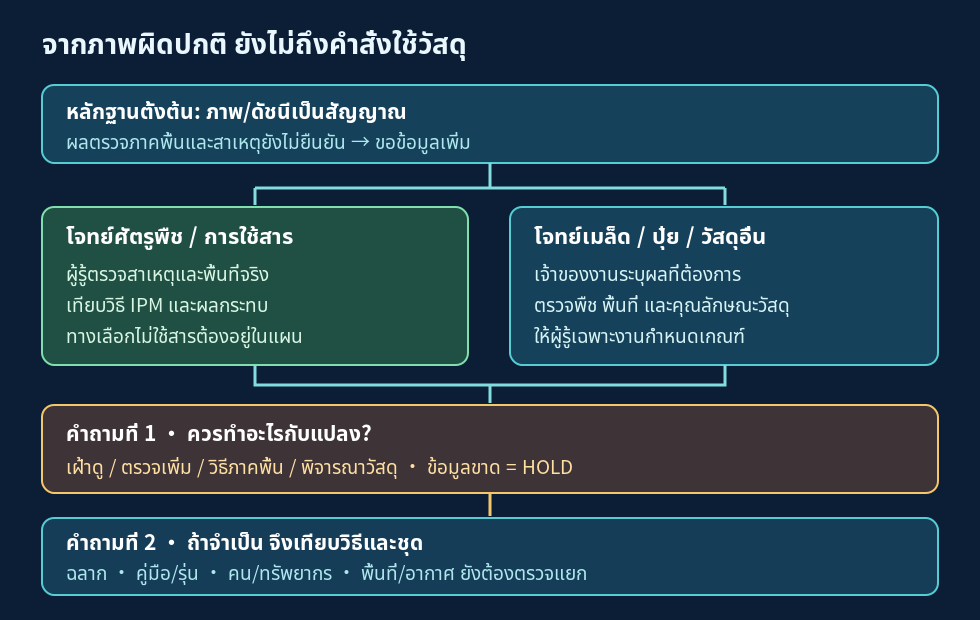
The diagram is a training framework, not a real approval pathway. Open the full-size decision diagram before choosing a kit
Practise linking the three existing KSEC groups from S7 without adding outcome codes: B writes a brief of what is seen from the image and what needs checking by someone knowledgeable, O records the non-drone option and the list of unconfirmed resources, D specifies that field_requested and image_candidate do not change into application_authorized. Keep the work products according to the existing M03 rubric; the learner-result status remains NOT_RUN until real trials are held
If it concerns a pesticide, separate the evidence into three paths
FAO states the scope of its 2024 manual on aerial application of pesticides for regulators, operators and applicators, with national requirements to be checked alongside; the WHO publication page states that this manual updates the one on aerial application from the 2001 edition. From the scope that could be read, the author therefore designed three evidence paths to be submitted separately to responsible reviewers for pesticide-use scenarios, not procedures or approval criteria from the full manual
| Evidence path | Question in the study plan | Who must confirm in real work |
|---|---|---|
| Necessity and material | Are there ground inspection results and reasoning comparing options per IPM yet; do the material and label match the scenario? | The work owner and the plant/chemical specialists for that job |
| Requirements and operators | Have the product's permission status, method of use, area/airspace rights and the qualifications of the people been checked as of now? | The person responsible for regulations and flight, and an applicator qualified for the real job |
| Off-target risk and method | Do neighbouring areas, people, water sources, conditions at the time of work, the system/inspection method and the suspension plan have area-specific evidence yet? | The planner and an assigned material/safety reviewer |
These three paths are a framework for organising the lesson's questions , not a list of fully verified Thai legal provisions or a certificate that spraying is safe. If any path has no evidence or confirming owner, mark hold only for the plans that depend on that path; do not use the readiness of the aircraft as a substitute for the readiness of the material, the people or the area. For seeds, fertilizer and other materials, a reviewer and evidence must be set according to the actual type of material; the pesticide manual is not used as an approval in their place

This diagram organises questions for submission to reviewers; it does not show real permissions or inspection results. Open the full-size three-path evidence diagram
In the existing KSEC, B separates these three paths in the brief and writes the unknowns, O names the evidence owner/condition hold of each path in the plan and the handover, D defines a test case in which evidence on one path does not move another path's status to confirmed automatically. Use the existing codes APP-M03-B/O/D and the existing rubric; no learner assessment results are added
Separate liquid, granular material and ground-based options
Liquid spraying requires a liquid system compatible with the material and the job, while sowing seeds or granular fertilizer requires a granular-material system that supports those material characteristics. The name 'agricultural drone', the tank capacity, or the ability to attach a module alone does not prove compatibility of the whole system, and does not make different materials use the same calibration method.
Use the same criteria for every option, consulting the kit-selection chapter C01–C10, System assembly and Mass/CG alongside. A cell with no evidence must stay 'awaiting confirmation' with an owner for the open item.
Scroll the table horizontally to see all columns. When the table has keyboard focus, use the left or right arrow keys.
| Shared criteria | Compatible liquid-only system | Compatible granular-material-only system | Ground-based option/service suited to the job |
|---|---|---|---|
| Request and material | The request owner/reviewer states the purpose and the type of liquid permitted | Separate seeds, granular fertilizer or other material by actual characteristics | Check whether people/tools/methods can deliver the result for the same request |
| Compatibility | The model manual, power link, controls, material-contact parts and FW must support it | The aircraft, mechanical module, material, control kit and FW must jointly support it | The tool manual, the material and the user's proficiency must support it |
| Mass and CG | Check the whole kit and changing load conditions; do not use tank mass alone | Include the module, mounting points and changing load; check limits per the manual | Check the load, transport and tool limitations of that method |
| Area and conditions | Review the air during work, crops/downwash, boundaries and sensitive areas | Review the material condition, area, crops, wind and boundaries according to the actual method | Review access, sensitive areas, soil/route conditions and air |
| Method/calibration evidence | Flow and receiving-result check methods according to the manual/actual material, with model and reviewer | Separate tare/empty/flow and material-specific data according to the manual | Quantity/result check methods accepted by the reviewer for the actual tool |
| People and resources | Operator/assistant, material handler, charging, procurement, clean water when the method requires it, and waste collection | Operator/assistant, material, procurement, power and storage/return | People, tools, transport, support and time confirmed |
| Maintenance | Inspection/cleaning/storage method according to the manual and material requirements | Mechanism maintenance/storage method specific to the system and material | Tool maintenance and material-handling method for that option |
| Total job cost | Equipment, module, people, material, power, training, repair, QA, waste management and delivery | Use the same cost headings, including module/material changes and review | Include people, tools, access, QA and time constraints; do not invent prices |
| Hold/backup plan | If evidence or resources are insufficient, hold/replan or ask the resource owner | If the material/module is changed without review, hold; do not silently reuse the old template | Use when the responsible person confirms that it can answer the request, or keep the work on hold |
A multirotor may be an option when the work pattern and the supported material-spreading kit suit the area. A fixed-wing or VTOL may suit some job conditions when takeoff and landing, flight pattern, payload system and release method are checked together. The real model manual must be consulted; do not conclude capability, flight range or work rate from the aircraft type. An aircraft that can do mapping does not automatically have material-spreading capability.
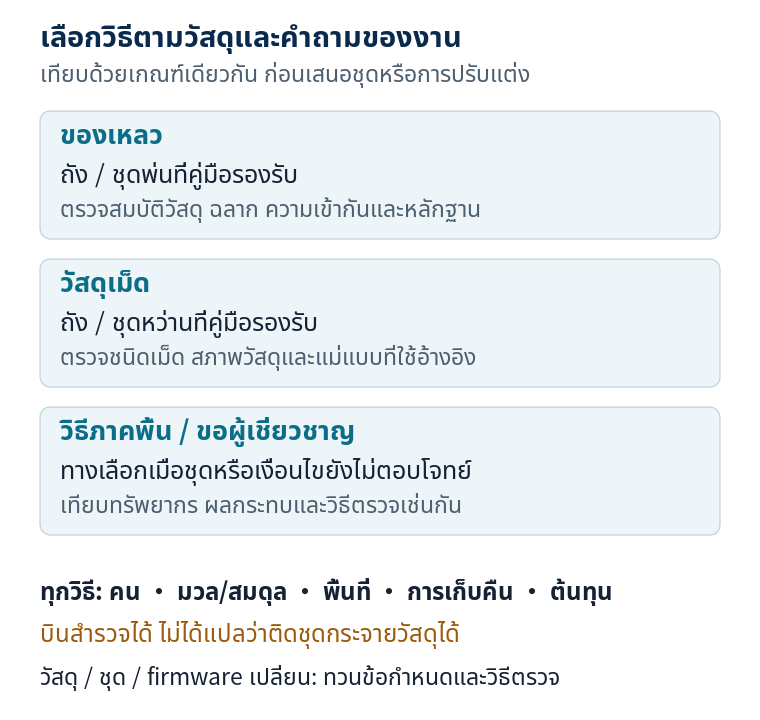
The diagram is a comparison framework for study, not a certification of a system or material. Open the full-size method-selection diagram
People, resources and boundaries need a confirmer
The plan must name the request owner, the site owner, the agricultural/material reviewer, the person responsible for flight, an operator trained in the method, assistants/observers per the plan, and the material handlers and clean-up staff designated by the reviewer, as well as the result recipient and the person responsible for open items. Do not invent personal names or acceptance evidence.
Scroll the table horizontally to see all columns. When the table has keyboard focus, use the left or right arrow keys.
| Topic | Evidence to request from the real job | While unconfirmed |
|---|---|---|
| Material and criteria | Label/current permission status, job conditions, manual and a qualified reviewer | Hold work that depends on that information; ask the responsible person to confirm |
| System and power | Aircraft, module, FW, payload/CG, battery, charging, link, manual/model and logs | Do not declare a kit ready from a calculation or a spec |
| Sensitive areas | Neighbors, canals/water sources, adjacent areas, walkways and access that must be protected according to the actual method | Request the criteria and a reviewer; do not create a universal buffer distance |
| Air and rights | Air conditions checked at the time of work, area rights, airspace and the permissions for the actual day/job | Check Aviation law and current information before deciding |
| Support route | Procurement/charging, clean water where relevant, clean/contaminated separation, return/waste and the responsible person | Hold/replan if the people or the route are not yet confirmed |
| Requests for support | What is requested, the resource owner who confirms, acceptance evidence, conditions and time limit | requested/pending is not confirmed; follow up with the owner or change the plan |
This chapter does not specify spray/spread rates, height, speed, droplet size, buffer distances, chemical formulations, PPE selection methods or activation commands. The responsible person must provide real values from the label, current permissions, the model/FW manual, area conditions and a reviewed method. This chapter has not checked product permission or Thai legal requirements for any specific job.
From the request to the plan sent to reviewers
- Define the job boundary: The request owner states the users of the result, the purpose, the material type, the real criteria and the responsible people who must review. If criteria are not yet defined, keep on hold.
- Compare methods: Liquid, granular material and ground-based options use the same headings. Keep the reasons for choosing/not choosing and the evidence still missing.
- Confirm resources: Roles, people, system, support, sensitive boundaries, air and rights have owners who confirm. Requests for support that are still pending do not count as readiness.
- Propose a material-specific inspection plan: Have a responsible person suited to the job approve the real method before proceeding, including the data-receiving format, uncertainty, hold conditions and fallback. This worksheet only writes the plan; it does not order sampling or real trials.
- Review evidence: Separate originals, quarantined data, computable mathematics, real criteria and acceptance results that do not yet exist. If information is found insufficient, hold/revise the version and review again.
- Send to the named recipient: Record the channel, version, open items, responsible person and extra-check conditions. Separate received (the file arrived), acknowledged (the recipient acknowledged the work) and approved (the person with authority approved within scope), then keep a correction log while preserving the originals.
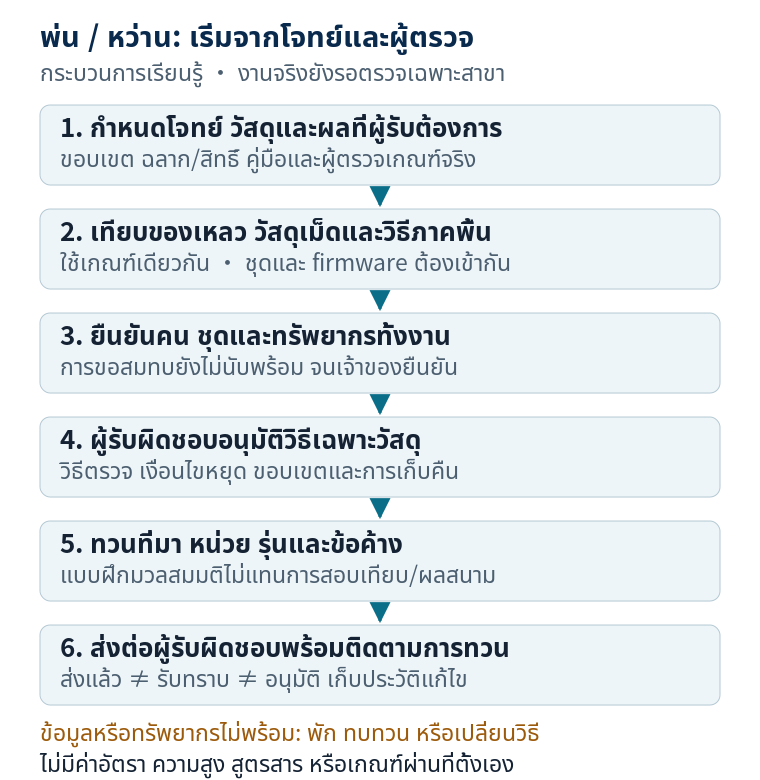
This is a learning process designed by the author, not an automatic approval system or CPX Open the full-size process diagram
Calibration evidence must match the system and the material
Spreading System T50/T25 manual pages 4–5, 7–9 and 12 separate model/FW/material compatibility, container weight settings, and the empty condition from the flow check, as well as material-specific data and power-off maintenance. They are therefore used as document-checking questions; installation steps or model values are not carried over as general instructions.
T50/T25 aircraft manual read only on PDF pages 38 and 46 (printed numbers 36 and 44), gives context on condition/payload limits, and on reviewing flow when the liquid changes viscosity or the system has abnormalities. Evidence for the granular-material module does not substitute for evidence for the liquid system, and the mass calculations in the worksheet do not substitute for any calibration result.
OECD 2021 executive summary, printed page 11, explains that evidence depends on equipment, product and work method. Exposure, efficacy and drift are different questions, so a single CV number is not used to answer all of them, nor treated as equipment-purchase advice.
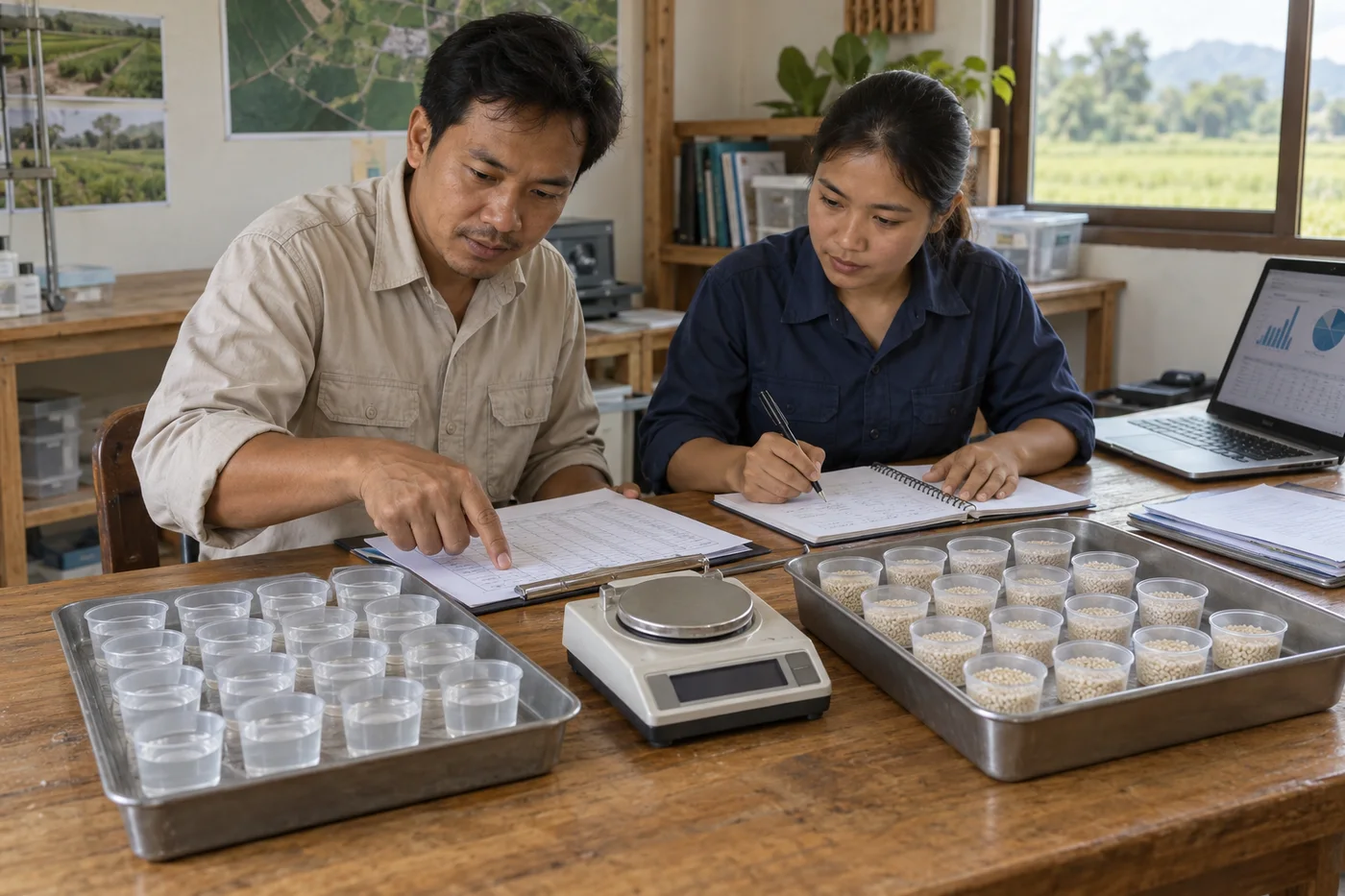
Image generated with AI to accompany document review; it does not show calibration results, a CSV or a real trial. Open the full-size evidence-review image
Case TRAIN-APP-01 and what is not in the data
Download agricultural-application-observations.csv and readme/schema In this case, TABLETOP ONLY: metadata_origin=author_provided_teaching_assumption, measurement_status=not_performed (sample_method not carried out), media_status=not_supplied, field_review=pending_field_review in every row. There is no location, data-collection date, aircraft, material, substance, crop, application rate or real treatment result.
The terms water_assumption and inert_granule_assumption are teaching labels. The unit g refers only to received-mass values made up by the author. No weighing, mass receiving or sampling was actually done, and the activity does not send learners out to collect data. g is not converted to g per area or to an application rate.
Scroll the table horizontally to see all columns. When the table has keyboard focus, use the left or right arrow keys.
| Row / group | Assumed value | Expected screening result for teaching |
|---|---|---|
| L01–L05 / L1 / C1–C5 / water_assumption | 80, 90, 100, 110, 120 g | 5 rows in the positive group; descriptive mathematics is used in this group |
| G01–G05 / G1 / C1–C5 / inert_granule_assumption | 8, 9, 10, 11, 12 g | 5 rows in another positive group; do not combine with L1 |
| Q01 / Q1 / C1 | quantity empty, g | Quarantine as missing_quantity; empty is not equal to 0 |
| Q02 / Q2 / C1 | 100, unit unknown | Quarantine as unknown_unit; do not guess the unit |
| Q03 / Q3 / C1 | −1 g | Quarantine as negative_quantity |
| Q04 and Q05 / Q4 / C1 | 100 and 105 g | Duplicate key (case_id,run_id,sample_id): quarantine both; do not choose the first/last |
| Z01–Z02 / Z1 / C1–C2 / water_assumption | 0, 0 g | Numbers usable; zero-mean group; CV undefined |
The screening result set by the author is 10 rows in the two positive-mean groups + 5 quarantined rows + 2 zero-mean rows = 17 . Do not fill 0 in place of missing data, do not combine different materials or runs, and do not drop the zero-mean group. This set has no validator/import that has been created or run.
Descriptive mathematics on paper
Use mean=Σx/n, sample SD s=√[Σ(x−mean)²/(n−1)] when n≥2, and CV=100s/mean when n≥2 and mean>0. If n=1 the sample SD is undefined. If mean=0, let CV=undefined with a reason, even when s=0; do not change it to 0% or to a pass
L1: sum 500 g → mean=500/5=100 g; deviations=−20,−10,0,10,20 g; sum of squares=1,000 g²; s=√(1,000/4)=15.811388… g; CV=100×15.811388…/100=15.811388…%
G1: sum 50 g → mean=10 g; deviations=−2,−1,0,1,2 g; sum of squares=10 g²; s=√(10/4)=1.5811388… g; CV=100×1.5811388…/10=15.811388…%
Z1: n=2, sum=0 g, mean=0 g; sum of squares=0 g²; s=0 g; CV undefined because mean=0. Round only the presented results to two decimal places; do not round intermediate values in the calculation.
Scroll the table horizontally to see all columns. When the table has keyboard focus, use the left or right arrow keys.
| Group | n | mean (g) | sample SD (g) | CV (%) | Scope of use |
|---|---|---|---|---|---|
| L1 | 5 | 100.00 | 15.81 | 15.81 | Mathematical answer for the hypothetical group |
| G1 | 5 | 10.00 | 1.58 | 15.81 | Equal CV but different quantities |
| Z1 | 2 | 0.00 | 0.00 | undefined | Zero values usable; CV undefined |
Equal CV does not mean equal quantity/application rate, effective swath width, drift, cumulative deposition, uniformity passing a criterion, crop response, or that real methods are comparable. This set has no acceptance threshold. A real method needs a receiver layout, overlap pattern, boundaries, crops/downwash, air, a sampling/data-collection method, uncertainty and acceptance criteria reviewed by the responsible person first. These values are not in the CSV.
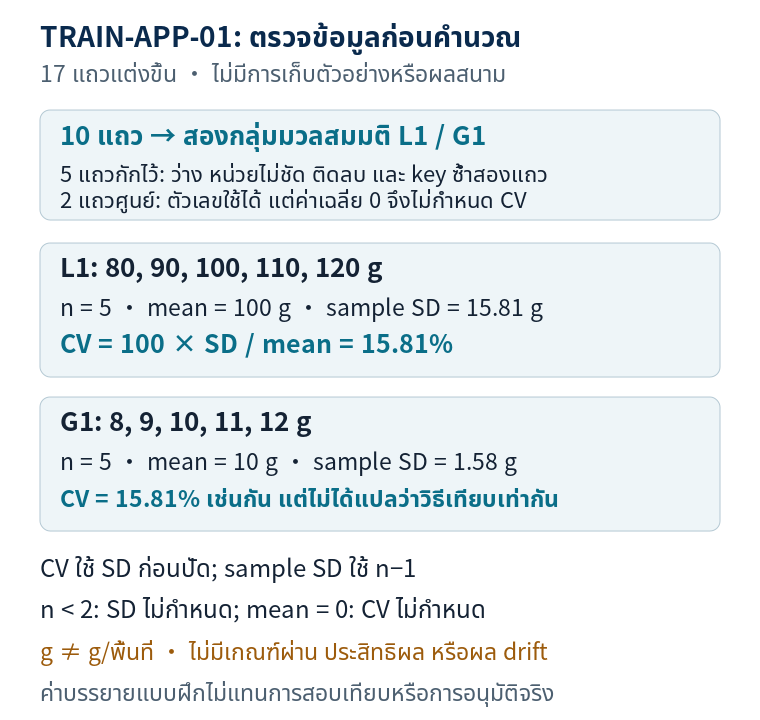
The diagram shows the fixture's expected values and the formulas written by the author; it is not a validator run result or a real spreading result. Open the full-size evidence diagram
B Beginner: brief and reasons for choosing or holding
Use the editable Worksheet B to write the recipient/request/deliverable, separate liquid from granular material, compare both and the ground-based option under the same headings, state the questions that must be sent to real reviewers, then answer the case where the recipient asks to 'choose the substance and order the work from M02 straight away', while keeping the boundary of the evidence. Keep B-v0/feedback/B-v1 and the owner of outstanding work.
Scroll the table horizontally to see all columns. When the table has keyboard focus, use the left or right arrow keys.
| ID / dimension | Prerequisites before doing and supplementary work | Observable goal | Activity / evidence | Pass / not yet passed |
|---|---|---|---|---|
| APP-M03-B-K01 / K | Can separate UAS/material/observations; review Basics and M02, then write the difference between spraying and spreading | Explain the request, options and limits using the same criteria | brief + liquid/granular/ground-based table | All 9 criteria, actual requests and reasons are complete; not passed when mapping drones are treated as able to spread material |
| APP-M03-B-S01 / S | Can read the brief/units and organise the list; review mission brief then separate the recipient/result | Creates a brief that traces the reviewer's questions and can hold | brief, missing-evidence/owner/review conditions | Links request → result → question → responsible person; not passed when spray values are filled in or g is treated as a rate |
| APP-M03-B-E01 / E | Accepts hypothetical data and the limits of authority; review Observations then correct the claim | Gives reasons that limit a request beyond the evidence and reports pending review | Answer to the case of ordering material from M02 + claim before/after | Does not diagnose or order a substance from an image, announces TABLETOP/pending; not passed when results are invented or self-approved |
| APP-M03-B-C01 / C | Keeps the original version and accepts feedback; review teamwork then record one piece of feedback | Reviews open items and fixes or keeps the proposal with reasons | B-v0/B-v1, answers to all feedback and follow-up tasks | Has owner/evidence/review conditions; not passed when open items are closed without evidence |
O Operator/planner: plan and evidence handed on
Use Worksheet O to arrange the six-step plan, state resources that are confirmed/awaiting confirmation, sensitive boundaries and the clean/contaminated/return routes as set by the reviewer, screen the 17 rows with reasons, calculate L1/G1/Z1 separately, then write a handover and a correction log that separate file arrival from work acknowledgment and approval. No real operations are performed in the exercise.
Scroll the table horizontally to see all columns. When the table has keyboard focus, use the left or right arrow keys.
| ID / dimension | Prerequisites before doing and supplementary work | Observable goal | Activity / evidence | Pass / not yet passed |
|---|---|---|---|---|
| APP-M03-O-K01 / K | Knows roles/model/units/mean; review integration and B, then explain calibration ≠ math | Explains the system, resources and real methods that still need confirmation | Six-step plan + resource/boundary/cleanup register | Separates material/system; every matter has a confirmer; not passed when requested is treated as confirmed |
| APP-M03-O-S01 / S | Can screen rows and use sample SD; review the formulas above, then calculate L1 by hand first | Screens 10/5/2, calculates the three groups, and submits work according to status | disposition, math, handover O-v0/O-v1 | Duplicate key: quarantine both; L/G/Z are correct; received/ack/approved kept separate; not passed when zero-filling or merging runs |
| APP-M03-O-E01 / E | Separates expected/real and rights; review Handover then limit the claims | States what is unknown and keeps on hold when evidence/resources are insufficient | hold/fallback rationale + data given to the recipient | No hypothetical threshold/pass; does not send real values that do not yet exist; not passed when CV is used to certify drift/field results |
| APP-M03-O-C01 / C | Reviews duties and keeps corrections; review teamwork, then answer one piece of feedback | Takes responsibility for open items and for traceable corrections | owner/recipient, correction log, original/revised versions | No silent edits, has review conditions and answers all feedback; not passed when received is written as approved |
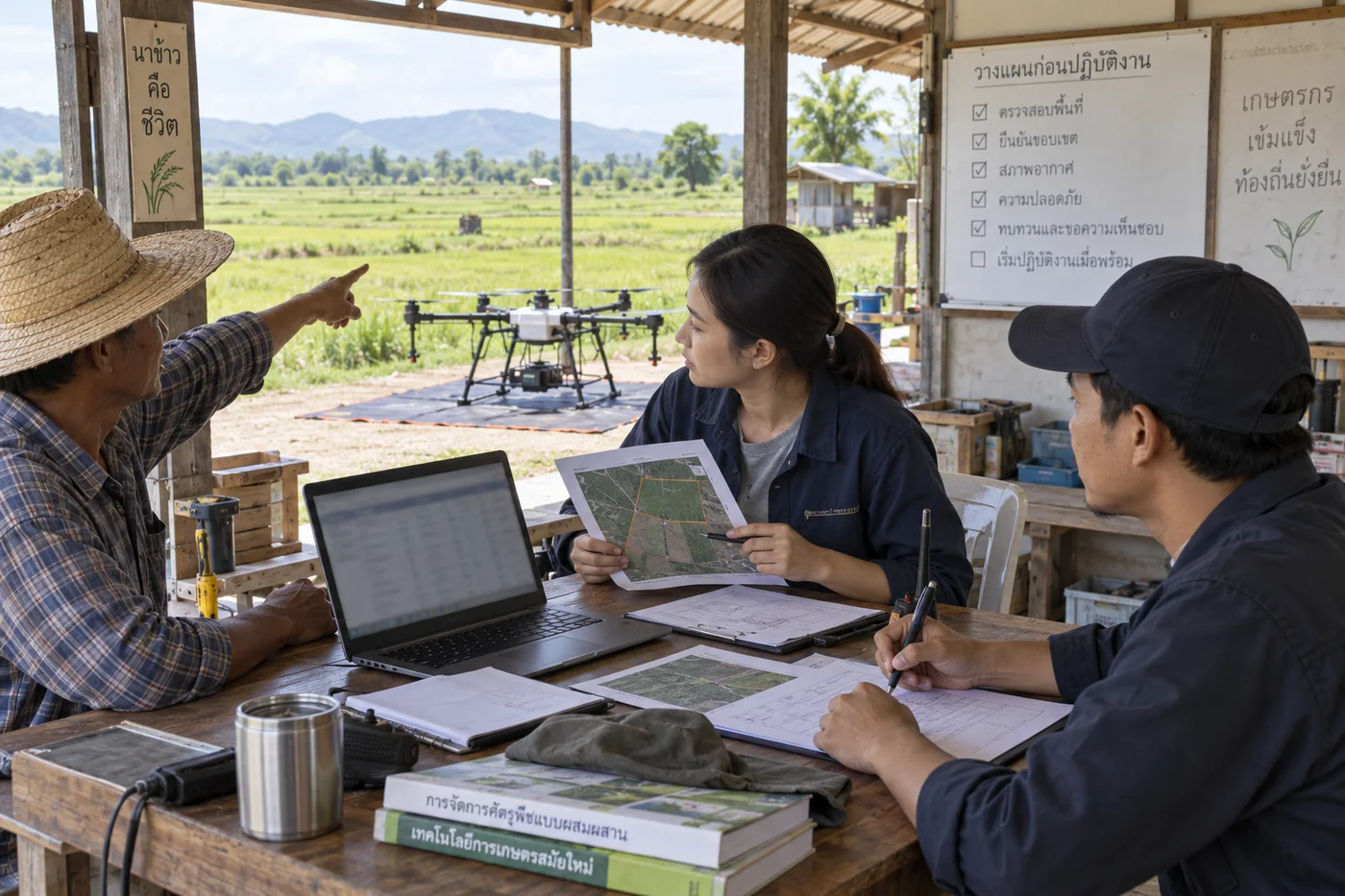
Image generated with AI to explain document handover; it is not evidence of acceptance or approval of real work. Open the full-size handover image
D Developer/customiser: requirements before building a checker
Use Worksheet D to propose R01–R08 and D01–D20 for data screening and for reviewing system changes, define input/output/units/null/reason/owner and a baseline of material + module + FW + method/model before changing the rules, and keep re-review/recheck/rollback. This kit has no validator program, upload/import, or delivery UI; everything is a proposal. actual=not_run
Test cases must include valid L/G, mixed groups, missing, unknown unit, negative, both duplicates, n=1, zero mean, locale decimal/NaN/Infinity, mass≠rate, payload/FW change, no threshold, pending_field_review, support request not yet confirmed, recipient not yet acknowledged, version change, CSV formulas/strings treated as data and not executed, and non-silent corrections. The test plan keeps originals and expected results separate from actual ones; it does not report run results or a pass in advance.
Scroll the table horizontally to see all columns. When the table has keyboard focus, use the left or right arrow keys.
| ID / dimension | Prerequisites before doing and supplementary work | Observable goal | Activity / evidence | Pass / not yet passed |
|---|---|---|---|---|
| APP-M03-D-K01 / K | Can write schema/units/reason; review testing then write blank≠0 | Explains R01–R08 and the limits that numbers cannot prove | requirement + input/output contract | Complete key/groups/math/readiness/version; not passed when a validator is said to certify the real system |
| APP-M03-D-S01 / S | Can tie expected values to error cases and null; review integration/testing, then write a zero case | Designs D01–D20 and recheck/rollback that are checked per interface | test matrix + baseline/change plan | All 20 cases have the correct expected value and actual not_run; not passed when only one duplicate row is quarantined |
| APP-M03-D-E01 / E | Separates proposals/results and untrusted text; review evidence report then correct the claim 'tests passed' | Maintains the evidence level and treats CSV text as inert data | claim/status/export policy | Does not execute CSV, does not invent run/approval results; not passed when pending becomes ready |
| APP-M03-D-C01 / C | Keeps the baseline/issue and accepts feedback; review teamwork, then record a trigger | Controls versions; reviews and restores values after changes, with an owner | D-v0/D-v1, issues, rollback/recheck record | Has the original, a restorer/reviewer, and conditions for staying on hold; not passed when a fix erases history |
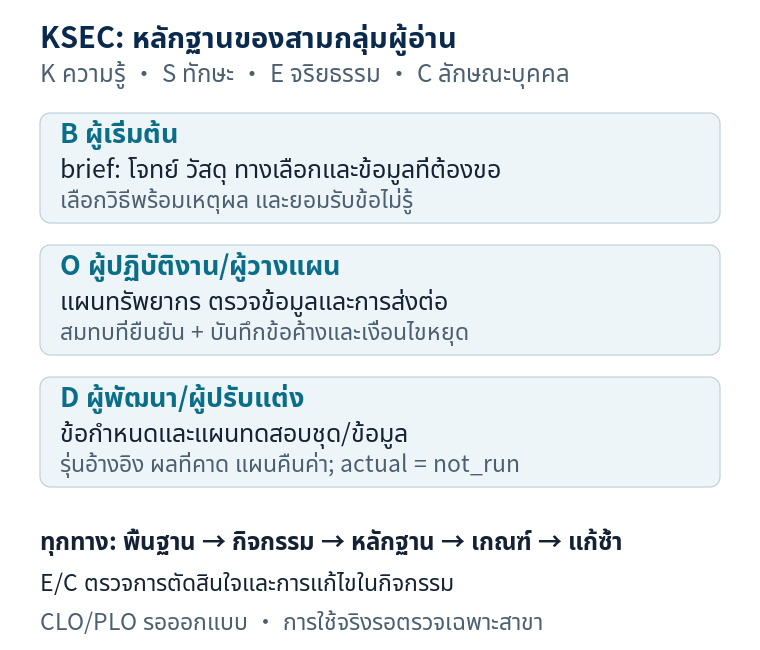
K = Knowledge, S = Skills, E = Ethics, C = Character. The diagram is a learning design, not a personal assessment result. E/C use reasoning and actions in context; they do not label permanent virtue or personality. Open the full-size KSEC diagram
Check work products and keep readiness criteria separate
Use the M03 rubric with model answers to check the 4 IDs of the pathway that was done, recording the result as evidence meets criteria / needs more practice / no evidence yet with the reason, reviewer, date, criteria version, before–after work product and the repeat practice in KSEC learning record . A solo learner should write 'self-checked' and the items still awaiting a reviewer; do not pass because everything is filled in, the reading is finished or speech is fluent.
curriculum-mapping.csv contains the 12 IDs of M03; the CLO/PLO fields are still empty. pending_design See the current amount of content and outstanding work at Overall status of the category The P3 readiness gate is still open and M03 is pending_field_review There are no learner results and no field-specific or site reviewer to certify them.
Before real use there must be a reviewer suited to the job and evidence specific to the material/label/current permissions, the model/FW manual, method, criteria, system, people, boundaries, air and material handling, complete for the real job. Passing a worksheet does not make those conditions pass. CPX-Sim remains on hold at the user's instruction.
References and the scope that was read
- DJI, T50/T25 Spreading System User Guide v1.0, April 2024, pages 4–5, 7–9 and 12: used for compatibility questions and system-specific evidence; installation steps and model values are not copied
- DJI, T50/T25 User Manual v1.0, checked only PDF pages 38/46 (printed numbers 36/44): context on conditions/payload and on reviewing liquid flow; it is not a licence or a certification of a learner's kit
- OECD 2021, State of the Knowledge: Unmanned Aerial Spray Systems in Agriculture, executive summary, printed page 11: separates questions of risk/efficacy and the limits of evidence
- FAO/WHO 2024, International Code of Conduct on Pesticide Management: guidance for aerial application of pesticides: read only the overview page; the original PDF still returned 403 at the check on 14 October 2026. Used only for the scope of pesticide risk management; it is not claimed that the full manual was read or that it is a drone SOP
- FAO, Use: Guidance for aerial application of pesticides: read the HTML page dated 14 October 2026, which names the audience as regulators, operators and applicators and says to follow national rules and practice; the three evidence paths in the chapter are the author's framing, not text or pass criteria from the full manual
- FAO, How to practice Integrated Pest Management: read the HTML page dated 13 October 2026; used only for the principle of comparing options and impacts for pest/pesticide-use scenarios, not to specify the material or method for the hypothetical plot
- Foundations in the library: Whole systems, Mass and balance, Crop monitoring, Aviation law and Testing
Original sources reviewed 11 October 2026, the FAO IPM page added 13 October, and the FAO/WHO scope page checked 14 October 2026. The TRAIN-APP-01 case, the numbers, the example formulas, the learning steps and the work-product criteria are the author's design, not data results from the manuals or experimental work of the cited sources. See readme/license or return to mission overview