How a camera drone works: components, camera and gimbal
UAT 471 UAS Operations for Aerial Photography and Creative Media
Lesson
By the end of this module you will be able to
- Explain that a camera drone is a system of aircraft, controller, radio link and people, and state what each part does
- Explain how a quadcopter climbs, descends, turns and moves, and how flight modes differ
- Work out the ground width of the frame and the size of things in it from height and field of view
- Explain how a three-axis gimbal works and how to look after it
- List the registrations and certificates needed before flying a camera drone in Thailand
Why this matters
Modern camera drones take off at the press of a button, so it can seem there is little to learn. Yet every time a drone hovers overhead it is a machine of nearly a kilogram with very fast spinning propellers. A pilot who does not understand how it works will panic when something goes wrong, for example when the drone starts drifting on its own after losing satellite signals, or the picture tilts because the gimbal is stuck. Basic understanding is therefore a safety matter, not engineering detail.
This is the first course of the Minor in Drone Photography and Creative Aerial Media, and it is about flying safely and legally. Making beautiful images comes in UAT 472, storytelling and editing in UAT 473, and working for a client in UAT 474.
All five modules follow one fictional case: the Creative Media Club of Thara Pathum University (a fictional university in Pathum Thani province) prepares to film the university’s open day from the air. Baitoey, a 21-year-old communication arts student, is the main pilot, Tonkla is the backup pilot, and other club members act as visual observers. Each module adds one step, from getting to know the aircraft to the last landing of the event day. All names, places and figures are fictional.
A camera drone is a system, not just a flying machine
An unmanned aircraft system (UAS) means every part that must work together for a flight, not only the drone. UAV textbooks divide it into the aircraft, the control station (for a camera drone, the remote controller with an app on a phone or tablet), the communication link, and the equipment carried, which for us is the camera (Fahlstrom and colleagues, 2022). The most important part is people: the pilot and helpers. Think of a car: you need the car, the steering wheel, a road and a licensed driver; without any of them the trip is not safe.
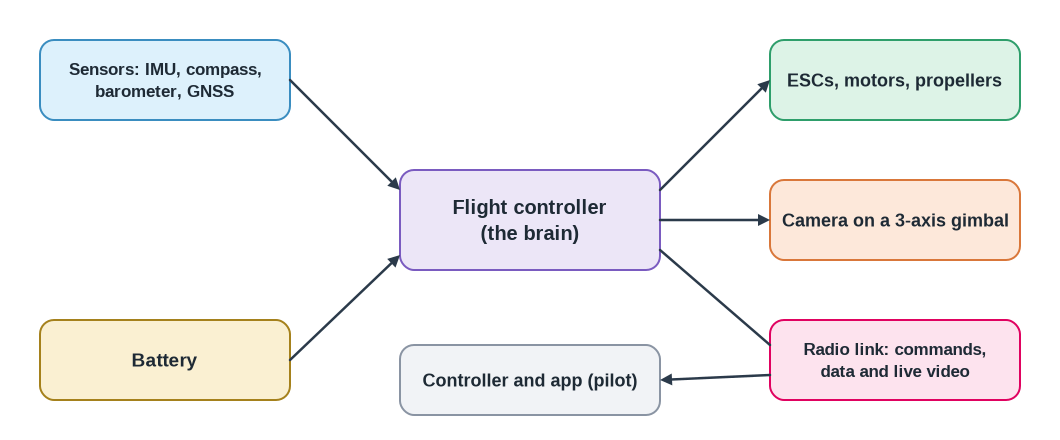
Parts and what they do
| Part | Job | Everyday comparison |
|---|---|---|
| Frame and arms | Hold everything together | Car body |
| Motors and propellers | Produce lift and control movement | Wheels and engine |
| ESC (electronic speed controller) | Set each motor’s speed on command | Accelerator |
| Flight controller | Read the sensors and work out how fast each motor must spin, hundreds of times a second | Brain and sense of balance |
| Sensors | IMU measures tilt and rotation, compass gives heading, barometer gives height from air pressure, GNSS gives position from satellites | Inner ear, eyes and map |
| Battery | Powers everything and sets flight time | Fuel tank |
| Camera and gimbal | Take pictures and keep them steady | Eyes and a steady hand holding the camera |
| Radio link, controller and app | Send commands up and data and live video down | Steering wheel and dashboard |
GNSS (global navigation satellite system) is the general name for satellite navigation systems such as the US GPS and China’s BeiDou. Many camera drones also have obstacle sensing using cameras or other sensors that look around the aircraft and stop it before a collision. They do not see in every direction and work poorly in the dark or with thin objects such as wires and small branches, so they are an aid, not a replacement for the pilot’s eyes.
How a quadcopter moves
A quadcopter has no rudder and no moving wing surfaces. It moves only by changing motor speeds. Diagonal propellers turn the same way and the other pair turns the opposite way, so their twisting forces cancel in a hover (Fahlstrom and colleagues, 2022).
- Up and down: all four motors speed up or slow down together
- Turning (yaw): speed up the pair that spins one way and slow the other pair, so the body rotates about its vertical axis
- Forward, back or sideways (pitch and roll): motors on one side spin faster, the drone tilts, and part of the lift carries it in the direction of tilt
The flight controller does all this automatically; the pilot only says “where I want to go”. The flight mode decides how much the aircraft helps.
- Position mode uses GNSS and other sensors to hold position: release the sticks and the drone hovers in place even in wind. This is the normal mode for filming
- Attitude mode keeps the drone level but does not hold position: release the sticks and it drifts with the wind. It can switch on by itself when GNSS is weak, for example under a roof or close to tall buildings, so the pilot must always be ready to fly by hand (practised in modules 2 and 4)
- Return to home (RTH) flies the drone back to the point recorded at take-off and lands it, used when the control link is lost or the battery runs low (set up in module 2)
Mode names differ between brands, so the pilot must read the manual of the actual aircraft.
The drone’s camera: sensor, lens and field of view
A drone camera works like a phone camera. The lens gathers light onto an image sensor, a grid of tiny light-sensitive cells, one per pixel. A 4K video frame is 3,840 pixels wide. The horizontal field of view (HFOV) tells how many degrees wide the camera sees. A wide-angle camera sees a lot of ground, but each object looks small.
When the camera looks straight down from height , the width of ground in the frame is , which comes from the triangle of the pinhole camera model (Szeliski, 2022). An easy way to remember it: fly twice as high, the frame is twice as wide, and everything in it is half the size.
Example 1 How wide is the frame from 60 m?
The club camera has a 72° horizontal field of view and records 4K video 3,840 pixels wide (assumed). Baitoey wants to know how wide a field the straight-down frame covers at 60 m.
- Half the field of view: , and
- Width: m
- Ground size per pixel: cm per pixel
One frame covers about 87 m of ground, a little wider than a standard football pitch. At 30 m it is only 43.6 m wide.
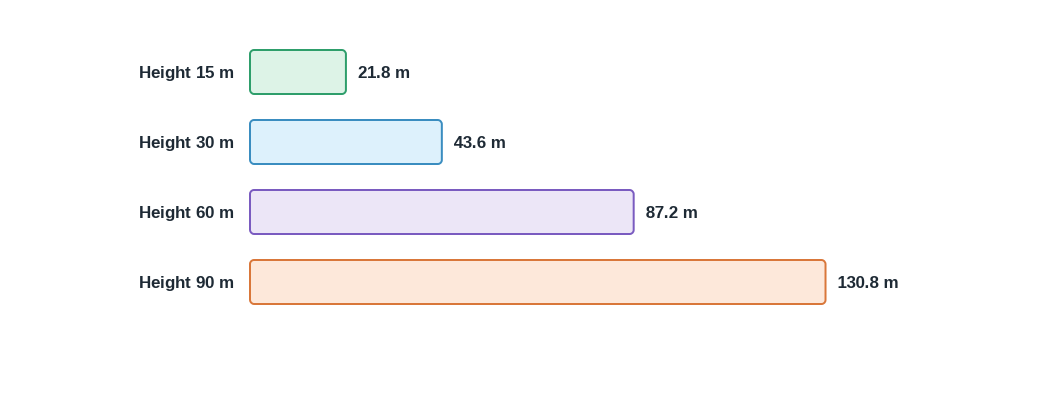
Example 2 How many pixels is a face?
A face is about 15 cm wide (assumed). At 60 m each pixel covers 2.27 cm of ground, so a face is pixels wide. Flying down to 15 m, the frame is 21.8 m wide, each pixel 0.57 cm, and a face about 26 pixels wide.
The numbers say two things. Wide shots from height show people as small dots whose faces are hard to recognise, but flying low or zooming makes people far clearer, which matters for privacy in module 5. (Oblique shots that do not look straight down are more complicated to compute, but the principle is the same: the further away, the smaller.)
For anyone who wants to try, the Python code below is a “calculator” for Examples 1 and 2. You do not need to program to take this course.
import math
hfov_deg = 72          # horizontal field of view of the club camera (assumed)
pixels = 3840          # 4K frame width in pixels
face_cm = 15           # rough width of a face (assumed)

for h in (15, 30, 60, 90):
    width = 2 * h * math.tan(math.radians(hfov_deg / 2))
    cm_per_px = width / pixels * 100
    print(f"height {h:2d} m: frame {width:5.1f} m wide, {cm_per_px:.2f} cm per pixel, face about {face_cm / cm_per_px:4.1f} px")
height 15 m: frame 21.8 m wide, 0.57 cm per pixel, face about 26.4 px
height 30 m: frame 43.6 m wide, 1.14 cm per pixel, face about 13.2 px
height 60 m: frame 87.2 m wide, 2.27 cm per pixel, face about 6.6 px
height 90 m: frame 130.8 m wide, 3.41 cm per pixel, face about 4.4 pxThe gimbal: why the picture stays level while the drone tilts
A drone has to tilt every time it moves and vibrates constantly from propellers and wind. A camera bolted straight to the body would tilt and shake with it. A gimbal is a camera mount with small motors that turn the camera against the body’s movement, using sensors that measure the camera’s own tilt to know how much to correct. It is like carrying a glass of water on a rocking boat: your arm keeps the glass upright.
Most camera-drone gimbals have three axes:
- Pitch tilts the camera down or up; the pilot controls it with a wheel on the controller to choose the camera angle (module 3)
- Roll keeps the horizon level
- Yaw smooths side-to-side wobble; some models can turn the camera independently of the drone’s nose
ArduPilot’s documentation explains that some gimbals stabilise themselves while others take angle commands from the flight controller, and that users can set where the camera points (ArduPilot Dev Team, n.d.). The gimbal is the most delicate part of a camera drone. Always remove the gimbal clamp before switching on (otherwise the gimbal motors strain and can fail), refit it before packing, never turn the camera by hand while powered, and calibrate the gimbal as the manual says when the picture stays tilted.
Besides the gimbal, some cameras use electronic stabilisation, cropping the edges slightly to cancel remaining shake, so the picture is a little narrower than the full field of view. Camera settings and using the gimbal for beautiful images belong to UAT 472.
Before your first flight: registrations and certificates
Everyone who will fly a camera drone in Thailand needs to know the following from week one (the full flight conditions are in module 5):
- A drone fitted with a camera must be registered in every case, whatever its weight, as the NBTC registration system summarises the conditions of the Civil Aviation Authority of Thailand (CAAT) (NBTC, n.d.). The club’s small drone must be registered even though it weighs under 2 kg
- The pilot applies through CAAT’s UAS Portal, passes an online knowledge test (E-Exam) and receives a drone pilot certificate valid for 2 years; after a failed test you must wait 24 hours to retake it (Civil Aviation Authority of Thailand, 2025)
- The drone is registered through the UAS Portal; the registration number does not expire unless cancelled and must be displayed clearly on the aircraft (Civil Aviation Authority of Thailand, 2025)
- The drone’s radio equipment needs a separate owner registration with the NBTC office (NBTC, n.d.)
- Third-party liability insurance of at least 1,000,000 baht per occurrence (Ministry of Transport, 2015)
- Age: the 2015 Ministry of Transport notification sets qualifications by purpose; for example, a person registering for photography or filming must be at least 20 years old, so the team chooses pilots who meet it (Ministry of Transport, 2015)
Rules change. Before relying on this list, always check the UAS Portal and the notifications in force on the day. In this course students first train in a flight simulator, and real flights happen only in the university’s practice area under an instructor, who checks the registrations of people and aircraft before every flight.
Module lab
Lab: getting to know the aircraft and starting in the simulator (4 hours a week for three weeks)
- Study the department’s camera drone switched off with propellers removed; point to the eight parts in the table and write what each does in your own words
- Remove and refit the gimbal clamp correctly; open the app’s live view, turn the pitch wheel, and watch how the gimbal corrects tilt while the instructor gently tilts the aircraft on the table (no propellers fitted)
- Measure the real frame width: set the camera pointing straight down on a 2 m stand above a floor with a tape measure, and compare with
- Practise in a flight simulator: hover for 1 minute, climb and descend straight, turn a full circle; record the time achieved without crashing
- Create a UAS Portal account and read the basic knowledge for pilots, to be ready for the E-Exam before real flying
Common mistakes
Watch out
- Thinking a small drone needs no registration: drones fitted with cameras must be registered in every case
- Trusting obstacle sensing too much: it cannot see wires or thin branches and does not look in every direction
- Forgetting to remove the gimbal clamp before switching on: the gimbal motors strain and fail
- Panicking when the drone drifts by itself, which is usually attitude mode after weak GNSS; fly it calmly by hand
- Thinking that flying higher shows everything clearly: higher means a wider frame but smaller objects
Summary
- A camera drone is a system: aircraft, controller and app, radio link, camera and people
- A quadcopter moves by changing motor speeds; position mode uses GNSS, attitude mode does not hold position
- Ground width of the frame ; twice the height gives twice the width and half the object size
- A three-axis gimbal turns the camera against the aircraft’s motion; remove the clamp before switching on
- Camera drones must be registered, pilots must pass the E-Exam, radio equipment is registered with the NBTC, and insurance is required
Check your understanding
- Why do we speak of an unmanned aircraft “system” rather than just a “drone”?
- How does a quadcopter turn without a rudder?
- A camera with a 72° field of view flies at 30 m. How wide is the straight-down frame?
- Flying up from 30 m to 60 m, how does the size of a face in the picture change?
- The club drone weighs 0.9 kg and carries a camera. Must it be registered with CAAT? Why?
Answers
- Because a flight needs several parts working together: the aircraft, controller and app, radio link, equipment such as the camera, and the people who fly and observe
- It speeds up the motor pair that spins one way and slows the other pair; the unbalanced twisting force rotates the body about its vertical axis
- m
- It halves, from about 13.2 pixels to about 6.6 pixels, because the frame is twice as wide with the same number of pixels
- Yes, because a drone fitted with a camera must be registered in every case, whatever its weight
Key formulas
| Ground width of the frame | |
| Ground size per pixel |
Key references
- Fahlstrom, P. G., Gleason, T. J., & Sadraey, M. H. (2022). Introduction to UAV systems (5th ed.). Wiley. link
- ArduPilot Dev Team. Cameras and gimbals. ArduPilot Copter documentation. link
- Szeliski, R. (2022). Computer vision: Algorithms and applications (2nd ed.). Springer. link
- Civil Aviation Authority of Thailand. (2025). Flying a drone in Thailand [Leaflet]. link
- สำนักงาน กสทช. คำถามที่พบบ่อย: การลงทะเบียนโดรน. ระบบลงทะเบียนเครื่องวิทยุคมนาคม. link
- กระทรวงคมนาคม. (2558). ประกาศกระทรวงคมนาคม เรื่อง หลักเกณฑ์การขออนุญาตและเงื่อนไขในการบังคับหรือปล่อยอากาศยานซึ่งไม่มีนักบิน ประเภทอากาศยานที่ควบคุมการบินจากภายนอก พ.ศ. 2558. ราชกิจจานุเบกษา, 132(86 ง), 6–12. link
Further reading
Study the assigned knowledge units in advance, review media and take the module quiz
M11 Media production: from what the audience needs to a deliverable image
กล้อง EO/IR และ gimbal
Preparing information before registration
In class / field
Lab or field practice from worksheets with a safety checklist
Learning evidence: Checked worksheets and quiz results