Weather, batteries and abnormal events
UAT 471 UAS Operations for Aerial Photography and Creative Media
Lesson
By the end of this module you will be able to
- Assess wind, rain, thunderstorms, heat and the site environment, and decide go or no-go
- Explain how lithium batteries work and their risks, and handle charging, storage and transport
- Plan flight time from the measured battery use rate and the reserve that must remain
- Choose the first action for abnormal events such as lost link, low battery and GNSS loss
Why this matters
Small camera drones are light and fly for a short time. A wind that people on the ground barely feel can stop a drone from getting back, a battery baking in April sun runs down faster than expected, and when the control link drops the pilot has only seconds to decide. The 2015 Ministry of Transport notification therefore requires an emergency plan before flying, covering accidents, medical care and loss of control, and requires registered pilots to report an accident to the authorities without delay (Ministry of Transport, 2015). This module teaches weather decisions, battery planning, and preparing answers to abnormal events before they happen.
In our case, open day falls on a Saturday at the end of January. The club must read the forecast, plan the number of batteries and rehearse abnormal events before the day.
Reading the weather for drone flying
Sources: the Thai Meteorological Department provides forecasts, warnings, weather radar and automatic weather station data (Thai Meteorological Department, n.d.). Use them for the overview one to three days ahead and check the radar again on the morning of the flight. At the site, use a handheld anemometer and your eyes, because the weather at the take-off point can differ from a station several kilometres away.
What to look at
- Wind and gusts: a gust is a brief sudden increase in wind. Wind is usually stronger at height than on the ground, and large buildings create swirling, gusty wind that changes direction and speed quickly; the FAA guide warns that wind around obstructions is an unseen danger (Federal Aviation Administration, 2016). Flying downwind on the way out is easy; the way back is upwind and uses more battery
- Rain and humidity: most camera drones are not waterproof; rain damages equipment and wets the lens
- Thunderstorms: common on rainy-season afternoons, with strong updrafts, downdrafts and gusts ahead of the rain (Federal Aviation Administration, 2016). If you hear thunder or see clouds building fast, end the flight
- Heat: strong sun pushes batteries, phones and controllers past the manufacturer’s range, and a phone may dim its screen until the picture cannot be seen; provide shade for equipment and people
- Visibility and light: haze or smoke make the drone hard to see. The rules require flying between sunrise and sunset when the aircraft can be seen clearly, and forbid flying near or into cloud (Ministry of Transport, 2015)
Site environment
- Compass interference from steel structures, cars and reinforcing steel in concrete; take off away from them
- Weak satellite signals close to tall buildings or under roofs
- Radio interference: busy events have many phones and Wi-Fi devices; the FAA guidance notes that frequency interference can cause lost links or flyaways (Federal Aviation Administration, 2021)
- Birds: some species attack drones, especially near nests
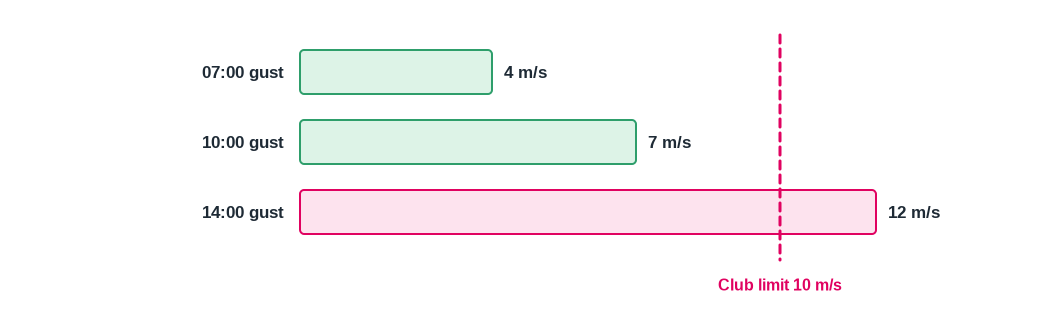
The club sets its limits in advance: mean wind no more than 8 m/s and gusts no more than 10 m/s (assumed), and always below the wind the manufacturer says the drone can handle. Limits set beforehand stop decisions being driven by the wish to fly on the day.
Example 1 When can we fly?
The team’s summary of the event-day forecast (assumed): 07:00 wind 2 m/s gusting 4 m/s; 10:00 wind 4 m/s gusting 7 m/s; 14:00 wind 7 m/s gusting 12 m/s with a chance of thunderstorms.
- 07:00: and , go
- 10:00: and , go
- 14:00: mean , but gusts and storms possible, no-go
The closing shot planned for the afternoon therefore needs a fallback, such as moving the wide shot to late morning or accepting that it will be missing. Every limit must be met at once; passing one is not enough.
Lithium batteries: an energy source to respect
Camera drones use lithium batteries, which store a lot of energy in a small pack. Energy is given in watt-hours, ; for example a 15.4 V, 4 Ah battery (assumed) holds Wh. The same energy can become heat and fire. The FAA guidance states that lithium battery fires can be caused by short circuits, improper charging, extreme heat, crash damage, mishandling or defects, and advises following the manufacturer’s recommendations (Federal Aviation Administration, 2021).
- Charging: with the manufacturer’s charger, on a non-flammable surface, attended; let a pack that has just flown cool before charging
- Storage: do not keep packs fully charged for long; use the storage level in the manual (many models do this automatically), in a dry, cool place
- Transport: terminals covered, never loose with keys or coins, never left in a car in the sun; carrying packs on passenger flights follows the airline’s rules
- Retiring: a pack that is swollen, cracked, unusually hot or smells must not be flown or charged; isolate it in a safe place and dispose of it properly
Planning flight time from the battery
The flight time printed on the box is measured in ideal conditions, such as hovering in calm air until empty. Real work gives much less, because a reserve must remain, the drone must fly back, and wind and heat use more energy. The reliable way is to use the measured battery use rate from the module 2 flight log.
Example 2 How many batteries for the event day?
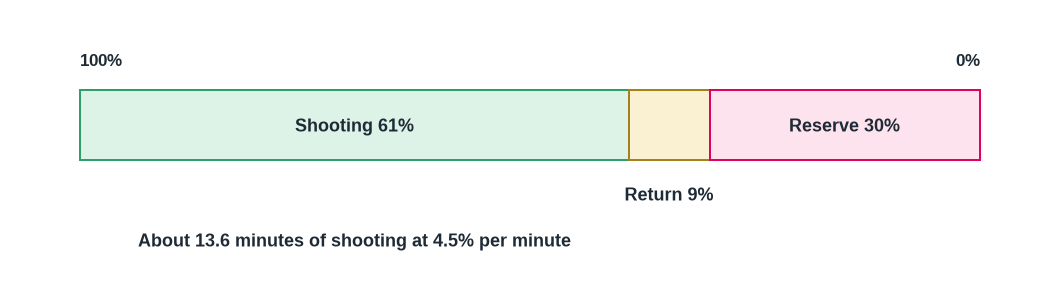
From the log, the club drone uses on average 4.5% of battery per minute while filming (assumed). The club lands with at least 30% left and allows 2 minutes to fly back and land. The event needs 30 minutes of filming in total (assumed).
- Share for returning and landing: %
- Share for filming: %
- Filming time per battery: minutes
- Number of batteries: , rounded up to 3, plus 1 spare, 4 in all
If the day is very hot or windy, the rate may rise to 5.2% per minute (assumed); filming time per battery drops to minutes. Three batteries are still just enough but with less margin, which is why the spare matters.
Python calculator for Example 2 (optional)
import math
drain = 4.5            # % per minute, measured in the lab (assumed)
reserve = 30           # land with at least 30 % (club rule, assumed)
return_min = 2         # minutes to fly back and land

shoot_pct = 100 - reserve - drain * return_min
shoot_min = shoot_pct / drain
need_min = 30          # shooting minutes needed on the day
batteries = math.ceil(need_min / shoot_min)
print(f"shooting share {shoot_pct:.0f} % = {shoot_min:.1f} min per battery")
print(f"{need_min} min of shooting needs {batteries} batteries + 1 spare = {batteries + 1}")
shooting share 61 % = 13.6 min per battery
30 min of shooting needs 3 batteries + 1 spare = 4Abnormal and emergency procedures
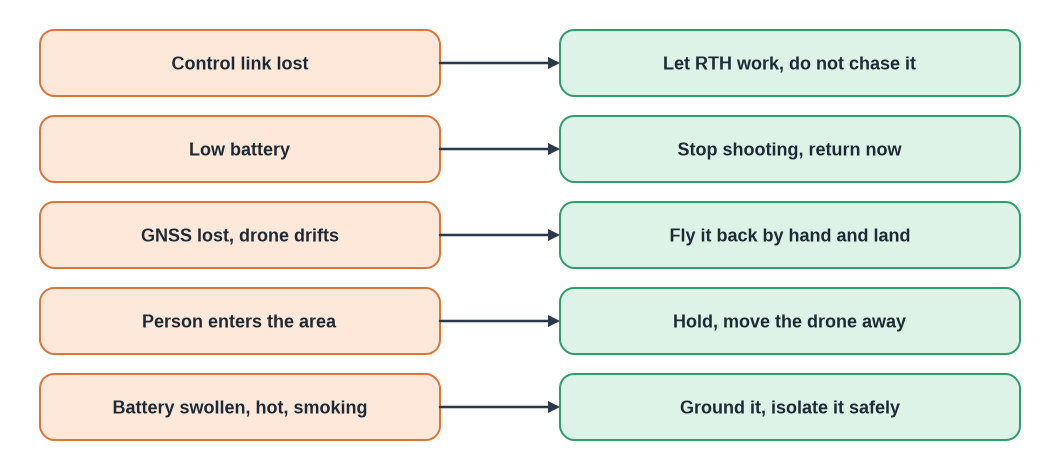
Abnormal events happen fast, and a startled pilot often makes things worse, for example by running after the drone or pressing several buttons at once. What works is agreeing the first action in advance and rehearsing until it is a habit. The order of priorities is fly the aircraft safely first, then navigate, then communicate: keep the drone somewhere safe, bring it back, then tell the team and others involved. The footage always comes last.
| Event | What you see | First action | Then |
|---|---|---|---|
| Control link lost | Frozen picture, app warns of signal loss | Point the controller antennas at the drone, let return-to-home work | Observer tracks it by eye, keep the landing spot clear, do not chase |
| Low battery | App warns of low percentage | Stop filming, fly back now by the shortest safe route | If it cannot reach home, land at the alternative spot |
| GNSS lost | App switches to attitude mode, drone drifts | Fly calmly by hand, into the wind so it does not drift away | Bring it back within sight and land |
| Compass fault | Drone circles or goes the wrong way | Stop commanding, use hand control in the direction that visibly works | Land, recalibrate away from steel |
| Person or vehicle enters the area | Observer calls a warning | Hold position, then move the drone away | Wait for the area to clear or abandon the shot |
| Collision or crash | Drone disappears from view | Stop the motors as the manual says once down, care for anyone injured first | Cordon the crash site, beware of a damaged battery, report the accident to the authorities as required |
Module lab
Lab: weather briefing, battery planning and abnormal-event drills (4 hours a week for three weeks)
- Week 10: give a weather briefing before every flight from Thai Meteorological Department forecasts and radar plus a handheld anemometer reading at the practice area; decide go or no-go against the club limits and record the reason
- Week 11: fly a planned filming flight in the practice area, note the battery percentage every minute, find the real use rate of each pack, then work out the batteries needed for the event with the method of Example 2
- Week 12: tabletop drills for each event in the table: the instructor reads a situation and students state the first action within 5 seconds; then practise in a simulator that can simulate link loss, and fly real drills only of return-to-home and landing at the alternative spot at the low height the instructor sets
- Inspect every battery, record its condition in the battery register, set aside any pack with abnormal signs, and never deliberately heat or swell a battery to test it
Common mistakes
Watch out
- Judging the wind at ground level and assuming it is the same at height; it is usually stronger aloft
- Planning from the flight time on the box instead of the measured use rate
- Flying the battery nearly flat for one last shot
- Charging hot packs straight after flying or leaving them in a car in the sun
- Running after the drone when the link drops instead of letting return-to-home work and preparing the landing spot
- Caring more about the footage than safety during an abnormal event
Summary
- Use Thai Meteorological Department forecasts and radar, measure wind on site, set limits for wind, rain, storms, heat and visibility in advance, and meet all of them at once
- Lithium batteries hold a lot of energy and must be charged, stored, moved and retired correctly
- Filming time per battery ; round the number of batteries up and add a spare
- Abnormal events: agree the first action in advance; fly safely, navigate, then communicate; footage always comes last
Check your understanding
- Mean wind 6 m/s, gusts 11 m/s, club limits 8 and 10 m/s. Can the flight go?
- How many watt-hours does an 11.55 V, 5 Ah battery hold?
- Use rate 5% per minute, 30% reserve, 2 minutes allowed for returning: how many filming minutes per battery?
- 40 minutes of filming are needed and each battery gives 12 minutes. How many batteries, including 1 spare?
- The picture freezes and the app warns of signal loss. What is the first action?
Answers
- No. The mean wind passes, but 11 m/s gusts exceed 10 m/s, and every limit must be met
- Wh
- Filming share %, so minutes
- , rounded up to 4, plus 1 spare, 5 in all
- Point the controller antennas at the drone and let return-to-home work; the observer tracks it by eye, keep the landing spot clear, and do not chase it
Key formulas
| Percentage available for shooting | |
| Shooting time per battery | |
| Battery energy |
Key references
- กรมอุตุนิยมวิทยา. (n.d.). Thai Meteorological Department: Weather forecast, warnings, weather radar and automatic weather stations. link
- Federal Aviation Administration. (2016). Remote pilot – small unmanned aircraft systems study guide (FAA-G-8082-22). link
- Federal Aviation Administration. (2021). Small unmanned aircraft systems (small UAS) (Advisory Circular 107-2A). link
- กระทรวงคมนาคม. (2558). ประกาศกระทรวงคมนาคม เรื่อง หลักเกณฑ์การขออนุญาตและเงื่อนไขในการบังคับหรือปล่อยอากาศยานซึ่งไม่มีนักบิน ประเภทอากาศยานที่ควบคุมการบินจากภายนอก พ.ศ. 2558. ราชกิจจานุเบกษา, 132(86 ง), 6–12. link
- Civil Aviation Authority of Thailand. (2025). Flying a drone in Thailand [Leaflet]. link
Further reading
Study the assigned knowledge units in advance, review media and take the module quiz
Reading wind, clouds and near-surface weather
ความปลอดภัยของแบตเตอรี่ลิเธียม
Diagnosing abnormal events before choosing a response
In class / field
Lab or field practice from worksheets with a safety checklist
Learning evidence: Checked worksheets and quiz results