Law, privacy, ethics and the operation day
UAT 471 UAS Operations for Aerial Photography and Creative Media
Lesson
By the end of this module you will be able to
- Identify the laws and agencies involved in one photo flight and the penalties for breaking them
- Check a mission against the general flight conditions and say when extra permission is needed
- Explain that images identifying people are personal data, and plan notice and data minimisation
- Make ethical decisions where the law is not explicit
- Plan and carry out a full day of photo flights safely, from checking registrations to the last landing
Why this matters
The most beautiful image is worthless if it was obtained by flying over a crowd, flying without permission, or publishing people who did not agree and were harmed by it. Aerial media work must pass three questions every time: is it legal, is it safe for the people around, and is it fair to the people in the picture? This final module brings everything together into the real operation day of the Creative Media Club, from checking registrations to the last landing of the open day.
The layers of law in one flight
One photo flight involves several rules and several agencies. Permission from one of them does not cover everything.
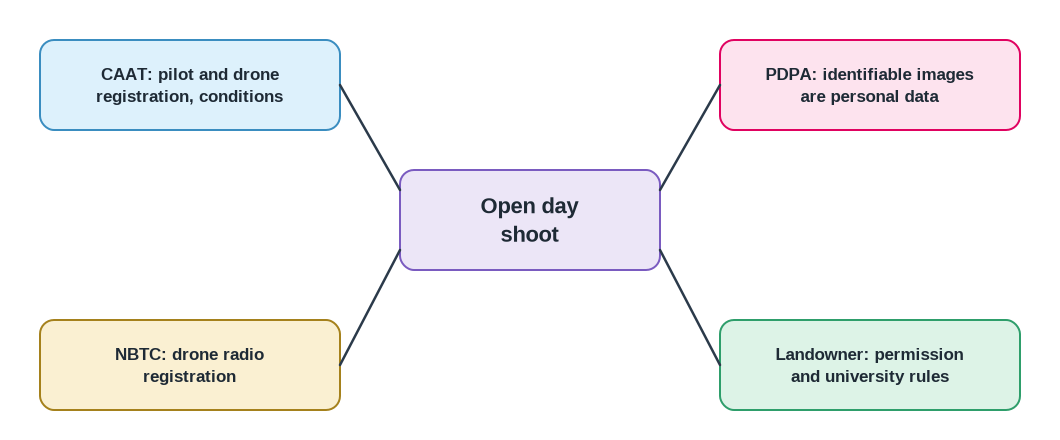
- The Air Navigation Act B.E. 2497 (1954): Section 24 forbids operating or releasing a pilotless aircraft without written permission from the Minister and compliance with the conditions set. Flying without permission is punishable under Section 78(1) by up to 1 year in prison, a fine of up to 40,000 baht, or both; a permitted pilot who breaks a condition of the permission faces a fine of up to 50,000 baht under Section 67/20 (Air Navigation Act, consolidated to Amendment No. 14, 2019)
- The 2015 Ministry of Transport notification sets who must register, their qualifications, documents and the general flight conditions (Ministry of Transport, 2015)
- The 2026 CAAT notification on permitting drones up to 25 kg to operate differently from the set conditions, in force since 17 May 2026, with a second amendment, applies when a mission must go beyond the general conditions, such as flying at night or above 90 m (Civil Aviation Authority of Thailand, 2026a, 2026b). The work in this course is designed to stay within the general conditions, so it does not need this notification, but you should know it exists
- Area-specific flight bans, such as CAAT Notification No. 16, which bans civil drone flights in border districts of some provinces except for permitted purposes (Civil Aviation Authority of Thailand, 2026c)
- The NBTC office registers drone owners and radio equipment (NBTC, n.d.)
- The Personal Data Protection Act B.E. 2562 (2019) for images that identify people (next section)
- The landowner, here the university, which has its own rules
General flight conditions to remember
The 2015 notification sets conditions before and during flight. The most important for photography are (Ministry of Transport, 2015; Civil Aviation Authority of Thailand, 2025):
- Keep the drone in sight at all times, and never fly it by the onboard camera
- Fly between sunrise and sunset when the drone can be seen clearly, and not near or into cloud
- No higher than 90 m above the ground
- Not within 9 km of an aerodrome, and not into prohibited, restricted or danger areas in the AIP, government premises, state agencies or hospitals, unless permitted
- Not over towns, villages, communities or gatherings of people
- Do not violate other people’s privacy or cause nuisance
- Horizontal separation: recreational drones up to 2 kg keep 30 m from people, vehicles, structures and buildings; registered pilots keep 50 m from people, vehicles, structures and buildings not involved in the flight
- Registered pilots must carry the registration certificate or a copy and a working fire extinguisher, hold third-party liability insurance of at least 1,000,000 baht per occurrence, and report any accident to the authorities without delay
The club films for the university; it is not flying as a hobby, so it always uses the 50 m distance. When unsure which condition applies, choose the stricter one and ask the agency. Rules change: check the UAS Portal and the notifications in force before every job.
Safety of the people around
At an event with an audience, the people most at risk are those who do not know a drone is flying. The club organises safety as a system.
- Clear roles: one pilot makes the final decision, the observer watches the drone and sky, and a ground marshal guards the cordon and the take-off spot
- Briefing before starting: review the area plan, shot times, weather limits, stop call and first actions for abnormal events
- Cordoned areas: the take-off spot is taped and signed, and nobody is under the flight path
- Go or no-go before every flight from the checklist; any fail or unknown means no flight
- Right to stop: anyone in the team can call stop on seeing danger, and nobody is blamed for doing so
Privacy and the Personal Data Protection Act
Section 6 of the Personal Data Protection Act B.E. 2562 defines personal data as information about a person that enables that person to be identified, directly or indirectly. Photos or video in which faces can be recognised are therefore personal data (Personal Data Protection Act B.E. 2562).
- Commonly misunderstood exemptions: Section 4(1) exempts collection only for a person’s own benefit or family activities, which does not fit filming for the university to publish. Section 4(3) exempts use or disclosure solely for mass media, fine arts or literature that follows professional ethics or serves the public interest; it has conditions and is not a pass for every job
- Give notice: Section 23 requires the data controller to inform people before or at the time of collection, including the purpose, the data collected and how long it is kept
- Collect only what is needed: Section 22 limits collection to what is necessary for a lawful purpose
- Sensitive data: Section 26, such as health, disability and religious belief, needs explicit consent unless the law provides otherwise, so do not zoom in on people in ways that reveal such data
In this job the data controller is the university, which decides how the images are collected and used, so the club works with the university office responsible. The UK Information Commissioner’s Office guidance is a useful example even though it is not Thai law: inform people with signs on site and an accessible privacy notice, record only when necessary rather than continuously, choose equipment and flying methods that reduce intrusion, keep files secure and delete them when no longer needed (Information Commissioner’s Office, n.d.).
The numbers from module 1 help design this directly. At 60 m a face in a 4K frame is only about 6.6 pixels wide, so wide shots from height hardly identify anyone, while flying low or zooming towards people does. The club therefore limits audience shots to wide views and does not single out anyone’s face without consent. Editing, blurring faces and getting permission to use images before publishing are taught in UAT 473.
Ethics: what to do even when the law does not require it
The law sets the minimum. Ethics asks how would we feel if we were the person in the picture or the person below?
- Windows and dormitories: never aim the camera into windows, rooms or bathrooms, even when passing legally
- People who do not want to be filmed: respect the request and delete images when asked
- Children and vulnerable people: take extra care; do not single out children or people in distress
- Noise and nuisance: propeller noise disturbs ceremonies, speeches and animals; choose times and heights that disturb least
- Honesty with the organiser: say truthfully which shots are possible; never promise shots that break the rules
- No risk for a shot: if a shot needs breaking the weather, battery or distance limits, the club does without it
The operation day: from registrations to the last landing
One day of work needs weeks of preparation. The club counts back from the event day (D0) so that problems can still be fixed.
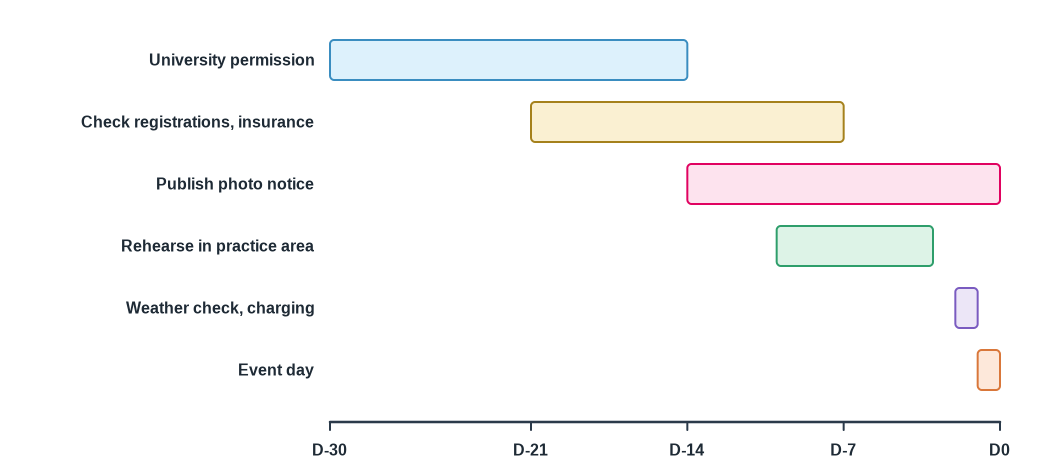
Example 1 Which documents expire before the event?
Open day is Saturday 23 January 2027 (assumed). The team checks documents at D-21 (2 January 2027) and finds (assumed): Baitoey’s pilot certificate was issued on 10 March 2025 and Tonkla’s on 5 January 2025, both valid for 2 years, and the insurance policy ends on 15 January 2027.
- Baitoey: expires 10 March 2027, 46 days after the event, valid
- Tonkla: expired 5 January 2027, 18 days before the event, not valid; it must be renewed first, and if that cannot be done in time he is not the backup pilot on the day
- Insurance: ends 8 days before the event; it must be renewed, otherwise nobody in the team can fly
Checking at D-21 leaves three weeks to fix problems; checking on the morning of the event would be too late.
from datetime import date
event = date(2027, 1, 23)                     # open day (assumed), 23 Jan 2570 B.E.
items = {
    "pilot certificate Baitoey": date(2027, 3, 10),
    "pilot certificate Tonkla": date(2027, 1, 5),
    "liability insurance": date(2027, 1, 15),
}
for name, expires in items.items():
    days = (expires - event).days
    print(f"{name:26s} expires {expires}  {'OK' if days >= 0 else 'EXPIRED'} ({days:+d} days)")
pilot certificate Baitoey expires 2027-03-10 OK (+46 days)
pilot certificate Tonkla expires 2027-01-05 EXPIRED (-18 days)
liability insurance expires 2027-01-15 EXPIRED (-8 days)The code uses Common Era years (2027 is 2570 in the Thai Buddhist Era).
Order of work on the day (assumed)
| Time | Task |
|---|---|
| 06:30 | Team arrives, checks weather and radar, walks the area, cordons the take-off spot |
| 06:50 | Team briefing: plan, stop call and first actions for abnormal events |
| 07:15 | Pre-flight checklist, go decision |
| 07:30 | Two orbits of the main hall before the gates open (module 3) |
| 09:00 | Opening stage shot from the closed car park, more than 50 m from the audience, camera pitched about 34° |
| 10:30 | Wide campus shot, moved from the afternoon because forecast gusts exceed the limit (module 4) |
| 11:00 | Last landing: power off, refit the gimbal clamp, store batteries with used packs separated |
| 11:15 | Debrief, flight log, two backup copies of the files, hand over to the editing team |
The debrief asks three questions: what went to plan, what did not, and what will change next time. It is recorded for the club’s next generation.
Module lab
Lab: full open day rehearsal (4 hours a week for three weeks)
- Week 13: build the group’s operations folder: a table checking every law and condition in this module with source and date checked, registration and insurance status of people and aircraft, a draft sign and notice about filming, and a countdown schedule from a fictional event day
- Week 14: full rehearsal in the practice area; classmates play the audience behind tape outside the 50 m distance and never under the flight path; the team follows the event-day order of work in full, from briefing to last landing, while the instructor injects one or two tabletop abnormal events
- Week 15: individual practical exam: pre-flight checklist, take-off and check hover, stage shot from stand-off at the computed angle, hand-flown orbit, response to an event called by the instructor, and landing; then the group presents its debrief
- Fly only in daylight in the practice area, never over people, and use the footage in class only; do not publish images of classmates who have not agreed
Common mistakes
Watch out
- Thinking a CAAT registration covers everything, forgetting NBTC registration, insurance and landowner permission
- Using 30 m for work that is not a hobby, although registered pilots must keep 50 m
- Thinking a public event needs no notice: identifiable images are personal data
- Claiming the media exemption for every job: it has conditions of professional ethics or public interest
- Checking documents on the morning of the event, leaving no time to fix expired ones
- Taking risks for a shot the organiser asked for
Summary
- One flight involves the Air Navigation Act, the 2015 Ministry of Transport notification, CAAT notifications, area-specific bans, the NBTC, the PDPA and the landowner; flying without permission carries up to 1 year in prison or a 40,000 baht fine
- General conditions: keep the drone in sight, daylight, no higher than 90 m, 9 km from aerodromes, no flight over gatherings, registered pilots 50 m from uninvolved people and buildings, carry documents and a fire extinguisher, and hold insurance
- Identifiable images are personal data: give notice, collect only what is needed, take care with sensitive data
- Ethics asks how the people in the picture and below would feel
- Plan the day back from D0, check documents early, then brief, check, fly, make the last landing and debrief
Check your understanding
- What is the penalty for flying a drone without permission under Section 24?
- Why does the club use a 50 m distance rather than 30 m?
- Can the club claim that filming for the university is collection for its own benefit and so outside the PDPA?
- The event is on 23 January 2027 and the insurance policy ends on 20 January 2027. What must be done?
- The organiser asks for a straight-down shot of the audience in front of the stage. How should the club reply?
Answers
- Under Section 78(1), up to 1 year in prison, a fine of up to 40,000 baht, or both
- The club’s work is not a hobby, and registered pilots must keep 50 m from uninvolved people, vehicles and buildings
- No. The Section 4(1) exemption covers only collection for one’s own benefit or family activities; publishing for the university does not qualify
- It ends 3 days before the event; renew the insurance so that it covers the event day, otherwise no flying
- It cannot be done, because a straight-down shot needs the drone above the audience, flight over gatherings is forbidden and 50 m must be kept; offer an oblique shot from a distance instead
Key formulas
| Go decision |
Key references
- พระราชบัญญัติการเดินอากาศ พ.ศ. 2497 และที่แก้ไขเพิ่มเติม (คำแปลภาษาอังกฤษของ กพท. แก้ไขถึงฉบับที่ 14 พ.ศ. 2562). link
- กระทรวงคมนาคม. (2558). ประกาศกระทรวงคมนาคม เรื่อง หลักเกณฑ์การขออนุญาตและเงื่อนไขในการบังคับหรือปล่อยอากาศยานซึ่งไม่มีนักบิน ประเภทอากาศยานที่ควบคุมการบินจากภายนอก พ.ศ. 2558. ราชกิจจานุเบกษา, 132(86 ง), 6–12. link
- สำนักงานการบินพลเรือนแห่งประเทศไทย. (2569). ประกาศ กพท. เรื่อง หลักเกณฑ์และวิธีการในการอนุญาตให้ผู้บังคับหรือปล่อยอากาศยานซึ่งไม่มีนักบิน ประเภทอากาศยานที่ควบคุมการบินจากภายนอก ที่มีน้ำหนักไม่เกิน 25 กิโลกรัม ปฏิบัติแตกต่างไปจากเงื่อนไขที่กำหนด พ.ศ. 2569 (มีผล 17 พฤษภาคม 2569). link
- สำนักงานการบินพลเรือนแห่งประเทศไทย. (2569). ประกาศ กพท. เรื่อง หลักเกณฑ์และวิธีการในการอนุญาตให้ผู้บังคับหรือปล่อยอากาศยานซึ่งไม่มีนักบิน ประเภทอากาศยานที่ควบคุมการบินจากภายนอก ที่มีน้ำหนักไม่เกิน 25 กิโลกรัม ปฏิบัติแตกต่างไปจากเงื่อนไขที่กำหนด (ฉบับที่ 2) พ.ศ. 2569. link
- Civil Aviation Authority of Thailand. (2025). Flying a drone in Thailand [Leaflet]. link
- สำนักงาน กสทช. คำถามที่พบบ่อย: การลงทะเบียนโดรน. ระบบลงทะเบียนเครื่องวิทยุคมนาคม. link
- พระราชบัญญัติคุ้มครองข้อมูลส่วนบุคคล พ.ศ. 2562. ราชกิจจานุเบกษา, 136(69 ก), 52–95. link
- Information Commissioner’s Office. Unmanned aerial systems (UAS) / drones. In Guidance on video surveillance (including CCTV). link
- สำนักงานการบินพลเรือนแห่งประเทศไทย. (2569). ประกาศ กพท. เรื่อง ห้ามบังคับหรือปล่อยอากาศยานซึ่งไม่มีนักบินในพื้นที่ที่อาจกระทบต่อความมั่นคง (สถานการณ์ชายแดนไทย–กัมพูชา) (ฉบับที่ 16) พ.ศ. 2569. link
Further reading
Study the assigned knowledge units in advance, review media and take the module quiz
จริยธรรม ความเป็นส่วนตัว และ PDPA ในงานโดรน
Law and registration
Exercise: preparing a mission on the computer
In class / field
Lab or field practice from worksheets with a safety checklist
Learning evidence: Checked worksheets and quiz results