Diagnosing abnormal events before choosing a response
Distinguish video, control link, GNSS and power issues through tabletop exercises.
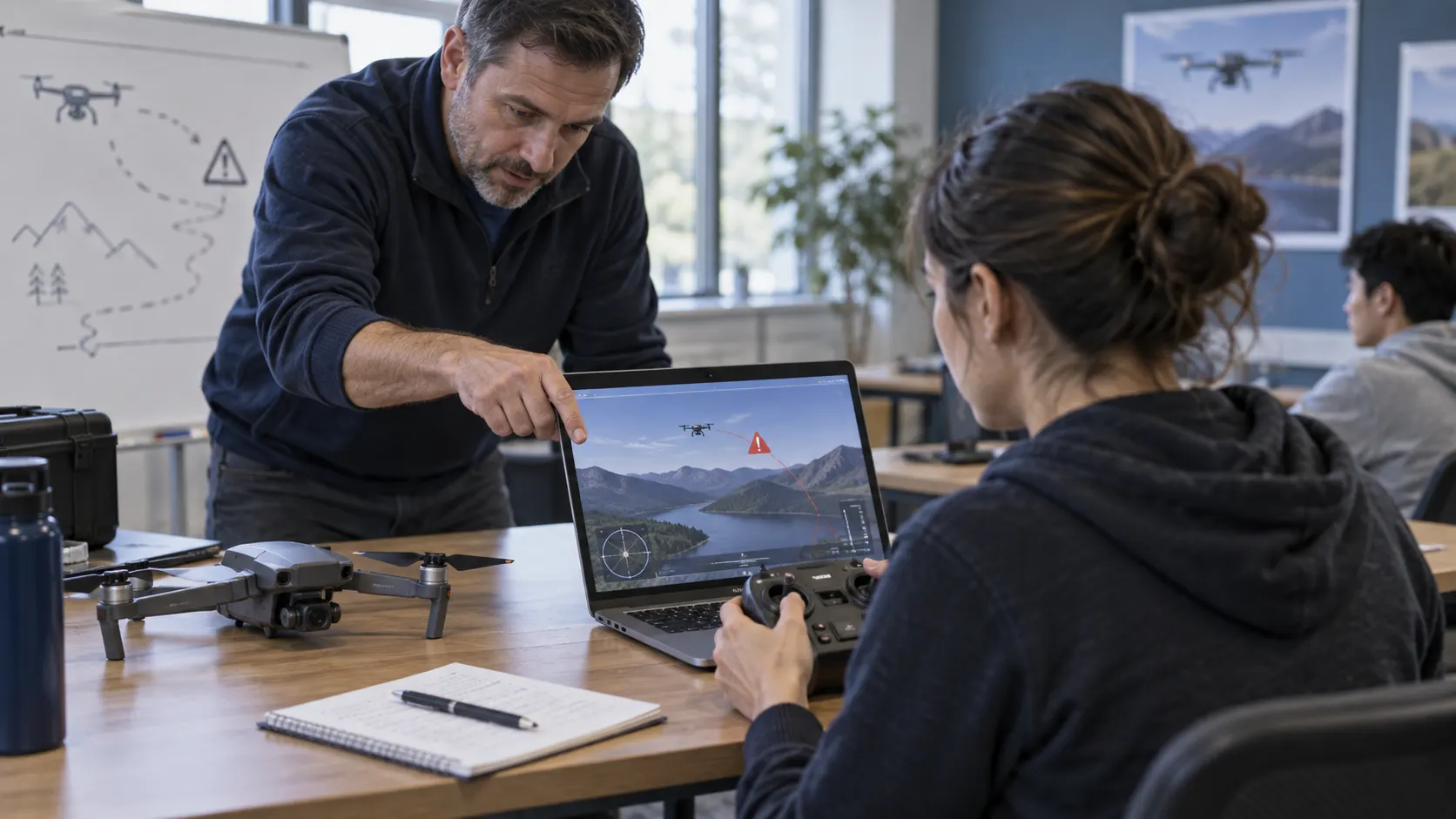
Learning outcomes and prerequisites
By the end of the chapter, learners will no longer use the phrase “signal lost” for every event, and will be able to separate symptoms, evidence, missing information and the manual sections that need to be checked. Before class, read checklists, communication and GNSS
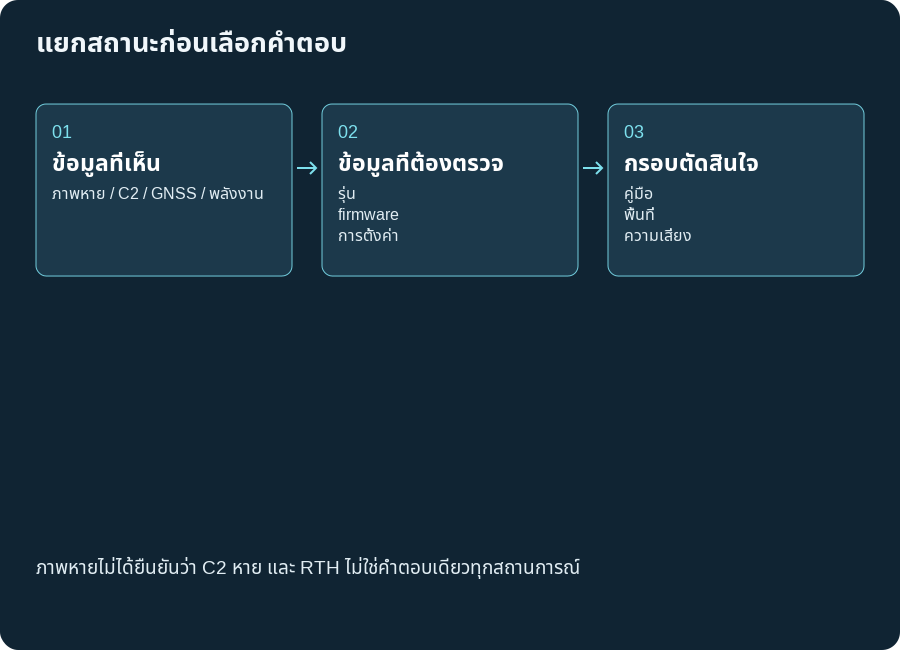
Open the full-size diagram to zoom in on details
One symptom does not confirm one cause
A frozen image may originate in the video path or the display, so it does not prove that the control link has been lost. Likewise, seeing a live image does not confirm that control commands are still getting through completely. Record what each source tells you separately, and do not fill in states for which there is no evidence yet.
PX4 documentation distinguishes several types of failsafe conditions and responses that depend on configuration. Use it as an example that a symptom's name and the system's behaviour are different things; do not use PX4 procedures or values as a substitute for the manual of every type of aircraft. PX4 Safety Configuration
| Symptom in the hypothetical scenario | What can be confirmed | What cannot yet be concluded |
|---|---|---|
| The on-screen image stops changing | The displayed image is not updating as observed | C2 lost, or the aircraft stopped moving |
| A link warning message appears | A warning appears at the recorded time | The cause and response mode, unless the details are read |
| The position on the map jumps | The displayed values change unexpectedly | The true position and the readiness of other systems |
| Power warning | The system reports a particular state | The exact remaining flight time under all conditions |
Prepare responses before an event
In real operations, procedures must be prepared in advance according to the manual, model, configuration and OM; do not wait to open this lesson during an event. Returning home or climbing is not a universal answer, because routes, position status, obstacles and system capabilities differ. This chapter therefore trains classification and document review; it does not give control instructions during real events.
Use event cards containing the time, data source, the warning message exactly as seen, the document version used, and unknown information. Separate “what the aircraft did” from “what the team expected the aircraft to do” so it can be reviewed later.
Tabletop exercise: frozen video but other data still changing
Use log.csv in mission workbook as the recording table. No signal-cutting trials or induced events are conducted on real aircraft.
- The instructor reads the card: “10:00:00 video frozen, telemetry time value still changing”. Learners write observations without assigning a cause.
- State which data still need to be checked to distinguish the video path, C2 and position.
- Write the names of the sections to look up in the actual system's manual, such as loss of video or loss of link, without inventing response values.
- Add the card “firmware and failsafe configuration unknown” and review which questions cannot be answered.
- Summarise what must be corrected in the documents before practising with an authorised system.
Model answer and rubric
From the first card, it can only be confirmed that the video is frozen and the on-screen telemetry time is still changing. The integrity of C2 or the actual state of every system cannot yet be guaranteed. When the configuration is unknown, the limitation must be recorded; never assume the aircraft will always return by itself.
Score 0–2 points each for separating symptoms, evidence, missing information, identifying the manual, and communicating status. Response speed is not a main criterion of this exercise.
References
- PX4, Safety (Failsafe) Configuration, main-branch documentation, source, checked 26 September 2026. Content may change. No flight-controller experiments are conducted in this chapter.
- Continue reading logs and debriefing to turn findings into follow-up actions.