Shot lists, production planning and genres
UAT 472 Fundamentals of Aerial Photography and Videography with Drones
Lesson
By the end of this module you will be able to
- Turn a client's needs into a shot list that states subject, angle, movement, time, aspect ratio and priority
- Plan a shoot from a site scout, sun position, stakeholders, batteries and a schedule
- Compute the number of battery flights and a hyperlapse length that is actually possible
- Choose shooting approaches for landscape, architecture, places, people, events, tourism and promotional work
Why this matters
A team that arrives on site and only then decides what to shoot usually comes back with dozens of lovely clips that cannot be used: they do not match what the client wanted, the opening shot is missing, the light is harsh midday light, or the batteries ran out before the best evening light. Professional work always starts at the desk with a shot list and a production plan, standard tools in film production (Brown, 2021). This module builds both for the Bang Suwari job (fictional) and then looks at how each genre needs a different approach. Sequencing shots into a story and storyboarding continue in UAT 473; taking paid client work, pricing and contracts belong to UAT 474.
From the client’s needs to a shot list
The municipality of Bang Suwari (fictional) wants (1) 30 stills for its website and brochure, (2) three 30-second vertical 9:16 videos for social media and (3) one 60-second horizontal 16:9 video for a tourism fair. Every piece must tell the same four stories: the river, the temple, the market and the festival.
The team turns these needs into an aerial shot list (ground shots have a separate list). Each row answers what, why, from which angle, with what movement, when, and for which use.
| Code | Subject | Purpose | Angle and movement | Time | Ratio | Priority |
|---|---|---|---|---|---|---|
| A1 | River and town at dawn | Opening shot | Low oblique, slow push in | 06:30–07:00 | 16:9 | Must |
| A2 | River bend | Pattern | Top-down, rise | 07:00–07:30 | 16:9, 9:16 | Must |
| A3 | Market roofs | Pattern and colour | Top-down, static (still) | 07:30–08:00 | 4:3, 1:1 | Must |
| A4 | Riverside market front | Context and life | High oblique, truck over water | 07:30–08:30 | 16:9 | Must |
| A5 | Chedi and hall | Architecture | High oblique, orbit | 15:30–16:30 | 16:9 | Must |
| A6 | Chedi with long shadow | Pattern of light | Top-down (still) | 16:30–17:00 | 4:3 | Should |
| A7 | Temple and river | Place reveal | Rise from behind the wall | 16:00–17:00 | 16:9, 9:16 | Must |
| A8 | Festival grounds before the crowd | Preparation | High oblique, pull back | 16:30–17:15 | 16:9, 9:16 | Must |
| A9 | Sunset over the town | Closing mood | Hyperlapse | 17:20–17:40 | 16:9 | Should |
| A10 | Closing shot over the river | Final shot | Pull back and rise | 17:00–17:40 | 16:9, 9:16 | Must |
The priority column separates “must have” from “should have”, a standard prioritisation habit: when time or batteries run short, the team drops “should” shots first. The ratio column shows which shots need a separate vertical take or a centred subject (module 1). Each shot also needs a ground backup that tells the same story in case flying is impossible that day.
Production planning
Site scout and stakeholders
Before the shoot day the team studies maps and satellite images, then walks the real site (a scout). It records obstacles (large trees, power lines, the chedi spire, lamp posts), open take-off points away from people, which way the main hall faces, and where crowds will gather on the festival day, and takes ground photos to plan angles. Site assessment and flight permission follow the procedures learned in UAT 471.
This job has several stakeholders. The team must ask the abbot before filming the temple and never fly during a ceremony, inform the market committee and vendors, and agree take-off points and flying times with the festival organiser. Community consent makes the job far smoother than being challenged after the fact.
Time and light
Use the sun’s position, not convenience, to set the times.
Example 1 The light table for the shoot day
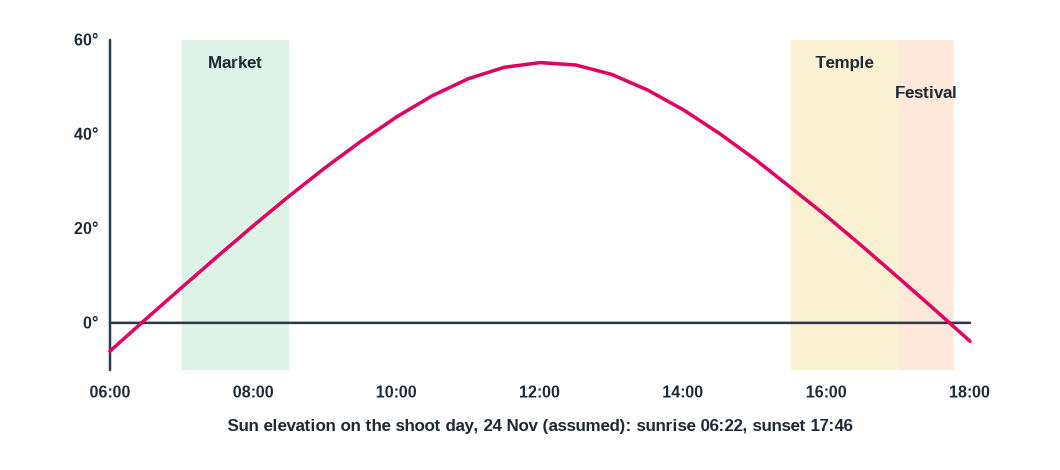
The team computes the sun’s position with NOAA’s solar position equations (NOAA Global Monitoring Laboratory, n.d.) at latitude 14.35 degrees north and longitude 100.57 degrees east (an assumed central-plains location) on 24 November (assumed) in Thai time: sunrise 06:22, solar noon 12:04 and sunset 17:46. Sun elevation:
| Time | 07:00 | 08:00 | 10:00 | 12:00 | 14:00 | 16:00 | 17:00 | 17:30 |
|---|---|---|---|---|---|---|---|---|
| Elevation (degrees) | 7.5 | 20.6 | 43.7 | 55.2 | 45.2 | 22.6 | 9.6 | 2.9 |
Decisions:
- Morning market 07:00–08:30: sun at 7.5 to 27 degrees, warm light and long shadows, and the market is at its busiest
- Temple 15:30–17:00: the sun drops from 28.7 to 9.6 degrees; the hall faces the river to the west (assumed), so afternoon light falls on its front as a near-front side light, and the chedi’s shadow exceeds 170 m at 17:00 (module 2)
- Festival 17:00 to before 17:46: the last window for flying under the general condition of flying between sunrise and sunset (UAT 471); the team films the festival grounds from the air before sunset and lands before 17:46, and the lanterns after sunset are filmed with ground cameras
- 10:00–14:00: the sun is 44 to 55 degrees high and the light is hard; use the time for scouting, backing up files and charging batteries
Weather can always change the plan. The team checks wind, cloud and rain using the procedures from UAT 471 and keeps the second morning as a reshoot window for missed shots.
Batteries, cards and equipment
Example 2 How many battery flights?
One battery flies about 30 minutes. The team’s rule is to land at 30% remaining, and it allows 4 minutes per flight for take-off, transit to the shot and return (all values assumed; the principle of reserves is covered in UAT 471).
- Shooting time per flight: minutes
- Morning (five shots, three takes each, 1.5 minutes per take): minutes, needing flights
- Temple (four shots): minutes, 2 flights
- Festival (two shots plus a 15-minute hyperlapse): minutes, 2 flights
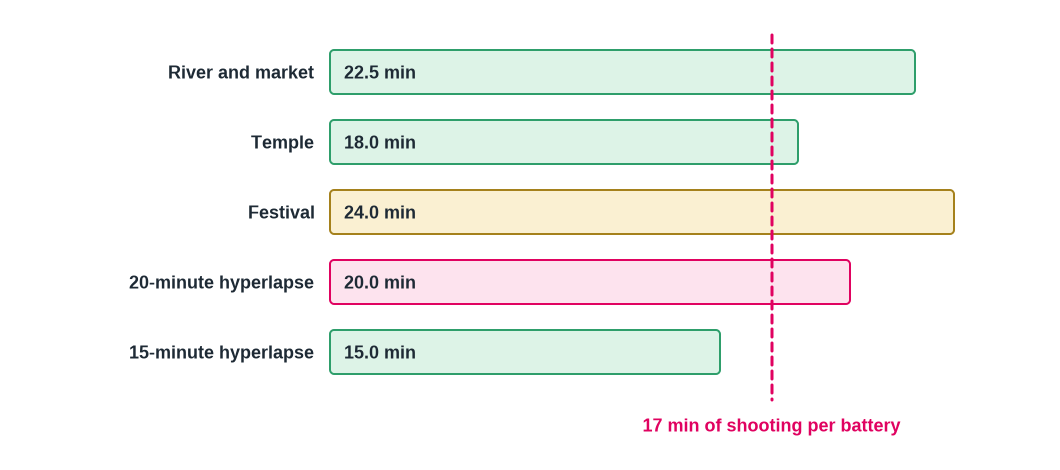
The key point: a hyperlapse is one continuous shot and must fit in a single battery. The first plan of 20 minutes exceeds 17 minutes and is impossible, so the team cut it to 15 minutes. For a 10-second clip at 25 fps (250 frames) that means one frame every seconds.
import math
nominal, reserve, overhead = 30, 0.30, 4      # minutes per battery, reserve share, take-off and transit minutes (assumed)
batteries, charge = 3, 90                     # batteries owned, minutes to recharge one (assumed)
per_battery = nominal * (1 - reserve) - overhead
print(f"shooting time per battery: {per_battery:.0f} min")
plan = [("river+market", 1, 5 * 3 * 1.5), ("temple", 1, 4 * 3 * 1.5), ("festival", 2, 2 * 3 * 1.5 + 15)]   # (place, day, minutes)
flights = {}
for place, day, minutes in plan:
    n = math.ceil(minutes / per_battery)
    flights[day] = flights.get(day, 0) + n
    print(f"{place:13s} day {day} {minutes:5.1f} min -> {n} batteries")
print(f"total {sum(flights.values())} battery flights")
gap = (15 * 60 + 30) - (8 * 60 + 30)          # 08:30 end of the market shoot to 15:30 start of the temple shoot
for day, n in sorted(flights.items()):
    extra = max(0, n - batteries)
    note = f", gap 08:30-15:30 = {gap} min >= {charge} min" if extra else ""
    print(f"day {day}: {n} flights, {batteries} batteries -> {extra} recharge(s) of {charge} min{note}")
shooting time per battery: 17 min
river+market day 1 22.5 min -> 2 batteries
temple day 1 18.0 min -> 2 batteries
festival day 2 24.0 min -> 2 batteries
total 6 battery flights
day 1: 4 flights, 3 batteries -> 1 recharge(s) of 90 min, gap 08:30-15:30 = 420 min >= 90 min
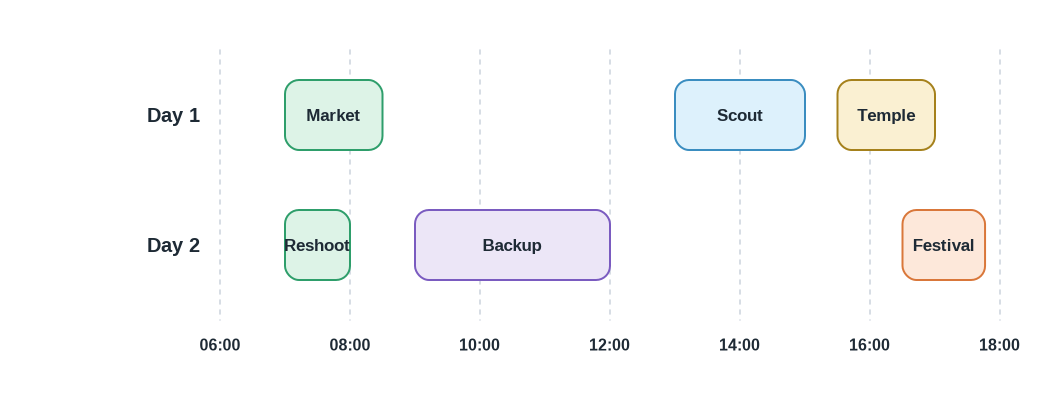
day 2: 2 flights, 3 batteries -> 0 recharge(s) of 90 minThe team owns three batteries and recharging one takes 90 minutes (both assumed). Day 1 (market and temple, as in the schedule below) needs 4 flights, one more than the batteries owned, so one battery must be recharged and used again. Between the end of the market shoot at 08:30 and the start of the temple shoot at 15:30 there are 420 minutes, far more than the 90 minutes needed, so the midday charging period planned in Example 1 is enough. Day 2 (festival) needs 2 flights and all batteries start the day charged. If your lab has fewer batteries or a slower charger, repeat the last step with its own numbers. Cards and file backup are computed in module 5.
The shoot schedule
The whole plan becomes a call sheet handed to everyone: date, call time and meeting point, shots in order, roles (pilot, visual observer, ground camera operator, file manager), equipment, contact numbers for the temple, market and festival coordinators, and the bad-weather backup plan.
Genres
The composition, light and movement principles of modules 1 to 3 apply everywhere, but each genre has its own emphasis.
Landscape
Landscape images convey space and atmosphere. Morning and evening light and light mist matter most. Place a level horizon on a thirds line, use the river or a road as a leading line, add a scale reference (one boat) and use slow movement such as a push in or a hyperlapse. Top-down frames suit the patterns of rice fields and river bends.
Architecture and places
Architecture must respect form. Tilting the camera down at a tall building makes vertical lines converge (the chedi seems to fall backwards). The fix is to fly at about half the building’s height or a little above and keep the camera nearly level, so verticals stay straight. Use side light to show detail, symmetry for top-down frames, and an orbit or a rise from behind a wall to reveal. A place differs from a building in that it must show relationships with its surroundings, such as temple and river or market and pier, so high obliques and wide shots work best. Sacred places need permission and ceremonies must not be disturbed.
People
Drones are poor at faces. People in aerial images are usually part of the scene, such as a vendor paddling a boat or someone on a bridge giving scale. Keep the distances from people set out in UAT 471. Images in which a person can be identified may be personal data under Thailand’s Personal Data Protection Act B.E. 2562 (2019), so the team plans consent from people who are the focus of a shot (such as a vendor filmed close with a ground camera) and avoids needlessly identifiable shots of the public. Image rights and responsible publication continue in UAT 473.
Events and festivals
Crowded events are the riskiest jobs. Never fly over a crowd. Choose flying positions outside the gathering at the required distances, film the preparation before people arrive, agree take-off points and announcements with the organiser, and stay within daylight under the general conditions. Evening atmosphere and close shots of people use ground cameras. An event happens once and cannot be reshot, so the shot list must be clear about which shots are essential.
Tourism
Tourism images sell an experience, not only a place: viewers should imagine themselves there. Use shots with a journey (a boat moving along the river), the best time of day and real community life. Images must be true to reality: no colour or editing that removes or invents things and leaves visitors disappointed. Shoot in several seasons when possible.
Promotional media
Promotional work carries a message the client wants to send, such as “an old town still full of life”. Images need space for text (sky or water), every aspect ratio the media require, and a consistent look across the set in white balance, colour profile and movement style, so footage from several days reads as one series.
Module lab
Lab: shot list and production plan
- The brief (hour 1): the instructor gives a short brief for a real place in or near the university (a garden, an old building or a weekend market); the team writes an 8 to 10 shot aerial shot list in the table format, with ground backups and priorities
- Site scout (hour 2): walk the site and record obstacles, take-off points, building orientation, where people gather and whose permission is needed
- Planning numbers (hour 3): find sunrise, sunset and sun elevation with an app or NOAA’s solar calculator, set the shoot windows, compute batteries with Example 2 and make the call sheet
- Rehearsal (hour 4): in the university’s designated practice area under an instructor, in daylight and never over people, shoot three “must” shots from the list, time each take and update the plan’s numbers
Common mistakes
Watch out
- Deciding on site: many clips, but the story is incomplete
- No priorities: batteries run out before the essential shots
- Using midday light because it matches office hours: harsh, flat images
- A hyperlapse longer than one battery: the shot breaks off midway
- Forgetting to ask the temple, market or organiser: filming is stopped halfway
- Flying close to a crowd for the shot: against the conditions and dangerous
- Tilting down at a tall building from close range: converging verticals
Summary
- A shot list states subject, purpose, angle, movement, time, ratio and priority for each shot, with a ground backup
- A production plan combines scout, stakeholders, sun position, weather, batteries and a call sheet
- Shooting time per battery is , and a continuous shot must fit in one battery
- Landscape stresses light and atmosphere, architecture form and straight lines, places relationships, people and events distance and consent, tourism a true experience, and promotion the message and consistency
Check your understanding
- A battery flies 25 minutes, the reserve is 30% and take-off and transit take 3 minutes. How many minutes of shooting per flight?
- You need 40 minutes of shooting with 17 minutes per flight. How many flights?
- A 12-minute hyperlapse for a 10-second clip at 25 fps: how often must a frame be taken?
- Why does the team film the festival grounds from the air before sunset and the lanterns after sunset from the ground?
- The chedi seems to be falling backwards. What causes it and how do you fix it?
Answers
- minutes
- , rounded up to 3 flights
- seconds
- The general conditions allow flying between sunrise and sunset, so there is no flying after dark (unless a night permission is held), and before sunset the crowd has not yet gathered, so flying near a crowd is avoided
- The camera is tilted down at a tall building so verticals converge; fly at about half the building’s height or a little above with the camera nearly level, or move further away
Key formulas
| Shooting time per battery | |
| Number of flights | |
| Timelapse interval |
Key references
- Brown, B. (2021). Cinematography: Theory and practice for cinematographers and directors (4th ed.). Routledge. link
- NOAA Global Monitoring Laboratory. General solar position calculations. link
- Mademlis, I., Nikolaidis, N., Tefas, A., Pitas, I., Wagner, T., & Messina, A. (2019). Autonomous UAV cinematography: A tutorial and a formalized shot-type taxonomy. ACM Computing Surveys, 52(5), 1–33. link
- Freeman, M. (2007). The photographer's eye: Composition and design for better digital photos. Focal Press. link
- พระราชบัญญัติคุ้มครองข้อมูลส่วนบุคคล พ.ศ. 2562. ราชกิจจานุเบกษา, 136(69 ก), 52–95. link
- สำนักงานการบินพลเรือนแห่งประเทศไทย. (2569). ประกาศ กพท. เรื่อง หลักเกณฑ์และวิธีการในการอนุญาตให้ผู้บังคับหรือปล่อยอากาศยานซึ่งไม่มีนักบิน ประเภทอากาศยานที่ควบคุมการบินจากภายนอก ที่มีน้ำหนักไม่เกิน 25 กิโลกรัม ปฏิบัติแตกต่างไปจากเงื่อนไขที่กำหนด พ.ศ. 2569 (มีผล 17 พฤษภาคม 2569). link
Further reading
Study the assigned knowledge units in advance, review media and take the module quiz
M11 Media production: from what the audience needs to a deliverable image
Site assessment and go/no-go decisions
จริยธรรม ความเป็นส่วนตัว และ PDPA ในงานโดรน
In class / field
Lab or field practice from worksheets with a safety checklist
Learning evidence: Checked worksheets and quiz results