Site assessment and go/no-go decisions
Record constraints, stakeholders, risks and evidence before deciding to start work
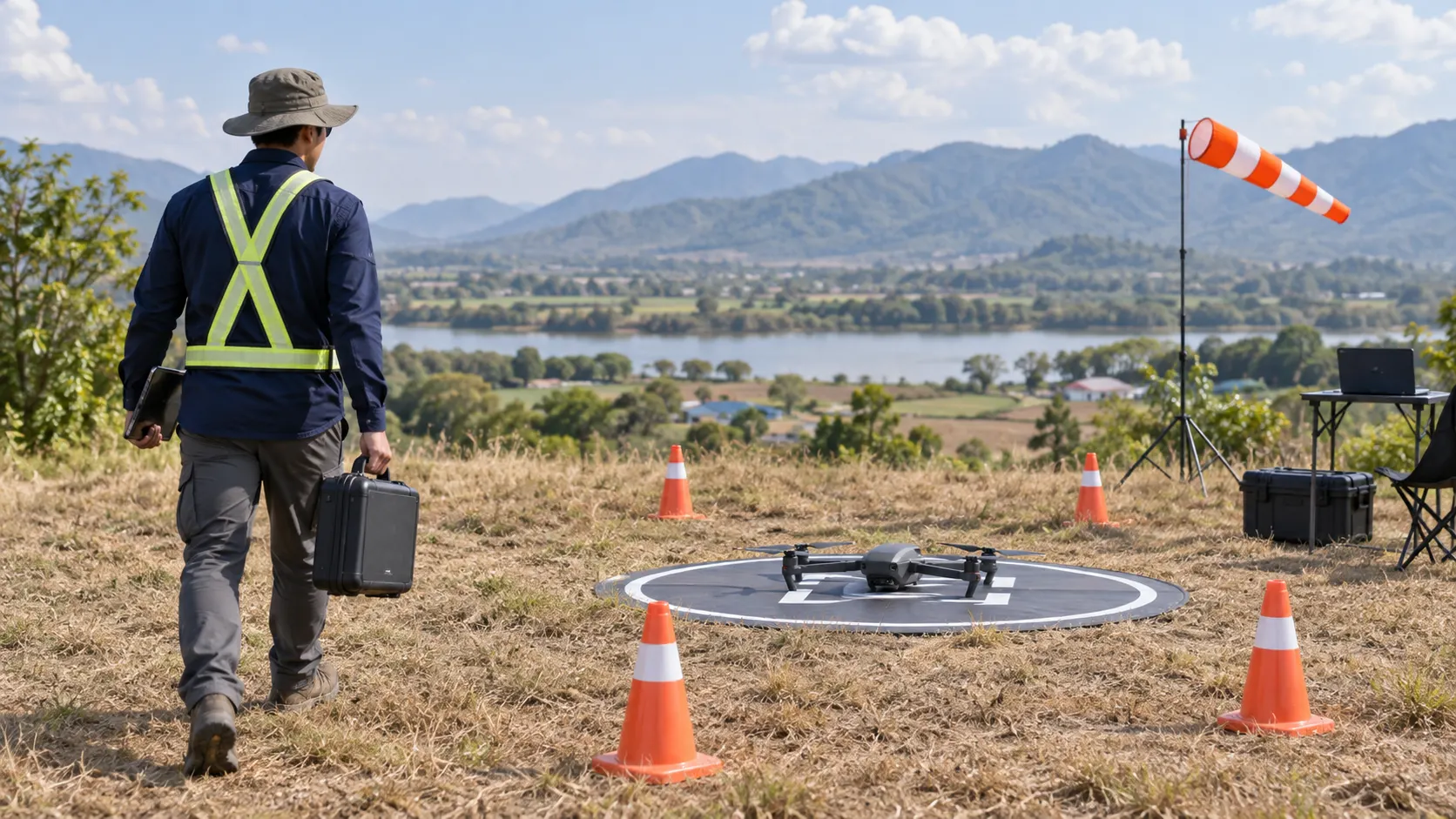
Outcomes and prerequisite knowledge
Learners will draw a hypothetical site layout, write a risk register with an owner for each control measure, and explain the ready/not-ready status with reference to evidence. Read brief, Airspace and Local weather conditions first
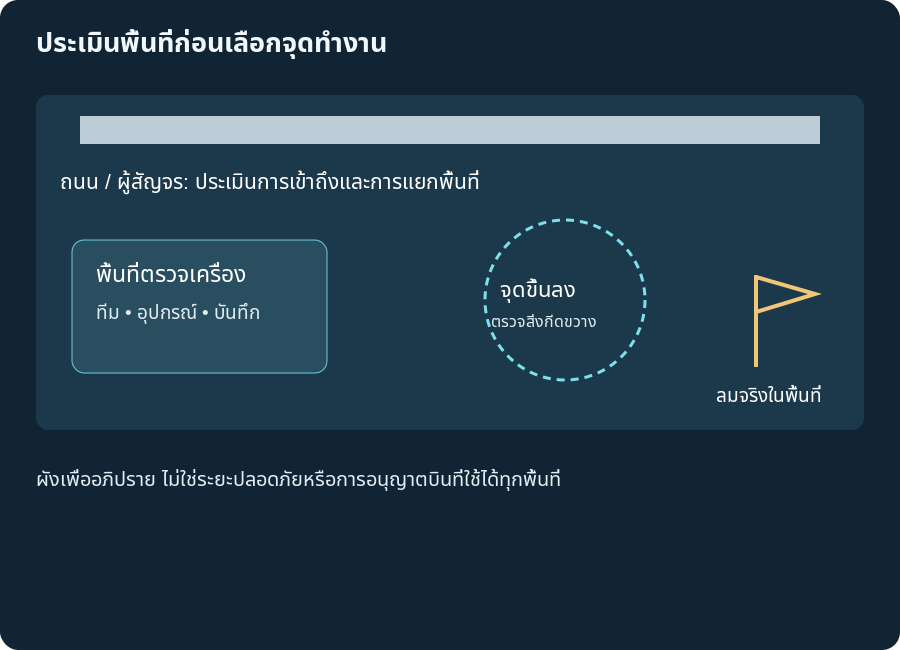
Open the full-size diagram to zoom in on details
A desk map is not yet the on-site reality
A map helps identify locations to check, but it does not confirm whether there are temporary power lines, passers-by or new activities on the day. Record the source, time, checker and unconfirmed items separately. When conditions change, earlier conclusions may no longer apply
Safety surveys, selecting the operating area and alternate areas, and cordoning off the area are separate topics in CAAT's OM guidance. This practice table helps gather evidence, but defining the actual area must follow the operator's manual and mission conditions CAAT-GM-UAS-001
| What to review | Evidence to record | What should not yet be concluded |
|---|---|---|
| People and stakeholders | Site coordination, access points, control status | No people in the image, so no one will pass through |
| Obstacles | Data source, check date and what could not be checked | An old map shows everything |
| Weather | Context data and time-stamped site observations | A distant station represents conditions at every point |
| Airspace and rights | Edition and effective time of the data used | A colour on the portal means authorisation |
| Equipment and team | Limits per the manual and actual readiness | Similar models can use the same criteria |
Every risk needs an owner and a check of its control measures
Write it as a chain of reasoning: hazard → who or what is exposed → possible consequence → control measure → responsible person → verification evidence → residual risk. For example, “people walking into the take-off/landing point” needs a way to manage the area and someone to check that conditions are as specified, rather than lowering the score on paper as soon as a measure is written
Use your organisation's decision criteria where they exist; do not borrow another organisation's colour table without knowing what it means. In this class we use the word HOLD when important information is not yet confirmed. Writing clear reasoning is worth more than turning every cell green
Exercise: a take-off/landing point with passers-by
Use site.csv and risk.csv in mission workbook There are no real coordinates or events
- Draw a hypothetical layout with the road, team assembly point, entrance and areas not yet checked, with the words “not to scale”
- Add at least three hazards, stating whether each is given in the problem or an assumption you added
- Write the responsible person and verification evidence for each control measure
- Make a decision while the site coordinator is not yet confirmed, then explain what information would allow a reassessment
- Have a classmate add an event of a person walking into the area after the check, and review the decision
Suggested answers and rubric
The status should be not ready to start while area control is an open item. Confirming the coordinator alone does not prove that all risks are closed; conditions and the relevant constraints must be checked again. Give 0–2 points per aspect: source/time, completeness of hazards, owners of control measures, verification evidence, and reasoning when conditions change
References and further reading
- CAAT, Guidance for Development of an Operations Manual, Issue 01 Rev 00 (2022), section Site Safety Assessment, original, checked 26 September 2026
- The flight authorisation lesson for how to separate site information from authorisation, and checklist for readiness-check evidence