Visual storytelling, concept, message and audience
UAT 473 Aerial Storytelling and Creative Content Production
Lesson
By the end of this module you will be able to
- Explain the idea of visual storytelling and the different jobs of aerial and ground shots
- Develop a media concept and write a one-sentence key message from a client brief
- Analyse the audience with personas and a weighted scoring table
- Split the time of a short clip into three acts with an opening hook and a closing call to action
Why this matters
Drone footage is easy to make beautiful, but a row of beautiful shots is not yet a story. Viewers scroll past a clip that is “just views” within seconds because they do not know why they are watching. What makes people stop, watch to the end, remember and act is a story: a person, a feeling and one clear message. This course follows UAT 471 (flying safely and legally) and UAT 472 (making good images) and teaches the next step, turning the footage you can shoot into a story that communicates. We do not reteach flying or camera settings; if you have forgotten them, revisit those two courses.
All five modules use one fictional case: the Fah Sai Indigo Cloth Community Enterprise (a fictional name) in a province of northeastern Thailand. A group of village women dye cotton with natural indigo, weave it by hand and sell through the group’s page. This year the group has a booth at a tourism fair, so it asks a student team for three pieces of brand story: a 60-second vertical clip for social media, a 90-second horizontal clip to loop on the booth screen, and a 15-second teaser, plus stills for a poster. All people, figures and prices in this course are assumed.
What visual storytelling is
Visual storytelling means letting viewers understand the story mainly from what they see, not from narration. The best-known rule is “show, don’t tell”. Instead of saying “our cloth is handmade at every step”, let the viewer see indigo-stained hands dipping the cloth into the pot again and again.
A good story has three easy-to-remember parts:
- A character viewers can care about, such as Mae Kham, a dyer of the older generation, and Ploy, her daughter who came home to run the group’s page (both fictional)
- What the character wants or faces, such as wanting the village’s patterns to reach the younger generation
- A change: the end differs from the beginning, such as white cloth turning blue and the mother’s work reaching city people
Block (2021) explains that images have their own structure running parallel to the story structure. Basic visual components such as space, line, shape, tone, colour, movement and rhythm can create mood, and one principle you can use at once is contrast and affinity. Very different shots cut together feel energetic; similar shots cut together feel calm. Use strong contrast where you want excitement and affinity where you want rest.
Aerial and ground shots do different jobs
| Aerial shots | Ground shots | |
|---|---|---|
| What they tell well | Where, how big, surrounded by what | Who, doing what, feeling what |
| Mood | Wide, calm, grand, overview | Close, warm, detailed |
| Example in the indigo story | The village among rice fields at dawn; drying cloth as a top-down pattern | Dyeing hands, indigo froth in the pot, a weaver’s face |
Aerial shots alone make a story cold and distant; ground shots alone leave viewers unsure where they are. A good story alternates the two for a reason (details in module 2). Every high-angle shot must come from a safe, legal flight as taught in UAT 471. A great idea that needs an illegal flight is not a usable idea.
From brief to concept and message
Every job starts with the client’s brief: a short document answering what is wanted, for whom, where it will appear, when it is due and who signs it off. The drone knowledge base unit on media production recommends filling every one of these fields before planning the shoot; if a field is unknown, write down whom you will ask. The Fah Sai brief (assumed) is:
- Objective: make people know the brand, follow the page and visit the booth or the village
- Channels: the group’s page and short-video accounts, and the booth screen at the fair
- Deliverables: 60 seconds vertical, 90 seconds horizontal, a 15-second teaser, stills
- Constraints: small budget, two shooting days, some villagers prefer not to be on camera
From the brief we develop a concept: the central idea that makes this piece different from others, written as one sentence an outsider understands. We then distil a key message: the single thing viewers should remember when the clip ends.
Example 1 From several concepts to a one-sentence key message
The team brainstormed three ideas and tested each with three questions: does it serve the objective, can it really be shot in two days, and does the story genuinely need aerial shots?
- “The colour of the sky, woven by hand” compares indigo with the sky over the village. Aerial shots of sky and rice fields connect directly to the cloth. It passes all three.
- “A day in Mae Kham’s life” follows the dyer from morning to evening. It is intimate, but aerial shots are just scenery, and it needs one person all day, which Mae Kham cannot give.
- “Patterns from the sky” uses top-down shots of drying cloth as geometric patterns. It is beautiful but has no character, so viewers may not feel connected.
The team chose idea 1 and borrowed the strength of idea 3 (the top-down drying rows). The key message is “Fah Sai indigo is the colour of the northeastern sky, handed from mother to daughter by hand.” It names the product, its origin and the value of handwork, and every shot can be tested against it: “does this shot support the message?”
Good messages are short, concrete and human. “Good quality cloth at a fair price” is abstract and anyone could say it; “the colour of the sky a mother hands to her daughter” creates a picture in the mind at once. Besides the message, agree the tone: for example warm, simple and proud, not sad or asking for pity, because the group wants respect for its craft, not sympathy.
Analysing the audience
The same message can work differently with different people, so before shaping the story you must know whom you are talking to. A widely used tool is the persona, which Nielsen Norman Group defines as a fictional yet realistic description of a typical or target user, built from research with real people such as interviews or surveys rather than guesswork (Dykes, 2025). For this job the team talked to Ploy, who reads the page’s follower data, and to customers at last year’s booth, and found three possible audiences:
- Urban Thai working travellers: watch short clips daily, like crafts, look for weekend trips
- Fabric buyers and designers: buy in bulk, care about quality and reliable supply
- Foreign fair visitors: walk past the booth, glance at the screen for a few seconds, may not hear sound or read Thai
With limited budget and time, the team must choose one primary audience for the 60-second clip. A transparent method is to score each group against criteria and multiply by the criterion weights, , which means “multiply each score by how much that criterion matters, then add up”.
Example 2 Choosing the primary audience with weighted scores
The team agreed three criteria and weights (assumed): group size 0.3, chance to buy or visit 0.4, and reachable through our channels 0.3 (total 1.0). Each group is scored 1 to 5 from the data collected.
| Group | Size (×0.3) | Buy or visit (×0.4) | Reachable (×0.3) | Total |
|---|---|---|---|---|
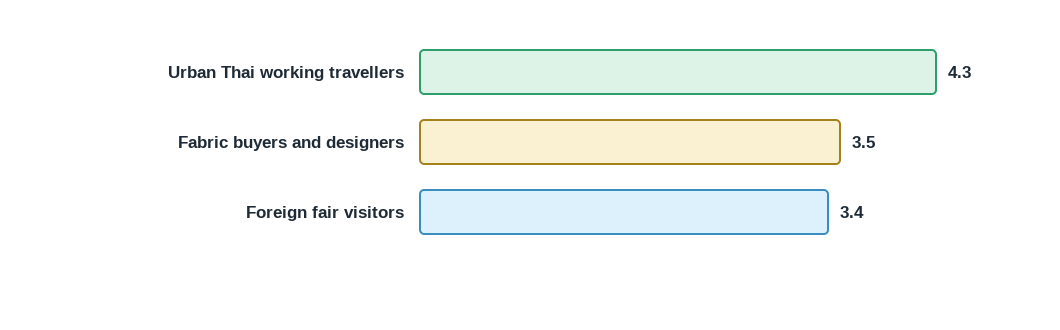
| Urban Thai working travellers | 4 → 1.2 | 4 → 1.6 | 5 → 1.5 | 4.3 |
| Fabric buyers and designers | 2 → 0.6 | 5 → 2.0 | 3 → 0.9 | 3.5 |
| Foreign fair visitors | 3 → 0.9 | 4 → 1.6 | 3 → 0.9 | 3.4 |
Working for the first row: , , , total .
Urban Thai working travellers score highest, so they are the primary audience of the 60-second clip. That does not mean dropping the others: foreign visitors become the primary audience of the 90-second booth loop, which must tell the story with images and short English text without relying on sound, and fabric buyers get a set of detailed stills of the cloth. The weights are a decision the team makes with the client; write down the reasons, because different weights can change the ranking.
With the primary audience chosen, write a one-paragraph persona, for example “Fon, 29, office worker in Bangkok, watches short clips while commuting, likes things with a story, plans a trip upcountry once a month” (assumed). Then ask of every decision: “Would Fon stop? Would she understand? Would she want to do something next?”
Basic story structure and timing
A short clip still needs a beginning, middle and end. The simplest structure is the three-act structure:
- Act 1, set-up: brings the viewer into the world of the story and introduces place and characters
- Act 2, main story: what the characters do or face; the longest and most detailed part
- Act 3, resolution: the outcome and its meaning, closing with a call to action (CTA) such as the page name or the booth location
Social media clips need a hook: the first few seconds that make people stop scrolling, such as white cloth slowly turning blue as it meets the air. The hook is part of act 1, not a separate block. A common starting split is 25%, 50%, 25%, adjusted to the story. The length of each act is , where is the total length and the share of the act.
Example 3 Splitting a 60-second clip
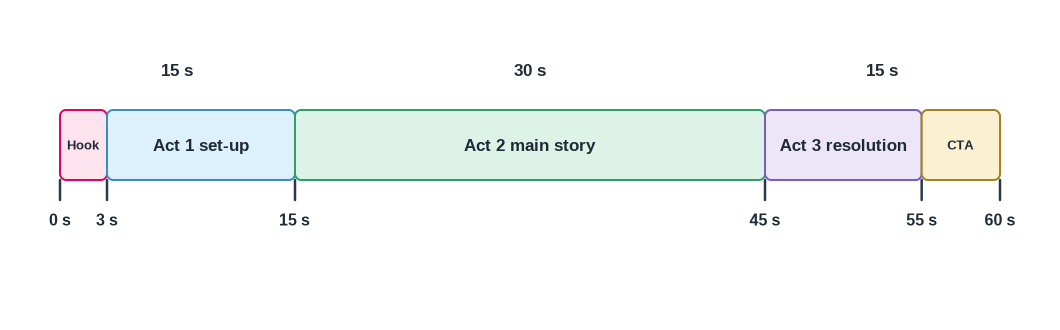
Use the 25%, 50%, 25% split for a 60-second clip, with a 3-second hook and a 5-second close with the call to action (assumed).
- Act 1: seconds (0 to 15 s). The first 3 seconds are the hook, leaving seconds of real set-up.
- Act 2: seconds (15 to 45 s).
- Act 3: seconds (45 to 60 s). The last 5 seconds are the call to action, leaving seconds of resolution (45 to 55 s).
Check the sum: seconds, exactly right. The 90-second booth clip can use the same split, , and seconds, but the booth does not need as strong a hook as a phone, because people walk up and start watching mid-clip at any time. The team therefore makes every 10 to 15 seconds of the booth clip understandable on its own.
The length must also fit the platform. YouTube, for example, states that Shorts can run up to three minutes and that vertical or square videos can be categorised as Shorts (Google, n.d.-b), while 16:9 is the standard ratio on a computer (Google, n.d.-a). Platform rules change often, so check the latest help pages whenever a job starts; format adaptation is covered in module 5.
Module lab
Lab: from brief to key message and timing (4 hours a week for 3 weeks)
Desk work and client conversations only; no flying in this module.
- Read the Fah Sai brief (or the brief your instructor gives) and fill every field of the brief table; for unknown fields, name whom you will ask.
- Brainstorm at least three concepts, test them with the three questions of Example 1, and write a one-sentence key message and the tone.
- Interview at least five people close to the target audience (classmates outside the team are fine), recording no real names or identifying details.
- Score the audience groups with weights as in Example 2, write the reasons for the weights, and try other weights to see whether the ranking changes.
- Write a one-paragraph persona for the primary audience.
- Split the 60-second and 90-second clips as in Example 3 and write one or two sentences on what each act will tell.
- Present to the class for 5 minutes; classmates and the instructor test the key message by asking “what do you remember after watching?”
Common mistakes
Watch out
- Starting from pretty pictures instead of a story: flying and filming everything, then wondering what to say, gives plenty of footage and no story
- Several key messages: trying to say quality, price, history and travel in one clip means viewers remember none of them
- Imagining the audience without talking to real people, so the persona is really a portrait of the team
- No people in the story: only high-angle shots of places, so viewers feel no connection
- A slow or long hook: opening with a logo or a still image for several seconds, so viewers scroll on before the story starts
- Forgetting flight limits: a concept that needs flying over people or at night conflicts with the conditions learned in UAT 471
Summary
- Visual storytelling lets viewers understand from what they see; a good story has a character, a want and a change
- Aerial shots tell where and how big; ground shots tell who and how it feels; a good story uses both
- The brief leads to a concept, distilled into a one-sentence key message that is short, concrete and human
- Personas are built from real people’s data; choose the primary audience with weighted scores and record the reasons for the weights
- A 25%, 50%, 25% three-act split is a good start; phone clips need a hook in the first seconds and a call to action at the end
Self-check
- How do aerial and ground shots tell different things? Give examples from the indigo story.
- Why is “good quality cloth at a fair price” a weaker message than “the colour of the sky a mother hands to her daughter by hand”?
- With weights size 0.2, buy or visit 0.3 and reachable 0.5, what total do urban Thai working travellers (scores 4, 4, 5) get?
- How long is each act of a 30-second clip split 25%, 50%, 25%?
- What should a good persona be built from?
Answers
- Aerial shots tell where, how big and surrounded by what, such as the village among rice fields. Ground shots tell who, doing what and feeling what, such as dyeing hands and a weaver’s face.
- The first is abstract and anyone could say it; the second is short, concrete, human and creates a picture in the mind at once.
- seconds, seconds, and seconds.
- Research data from real people, such as interviews, surveys or the page’s follower data, not the team’s guesses.
Key formulas
| Length of each act | |
| Weighted audience score |
Key references
- Block, B. (2021). The visual story: Creating the visual structure of film, TV, and digital media (3rd ed.). Routledge. link
- Dykes, T. (2025, October 3). Personas make users memorable. Nielsen Norman Group. link
- Google. (n.d.). Understand three-minute YouTube Shorts. YouTube Help. link
- Google. (n.d.). YouTube recommended upload encoding settings. YouTube Help. link
Further reading
Study the assigned knowledge units in advance, review media and take the module quiz
In class / field
Lab or field practice from worksheets with a safety checklist
Learning evidence: Checked worksheets and quiz results