Story outline, storyboard and sequencing aerial with ground shots
UAT 473 Aerial Storytelling and Creative Content Production
Lesson
By the end of this module you will be able to
- Write an act-by-act story outline and a draft voice-over from the key message
- Build a storyboard and shot list giving shot size, camera movement, sound and length
- Sequence shots by continuity editing principles and combine aerial and ground shots for a reason
- Choose a narrative construction and calculate the number of shots and the footage to shoot
Why this matters
Module 1 gave us a key message, an audience and a timing plan, but not what to shoot, how the shots join or how many flights we need. A team that reaches the village without a shot plan wastes flights on angles it never uses, forgets the connecting shots it needs, and comes home to find that aerial and ground footage will not cut together: the light differs, directions are reversed, or nothing leads the viewer down from the sky to the dyer’s hands. This module turns the story in your head into a plan on paper that everyone shares: the pilot, the ground camera operator and the client.
From story outline to voice-over
A story outline tells the whole story in short text, act by act, before any shot detail. It checks that the story moves forward and lands on the key message. The outline of the 60-second Fah Sai clip (assumed):
| Act | Time | What it tells |
|---|---|---|
| 1 Set-up | 0 to 15 s | Hook: white cloth lifted from the pot turns blue; cut to the sky and the village among rice fields at dawn |
| 2 Main story | 15 to 45 s | Mae Kham dyes cloth; Ploy helps and films clips for the page; drying rows form a pattern from the sky; the weaver turns thread into pattern |
| 3 Resolution | 45 to 60 s | A finished cloth waves in the wind; the camera pulls up until the sky matches the cloth; brand name and booth location |
Next write a voice-over draft or on-screen text, if you choose to tell the story with a voice. Keep it shorter than you think: a short clip must leave room for images and natural sound to work. The team chose two sentences in Mae Kham’s own voice instead of a professional narrator, because it fits the “warm, proud” tone better, plus short on-screen text for people watching with the sound off.
Storyboard and shot list
A storyboard is a sequence of sketches, one panel per shot, with notes. It need not be pretty: boxes and stick figures are enough, or phone photos taken while scouting the location. A storyboard answers questions text cannot: how wide the shot is, from which angle, and which way things move.
Each panel should give at least the following (shot sizes and camera moves were covered in UAT 472):
- Shot number, such as S01
- Type: aerial (A) or ground (G)
- Size and angle, such as extreme wide high-angle, or close-up at eye level
- Movement of the camera or drone, such as flying backwards while climbing, or a slow pan
- Sound: voice-over, natural sound or music
- Approximate length in seconds
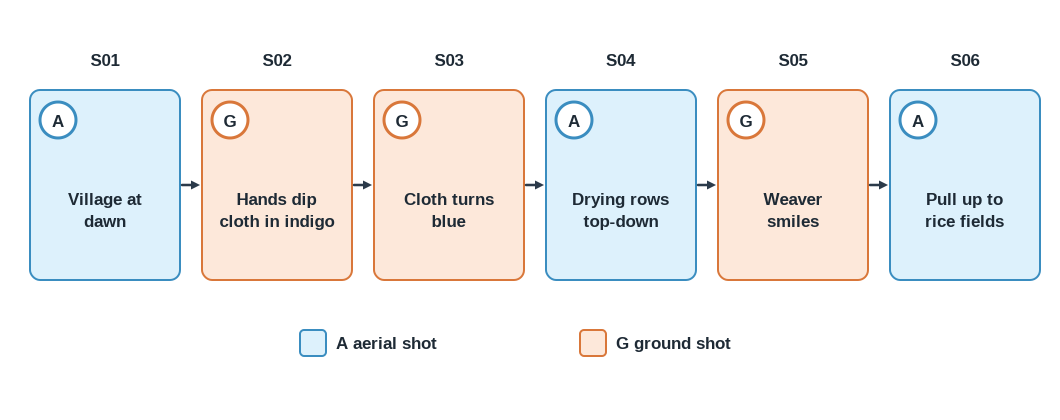
A shot list is the same table reorganised for shooting, ordered by location and time rather than story order. For example, shoot every aerial shot that needs morning light in the morning flights, then the ground shots in the dye house later in the morning. The shot list also says what must be visible and how each shot will be accepted. The drone knowledge base unit on media production stresses that a shot list is a “proposal”, not shots already captured, so include backup shots.
Sequencing shots
Shot sequencing decides which shot comes first. The most common pattern is wide to close: a wide shot says where we are (the establishing shot), a medium shot says who is doing what, a close-up shows detail and emotion, and you pull back out when changing scene.
Mainstream film uses continuity editing: conventions that keep viewers from noticing the change of shot. Smith (2012) explains that these conventions work because they match how attention works: viewers follow movement and what characters look at, and cutting at the moment attention is being led makes the join nearly invisible. Key conventions:
- The 180-degree rule: draw an imaginary line through the action (for example the line along which Mae Kham faces the pot) and keep every camera on one side. Cross it and left and right swap, confusing the viewer.
- Screen direction: if a cart or a person moves left to right in one shot, the next shot should keep that direction. This matters a lot for aerial shots, because the direction the drone flies sets the direction everything flows on screen.
- Match on action: cut while a movement is still happening, for example hands starting to lift the cloth in a wide shot, continued in a close-up while the cloth is still rising. The movement carries the eye across the cut.
Shot length sets the pace. It is measured as average shot length (ASL): total length divided by the number of shots. Cutting et al. (2010) analysed decades of Hollywood films and found shots becoming shorter over time. Short shots feel fast and exciting; long shots let viewers rest and take things in. Slow-moving aerial shots usually need to be longer than ground shots, because viewers need time to read a wide image.
Combining aerial and ground shots
The hard part of drone work is the join between two very different heights. Cutting straight from tens of metres up to someone’s hands can feel like a jump. These techniques make the join smooth:
- Step down in height: an extreme wide aerial shot, then a lower or closer aerial shot, then a medium ground shot.
- Connecting shots that move in or out: the drone flies towards the dye-house roof, then cut to a ground shot walking through the door in the same direction. Continuous movement feels like one journey.
- Match shape or colour: top-down drying rows form straight blue lines; cut to a close-up of blue warp threads on the loom running the same way, using Block’s (2021) principle of affinity.
- Match light and time of day: a warm morning aerial shot should not cut to a ground shot under harsh noon light. Plan both kinds close in time, or match the colour in module 3.
- Carry the sound: let the clack of the loom or the sound of water in the pot start just before the picture changes. Sound carries viewers across a cut as well as images do (details in module 4).
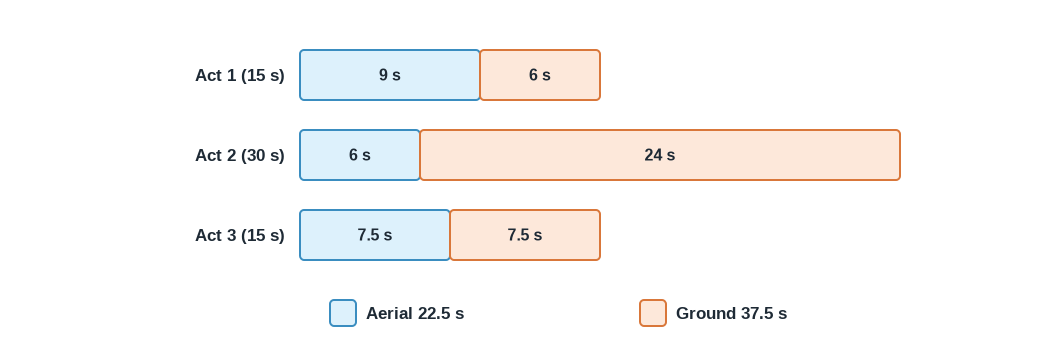
The mix of the two kinds should change with each act’s job. Act 1 must establish place, so it uses many aerial shots. Act 2 tells people and handwork, so ground shots dominate. Act 3 pulls back to the overview and the meaning, so aerial shots return.
Example 1 How many shots does the 60-second clip need?
The team sets the aerial share (assumed) at 60% in act 1, 20% in act 2 and 50% in act 3, an average aerial shot length of 3.75 seconds (slow moves) and an average ground shot length of 2.5 seconds.
- Aerial seconds: act 1 , act 2 , act 3 ; total seconds.
- Ground seconds: seconds (6, 24 and 7.5 seconds by act).
- Number of shots : aerial shots, ground shots, 21 shots in all.
- Average shot length of the whole clip: seconds.
Aerial footage is 37.5% of the time but only 6 of 21 shots, matching the feel we want: aerial shots long and calm, ground shots short and lively. These figures are for planning, not fixed rules; the edit may change them.
Narrative construction
Narrative construction is choosing how to order events so they mean something. The same story can be ordered in several ways:
- Chronological: morning to evening, or cotton to finished cloth. Easiest to follow; suits how-to and process clips.
- Circular: ends on the same image or idea as the start, now with a new meaning. For example, start on the sky and end on the sky, which we now know is the colour of the cloth. It fixes the key message in the mind.
- Parallel: intercut two lines of action, such as the mother’s hands dyeing cloth and Ploy’s hands filming for the page, comparing old and new generations.
- Thematic: short chapters such as colour, pattern, people. Suits the booth loop, where people join mid-clip.
The team chose a circular structure with a parallel passage in act 2 for the 60-second clip, and a thematic structure for the 90-second booth clip, because each short chapter stands on its own. This choice also decides what tells the story: a narrator, the real voices of the people in it, or on-screen text only. Phone clips, which many people watch muted, must make sense from images and text; sound adds emotion.
Shooting plan from the storyboard
The footage shot is always several times the final length, because each shot is repeated in several takes and needs spare frames at the head and tail for editing. The ratio of footage shot to final length is the shooting ratio; it helps estimate shooting time, storage and the number of flights.
Example 2 How much footage must we shoot?
The team plans (assumed) three takes of every shot, 20 seconds per aerial take (including the start and stop of the move) and 15 seconds per ground take.
- Aerial: seconds, or 6 minutes.
- Ground: seconds, or 11.25 minutes.
- Total seconds; shooting ratio to 1.
Only 6 minutes of aerial footage need recording, but flight time is much longer: take-off, framing, waiting for light, and landing with the battery reserve calculated in UAT 471. The team therefore splits the aerial shots into two morning flights with the same light, and uses these figures to work out batteries and card space by the methods of UAT 471 and UAT 472. Interesting shots that are not on the list can be captured once the main list is complete.
The shooting plan must also say who will appear on camera and whose consent is needed before the shoot day, because some villagers prefer not to be filmed. Sorting this out early is far cheaper than cutting shots later; image rights are covered in module 5.
Module lab
Lab: storyboard, shot list and animatic (4 hours a week for 3 weeks)
- Write the act-by-act outline and a draft voice-over or on-screen text from the key message and timing of module 1.
- Storyboard the 60-second clip in at least 18 panels, giving type A or G, shot size, movement, sound and length.
- Calculate the aerial share, the number of shots and the shooting ratio as in Examples 1 and 2 with your team’s values.
- Check every join between aerial and ground shots against the five techniques, and check the 180-degree rule and screen direction.
- Shoot rough phone footage on campus and assemble an animatic: a storyboard timed to the real length with rough sound. See whether the pace works.
- If the instructor runs a flying session, shoot one or two connecting aerial shots in the university’s designated practice area under the instructor’s supervision, in daylight, never over people, and within the Thai rules in force.
- Reorder the shot list by location and shooting time, with backup shots and a list of people whose consent is needed.
Common mistakes
Watch out
- Skipping the storyboard because the clip is short, then missing the connecting shots and having to reshoot
- Cutting from sky to hands at once with no intermediate step, so the join jumps and viewers lose their bearings
- Flight direction fighting the ground shots, for example the drone flies left but the next shot has someone walking right
- Crossing the 180-degree line between two close-ups, so Mae Kham and the pot swap sides
- Aerial shots as short as ground shots, so viewers have no time to read the wide image
- A shot list in story order instead of by location and light, forcing unnecessary extra flights
Summary
- The story outline tells the whole story act by act; a voice-over must be short and leave room for images
- The storyboard gives type, size, angle, movement, sound and length for every shot; the shot list reorders it by location and time
- Wide to close, the 180-degree rule, screen direction and match on action keep cuts smooth
- Combine aerial and ground shots by stepping down in height, connecting shots, matching shape or colour, matching light and carrying sound across the cut
- The number of shots and the shooting ratio help plan time, flights and storage
Self-check
- How does a storyboard differ from a shot list?
- How many shots does a 30-second clip with a 2.5-second average shot length have?
- What is the 180-degree rule, and what happens if you break it?
- Name two techniques that help aerial shots cut smoothly with ground shots.
- Why did the team choose a thematic structure for the booth clip?
Answers
- A storyboard orders shots as they appear in the story, with sketches. A shot list is the same table ordered by location and shooting time, with acceptance criteria and backup shots.
- shots.
- Every camera stays on one side of an imaginary line through the action. Crossing it swaps left and right on screen and confuses viewers.
- For example: step down in height from extreme wide to medium, use connecting shots moving in the same direction, match shape or colour, match the light, or let the sound start before the picture changes (any two).
- Because people walk up and start watching mid-clip at any time, so each short chapter must make sense on its own.
Key formulas
| Number of shots from average shot length | |
| Shooting ratio |
Key references
- Block, B. (2021). The visual story: Creating the visual structure of film, TV, and digital media (3rd ed.). Routledge. link
- Smith, T. J. (2012). The attentional theory of cinematic continuity. Projections, 6(1), 1–27. link
- Cutting, J. E., DeLong, J. E., & Nothelfer, C. E. (2010). Attention and the evolution of Hollywood film. Psychological Science, 21(3), 432–439. link
Further reading
Study the assigned knowledge units in advance, review media and take the module quiz
M11 Media production: from what the audience needs to a deliverable image
Camera settings and image-quality checks
In class / field
Lab or field practice from worksheets with a safety checklist
Learning evidence: Checked worksheets and quiz results