Content by sector, platform formats, copyright, image rights and responsible publication
UAT 473 Aerial Storytelling and Creative Content Production
Lesson
By the end of this module you will be able to
- Adapt one story for social media, tourism, public relations, marketing, real estate, events and organisations
- Adjust aspect ratio, length and file settings to each digital platform
- Explain copyright ownership of commissioned work, the term of protection and the exceptions relevant to photography under Thai law
- Manage image rights and the personal data of people on camera, and publish responsibly
Why this matters
A finished edit does not reach anyone until it is adapted to the purpose of its users and to the platform where it is published. Even the best piece can be taken down, bring a lawsuit or harm the people in it if it uses images or music without rights, films people without consent, or is edited to mislead. This final module takes the Fah Sai clip (assumed) to the public properly: format, rights and responsibility. The legal content here is for learning, not legal advice; real cases must be checked against the version in force and a lawyer. Full commercial client work, including quotes, contracts and delivery, continues in UAT 474.
Content for each sector
Aerial storytelling serves many sectors, each wanting something different:
| Sector | Main goal | What aerial shots add | Caution |
|---|---|---|---|
| Social media | Make people stop, follow, share | An unusual hook, angles people have never seen | Short, vertical, understandable muted |
| Tourism | Make people want to visit | Location, scenery and how to get there | Images must match what visitors will really find |
| Public relations | Build understanding and a good image | Show the scale of a project or its effect on a community | Facts must be accurate and verifiable |
| Marketing | Sell a product or service | Tie the product to its origin and story | Product claims must be true |
| Real estate | Show location, size and surroundings | Site, access, distance to landmarks | Do not hide what buyers should know, such as high-voltage lines |
| Events | Record and invite people next time | Scale of the event, atmosphere, people | Flying over crowds is tightly restricted and attendees are identifiable |
| Organisations | Tell identity, values and achievements | Workplace and scale of operations | Staff images need consent |
The Fah Sai job uses one set of footage in four sectors. The 60-second vertical clip is social media work; the 90-second booth clip is tourism, closing with a map to the village; stills and a short text sent to the provincial office are public relations; and the 15-second teaser launching a new collection is marketing. The key message stays the same, but emphasis, length and call to action change. Real estate, events and organisations follow the same principle: start from that sector’s goal and ask how aerial shots serve it.
Adapting to digital platforms
Each platform favours different formats and the rules change often, so check the platform’s help pages every time. At the time of writing, YouTube recommends MP4 files with H.264 video, AAC-LC or Opus audio at 48 kHz, the same frame rate as recorded, and SDR video bitrates at 24, 25 or 30 frames per second of 8 Mbps at 1080p and 35 to 45 Mbps at 2160p (4K) (Google, n.d.-a). It also states that Shorts can run up to three minutes and that vertical or square videos can be categorised as Shorts (Google, n.d.-b).
Five things change between platforms:
- Aspect ratio: 16:9 for horizontal screens and the booth, 9:16 for vertical short video, 4:5 or 1:1 for feed posts
- Length: cut short versions from the long one rather than speeding it up
- First frame and thumbnail: the first frame must be the hook; the thumbnail must read at small size
- Text and subtitles: move them into each app’s safe area
- File: resolution, bitrate and loudness as in module 4
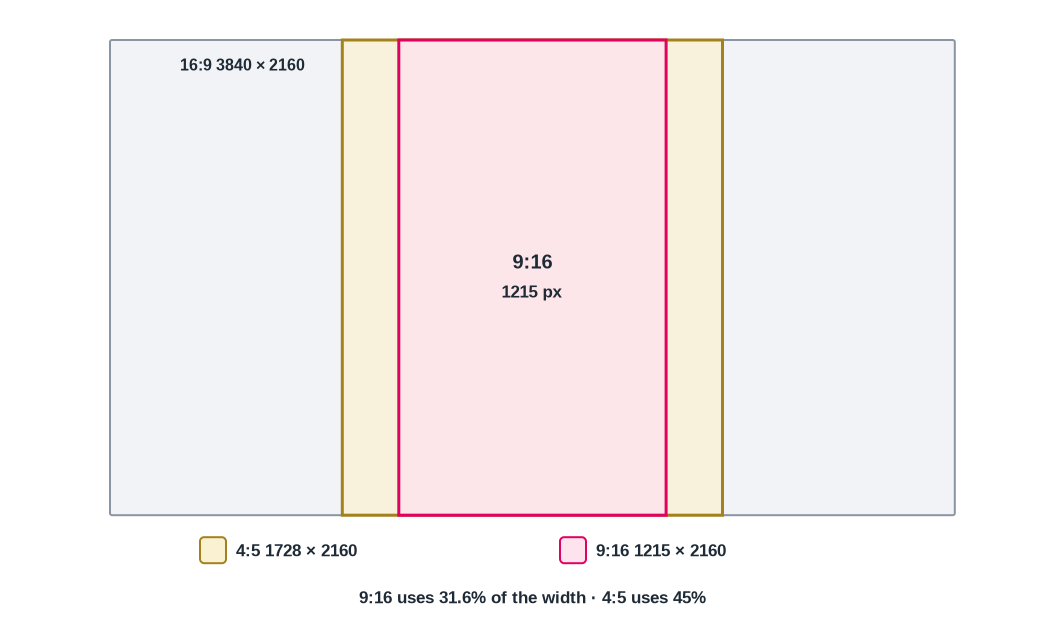
Cropping horizontal footage to vertical keeps the full height and cuts the width. The crop width is , where is the target ratio.
Example 1 Is 4K or 1080p better when you need vertical versions?
The team must deliver 9:16 and 4:5 versions 1080 pixels wide. Compare a 4K source (3840 × 2160) with a 1080p source (1920 × 1080), and estimate file sizes at the chosen bitrates (video only, excluding audio).
- 4K to 9:16: pixels, of the width; scaled to 1080 by , so it stays sharp.
- 1080p to 9:16: pixels, which must be enlarged times, so it looks soft.
- File size : a 60-second clip at 8 Mbps is MB; the 90-second 4K booth clip at 40 Mbps is MB.
# Vertical crop windows and approximate file sizes
for src_w, src_h in ((3840, 2160), (1920, 1080)):
    for name, (a, b) in (("9:16", (9, 16)), ("4:5", (4, 5))):
        crop_w = src_h * a / b                  # keep the full height, cut the width
        scale = 1080 / crop_w                   # deliver 1080 px wide
        note = "downscale, sharp" if scale <= 1 else "upscale, soft"
        print(f"{src_w}x{src_h} -> {name}: crop {crop_w:.1f} px wide ({crop_w / src_w:.1%}), scale x{scale:.3f} {note}")

for label, seconds, mbps in (("60 s vertical 1080p", 60, 8), ("90 s booth 4K", 90, 40), ("15 s teaser", 15, 8)):
    print(f"{label}: {seconds * mbps / 8:.0f} MB")
3840x2160 -> 9:16: crop 1215.0 px wide (31.6%), scale x0.889 downscale, sharp
3840x2160 -> 4:5: crop 1728.0 px wide (45.0%), scale x0.625 downscale, sharp
1920x1080 -> 9:16: crop 607.5 px wide (31.6%), scale x1.778 upscale, soft
1920x1080 -> 4:5: crop 864.0 px wide (45.0%), scale x1.250 upscale, soft
60 s vertical 1080p: 60 MB
90 s booth 4K: 450 MB
15 s teaser: 15 MBThe team’s conclusion: shoot aerial and ground footage in 4K with the important subject in the middle, and vertical crops stay sharp without reflying. If you know from the start that a shot is mainly for vertical use, some cameras can shoot vertically; plan it in the storyboard.
Copyright in our work and in others’ work in the frame
Thailand’s Copyright Act B.E. 2537 (1994) has been amended four times: No. 2 and No. 3 B.E. 2558 (2015), No. 4 B.E. 2561 (2018) and No. 5 B.E. 2565 (2022), in force since 23 August 2022 (180 days after publication in the Royal Gazette on 24 February 2022). What media makers need to know:
- Copyright arises on creation: the author owns it (section 8), with no registration. Photographs are artistic works, videos are audiovisual works, songs are musical works (section 6).
- Employees’ works: unless agreed otherwise in writing, copyright belongs to the employee who created the work, but the employer may publish it for the purpose of the employment (section 9).
- Commissioned works: the commissioner owns the copyright unless the author and the commissioner agreed otherwise (section 10).
- Transfer: other than by inheritance, a transfer must be in writing, signed by both parties (section 17); a licence to use may carry conditions (section 15).
- The author’s personal rights: the author may claim authorship and forbid distortion that damages their reputation, even after transferring copyright (section 18).
- Term: generally the author’s life plus 50 years (section 19). Amendment No. 5 rewrote section 21 to cover only audiovisual works, cinematographic works, sound recordings and broadcasts, protected for 50 years from creation or first publication. Photographs are no longer in section 21 and are protected under the general rule.
- Online service providers: Amendment No. 5 added sections 43/1 to 43/8 on exemptions from liability for service providers that meet conditions such as announcing a policy to terminate repeat infringers. This underpins the notice-and-takedown systems platforms use.
Other people’s works in our frame: the Act has exceptions aimed squarely at photography. Drawing, painting, photographing or filming an architectural work does not infringe the copyright in that architectural work (section 38). Doing the same with an artistic work permanently displayed in a public place, other than architecture, is not infringement either (section 37), and photographing a work that includes an artistic work as a component does not infringe that artistic work (section 39). The general exceptions for research, study, criticism and quotation (sections 32 and 33) apply only where the use does not conflict with the owner’s normal exploitation and does not unreasonably prejudice the owner’s legitimate rights, so advertising should not rely on them. Note that copyright exceptions answer only the copyright question; they say nothing about the rights of a property owner, such as filming inside private premises, or about the personal data of people in the image. (Checked against the Royal Gazette text of Amendment No. 5 and the WIPO Lex list of amendments on 22 October 2026.)
Example 2 Who owns the Fah Sai footage?
A team of three students worked for the enterprise (assumed) without a written contract, used a phin track that a local musician played for them, and filmed patterns on cloth the weaver designed herself.
- The delivered clip is commissioned work, so under section 10 the client owns the copyright unless agreed otherwise. To use it in their own portfolio, the team must ask permission.
- Unused raw footage: with no clear agreement, it is easy to dispute whether it is part of the commissioned work.
- The phin music: the musician has performer’s rights and, if the melody is her own, copyright in the musical work; written permission is needed.
- The cloth pattern: if it is a new design, it may be the weaver’s artistic work. Filming it to tell the group’s story with consent is fine, but the pattern must not be reused in other work.
So before the next job the team drafts a one-page agreement: the client owns the delivered work, the team may use it in a non-commercial portfolio, how long raw footage is kept and who can access it, with music licences and everyone’s consent forms attached. Proper contracts for commercial work are taught in UAT 474.
Image rights and personal data
An image showing a face, a licence plate or a house that can be linked to its owner is personal data under the Personal Data Protection Act B.E. 2562 (2019) (PDPA), which defines it as information that identifies a person directly or indirectly (section 6). Key points for media work:
- Consent: a data controller may not collect, use or disclose personal data without the data subject’s consent given before or at that time, unless the law allows. Consent must be explicit, in writing or electronically, state the purpose, be separate from other text, use plain language and not deceive (section 19).
- Withdrawal: the data subject may withdraw consent at any time, as easily as it was given, but withdrawal does not affect what was already done lawfully (section 19). In practice the team must be ready to take a clip down or re-edit it for any further use.
- Minors: for minors aged ten or under, consent comes from the person with parental authority, and older minors in many cases also need that person’s consent (section 20). Village children who run into shot need a parent’s signature.
- Other bases: section 24 allows collection without consent in some cases, such as necessity for a contract or legitimate interests, unless those interests are less important than the data subject’s fundamental rights. Advertising that features a person should rely on consent; make people far away in a wide shot unidentifiable, or have a lawyer check the basis used.
- Sensitive data such as religion, health or disability requires explicit consent unless an exception applies (section 26), so take special care with religious ceremonies in the village.
- Media and art exemption: section 4(3) exempts use or disclosure solely for mass media, artistic or literary work that follows professional ethics or serves the public interest. A brand advertisement should not be treated as falling under it.
Beyond the PDPA, commercial photography uses model releases for people and property releases for property. The stock library Shutterstock, for example, requires a model release for commercial content showing a recognisable person, and a property release for artworks, restricted buildings, interiors or private land, while editorial content needs neither. A release gives the names of the photographer and the subject, handwritten signatures and dates, and a parent’s or guardian’s signature for minors (Shutterstock, n.d.). A release is an agreement that proves permission and can be combined with PDPA consent in one document if it states the purpose, channels and period of use clearly.
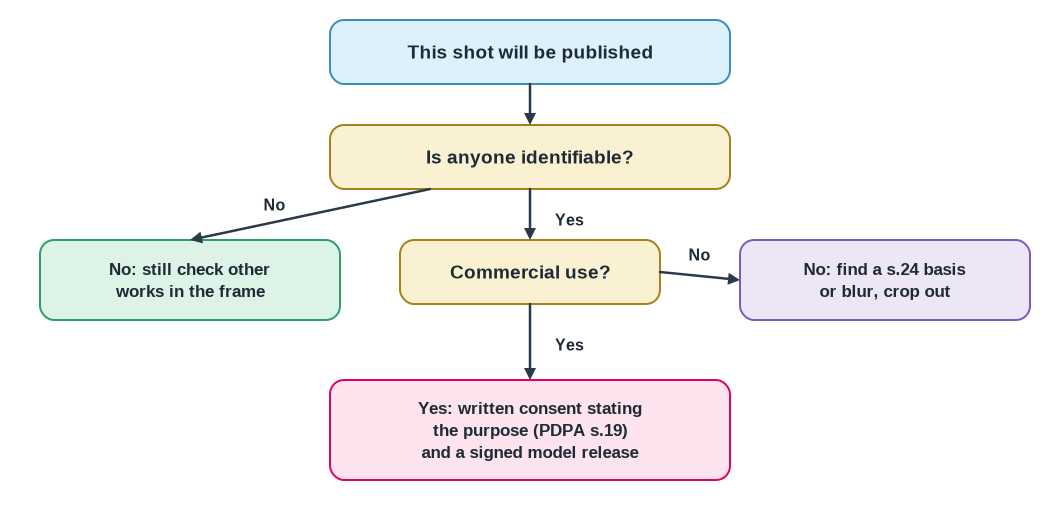
Drone images carry a particular risk because they see over fences into yards and roofs that people on the ground cannot see. The privacy conditions on flying learned in UAT 471 apply while shooting; this module focuses on publishing: before release, go through every shot with the chart in Figure 2. The drone knowledge base unit on ethics, privacy and the PDPA in drone work recommends the same principles: collect only what is necessary, inform people, and delete when no longer needed. Note that a draft PDPA amendment went to public consultation in 2026, but at the time of writing it has not been found enacted, so this lesson uses the B.E. 2562 Act in force.
Responsible publication
Being legal is not enough. Responsible work must not mislead viewers or harm the people in it. The team’s principles:
- Images match reality: tourism images show what visitors will really find, cloth colour matches the product, nothing is added that does not exist (module 3).
- Disclose AI use: YouTube requires creators to disclose realistic content generated or altered with AI, such as invented footage of a real place or making a real person appear to say something they did not, but not colour or lighting adjustments, filters, or AI help with scripts and captions (Google, n.d.-d). Other platforms have different rules, but the principle travels: if viewers might believe it really happened, say so.
- Respect the people in the story: credit the craftspeople who agree to be named, respect the cultural meaning of patterns, never make the community look pitiful for views, and let the community see the final cut before release.
- Do not publish footage from unsafe or non-compliant flights: shots flown over people or too close set a bad example however beautiful they are.
- Do not pinpoint people’s homes: the map to the village uses a public meeting point such as the group’s office, not a weaver’s house.
- Do not edit images of people to harm them: creating or altering someone’s image and publishing it in a way that damages their reputation or exposes them to contempt may breach both criminal law and the computer crime law; consult a lawyer if unsure.
- Keep the evidence: consent forms, music and font licences, flight logs and the client-approved version, kept with the project for the agreed period; then delete raw footage containing personal data when it is no longer needed.
Module lab
Lab: a publish-ready delivery package (4 hours a week for 3 weeks)
Computer-lab work, no flying; this is the end-of-term mini-project.
- Write the sector table for your team’s work: goal, channel, length and call to action of each piece.
- Cut the 9:16 60-second version, the 16:9 90-second version and the 15-second teaser from one project; calculate crops and file sizes as in Example 1; check export settings against the platform’s current help pages and record the date checked.
- Check the rights of every shot with the chart in Figure 2: a table of shots, identifiable people, basis or release, and the fix (blur, crop, replace).
- Draft a one-page agreement on copyright and portfolio use, and a consent form stating purpose, channels and period (use fictional names in your submission).
- Assemble the music and font licence log from module 4.
- Go through the seven responsible-publication points and record what you changed.
- Present the package to the class as if to the client for 10 minutes, take feedback and revise.
Common mistakes
Watch out
- One clip for every platform, so a horizontal clip in a vertical app shows half a screen of black bars
- Shooting 1080p and cropping to vertical, so the image breaks up when enlarged
- Assuming the person who shot it always owns it: commissioned work belongs to the client unless agreed otherwise
- Verbal consent only, which cannot be proved and did not state the purpose
- Forgetting children in the frame, who need a parent’s consent
- Thinking the architecture exception covers everything: private premises and the people in the shot still matter
- Using AI-generated images that look like a real place without disclosure
Summary
- Sectors have different goals; one story can serve several by changing emphasis, length and call to action
- Adapt aspect ratio, length, first frame, text and file to each platform; crop width ; shoot 4K for sharp vertical crops and check the current platform rules
- Copyright arises on creation; commissioned work belongs to the client unless agreed; transfers must be in writing; photographs are protected for the author’s life plus 50 years after Amendment No. 5 of 2022; photographing architecture does not infringe its copyright
- Identifiable images are personal data; advertising uses written consent stating the purpose, minors need a guardian’s consent, and releases are used alongside
- Publish responsibly: match reality, disclose realistic AI, respect the community, never use footage from non-compliant flights, and keep complete records
Self-check
- A 4K frame (3840 × 2160) cropped to 4:5 gives a window how many pixels wide, and must it be shrunk or enlarged to deliver 1080 wide?
- About how many MB of video is a 15-second clip at 8 Mbps?
- Under section 10, who owns the copyright in a clip the team was commissioned to make, if nothing was agreed?
- An eight-year-old features prominently in an advertising clip. Whose consent is needed?
- Under YouTube’s rules, must you disclose using AI to add a field of flowers that does not exist to a village shot?
Answers
- pixels; delivering 1080 wide means shrinking by , so it stays sharp.
- MB.
- The client, unless the author and the client agreed otherwise.
- The person with parental authority, because the minor is ten or under (PDPA section 20).
- Yes, because it is realistic invented footage of a real place that viewers might believe exists.
Key formulas
| Crop width keeping the full height | |
| Approximate file size (video only) |
Key references
- พระราชบัญญัติลิขสิทธิ์ พ.ศ. 2537 แก้ไขเพิ่มเติมโดย (ฉบับที่ 2) พ.ศ. 2558, (ฉบับที่ 3) พ.ศ. 2558, (ฉบับที่ 4) พ.ศ. 2561 และ (ฉบับที่ 5) พ.ศ. 2565 [ฉบับรวม]. WIPO Lex. link
- พระราชบัญญัติลิขสิทธิ์ (ฉบับที่ 5) พ.ศ. 2565. ราชกิจจานุเบกษา, 139(13 ก), 1–11. link
- พระราชบัญญัติคุ้มครองข้อมูลส่วนบุคคล พ.ศ. 2562. ราชกิจจานุเบกษา, 136(69 ก), 52–95. link
- Shutterstock. (n.d.). Content publishing standards: Legal documentation. Shutterstock Contributor Support. link
- Google. (n.d.). Disclosing use of GenAI content. YouTube Help. link
- Google. (n.d.). YouTube recommended upload encoding settings. YouTube Help. link
- Google. (n.d.). Understand three-minute YouTube Shorts. YouTube Help. link
Further reading
Study the assigned knowledge units in advance, review media and take the module quiz
จริยธรรม ความเป็นส่วนตัว และ PDPA ในงานโดรน
M11 Media production: from what the audience needs to a deliverable image
In class / field
Lab or field practice from worksheets with a safety checklist
Learning evidence: Checked worksheets and quiz results