Clients, Audiences and Concepts
UAT 474 Commercial Drone Media Production
Lesson
By the end of this module you will be able to
- Explain what drones add to commercial media and when ground footage serves the brief better
- Read a client brief, ask follow-up questions and turn the needs into a measurable list of deliverables
- Analyse target audiences and set the key message of each deliverable
- Develop at least three concepts, choose with a weighted scoring table and pick a presentation format that suits the client
Why this matters
In UAT 471 to 473 you learned to fly safely, make good images and tell a story with them. Work that someone pays for adds one more layer. The most beautiful footage can still fail: the client wanted to sell villas and you delivered a sunset mood piece, or the client needed vertical clips for phones and you delivered everything in landscape. Commercial work starts with one question: what should which people think, feel or do after seeing this? It does not start with the drone or the camera.
This is the capstone of the Minor and uses one fictional case for all five modules: a boutique resort called “Silawaree” with 24 rooms sits on a small cove on Thailand’s eastern seaboard and is launching a project of 8 pool villas for sale next to the resort. The owner hires “Mekkhao Productions”, a small media team, to handle the job from brief to pitch, quote, shoot, edit, review rounds and delivery. All names, places, companies, prices and numbers are fictional (assumed). Real market rates vary widely with region, experience and scope.
Drones in commercial media
Commercial media are images or videos made to help a business or organisation reach a goal: sell rooms, sell homes, build a brand or announce news. Aerial images do three things that ground images cannot:
- show spatial relationships: how far the villas are from the beach, how the resort sits on the cove, how easy the access road is
- convey scale and atmosphere: an opening shot that slowly rises until the whole bay is in view
- offer a fresh viewpoint that makes viewers stop scrolling
A study of drone videos that people shared on YouTube found that they have distinctive user-generated content characteristics and tend to cluster in more populated areas; the authors argue that destination marketers should pay attention to this kind of content (Stankov et al., 2019). But a drone is not the answer to every shot. Bed linen, the taste of breakfast or a staff member’s smile are told better with a ground camera. Good work uses aerial shots only where height adds meaning and mixes them with ground footage, as module 3 shows.
Key idea
The client is not buying “drone footage”. The client is buying a business result, such as more bookings or more villa viewings. Aerial imagery is one tool, and you have to show that it helps reach that result.
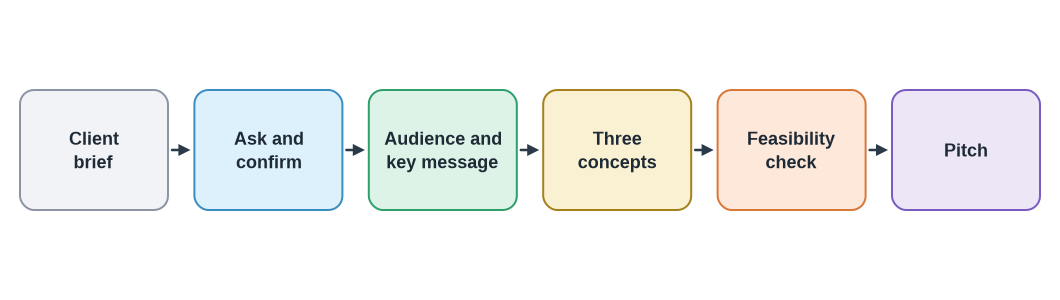
Reading the brief and asking until it is complete
A brief is the document in which the client says what it wants. The UK advertising agencies’ association (IPA) stresses that a written brief is important but not sufficient: a briefing meeting is needed so that both sides really understand each other (Institute of Practitioners in Advertising [IPA], 2013). The aerial media unit of the drone knowledge base asks for the same fields before planning: who owns the message, the audience, the publishing channels, file format, aspect ratio, sound, deadline, delivery method and who signs off.
Silawaree’s brief simply said: “We want beautiful drone videos of the resort and villas to promote the launch, budget no more than two hundred thousand.” That sentence leaves many questions open, so Mekkhao Productions held a meeting and asked by category.
| Question category | Example question | Answer received (assumed) |
|---|---|---|
| Business goal | If this works, what will change? | More direct bookings on the website, and people booking villa viewings |
| Audience | Who watches, where, on which device? | Working couples in Bangkok, and families looking for a holiday home |
| Deliverables | How many pieces, how long, used where? | See the table in Example 1 |
| Constraints | Which days can we shoot, are guests staying, any no-filming areas? | Weekdays; half the resort occupied; no filming of occupied rooms |
| Decision makers | Who approves the concept and the final cut? | The marketing manager, with final sign-off by the project owner |
| Time and money | Deadline, budget, payment | Ready 6 weeks before the launch; total budget at most 200,000 THB |
After the meeting the team writes a one-page brief recap and asks the client to confirm it in writing. This prevents the most common problem in commissioned work: the two sides understanding the scope differently. Goals should be measurable: “three vertical videos to post during the first four weeks after launch” is better than “we want more people to know us”.
Example 1 Turning the brief into deliverables and shooting volume
After the meeting the client confirmed these deliverables (assumed):
| Deliverable | Quantity | Length each | Channel |
|---|---|---|---|
| Brand film, landscape 16:9 | 1 | 60 s | Website, YouTube |
| Short vertical videos 9:16 | 3 | 20 s | Social media |
| Villa sales video 16:9 | 1 | 45 s | Project sales page |
| Opening event highlight | 1 | 90 s | Social media and press release |
| Stills | 15 aerial, 10 ground and 10 from the opening event | Booking sites, brochure, press release |
Step 1, count the video pieces. pieces.
Step 2, total running time to deliver. s, or 4 min 15 s.
Step 3, count the stills. images.
Step 4, estimate the footage to shoot. You always shoot more than you use: some shots suffer from wind, some miss the light, and the editor needs choices. The ratio between footage shot and footage used is the shooting ratio. The team uses 20 to 1 for this job (assumed; every team uses its own value from experience).
These 85 minutes feed module 2 (flights and batteries) and module 4 (storage). Writing the deliverables as a table also lets the client see clearly what is and is not in the job.
Audiences and key messages
A target audience is the group of people the work must reach and move, never “everyone”. Silawaree’s work has three audiences with different needs.
| Audience | What they want to know or feel | Key message | Shots that help |
|---|---|---|---|
| Working couples | Real rest, quiet, beauty, close to Bangkok | “Escape the city and wake up to the sea in one weekend” | Calm sea at dawn, ground shots of breakfast by the pool |
| Families looking for a villa | Location, distance to the beach, privacy, value | “A holiday home on the cove, a short walk to the beach” | High angles showing villa to beach distance, the site layout |
| Media and partners | What news, when, who | “Launch of a villa project on the cove” | Event coverage and project overviews usable with a news story |
The key message is the one sentence you want viewers to remember. If you cannot write it as one sentence, the team is not yet clear. Channels matter too: people watching vertical video on a phone decide within the first few seconds whether to keep watching, while someone looking for a villa will watch a longer video on the project page. Audience-centred storytelling was covered in UAT 473; this module ties it to the client’s business goal.
Developing concepts and presentation formats
A concept is the central idea that ties all the images together. Mekkhao Productions proposed three:
- A “Wake up to the sea”: one guest’s day from dawn to evening light; aerial shots open and close the story, ground shots carry the details
- B “From sky to suite”: one continuous shot flying from the open sea over the beach, across a terrace and into a guest room
- C “Island hopping”: following the resort’s boat to islands around the bay, then circling back to the villas
Each concept needs a presentation format so the client can picture it before money is spent on the shoot. Common formats:
- mood board: a sheet of reference images, colours, light and mood; good for clients who think visually
- treatment: one or two pages that describe in words what the viewer will see, in order
- storyboard: shot-by-shot sketches (how to make one was covered in UAT 473 module 2)
- animatic or video mock-up: sketches or reference images cut to temporary music; good when rhythm matters
- pitch deck: slides that combine everything with an outline plan and a price range
Executives have little time, so effective pitches are short, no more than 10 to 15 minutes. Start by restating the client’s goal, then present the recommended concept with reasons, instead of laying out three concepts with no recommendation.
Key idea
Before you pitch any concept, check that it can actually be shot safely and legally. Pitching shots you cannot make and telling the client later destroys trust faster than pitching a plainer idea that you can deliver.
Checking feasibility
Filming for business is use for a purpose other than hobby, entertainment or sport under clause 4 (2) of the Ministry of Transport notification of 2015, so the drone must be registered and the general conditions apply: keep the drone in sight at all times, fly in daylight, no higher than 90 m, and at least 50 m horizontally from people, vehicles, structures or buildings not involved in the operation (Ministry of Transport, 2015; Civil Aviation Authority of Thailand, 2025). Registration, the pilot certificate and insurance are covered in module 2. At this stage the team uses these rules as a filter on concepts.
- Concept A flies over the sea and the beach when no guests are there, within sight, in daylight: possible under the general conditions.
- Concept B must fly close to buildings, across a terrace with people and possibly indoors. It needs a specialist pilot, many rehearsals and a thorough risk assessment; if done at all, the area must be closed so that only people involved in the shoot are present.
- Concept C follows the boat so far that the drone may go out of sight, which breaks the general conditions. It would need advance permission for operations that differ from the conditions under the 2026 CAAT notification, which cannot be obtained before the six-week deadline.
Example 2 Choosing a concept with a weighted scoring table
A weighted scoring table makes the choice reasoned and easy to explain to the client. The team agrees the criteria and weights before scoring (assumed): fit with the business goal 0.35, appeal to the audience 0.25, feasible, safe and legal 0.25, within budget 0.15. The weights add up to 1. Each criterion is scored from 1 to 5.
| Concept | Goal | Audience | Feasible | Budget |
|---|---|---|---|---|
| A Wake up to the sea | 4 | 4 | 5 | 4 |
| B From sky to suite | 5 | 5 | 2 | 3 |
| C Island hopping | 3 | 4 | 2 | 2 |
Concept A step by step: multiply each score by its weight, then add.
Concept B:
Concept C:
Concept B scores highest on goal and appeal but loses to A because it is hard and risky. The team recommends A as the main concept and offers B’s signature moment in a safer form: fly in from the sea and stop in front of the terrace at a safe distance, then cut to a ground shot walking into the room, as module 3 shows.
Calculator for the curious. This code does the same arithmetic; change the weights or scores and run it again.
# criterion weights: goal, audience, feasibility, budget (sum to 1)
weights = (0.35, 0.25, 0.25, 0.15)
concepts = {
    "A Wake up to the sea": (4, 4, 5, 4),
    "B From sky to suite": (5, 5, 2, 3),
    "C Island hopping": (3, 4, 2, 2),
}
for name, scores in concepts.items():
    total = sum(w * s for w, s in zip(weights, scores))   # multiply, then add
    print(f"{name}: {total:.2f}")
A Wake up to the sea: 4.25
B From sky to suite: 3.95
C Island hopping: 2.85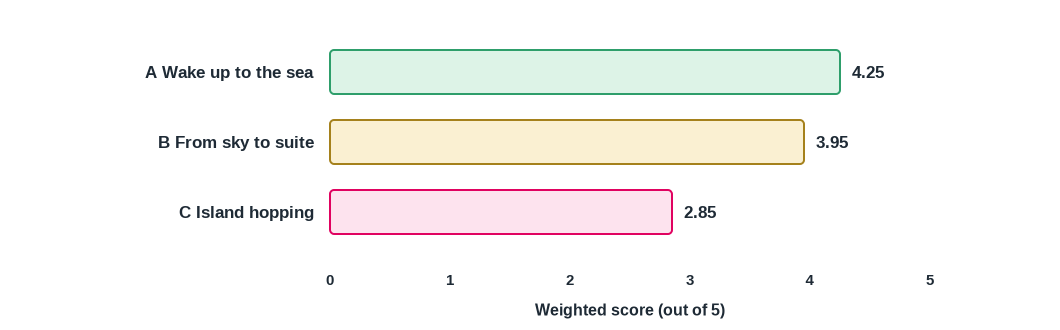
The table does not decide for you. If the client weights appeal very heavily, the result may change. What the table gives is a conversation based on visible reasons, and it shows the client that the team thought about safety from the start. Film production handbooks likewise advise settling scope, budget and risk in pre-production, because fixing them on the shoot day costs far more (Honthaner, 2010).
Module lab
Lab: from brief to concept pitch (no flying)
Work in teams of 3 to 4. The instructor or another team plays the client, using a fictional brief handed out in class (a resort, a riverside café or a housing project).
- Hour 1: hold the briefing meeting, ask by the six categories in the table, note the answers and list what is still unknown and whom to ask.
- Hour 2: write a one-page brief recap with a measurable goal, the deliverables table, total running time and footage to shoot from the shooting ratio you choose.
- Hour 3: write the audience and key message table, draft three concepts and check each against the flight conditions in this module.
- Hour 4: score the concepts, make a mood board or treatment for the recommended one, pitch for 10 minutes and take 5 minutes of questions from the “client”.
Submit: the brief recap, the audience table, the scoring table and the pitch file.
Common mistakes
Watch out
- Starting from the shots you want to make instead of the client’s goal.
- Taking the brief verbally only with no written recap, then arguing about scope at delivery.
- Writing “everyone” as the audience, so the message is too broad for anyone to remember.
- Pitching concepts that break the flight conditions, such as following a boat out of sight or flying over guests, and hoping to find a way later.
- Ignoring the shooting ratio, which makes flight time and storage plans far too small.
Summary
- Commercial work starts from the client’s goal and the audience; aerial shots must prove they add meaning.
- A written brief is not enough: hold a briefing meeting, then send a recap for written confirmation.
- Each audience needs its own key message and shots.
- Present several concepts in a format that suits the client and choose with a weighted score that includes feasibility and legality.
- Estimate the footage to shoot with .
Self-check
- Why is a written brief alone not enough?
- A job must deliver 120 s of video in total and the team uses a shooting ratio of 15 to 1. How many minutes of footage must be shot?
- Three criteria have weights 0.4, 0.3 and 0.3. A concept scores 5, 3 and 2. What is its weighted score?
- Give an example of a resort shot that should use a ground camera rather than a drone, with a reason.
- Which flight condition does the concept “follow the boat to a distant island” break, and what must be done if the client still wants it?
Answers
- Clients often write briefly and in broad terms. You must meet and ask about goal, audience, deliverables, constraints, decision makers, time and budget, then send a recap for confirmation.
- s min.
- For example breakfast, bed linen, or the faces of guests and staff: they need close detail that height does not help tell, and you should not fly close to people.
- The drone must stay in visual line of sight. Flying beyond sight needs advance permission for operations that differ from the conditions under the 2026 CAAT notification, or the concept must be changed to stay within sight.
Key formulas
| Weighted concept score | |
| Footage to shoot from the shooting ratio |
Key references
- Institute of Practitioners in Advertising. (2013). Briefing an agency: Best practice guide. IPA. link
- Stankov, U., Kennell, J., Morrison, A. M., & Vujičić, M. D. (2019). The view from above: The relevance of shared aerial drone videos for destination marketing. Journal of Travel & Tourism Marketing, 36(7), 808–822. link
- Honthaner, E. L. (2010). The complete film production handbook (4th ed.). Routledge. link
- Civil Aviation Authority of Thailand. (2025). Flying a drone in Thailand [Leaflet]. link
- กระทรวงคมนาคม. (2558). ประกาศกระทรวงคมนาคม เรื่อง หลักเกณฑ์การขออนุญาตและเงื่อนไขในการบังคับหรือปล่อยอากาศยานซึ่งไม่มีนักบิน ประเภทอากาศยานที่ควบคุมการบินจากภายนอก พ.ศ. 2558. ราชกิจจานุเบกษา, 132(86 ง), 6–12. link
Further reading
Study the assigned knowledge units in advance, review media and take the module quiz
M11 Media production: from what the audience needs to a deliverable image
Brief: questions, deliverables and team roles
In class / field
Lab or field practice from worksheets with a safety checklist
Learning evidence: Checked worksheets and quiz results