Production Planning: Locations, Flight Routes, Schedule, Equipment, Crew and Budget
UAT 474 Commercial Drone Media Production
Lesson
By the end of this module you will be able to
- Survey a location and set the take-off point, route, height and separation of each shot within the flight conditions
- Check the legal paperwork a commercial job needs before it is accepted, namely registration, pilot certificate, insurance, radio equipment and site permission
- Schedule the shoot around the light, calculate batteries per flight window and assign crew roles
- Build a direct cost budget by category with a contingency
Why this matters
The client has approved concept A, “Wake up to the sea”. From now on every hour the team spends at the resort costs money: wages, equipment, and the client’s time spent closing areas for the shoot. A well-prepared team knows in advance where each shot takes off, which route it flies, how many batteries it needs, who does what, and what happens if it rains. Production handbooks call this stage pre-production and treat it as the stage that decides whether the job succeeds (Honthaner, 2010).
UAT 471 taught how to plan the area, route, weather and batteries for one flight. This module scales that up to a paid job with several days, several people and a budget.
Surveying the location
A location recce is a visit to the real place before the shoot day. Mekkhao Productions spent a day at Silawaree with the marketing manager and noted (assumed):
- take-off and landing: a lawn behind the service building, level, no branches overhead, no public foot traffic; a back-up point on the car park roof
- obstacles: a tall row of coconut palms along the beach, power lines along the access road, a flagpole in front of the lobby
- people not involved: the beach in front of the resort is a public beach with walkers in the morning and evening; local houses stand next door
- wind and sea: the sea breeze strengthens in the afternoon; at low tide the beach is wider and looks better
- who can give permission: the resort can permit flying over its own land; flying past the public beach needs a check with the local authority that manages it, and never over people on the beach
Every shooting position is recorded with coordinates, a ground photo, the direction of morning and evening light, and the shots planned from it. The site assessment unit of the drone knowledge base uses the same principle: record what you actually saw with a time, separately from what you assume.
Paperwork and law before accepting the job
Filming for business is use for a purpose other than hobby, entertainment or sport under clause 4 (2) of the Ministry of Transport notification of 2015. The team must confirm that every document is in place and still valid before signing, because a single missing item means no flying.
| Item | What you need | Where to check |
|---|---|---|
| Pilot | Basic drone pilot certificate from the online knowledge test, valid for 2 years | CAAT UAS Portal |
| Aircraft | Drone registration, with the registration number displayed clearly on the drone | CAAT UAS Portal |
| Insurance | Third-party liability insurance of at least 1,000,000 THB per occurrence | The team’s policy |
| Radio | Registration of the drone’s radio equipment | NBTC office |
| Area | Permission from the landowner; check prohibited, restricted and danger areas and the 9 km distance from aerodromes | Landowner, eAIP and CAAT notifications |
| Operations outside the conditions | Flying above 90 m, at night or in restricted areas needs advance permission | 2026 CAAT notification |
The table was checked against the 2015 Ministry of Transport notification and CAAT’s 2025 leaflet (Ministry of Transport, 2015; Civil Aviation Authority of Thailand, 2025; Civil Aviation Authority of Thailand, 2026). CAAT’s 2025 leaflet says a drone registration number does not expire unless cancelled, while clause 15 of the 2015 notification makes a registration certificate valid for 2 years. The team therefore opens the UAS Portal and reads the actual expiry date of every item instead of relying on memory, and checks the notifications in force before every job, because these rules change.
The general conditions used to plan every shot include at least: keep the drone in sight at all times, fly between sunrise and sunset, stay clear of cloud, no higher than 90 m above ground, not within 9 km of an aerodrome unless permitted, and, for operators registered under clause 4 (2), at least 50 m horizontally from people, vehicles, structures and buildings not involved in the flight.
Watch out
“The client said yes” does not mean “we may fly”. The resort owner can permit flying over the resort’s own land only. The owner has no power to permit flights over the public beach, neighbouring houses or areas CAAT prohibits, and cannot waive CAAT’s conditions.
Flight routes shot by shot
Each aerial shot is written as one row of a flight card, so that pilot, camera operator and observer share one plan.
| Shot | Take-off | Route and height | Separation from people not involved | Abort trigger |
|---|---|---|---|---|
| A1 Morning cove reveal | Lawn | Out to sea 150 m, turn back, rise from 20 to 60 m | Beach empty, path closed for 15 minutes | Someone walks onto the beach |
| A2 Villa orbit | Lawn | Circle of 60 m radius round the show villa at 40 m | Villa empty, crew inside | Gusts above the team’s limit |
| A3 Villa row | Car park roof | Parallel to the villa row at 40 m | More than 50 m from local houses | Battery reaches reserve |
| A4 Evening pull-back | Lawn | From the show room terrace back out to sea, rising to 80 m | Show room and cast who signed releases | Light gone, or a boat approaches |
Every shot stays below 90 m and within sight. Shot A4 uses crew members who are involved in the shoot, not real guests.
Scheduling around the light
Concept A needs two kinds of light: morning light soon after sunrise and golden hour before sunset. Midday light is hard with short shadows; it suits shots of the site layout where clear detail matters more than mood. The team splits the work into two shoot days (assumed: sunset around 18:10 on the shoot day; always check the actual time for the date and place from an astronomical source).
- Day 1: 06:00 to 07:30 the cove reveal; 09:00 to 11:00 the villa shots; afternoon ground shots in the rooms; 16:45 to 18:00 the evening pull-back
- Day 2: ground footage, stills and any reshoots
- Weather day: one spare day for rain or strong wind, agreed with the client in advance
The daily plan handed to the crew is the call sheet: call time and place, names and phone numbers, shots in order, take-off points, emergency plan and expected weather.
Equipment and batteries
The kit list has a drone kit (main and back-up drones, controllers, memory cards, ND filters), a ground camera kit (camera, lenses, tripod, handheld gimbal, microphones) and a field kit (chargers, power, umbrellas, anemometer, cones, radios, first-aid kit). Choosing filters and camera settings was covered in UAT 472.
Example 1 How many battery packs on day 1?
Makers quote flight time under test conditions, which is longer than real flying with a sea breeze and hovering while you wait for the moment. The team starts from a rated 30 minutes per pack (assumed) and lands with no less than 30% remaining (team rule, assumed).
Step 1, usable time per pack.
Step 2, planned airtime in each window (including take-off, landing and rehearsals): morning 25 min, villas 40 min, evening 35 min, 100 min in total.
Step 3, count packs window by window, because a half-used pack from the morning cannot be used in the evening (a fresh pack for every flight keeps the reserve rule).
That is 6 pack uses. Dividing the 100-minute total in one go gives , one pack too few.
Step 4, check charging. The team has 4 packs. The morning and villa windows use all 4, so they must be full again before the evening. The charger takes 2 packs at a time, 60 minutes each (assumed).
The gap from 11:00 to 16:45 is 345 minutes, so there is plenty of time. When charging from the resort’s 230 V mains, ask for a sheltered, cool socket, following the lithium battery safety rules from UAT 471 module 4.
Calculator for the curious
import math

rated_min, reserve = 30, 0.30                 # maker's flight time and team reserve (assumed)
usable = rated_min * (1 - reserve)
windows = {"sunrise": 25, "villas": 40, "golden hour": 35}   # planned flight minutes
total = 0
for name, minutes in windows.items():
    packs = math.ceil(minutes / usable)       # always round up
    total += packs
    print(f"{name}: {minutes} min -> {packs} packs")
print(f"usable {usable:.0f} min per pack, {total} packs in the day")
print(f"charge 4 packs on 2 ports: {4 * 60 / 2:.0f} min")
sunrise: 25 min -> 2 packs
villas: 40 min -> 2 packs
golden hour: 35 min -> 2 packs
usable 21 min per pack, 6 packs in the day
charge 4 packs on 2 ports: 120 min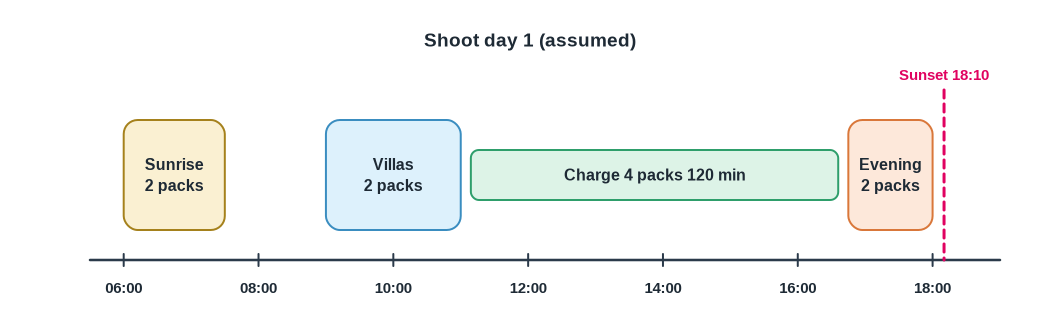
Crew and roles
On a commercial job one person should not both fly and operate the camera, because their eyes end up on the screen instead of the drone. Mekkhao Productions splits the roles:
| Role | Main duties |
|---|---|
| Remote pilot | Makes every safety decision; may cancel a shot without asking anyone |
| Visual observer | Watches the drone and the sky; calls out people, boats, birds or other aircraft coming close |
| Ground camera operator | Shoots ground footage and stills |
| Producer | Liaises with the client, clears areas, collects releases from people in shot, keeps time and budget |
On a small budget the producer may also shoot stills, but the pilot and observer should not take on other tasks while flying. Before each flight window there is a short briefing: the shots, take-off points, hand or radio signals and abort triggers.
Assessing the job’s risks
ISO 31000 sets out the risk management principle: identify risks, analyse likelihood and consequence, then choose how to treat them (International Organization for Standardization [ISO], 2018). For this job the team keeps a short risk register, for example:
| Risk | Treatment |
|---|---|
| Someone walks under the route on the beach | Producer clears the area, observer calls, pilot stops or changes route |
| Strong afternoon sea breeze | Move flights to morning and evening; check wind before every flight |
| Rain on the shoot day | Use the weather day agreed in the contract |
| Guests filmed without consent | Shoot while areas are closed, use cast with signed releases, review footage before delivery (module 5) |
| Memory card failure | Back up at every break using the 3-2-1 rule (module 4) |
Budget
The budget turns the whole plan into money. Project management guidance recommends splitting costs by category and holding a contingency for risks you know may happen but cannot size in advance (Project Management Institute, 2025).
Example 2 Direct cost budget for the Silawaree job
All wages and rental rates are assumed for practice; real market rates vary widely. Working days include the producer’s 1-day recce and 3 shoot days (2 production days and the opening event).
Step 1, crew.
| Role | Day rate (THB) | Days | Total (THB) |
|---|---|---|---|
| Remote pilot | 6,000 | 3 | 18,000 |
| Visual observer | 2,500 | 3 | 7,500 |
| Ground camera operator | 5,000 | 3 | 15,000 |
| Producer | 4,000 | 4 | 16,000 |
Crew total THB.
Step 2, other categories.
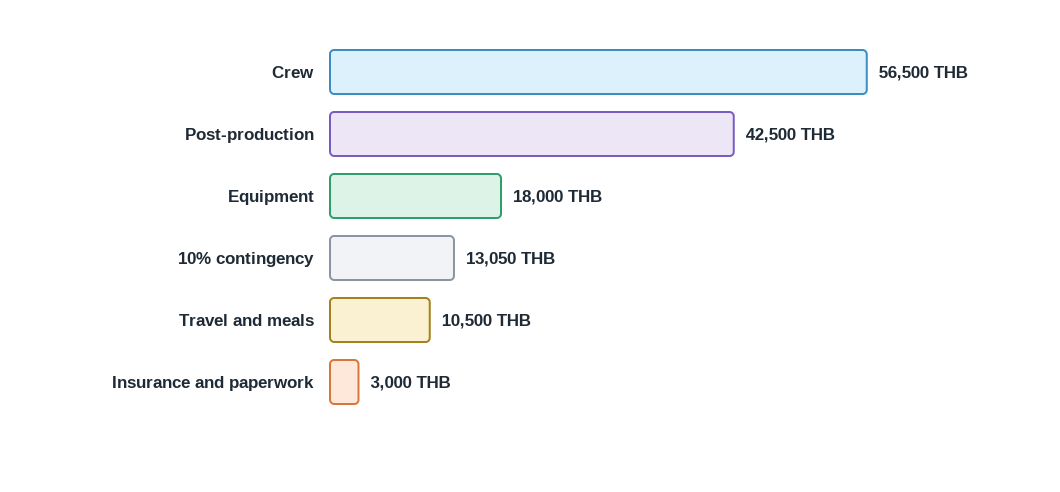
- Equipment (depreciation or rental): drone kit , ground kit , total 18,000 THB
- Travel 6,000 and meals 4,500, total 10,500 THB
- Extra insurance and paperwork 3,000 THB
- Post-production: editor , colour and sound 8,000, music licences 3 tracks 1,500 , total 42,500 THB
Step 3, add up and apply a 10% contingency.
Crew is the largest category (43.3% of 130,500 THB), followed by post-production (32.6%). Many students assume the drone is the main cost, but on real jobs people’s time matters far more. The 143,550 THB figure is not yet the price quoted to the client: overhead and profit are added in module 5.
Module lab
Lab: a complete production plan and a route test flight
- Hour 1: survey the university’s designated practice area as if it were the client’s location. Record take-off points, obstacles, light direction and people who may pass, with photos and coordinates.
- Hour 2: complete the legal paperwork table (with assumed data; do not submit real applications) and flight cards for at least 4 shots. Every shot stays at or below 90 m, within sight and at the required separation from people not involved.
- Hour 3: test-fly two routes in the practice area with a small drone under the instructor’s supervision, in daylight and never over people (start in the simulator if the team is not yet fluent). Time each shot and compare with the plan.
- Hour 4: revise the plan, calculate packs per flight window from the measured times, write a one-day call sheet, a risk register and a direct cost budget with contingency.
Submit: recce notes, paperwork table, flight cards, call sheet, risk register and budget.
Common mistakes
Watch out
- Assuming the client’s permission covers everywhere, although the public beach and neighbouring houses are not the client’s land.
- Not checking expiry dates of the pilot certificate, registration and insurance policy before the shoot.
- Counting batteries from the day’s total airtime instead of window by window.
- Letting the pilot operate the camera on a job with people and obstacles around.
- No weather day in the plan and contract, so rain forces a choice between flying in risky conditions and breaking the contract.
- A budget with no contingency, or one that counts only the drone and forgets post-production labour and music licences.
Summary
- Survey the real location before the shoot: take-off points, obstacles, people not involved, light and who can give permission.
- Commercial work needs registration, a pilot certificate, insurance of at least 1,000,000 THB per occurrence, radio registration and site permission; check the rules in force every time.
- Every shot has a flight card within the 90 m, daylight, line-of-sight and 50 m separation conditions.
- Count batteries per window, with .
- Budget by category and add a contingency, .
Self-check
- A pack is rated at 25 minutes and the team keeps a 30% reserve. How many packs does a 40-minute window need?
- Why must a video job for a resort be registered under the 2015 notification even if the drone weighs less than 2 kg?
- Direct cost is 80,000 THB with a 10% contingency. What is the total budget?
- Why should the pilot not operate the camera on a job with people around the area?
- One shot would need 120 m of height to show the whole bay. What options does the team have?
Answers
- min; packs.
- It is use for a purpose other than hobby, entertainment or sport (clause 4 (2), such as photography or filming), which must be registered whatever the weight.
- THB.
- The pilot’s eyes would be on the screen rather than on the drone and the people nearby, so the camera should go to a separate operator with an observer as well.
- Use a wider lens or move the take-off point further away instead of climbing. If it must still be above 90 m, request advance permission for operations that differ from the conditions under the 2026 CAAT notification.
Key formulas
| Usable flight time per pack | |
| Batteries per flight window | |
| Budget with contingency |
Key references
- Honthaner, E. L. (2010). The complete film production handbook (4th ed.). Routledge. link
- Civil Aviation Authority of Thailand. (2025). Flying a drone in Thailand [Leaflet]. link
- กระทรวงคมนาคม. (2558). ประกาศกระทรวงคมนาคม เรื่อง หลักเกณฑ์การขออนุญาตและเงื่อนไขในการบังคับหรือปล่อยอากาศยานซึ่งไม่มีนักบิน ประเภทอากาศยานที่ควบคุมการบินจากภายนอก พ.ศ. 2558. ราชกิจจานุเบกษา, 132(86 ง), 6–12. link
- สำนักงานการบินพลเรือนแห่งประเทศไทย. (2569). ประกาศ กพท. เรื่อง หลักเกณฑ์และวิธีการในการอนุญาตให้ผู้บังคับหรือปล่อยอากาศยานซึ่งไม่มีนักบิน ประเภทอากาศยานที่ควบคุมการบินจากภายนอก ที่มีน้ำหนักไม่เกิน 25 กิโลกรัม ปฏิบัติแตกต่างไปจากเงื่อนไขที่กำหนด พ.ศ. 2569 (มีผล 17 พฤษภาคม 2569). link
- สำนักงานการบินพลเรือนแห่งประเทศไทย. (2569). ประกาศ กพท. เรื่อง กำหนดพื้นที่หวงห้ามเด็ดขาด พื้นที่หวงห้ามเฉพาะ และพื้นที่อันตราย (ฉบับที่ 2) พ.ศ. 2569. link
- สำนักงาน กสทช. ประกาศและแนวปฏิบัติการขึ้นทะเบียนเครื่องวิทยุคมนาคมสำหรับอากาศยานไร้คนขับ (ตรวจสอบฉบับปัจจุบันก่อนใช้สอน). link
- International Organization for Standardization. (2018). Risk management – Guidelines (ISO 31000:2018). link
- Project Management Institute. (2025). A guide to the project management body of knowledge (PMBOK guide) (8th ed.). link
Further reading
Study the assigned knowledge units in advance, review media and take the module quiz
Site assessment and go/no-go decisions
Preparing information before registration
ความปลอดภัยของแบตเตอรี่ลิเธียม
In class / field
Lab or field practice from worksheets with a safety checklist
Learning evidence: Checked worksheets and quiz results