Documentation and presentation
UAT 491 Unmanned Aircraft Systems and Automation Technology Capstone Project
Lesson
By the end of this module you will be able to
- Write a project report in which every conclusion links back to evidence, cited in APA 7 style
- Assemble a reproducibility package following the FAIR principles and check file integrity with hashes
- Document the intended scope of the AI model with a model card
- Set go/no-go criteria for the demonstration in advance and plan the presentation time
Why this matters
In week 15 the committee looks at three things: does the system really work, does the report prove that it meets the requirements, and can others repeat or build on the work. The facilities division in our case wants to know the same: how can it keep using the system after the team graduates? This lesson closes the rain-gutter inspection drone project. All figures are hypothetical.
Structure of the project report
The engineering design textbook by Dym and colleagues advises writing the report for a reader who was not on the team. Every conclusion should point back to evidence, for example “The system meets requirement R1 (see test cards 1–4 and Table 5)”, not “The system works well”.
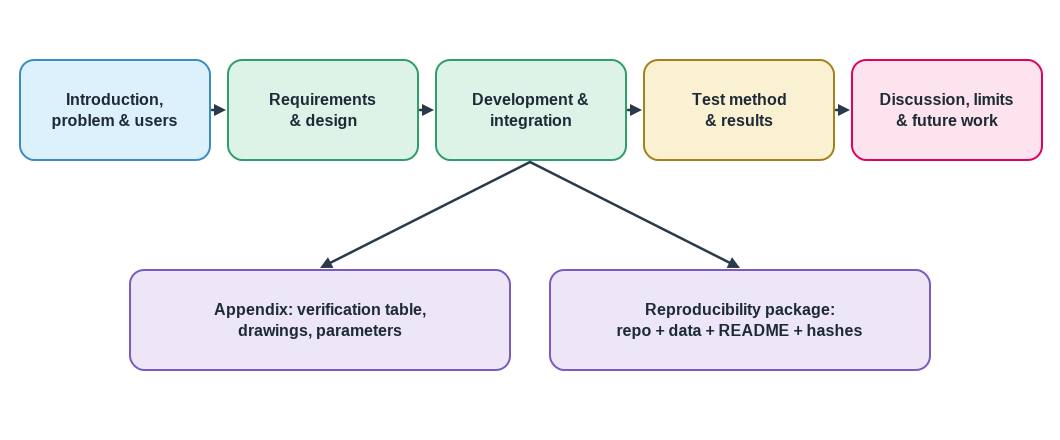
Writing habits that make a report readable and checkable:
- Figures and tables are numbered, captioned and referred to in the text.
- Use SI units and state the uncertainty of measured values.
- The results report both the requirements met and those not met; the discussion states limitations honestly, for example that testing only took place on dry days.
- Cite in the style of the APA Publication Manual, 7th edition: author–date in the text, such as (Cohen, 1988); for works with three or more authors, the first author followed by et al., such as (Wilkinson et al., 2016); and DOIs written as URLs in the reference list.
If AI tools helped with writing or code, disclose them according to the course and university policy; the team remains responsible for the accuracy of every statement.
A reproducibility package following FAIR
A reproducibility package is everything someone else needs to obtain the same results as the report: code, parameters, raw data, models and instructions for running them. The FAIR principles of Wilkinson and colleagues (2016) make a good framework.
- F (Findable): a persistent identifier, such as the repository tag used in the report
- A (Accessible): retrievable by standard means, with the access conditions for confidential data stated
- I (Interoperable): open formats that other software can read, such as CSV and standard autopilot log files
- R (Reusable): fully described, with a licence and the provenance of the data
The README should at least explain installation, software versions, how to run each analysis, and which script produces each figure or table in the report. Images showing people or homes must be handled under personal data protection law before they are published.
Example 1 Checking that files still match the report
A SHA-256 hash changes completely even if a single character of the file changes. The team therefore records the hashes of the data and parameter files at the end of the report and checks them again before handover.
import hashlib, json, os, tempfile


def sha256(path):
    with open(path, "rb") as f:
        return hashlib.sha256(f.read()).hexdigest()


with tempfile.TemporaryDirectory() as root:
    files = {"data/test_runs.csv": "run,distance_m,speed_mps,found\n1,6,1,37\n2,10,1,34\n",
             "config/params.txt": "WP_SPD 2.0\n"}
    for name, text in files.items():
        os.makedirs(os.path.join(root, os.path.dirname(name)), exist_ok=True)
        with open(os.path.join(root, name), "w", newline="\n") as f:
            f.write(text)
    manifest = {name: sha256(os.path.join(root, name)) for name in files}   # recorded at the end of the report
    print(json.dumps({k: v[:12] for k, v in manifest.items()}, indent=1))

    with open(os.path.join(root, "config/params.txt"), "w", newline="\n") as f:
        f.write("WP_SPD 1.5\n")                                       # someone edits the file later
    for name, h in manifest.items():
        ok = sha256(os.path.join(root, name)) == h
        print(f"{name:<18} {'matches report' if ok else 'CHANGED since report'}")
{
"data/test_runs.csv": "2274ba858be1",
"config/params.txt": "794daa5e3729"
}
data/test_runs.csv matches report
config/params.txt CHANGED since reportThe parameter file was edited (the flight speed changed) after the report was issued. If the facilities division used this file, the results would not match the report. A check like this takes seconds and prevents a lot of confusion.
A model card for the detector
An AI model handed over to users needs a description of what it can and cannot do. Mitchell and colleagues (2019) proposed the model card, a short document stating the intended use, the training data, evaluation results broken down by condition and the limitations. For the blockage detector it should include at least:
| Section | Example |
|---|---|
| Intended use | Point technicians to likely blockages for them to check, not replace their judgement |
| Training data | Gutter images from 4 buildings, taken in October in daylight |
| Results by condition | Recall 92.5% at 6 m and 1 m/s; 60.0% at 10 m and 2 m/s |
| Known limitations | Not yet tested with wet gutters, strong shadows or other roof types |
Demo day: go or no-go
Flying a demonstration in front of an audience is riskier than a test flight: people are close by and there is pressure to fly no matter what. The team must set go/no-go criteria in advance from the risk assessment in UAT 401, agree them with the advisor, and keep a video of a real flight as a backup. If any check fails, switch to the video at once, with no negotiation.
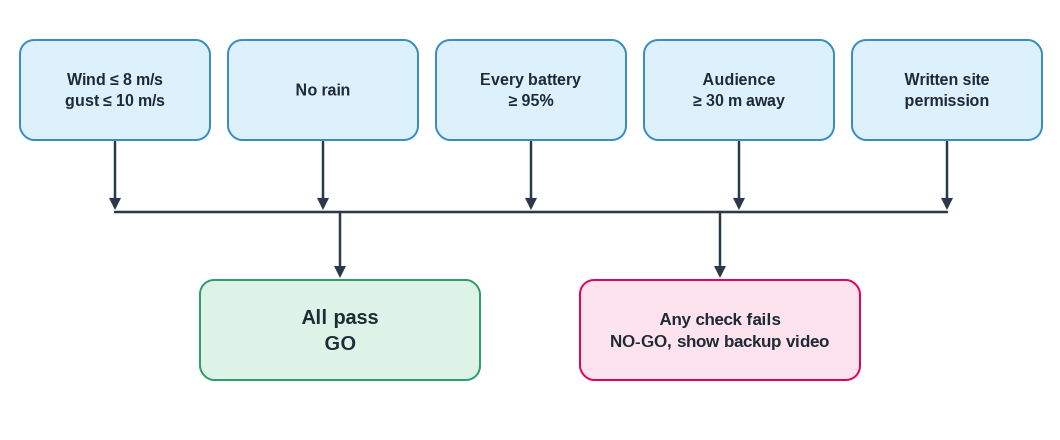
Example 2 Checking the criteria at two times of day
LIMITS = dict(wind_mps=8.0, gust_mps=10.0, battery_pct=95, crowd_m=30)   # team criteria (hypothetical)


def go_no_go(now):
    reasons = []
    if now["wind_mps"] > LIMITS["wind_mps"]:
        reasons.append(f"wind {now['wind_mps']} m/s")
    if now["gust_mps"] > LIMITS["gust_mps"]:
        reasons.append(f"gust {now['gust_mps']} m/s")
    if now["raining"]:
        reasons.append("rain")
    if min(now["battery_pct"]) < LIMITS["battery_pct"]:
        reasons.append(f"battery {min(now['battery_pct'])}%")
    if now["crowd_m"] < LIMITS["crowd_m"]:
        reasons.append(f"audience {now['crowd_m']} m from flight area")
    if not now["permission"]:
        reasons.append("no written permission for the site")
    return ("GO", []) if not reasons else ("NO-GO", reasons)


checks = {"09:00": dict(wind_mps=4.2, gust_mps=6.5, raining=False, battery_pct=[100, 98], crowd_m=35, permission=True),
          "13:30": dict(wind_mps=7.1, gust_mps=11.8, raining=False, battery_pct=[97, 93], crowd_m=35, permission=True)}
for label, now in checks.items():
    verdict, why = go_no_go(now)
    print(label, verdict, *(["-", "; ".join(why)] if why else []))
09:00 GO
13:30 NO-GO - gust 11.8 m/s; battery 93%In the morning every check passes. In the afternoon the gusts exceed the limit and one battery is not fully charged, so the team demonstrates with the video in the afternoon. Writing the criteria as code or as a clear checklist makes the decision quick, and nobody has to take a risk out of politeness to the audience.
The presentation
A 15-minute presentation should tell the story in an order the audience can follow. One way to split the time: problem and users 2 minutes, solution and architecture 3 minutes, live demo or video 4 minutes, results against requirements 4 minutes, and limitations and next steps 2 minutes. Every number on a slide must match the report, and the team should rehearse against the clock at least twice. NASA’s handbook treats handing documents and knowledge over to the users as part of closing a project, so the team should also set aside time to train the facilities technicians.
Module lab
Lab: hand over the project
- Write the report following Figure 1, with every conclusion referring to a test card or table.
- Organise the repository as a reproducibility package with a README, a licence and hashes of the key files, and check them as in Example 1.
- Write a model card for the detector, reporting results by the conditions actually tested.
- Agree the go/no-go criteria with your advisor, prepare a backup video and rehearse the presentation against the clock.
- Hand over a user manual and train the real users.
Common mistakes
Watch out
- Conclusions without evidence, such as “the system is highly accurate” with no numbers or conditions
- Hiding requirements that were not met instead of explaining the cause and the fix
- An incomplete reproducibility package: no README, no software versions, or files edited after the report
- Deciding to fly the demo by feel, with no criteria set in advance
- Numbers on the slides that do not match the report
Summary
- Write the report for readers outside the team to read and check; link every conclusion to evidence and cite in APA 7 style.
- A FAIR reproducibility package with hashes lets users get the same results as the report.
- A model card states the intended use, results by condition and limitations.
- Go/no-go criteria must be set in advance, with a backup video always ready.
Check your understanding
- With 12 minutes to present and the same proportions as the 15-minute example, how long should the results against requirements take?
- What does it mean if a file’s SHA-256 hash does not match the one recorded in the report?
- Which FAIR principle covers licensing and data provenance?
- How do you cite the 2016 work by Wilkinson, Dumontier, Aalbersberg and colleagues in the text in APA 7 style?
- On demo day the wind is 6 m/s with gusts of 9.5 m/s, no rain, every battery at 96%, written permission in hand, but the audience is 25 m away. Under the criteria in Example 2, what is the decision?
Answers
- minutes
- The file was changed after the report was issued; it cannot be used to reproduce the reported results until you know what changed
- R (Reusable)
- (Wilkinson et al., 2016)
- NO-GO, because the audience is closer than 30 m; show the video, or move the audience back and check again
Key formulas
| File integrity check |
Key references
- American Psychological Association. (2020). Publication manual of the American Psychological Association (7th ed.). American Psychological Association. link
- Wilkinson, M. D., Dumontier, M., Aalbersberg, I. J., et al. (2016). The FAIR guiding principles for scientific data management and stewardship. Scientific Data, 3, 160018. link
- Mitchell, M., Wu, S., Zaldivar, A., Barnes, P., Vasserman, L., Hutchinson, B., Spitzer, E., Raji, I. D., & Gebru, T. (2019). Model cards for model reporting. In Proceedings of the Conference on Fairness, Accountability, and Transparency (pp. 220–229). ACM. link
- Dym, C. L., Little, P., & Orwin, E. J. (2013). Engineering design: A project-based introduction (4th ed.). Wiley. link
- National Aeronautics and Space Administration. (2016). NASA systems engineering handbook (NASA/SP-2016-6105 Rev 2). link
Further reading
Study the assigned knowledge units in advance, review media and take the module quiz
In class / field
Team project work, advisor meetings and progress presentations
Learning evidence: Project milestone deliverables