Alternatives and feasibility
UAT 493 Unmanned Aircraft Systems and Automation Technology Capstone Project I
Lesson
By the end of this module you will be able to
- Generate several genuinely different concepts, not variants of one idea
- Use a Pugh matrix to compare concepts against a datum and iterate to improve them
- Screen concepts through technical, regulatory, cost, schedule and safety feasibility gates
- Write a concept selection rationale that traces back to the requirements
Why this matters
Most teams choose their concept on day one and spend the rest of the time finding reasons to support it. A systematic comparison of alternatives forces the question “is there a better way?” and records why the concept was chosen, which project examiners always ask. UAT 316 covered cost analysis and weighted decision matrices. This module uses a tool suited to the concept stage, when detailed data does not yet exist: the Pugh matrix.
Generating genuinely different alternatives
For the canal inspection problem the team sketched four concepts:
- A (datum) a multirotor flown manually, images reviewed by people
- B a multirotor flying automatic waypoints, with AI finding the damage
- C a VTOL drone flying automatically over a longer range, images reviewed by people
- D fixed cameras installed along the canal
Concept D is not a drone at all. Including a different kind of alternative checks whether a drone really is the right answer.
The Pugh matrix
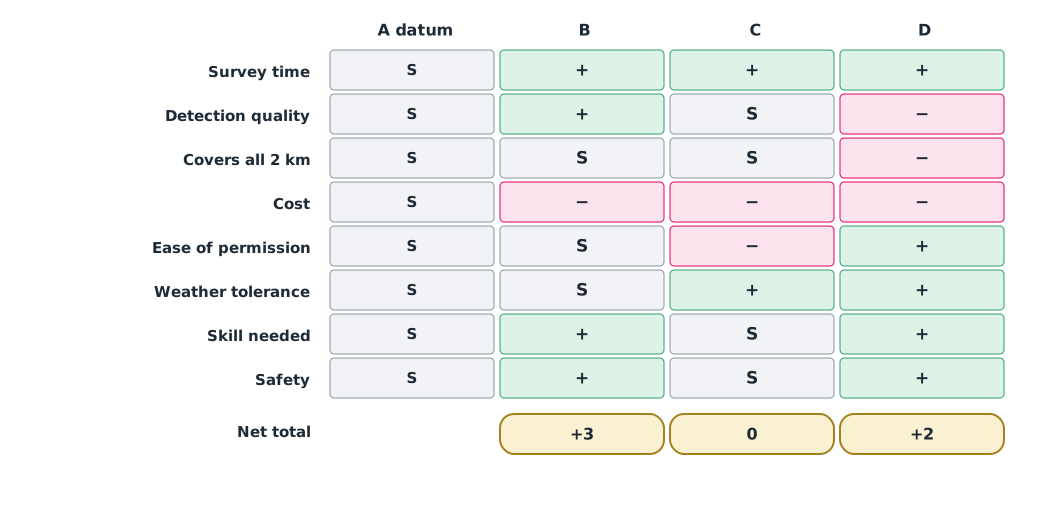
Pugh concept selection (Pugh, 1991) compares each concept with a datum one criterion at a time: better scores +, worse scores −, the same scores S. It suits the concept stage because it does not need detailed numbers that are not yet available.
Example 1. Comparing concepts B, C and D with A
criteria = ["survey time", "detection quality", "covers all 2 km", "cost", "ease of permission",
            "weather tolerance", "skill needed", "safety"]
scores = {  # +1 better than A, 0 same, -1 worse
    "B": [1, 1, 0, -1, 0, 0, 1, 1],
    "C": [1, 0, 0, -1, -1, 1, 0, 0],
    "D": [1, -1, -1, -1, 1, 1, 1, 1],
}
for name, s in scores.items():
    plus, minus = s.count(1), s.count(-1)
    weak = [c for c, v in zip(criteria, s) if v < 0]
    print(f"{name}: +{plus} -{minus} net {plus - minus:+d}  weaknesses: {', '.join(weak)}")
B: +4 -1 net +3 weaknesses: cost
C: +2 -2 net +0 weaknesses: cost, ease of permission
D: +5 -3 net +2 weaknesses: detection quality, covers all 2 km, costB has the highest net score, but a Pugh matrix is not meant to pick a winner from the total. Look at each weakness. D cannot cover the whole 2 km of canal, which is a Must requirement, so it is eliminated even though its total is not low. B is weak on cost; the team might reduce cost by running the AI model on the ground station after the flight, then evaluate again with B as the new datum. Pugh recommends repeating this over several rounds until the concept improves.
Feasibility gates
A concept that looks good on paper may not be achievable. Pass it through the gates one at a time; if it fails a gate, change it or drop it.
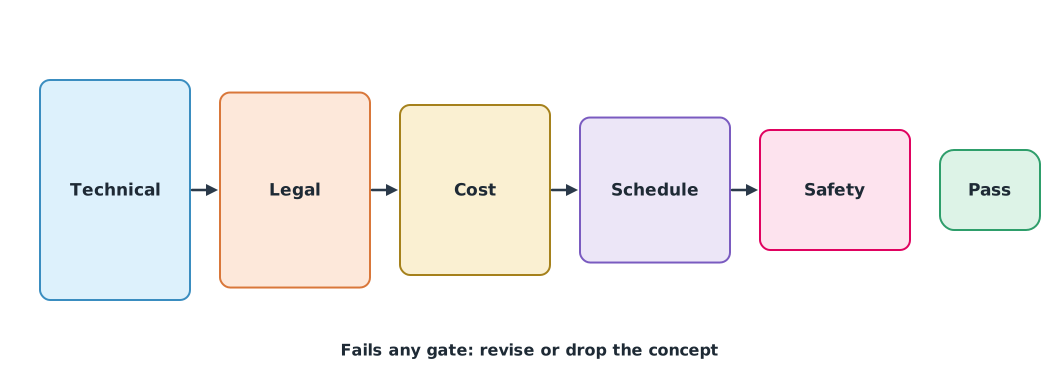
- Technical: how mature is the technology (TRL), and can the team deliver it within one academic year?
- Regulatory: can it be flown under general conditions, or does it need a Specific authorisation? (see UAT 313 and the CAAT PDRA guidance)
- Cost: is it within the project budget? (life-cycle cost methods are in UAT 316)
- Schedule: can it be delivered in time for the next semester?
- Safety: can the risk to people and property be managed?
Module lab
Project deliverable: trade study
- Brainstorm at least four genuinely different concepts, including at least one that is not a drone
- Choose 6–10 criteria from the module 2 requirements and build a Pugh matrix with Example 1
- Improve the best concept to fix its weaknesses, then run a second Pugh round with that concept as the datum
- Pass the final concept through all five feasibility gates, recording evidence for each gate
- Write a one-page selection rationale that cites every relevant requirement
Common mistakes
Watch out
- All alternatives are the same concept with minor differences
- Picking the winner from the total score without checking weaknesses that conflict with Must requirements
- Running Pugh only once and stopping
- Using criteria that are not linked to the requirements
- Skipping the regulatory gate until the day of the test flight
Summary
- Generate genuinely different alternatives, including non-drone options
- A Pugh matrix compares against a datum with + − S to expose weaknesses and improve concepts over several rounds
- A concept must pass the technical, regulatory, cost, schedule and safety gates
- The selection rationale must trace back to the requirements
Check your understanding
- A concept scores five + and two −. What is its net score?
- In a Pugh matrix, what does the datum score on every criterion?
- Why is concept D eliminated even though its net score is positive?
- After improving a concept, what does Pugh recommend?
- Which gate checks whether a Specific flight authorisation is needed?
Answers
- S (same)
- It cannot cover the whole 2 km of canal, which is a Must requirement
- Evaluate again using the improved concept as the new datum
- The regulatory gate
Key formulas
| Pugh net score |
Key references
- Pugh, S. (1991). Total design: Integrated methods for successful product engineering. Addison-Wesley. link
- Dym, C. L., Little, P., & Orwin, E. J. (2013). Engineering design: A project-based introduction (4th ed.). Wiley. link
- National Aeronautics and Space Administration. (2016). NASA systems engineering handbook (NASA/SP-2016-6105 Rev 2). link
- National Aeronautics and Space Administration. (2023). Technology readiness levels. link
- สำนักงานการบินพลเรือนแห่งประเทศไทย. (2568). แนวปฏิบัติในการขอปฏิบัติการบินอากาศยานซึ่งไม่มีนักบินโดยใช้การประเมินความเสี่ยงที่เป็นไปตามเงื่อนไขที่กำหนดสำหรับการบินเกินกว่าระยะสายตา (CAAT-GM-UAS-PDRA101 ปรับปรุงครั้งที่ 00). link
Further reading
Study the assigned knowledge units in advance, review media and take the module quiz
Lifecycle cost and acceptance
Innovation and entrepreneurship in the drone industry
In class / field
Team project work, advisor meetings and progress presentations
Learning evidence: Project milestone deliverables