Understanding co-op, self-assessment and career planning
UAT 496 Preparation for Work-Integrated Learning and Co-operative Education
Lesson
By the end of this module you will be able to
- Explain what co-operative education and CWIE mean, the roles of the student, the workplace mentor and the supervising lecturer, and the path from UAT 496 to UAT 497
- Compute the minimum hours of real work and the hours of preparation set by the 2022 Higher Education Standards Committee notification
- Assess your own competencies with evidence, and say which evidence to collect next
- Choose a workplace with a weighted decision matrix and write a career plan with specific goals and an expectations record
Why this matters
Co-operative education does not start on the first day you walk into the company. It starts months earlier. Well-prepared students choose a workplace that matches what they want to learn, pass the interview, and begin work safely and with confidence. Unprepared students often do not know where they are strong or weak, pick a placement because it is near home or because friends are going, and then spend the first weeks catching up. This course is the preparation before UAT 497 Co-operative Education, the full-time 16-week placement.
This course follows one fictional case through all three modules: Pim, a year-4 student in unmanned aircraft systems and automation technology, is preparing for co-op. She has three options: A, a crop-spraying drone service company; B, a company that inspects solar farms with drones; and C, a company that installs factory automation. In this module Pim assesses herself and chooses a workplace. In module 2 she applies and is interviewed, and in module 3 she prepares to work at the company she chose. All names, figures and companies are fictional. The Python code can be downloaded from /downloads/uat-496/.
Co-operative education and work-integrated learning
The 2022 notification of the Higher Education Standards Committee (the CWIE notification below) defines Cooperative and Work Integrated Education (CWIE) as competency-based experiential education that the institution and the workplace design together, in which students study at the institution alongside real work in a workplace so that they are ready for the real world of work (Ready to Work) (clause 2). The CWIE page of the Ministry of Higher Education, Science, Research and Innovation states the same goal, that students are Ready to Work after graduation (Ministry of Higher Education, Science, Research and Innovation, n.d.). Internationally, the World Association for Cooperative Education (WACE) uses CWIE as a broad term covering several forms of experiential learning, such as co-op, placements, research and community-based learning (WACE, n.d.). The research literature on work-integrated learning is collected in Zegwaard and Pretti (2023).
The notification names three parties that students should know before they start.
- The student chooses the workplace voluntarily, works like an employee, writes the report and presents it
- The workplace mentor gives knowledge and advice, teaches the work and assesses performance. The notification sets qualifications: at least a bachelor’s degree in the same or a close field, or proven skill in the field, plus at least 6 months of experience in the position being supervised, or completion of a mentor training course (clause 4.1.4)
- The supervising lecturer advises on both academic matters and work skills at the workplace, follows progress and guides the writing of the report
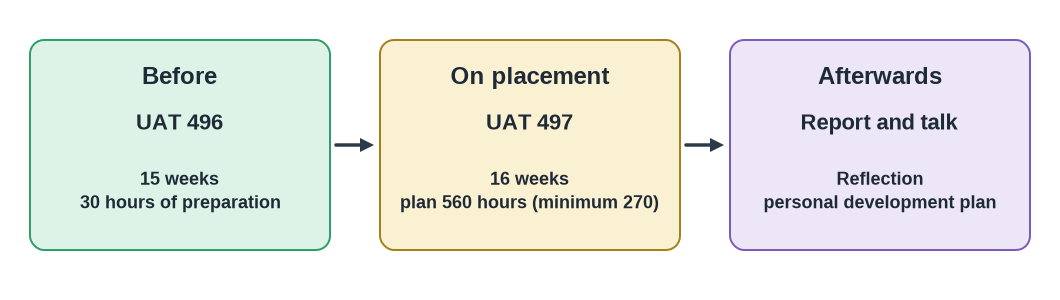
The notification also lists what students must do before they go (clause 4.2.3). The table shows where each item sits in this course. What students do during the placement, such as daily and weekly reports, is also in module 3.
| What the student does before the placement | Where it is in this course |
|---|---|
| Study the workplace and choose it voluntarily | Module 1: choosing a workplace |
| Write an expectations record before starting | Module 1: career planning |
| Prepare a job application and CV | Module 2: application documents |
| Prepare emotional, social, language and teamwork skills | Module 2: communication, teams and professionalism |
| Prepare digital skills and safety readiness | Module 3: digital tools, safety |
Clause 4.2.1 also requires the institution to prepare students for at least 30 hours (in one session or several) and to hold an orientation before the real placement. Example 1 computes these figures.
Example 1 Minimum hours and preparation hours
Clause 3 of the notification sets at least 6 credits of real work for a co-op curriculum, with at least 45 hours of real work per credit. UAT 497 has 6 credits with the pattern 6(0-35-18), where the middle number is 35 practice hours a week, and its course description requires at least 16 consecutive weeks.
# CWIE notification B.E. 2565 clause 3: at least 45 hours of real work per credit
credits, hours_per_credit = 6, 45              # UAT 497 has 6 credits
per_week, weeks = 35, 16                       # 6(0-35-18): 35 practice hours a week, at least 16 weeks
prep = 2 * 15                                  # UAT 496: 2 lab hours a week for 15 weeks

need = credits * hours_per_credit
planned = per_week * weeks
print(f"minimum {need} h, planned {planned} h, margin {planned - need} h ({planned / need:.2f} times the minimum)")
print(f"preparation in UAT 496: {prep} h")
minimum 270 h, planned 560 h, margin 290 h (2.07 times the minimum)
preparation in UAT 496: 30 hThe minimum under the notification is hours, but the UAT 497 plan is hours, about twice the minimum. Co-op in this programme is therefore not a short attachment but real full-time work. The preparation in UAT 496 is hours, which matches the 30 hours in the notification exactly.
The work waiting in UAS and automation
Co-op in this field is not one job. Before assessing yourself it helps to know what different workplaces ask of students and what to prepare. The table is a broad summary, not a list of any one company’s positions. Check the details in each employer’s announcement.
| Type of workplace | Work students often help with | What to prepare | Main hazards |
|---|---|---|---|
| Crop-spraying drone service | Mission preparation, battery care, helping load product, logging work | Read the operating procedures and product labels; basics of lithium polymer (LiPo) batteries | Chemicals, propellers, batteries, heat |
| Solar-farm or infrastructure inspection | Planning flight lines, processing images, writing reports | Photogrammetry, thermal imagery, image software | Electricity, heat, flying near structures |
| Factory automation installation | Helping install and test sensors, controllers and mobile robots; writing documents | Electrical basics, controllers and machine safety | Moving machines, electricity |
Questions to ask every employer before accepting are: who will be the workplace mentor and do they meet the qualifications in clause 4.1.4; what do the three-party agreement and allowances or benefits say (clause 4.2.1 has the institution agree this with the workplace as appropriate); and, if the work involves flying, does the company let students fly, under whose licence and conditions. Flying must follow the CAAT announcements and conditions in force at the time (the latest example, in force from 17 May 2026, is CAAT, 2026) and the company’s own authorisation. These points are checked again before starting in UAT 497 module 1.
Self-assessment
Self-assessment means knowing what you can do at what level, and what evidence supports it. If you rate yourself too high, the company may give you work you cannot do. If you rate yourself too low, you may lose opportunities. Use three views together.
- Skills and knowledge, compared with the competencies employers look for. The US National Association of Colleges and Employers (NACE) summarises career readiness in eight competencies which, beyond technical skills, include areas that employers value (NACE, n.d.): career and self-development, communication, critical thinking, equity and inclusion, leadership, professionalism, teamwork and technology.
- Interests, meaning what kinds of activity you enjoy, such as hands-on work, analysis, helping people or keeping things in order. One example tool is the O*NET Interest Profiler from the US Department of Labor, a self-assessment of vocational interests compatible with Holland’s six-area RIASEC structure. The short form (Mini-IP) has 30 questions and can be taken online in English (O*NET Resource Center, n.d.).
- Needs and life conditions, such as housing, travel cost, time and what you value in work.
The eight NACE competencies work as a checklist, but ratings given by feeling are often inaccurate. This course therefore uses a simple rule: a claimed level needs evidence. It uses the same 1 to 4 scale as UAT 497.
| Level | Meaning | Evidence needed (course rule) |
|---|---|---|
| 1 | Have heard of it | None |
| 2 | Can do it with help | 1 item |
| 3 | Can do it alone | 2 items |
| 4 | Can teach others | 3 items |
Evidence is something others can check: a work product, a project result, a certificate, a practice log, or written feedback from a lecturer or classmate. If the claimed level is and you have items of evidence, the evidence-supported level is .
Example 2 Pim assesses eight competencies
Pim rates herself and counts the evidence she really has (assumed data).
# Levels 1-4: 1 have heard of it, 2 can do it with help, 3 can do it alone, 4 can teach others (assumed data)
# Course rule (assumed): levels 2, 3, 4 need 1, 2, 3 items of evidence, that is s = min(c, 1 + e)
skills = {   # competency: (claimed level, items of evidence)
    "career and self-development": (3, 2), "communication": (3, 1), "critical thinking": (3, 2),
    "equity and inclusion": (2, 1), "leadership": (2, 1), "professionalism": (4, 1),
    "teamwork": (3, 3), "technology": (4, 3),
}
supported = {k: min(c, 1 + e) for k, (c, e) in skills.items()}
for k, (c, e) in skills.items():
    flag = "  <- collect more evidence" if supported[k] < c else ""
    print(f"{k:<28} claimed {c}  evidence {e}  supported {supported[k]}{flag}")
n = len(skills)
print(f"mean claimed {sum(c for c, e in skills.values()) / n:.2f}, mean supported {sum(supported.values()) / n:.2f}")
career and self-development claimed 3 evidence 2 supported 3
communication claimed 3 evidence 1 supported 2 <- collect more evidence
critical thinking claimed 3 evidence 2 supported 3
equity and inclusion claimed 2 evidence 1 supported 2
leadership claimed 2 evidence 1 supported 2
professionalism claimed 4 evidence 1 supported 2 <- collect more evidence
teamwork claimed 3 evidence 3 supported 3
technology claimed 4 evidence 3 supported 4
mean claimed 3.00, mean supported 2.62The mean she claims is 3.00 but the mean the evidence supports is 2.62. The whole gap comes from two competencies: communication, where she claims level 3 with one item, and professionalism, where she claims level 4 with one item. Pim has two options: collect more evidence, or lower the claim to match. Technology and teamwork have full evidence, so they are strengths she can put in her CV with confidence.
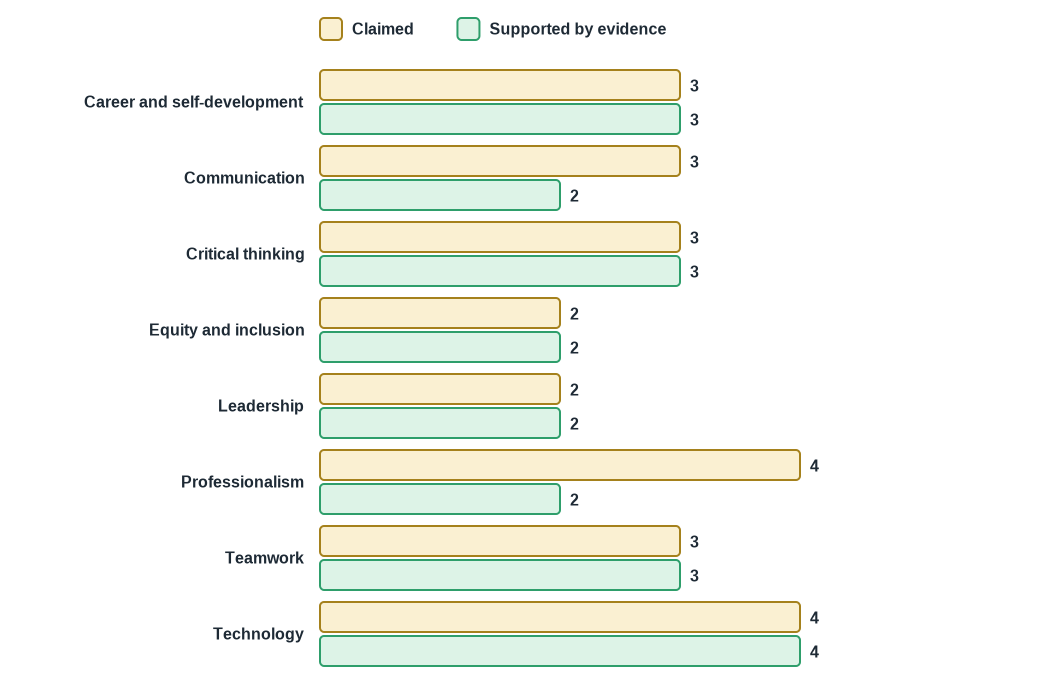
A low level is not a fault. What mentors dislike is a claim of a level that cannot be shown. Comparing yourself with what a job needs (the job-match score) is taught in UAT 497 module 1, and comparing with the mentor’s ratings at the end of the placement is in UAT 497 module 5.
Career planning
A career plan need not be long, and it need not be fixed for life, but it should have goals in three periods: before co-op, during co-op, and one to three years after graduating. The review by Locke and Latham (2002) reports that specific, difficult goals consistently led to higher performance than urging people to do their best, and that goals work most strongly when people are committed to them. So write goals with numbers and dates, and choose goals you really want.
Choosing a workplace
Clause 4.2.3 of the notification asks students to study workplace information and choose voluntarily. A weighted decision matrix makes the reasons for a choice checkable. The steps are: (1) set the criteria that matter to you; (2) give weights that total 100; (3) score each option from 1 to 5 on each criterion, with a reason; (4) compute
where is the weight of criterion and is the score of option on it.
Example 3 Pim chooses between companies A, B and C
Pim sets five criteria: learning value (learning), fit with her interests (fit), supervision and safety culture (supervision), chance of a project (project), and cost and travel (cost). All scores are assumed. She tries two sets of weights: the first as she first thought, and the second giving more weight to supervision and safety.
# Weighted decision matrix: each criterion scored 1-5 (assumed data); weights total 100
scores = {
    "A": {"learning": 4, "fit": 5, "supervision": 3, "project": 4, "cost": 4},
    "B": {"learning": 5, "fit": 4, "supervision": 4, "project": 2, "cost": 2},
    "C": {"learning": 3, "fit": 3, "supervision": 5, "project": 4, "cost": 4},
}
weight_sets = {
    "base": {"learning": 30, "fit": 25, "supervision": 20, "project": 15, "cost": 10},
    "safety-first": {"learning": 20, "fit": 20, "supervision": 35, "project": 15, "cost": 10},
}
for name, w in weight_sets.items():
    assert sum(w.values()) == 100
    total = {c: sum(w[k] * v for k, v in s.items()) / (5 * sum(w.values())) * 100 for c, s in scores.items()}
    ranking = sorted(total, key=total.get, reverse=True)
    print(f"{name:<13}", "  ".join(f"{c} {total[c]:.1f}%" for c in ranking))
base A 81.0% B 76.0% C 73.0%
safety-first C 79.0% A 77.0% B 74.0%Check A under the first weights by hand: , divided by , gives 81.0%. The result is that under the first weights A ranks first (81.0%), but when supervision and safety are emphasised C moves to first (79.0%) and A drops to second (77.0%).
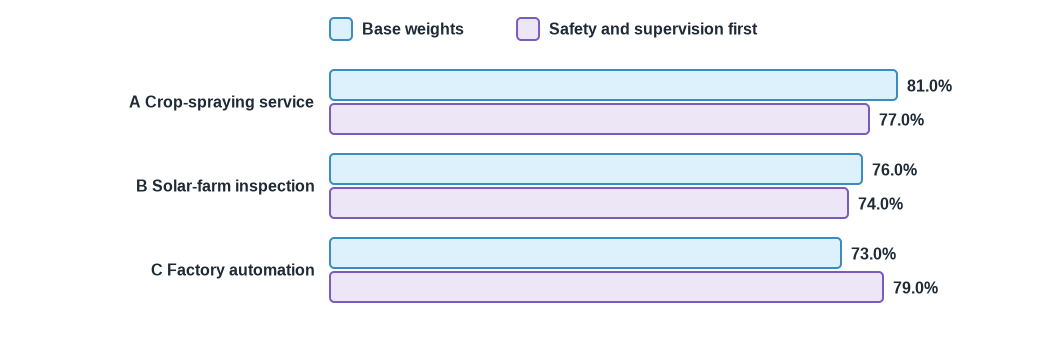
A decision matrix does not decide for us, but it shows what the result is sensitive to. Here the ranking flips when the weights change, which means the gap between A and C is not large enough to be sure, and A’s supervision score (3 out of 5) is what must be clarified at the interview. Pim stays with A and prepares questions: who is the workplace mentor and how experienced, what safety procedures are used, and is there training before work starts (module 2 uses these questions and module 3 explains why they matter). The trap to avoid is adjusting the weights until they match the company you already chose, because then the table only justifies an answer.
The three-period plan and the expectations record
Pim writes a one-page career plan (assumed data). Every goal has a number, a date or something that can be checked.
| Period | Specific goal | How she will know it worked |
|---|---|---|
| Before (by week 10 of this course) | Add one item of evidence each for communication and professionalism | The evidence-supported level rises from 2 to 3 in both |
| During co-op (16 weeks) | Join at least 10 spraying missions as an assistant, as far as the company allows, with a complete record of each | 10 records signed by the workplace mentor |
| 1 to 3 years after graduating | Work as a pilot of agricultural drones under the CAAT conditions in force | Authorised and with a flight record kept |
Clause 4.2.3 also asks students to write an expectations record before the placement. Keep it to half a page that answers four questions: What do I want to learn? What do I hope to deliver? What worries me? How will I know this co-op went well? Keep it and reopen it at the end to see how far the expectations matched reality.
Module lab
Lab: my preparation file
- Rate yourself on the eight competencies and write the evidence the rule requires (levels 2, 3, 4 need 1, 2, 3 items). Compute the evidence-supported levels with the code in Example 2 and find the two competencies with the biggest gaps
- Take the O*NET Mini-IP (30 questions, in English) or the co-op centre’s interest survey, and note your top three areas
- Collect information on at least three workplaces from the co-op centre’s announcements, company websites and senior students. Set your own criteria and weights, score every cell with a reason, and compute with the code in Example 3 using both the original weights and a set that stresses safety and supervision
- Write a one-page career plan in three periods, every goal with a number or date, and a half-page expectations record
- Write at least five questions to ask a workplace, including the mentor, allowances or benefits, safety and permission to fly, and have your advisor or the co-op centre staff check them
Common mistakes
Watch out
- Choosing a placement because it is near home or friends are going, without asking what you will learn and how you will be supervised
- Rating yourself above your evidence, or so low that you never put yourself forward
- Setting broad goals such as “get better”, which cannot show whether they were met
- Adjusting weights until they match the company you already picked, so the table helps no decision
- Not asking about the mentor, safety and permission to fly before accepting
Summary
- CWIE is study at the institution together with real work so students are ready to work; it has three parties, the student, the workplace mentor and the supervising lecturer
- The 2022 notification requires at least 45 hours of real work per credit (6 credits is 270 hours) and at least 30 hours of preparation
- Assess yourself with evidence: a claimed level needs at least items, and the supported level is
- Choose a workplace with a weighted matrix and try more than one set of weights; if the ranking flips, gather more information
- Write a three-period career plan with specific goals and an expectations record before the placement
Check your understanding
- Under the 2022 notification, how many hours of real work does a 6-credit co-op curriculum need at least?
- A student works 35 hours a week for 16 weeks. How many hours is that in total, and how many times the minimum in question 1 (two decimals)?
- A student claims level 3 in communication but has only 1 item of evidence. What is the evidence-supported level, and how many more items are needed to claim level 3?
- Company D scores learning 4, fit 3, supervision 5, project 3, cost 5. Using the first weights in Example 3 (30, 25, 20, 15, 10), what is its weighted score in percent?
- Why should you try more than one set of criterion weights before choosing a workplace?
Answers
- hours
- hours, and times
- ; one more item (2 in total) is needed to claim level 3
- To see whether the result is sensitive to the weights. If the ranking flips, the gap is not large enough to be sure and more information is needed on the criteria that matter
Key formulas
| Minimum hours of real work | |
| Evidence-supported level | |
| Weighted score of option j |
Key references
- คณะกรรมการมาตรฐานการอุดมศึกษา. (2565). ประกาศคณะกรรมการมาตรฐานการอุดมศึกษา เรื่อง หลักเกณฑ์และแนวปฏิบัติเพื่อส่งเสริมการจัดหลักสูตรสหกิจศึกษาและการศึกษาเชิงบูรณาการกับการทำงาน พ.ศ. 2565. link
- สำนักงานปลัดกระทรวงการอุดมศึกษา วิทยาศาสตร์ วิจัยและนวัตกรรม. สหกิจศึกษาและการศึกษาเชิงบูรณาการกับการทำงาน (CWIE). link
- World Association for Cooperative Education. What is WACE and CWIE. link
- Zegwaard, K. E., & Pretti, T. J. (Eds.). (2023). The Routledge international handbook of work-integrated learning (3rd ed.). Routledge. link
- National Association of Colleges and Employers (NACE). (n.d.). Career readiness competencies: Career readiness defined [Web page]. NACE. link
- O*NET Resource Center. (n.d.). O*NET Interest Profiler [Web page]. U.S. Department of Labor, Employment and Training Administration. link
- Locke, E. A., & Latham, G. P. (2002). Building a practically useful theory of goal setting and task motivation: A 35-year odyssey. American Psychologist, 57(9), 705–717. link
- สำนักงานการบินพลเรือนแห่งประเทศไทย. (2569). ประกาศ กพท. เรื่อง หลักเกณฑ์และวิธีการในการอนุญาตให้ผู้บังคับหรือปล่อยอากาศยานซึ่งไม่มีนักบิน ประเภทอากาศยานที่ควบคุมการบินจากภายนอก ที่มีน้ำหนักไม่เกิน 25 กิโลกรัม ปฏิบัติแตกต่างไปจากเงื่อนไขที่กำหนด พ.ศ. 2569 (มีผล 17 พฤษภาคม 2569). link
Further reading
Study the assigned knowledge units in advance, review media and take the module quiz
In class / field
Lab or field practice from worksheets with a safety checklist
Learning evidence: Checked worksheets and quiz results