Work phase 1
UAT 497 Work-Integrated Learning in Unmanned Aircraft Systems and Automation Technology
Lesson
By the end of this module you will be able to
- Keep a logbook that serves as verifiable evidence of learning
- Summarise working hours by category and compare with the plan
- Write reflective entries using Gibbs' cycle and relate them to Kolb's learning cycle
- Ask the mentor for feedback and use it to adjust the plan
Why this matters
Working does not by itself produce learning; many people repeat the same tasks for weeks without gaining anything more. Learning happens when you stop to think about what happened, why, and what to do next. Schön (1983) called people who work this way “reflective practitioners”. The logbook is the evidence of what was done and the raw material for the final report.
The logbook
A good logbook is written every day, briefly but verifiably: date, task, category, hours, tools or equipment used, result and who signed it off (the mentor). Never include confidential client data or personal data; if needed, refer to jobs by code rather than name.
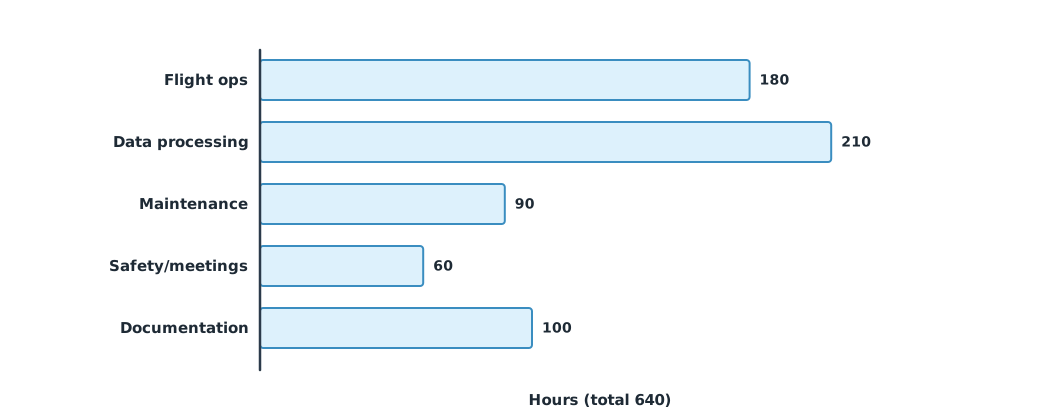
Example 1 Hours against the plan
Totals over 16 weeks of 40 hours each (hypothetical data).
plan = {"flight ops": 200, "data processing": 180, "maintenance": 80, "safety & meetings": 60, "documentation": 120}
actual = {"flight ops": 180, "data processing": 210, "maintenance": 90, "safety & meetings": 60, "documentation": 100}
WEEKS = 16

for k in plan:
    diff = (actual[k] - plan[k]) / plan[k] * 100
    flag = "" if abs(diff) <= 10 else "<- discuss with mentor"
    print(f"{k:<18} plan {plan[k]:>3} h, actual {actual[k]:>3} h ({diff:+5.1f}%) {flag}")
total = sum(actual.values())
print(f"total {total} h = {total / WEEKS:.1f} h/week over {WEEKS} weeks")
flight ops plan 200 h, actual 180 h (-10.0%)
data processing plan 180 h, actual 210 h (+16.7%) <- discuss with mentor
maintenance plan 80 h, actual 90 h (+12.5%) <- discuss with mentor
safety & meetings plan 60 h, actual 60 h ( +0.0%)
documentation plan 120 h, actual 100 h (-16.7%) <- discuss with mentor
total 640 h = 40.0 h/week over 16 weeksData processing ran over plan while flight operations and documentation ran under. That is not wrong, but discuss with the mentor whether flight practice will still cover the CLOs, and explain the change in the report.
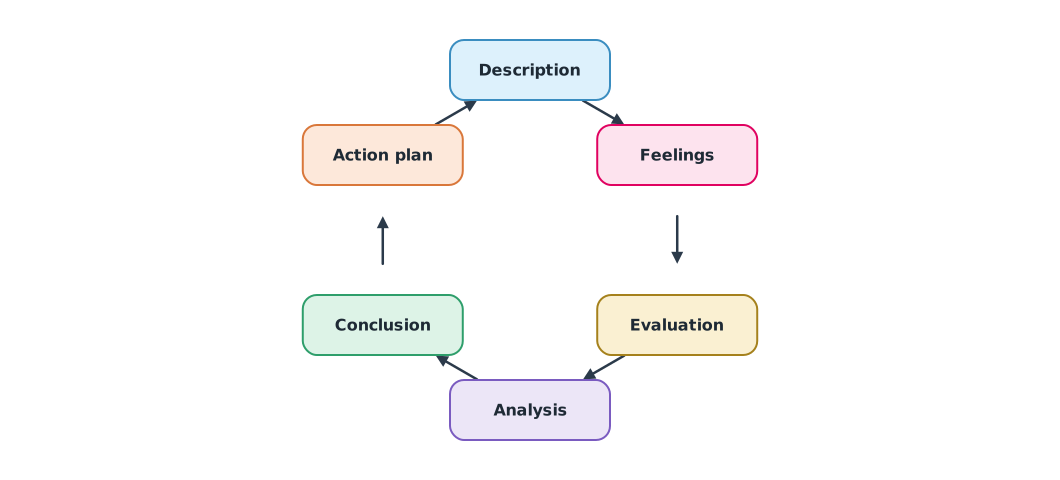
The reflective cycle
Kolb (1984; revised 2015) describes experiential learning as a four-stage cycle: concrete experience, reflective observation, abstract conceptualisation and active experimentation. Gibbs (1988) turned this into an easy-to-use six-stage structure for writing:
- Description: what happened?
- Feelings: what were you thinking and feeling at the time?
- Evaluation: what was good and bad?
- Analysis: why did it happen that way? Link it to knowledge from your courses.
- Conclusion: what did you learn, and could you have done anything else?
- Action plan: what will you do next time?
Example 2 Checking that reflections cover all six stages
Entries from three weeks, with each stage written under its own heading (content shortened).
STAGES = ["description", "feelings", "evaluation", "analysis", "conclusion", "action plan"]
entries = {
    "week 3": {"description": "mission aborted: compass error", "feelings": "stressed",
               "evaluation": "abort was correct", "analysis": "steel roof near take-off point",
               "conclusion": "site survey missed metal", "action plan": "add metal check to site survey"},
    "week 4": {"description": "processed 1,200 images", "evaluation": "two blurry strips",
               "action plan": "check shutter speed"},
    "week 5": {"description": "client meeting", "feelings": "nervous", "evaluation": "good questions",
               "analysis": "prepared a one-page summary", "conclusion": "summaries help"},
}
for week, e in entries.items():
    missing = [s for s in STAGES if not e.get(s)]
    print(f"{week}: {len(STAGES) - len(missing)}/6 stages" + (f", missing {', '.join(missing)}" if missing else ""))
week 3: 6/6 stages
week 4: 3/6 stages, missing feelings, analysis, conclusion
week 5: 5/6 stages, missing action planWeek 4 has description, evaluation and action plan but no analysis of why the images were blurred, the stage that links to the sensors and photography courses. Entries like this miss the most important learning opportunity.
Feedback from the mentor
Ask for feedback at least every two weeks, and ask specific questions, such as “in this week’s image processing, which step should I do faster?” rather than “how am I doing?”. Record the feedback and what you changed in the plan. The WIL handbook edited by Zegwaard and Pretti (2023) shows that dialogue between student, mentor and lecturer is at the heart of workplace learning.
Activity during work
Activity: logbook and reflections
- Write the logbook every day and have the mentor sign it weekly.
- At the end of each month, compare hours with the plan using Example 1.
- Write at least one Gibbs reflection per week and check it with Example 2.
- Ask the mentor for specific feedback every two weeks.
- Prepare a summary of the three things you learned most for supervision visit 1.
Common mistakes
Watch out
- Writing the logbook several days later.
- Recording only what was done, with no analysis.
- Including confidential client data in entries.
- Asking vague questions that produce unusable feedback.
- Not adjusting the plan when real work differs from it.
Summary
- A daily logbook is verifiable evidence and raw material for the report.
- Comparing hours with the plan shows whether learning still covers the CLOs.
- Write reflections in Gibbs’ six stages, especially analysis, which links to prior knowledge.
- Ask for specific feedback regularly and use it to adjust the plan.
Check your understanding
- How many stages does Gibbs’ cycle have, and what are they?
- Planned 200 hours, actual 180 hours: what is the deviation?
- Which Gibbs stage links experience to knowledge from courses?
- What are Kolb’s four stages?
- Why should the logbook not be written several days later?
Answers
- Six: description, feelings, evaluation, analysis, conclusion and action plan.
- Analysis.
- Concrete experience, reflective observation, abstract conceptualisation and active experimentation.
- Details are misremembered and the evidence becomes less credible.
Key formulas
| Deviation from plan |
Key references
- Gibbs, G. (1988). Learning by doing: A guide to teaching and learning methods. Further Education Unit, Oxford Polytechnic. link
- Kolb, D. A. (2015). Experiential learning: Experience as the source of learning and development (2nd ed.). Pearson Education. link
- Schön, D. A. (1983). The reflective practitioner: How professionals think in action. Basic Books. link
- Zegwaard, K. E., & Pretti, T. J. (Eds.). (2023). The Routledge international handbook of work-integrated learning (3rd ed.). Routledge. link
Further reading
Study the assigned knowledge units in advance, review media and take the module quiz
In class / field
Workplace practice under a supervisor
Learning evidence: Work log endorsed by the supervisor