Aerodynamics: from Navier–Stokes to drone models
Read forces and flow from the equations, experiment with channel flow, then explore wind near the ground, around buildings and around payloads before applying the data to drones
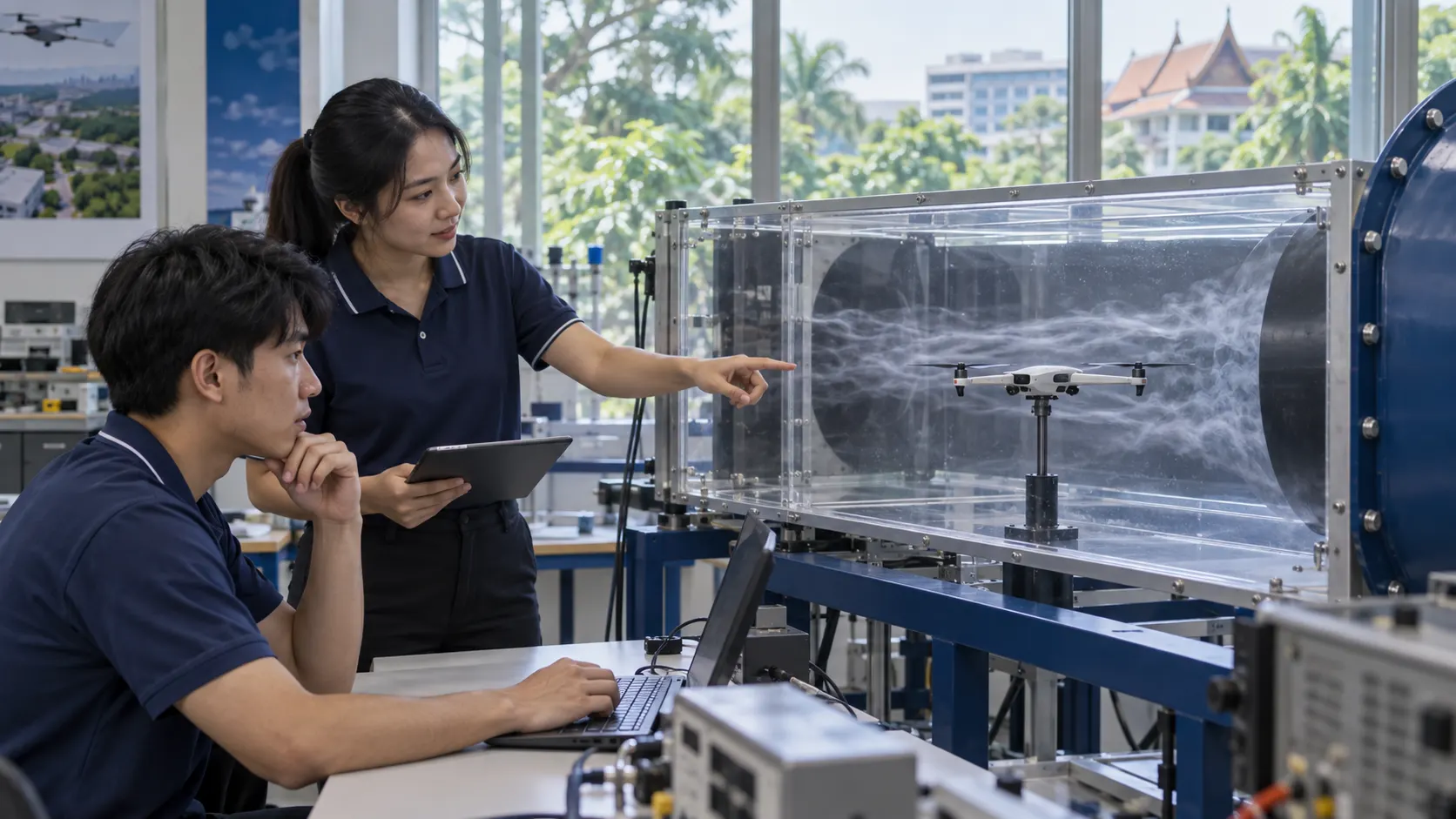
Start from the question you want to answer
Air exerts force on a drone through pressure and shear stress on its surfaces, while the Navier–Stokes equations describe the change of momentum of the fluid. Obtaining a streamline picture is therefore not yet an answer about lift or accuracy; you must also state the quantity required, the conditions and how the result will be checked. See the overview of the equations from NASA Glenn
At the end of this set of chapters, learners will be able to read the meaning of the terms in the equations, calculate Reynolds and Mach numbers, solve a simple channel-flow problem, and pose questions about rotor wash near the ground, wind around buildings and the effect of payloads. The background used is algebra, graphs, derivatives and introductory integrals; readers who have not yet studied calculus can start from the explanations and example tables.
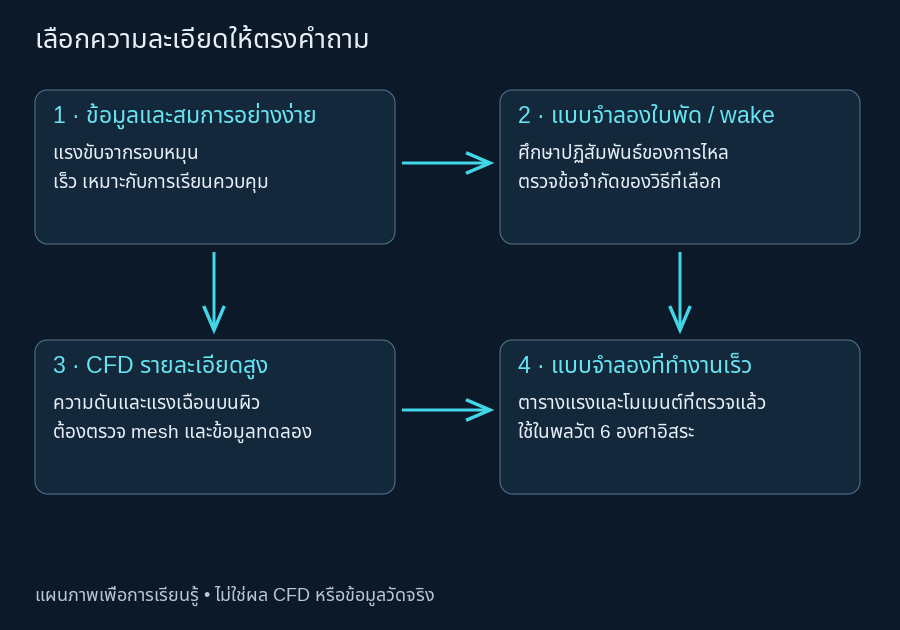
Study in order and keep your work products
| Chapter | Key question | Checkable work product |
|---|---|---|
| 1. Reading the equations | How do forces change the velocity of a fluid? | Equations with units and assumptions |
| 2. Choosing the model level | How important are viscosity and compressibility? | Re, Mach and the rationale for choosing the reference length |
| 3. Channel-flow laboratory | Does the numerical answer match the analytical answer? | Graphs, errors and CSV |
| 4. Planning CFD work | What evidence makes the results trustworthy? | Plan for the grid, time, boundary conditions and comparison of results |
| 5. Rotor wash near the ground | How do height and measurement point position change the results? | Table of h/R, thrust and outwash measurement positions |
| 6. Wind around buildings | Is a single-point average wind speed enough? | Layout of wind measurement points and an example of dynamic pressure |
| 7. Rotors and payloads | How do weight and aerodynamic force differ? | Comparison table of a bare drone and a drone carrying a box |
| 8. Preparing to connect to DroneSim | How will forces be passed into the motion model? | A data contract with units, axes and valid range |
| 9. Reading NASA MTB2 test data | What do the real measured data tell us, and what else must be checked before comparing with CFD? | Six-component hub loads, graphs and a traceable unit-conversion workbook |
First example: a calculated number is not yet the whole force
Assume air density ρ = 1.225 kg/m³ and reference velocity U = 10 m/s. The dynamic pressure is q = ½ρU² = 61.25 Pa . If we use a reference area S = 0.02 m² and assume a drag coefficient CD = 1, then D = qSCD = 1.225 N. This example is unit practice, not a measured result for any drone. The actual CD depends on shape, attitude and flow, so evidence is needed before use.
Check the units: Pa × m² = N, and note that when U doubles, q quadruples, but the actual force quadruples only if S, ρ and CD remain unchanged. Read more about force models in Simulator physics
Scope of this classroom
The channel-flow calculator solves a reduced steady laminar 1D problem between stationary plates. The CFD chapter has a practice set for an actuator disk with prescribed thrust, run with OpenFOAM with comparison results on two grids, and the DroneSim chapter has an example of a fuselage drag coupling module that has been tested with the motion system.
The three cases of ground, building and payload box have adownloadable CFD experiment set with results for 14 cases . It uses a viscous fluid with ν = 0.01 m²/s for practising reading forces, velocities, grids and time steps. It is not a simulation of real air around a drone . Some quantities are still highly grid-sensitive even though the solver meets its numerical stopping criteria, so the model still needs development and comparison with experimental data before use with real drones.
Checking answers against analytical equations is called verification, whereas validation requires comparison with experiments relevant to the real application. The two answer different questions under the NASA V&V framework. The accompanying file is the channel-flow workbook ZIP , which contains numerical exercises and record forms; it does not contain rotor CFD results.
After reading the results of all three cases, go to the laboratory for passing forces to DroneSim to see which forces cannot substitute for one another, experiment with continuous trajectories using synthetic tables, and practise comparing values with uncertainty. Workbooks and run results are provided for re-checking, while software testing is still kept separate from confirming results with real drones.
Think and check your answer
Problem: Using the same example assumptions but reducing the velocity to 5 m/s, what are q and D, and what evidence is missing if the result is to be used for a real drone?
Model answer: q = 15.3125 Pa and D = 0.30625 N. What is missing is a verifiable CD for that shape and flow condition, as well as the definition of the reference area and the uncertainty. A correct calculation does not automatically make the assumptions correct.
Bibliography
Original sources checked 26 September B.E. 2569 (2026). Documents are linked at the owners' websites; PDFs are not redistributed.