Logs, handover and post-mission debrief
Write records that separate events from conclusions, and track corrective actions until there is evidence to close them
Outcomes and prerequisite knowledge
Learners will record events with their source and time, link deficiencies to corrective action items, and have someone else check what evidence closed each issue. Read Abnormal events and Data handover first
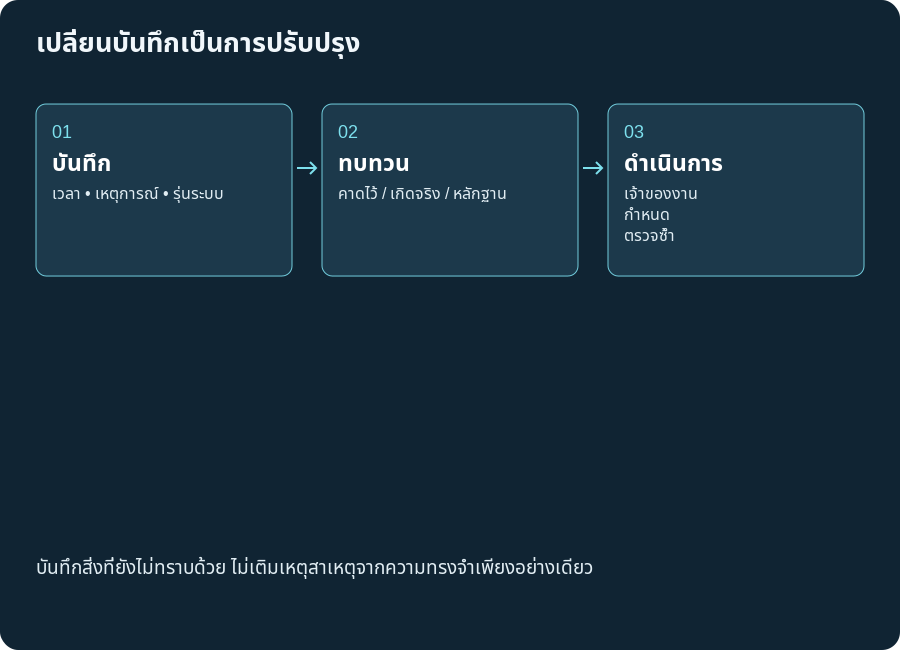
Open the full-size diagram to zoom in on details
Write so that someone who was not on site can understand
“The images were poor because of the signal” is both an observation and a guessed cause in a single sentence. Try writing “At 10:00:00+07:00 the on-screen image stopped updating, around the time the observer reported; cause not yet confirmed; see log EV03”. This leaves room for further checking without turning an assumption into a fact
CAAT's OM guidance has sections on documentation, records and occurrence handling. Form design should match the operator's actual system. This lesson offers a practice format; it does not set document retention periods or legal reporting procedures on behalf of the authority OM guidance
Separate three types of record
| Record | What to keep | Example linking code |
|---|---|---|
| Task/event | Time, source, observation, decision | SIM-01 / EV01 |
| Deficiency | Problematic equipment or document, status of the person taking over | DEF01 → EV01 |
| Improvement | What must be fixed, owner, check date, closure evidence | A01 → DEF01 |
A debrief compares what was expected with what happened; it does not look for someone to blame before understanding the data. Start from events that can be traced back, then choose changes that can be verified. For example, “add a reviewer for the revision before the work day” is clearer than “everyone be more careful with documents”
When a fix is complete, there must be a reviewer and new evidence, and the old history is not deleted. Keeping originals and new report versions is covered next in Evidence and reports
Exercise: close an action with evidence
Use log.csv and debrief.csv from mission workbook All events are hypothetical data
- Record an event where the manual does not match the firmware, separating what was seen from the expected impact
- Define an action with an owner, a check date and the expected result
- Suppose you received the manual version that matches the set; write what else must be checked before closing the action
- Add a reviewer independent of the doer as far as classroom resources allow, then have them trace back the codes
- Give the brief, log and debrief to a classmate and have them try to explain the sequence of events; if they cannot, revise the records
Answer key and assessment criteria
Obtaining a new manual file is not enough if it has not been confirmed as the version in use and the checklist has not been updated accordingly. Simulate the closure evidence as the document name, revision, reviewer and desk-check result of the document, labelled as a training exercise with no actual flight test
Score 0–2 for each aspect: time/source, separation of facts, linking codes, task owner and closure evidence. A proposal with no owner or no method of verification is considered not yet ready to close
References and next steps
- CAAT, Guidance for Development of an Operations Manual, Issue 01 Rev 00 (2022), sections Documentation and Records and Report and Handling of Occurrence, original, checked 26 September 2026
- Go to Analysing mission images and data to practise the quality of the conclusions you pass on