Aircraft types and missions
UAT 201 Fundamentals of Unmanned Aircraft Systems
Lesson
By the end of this module you will be able to
- Compare the strengths and limits of multirotor, fixed-wing, helicopter, VTOL and lighter-than-air aircraft
- Explain the four forces and how a quadcopter tilts and yaws by changing propeller speeds
- Calculate thrust per motor in a hover, and the minimum speed at which a wing lifts the aircraft
- Choose an aircraft type for a mission with a weighted criteria table
Why this matters
No drone type is best for every job. A quadcopter easily hovers to photograph a building’s windows, but surveying hundreds of hectares of paddy fields drains its battery before it finishes. A fixed-wing aircraft flies long and far but cannot stop in mid-air and needs somewhere to take off and land. Choosing the right aircraft for the mission from the start saves both money and time.
Types of unmanned aircraft
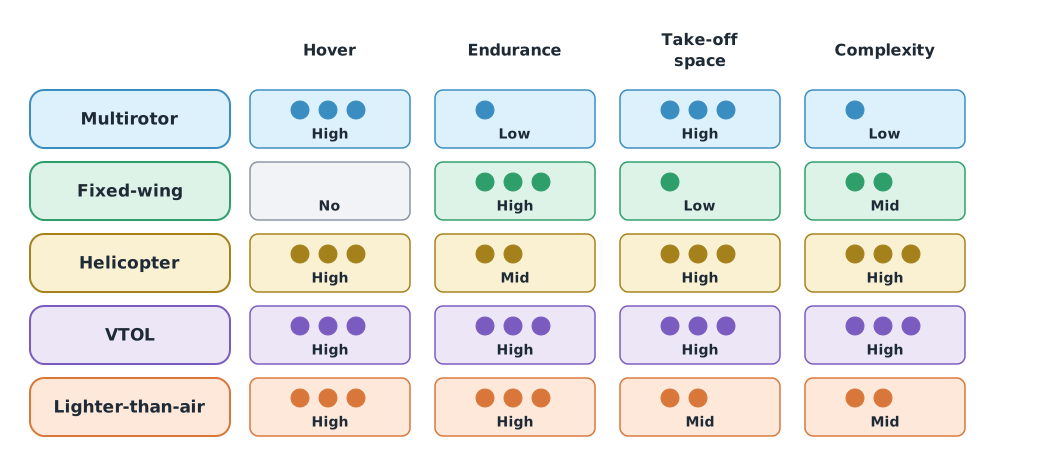
| Type | How it stays up | Suits | Limits |
|---|---|---|---|
| Multirotor | Several rotors give upward thrust directly | Building inspection, photography, tight spaces | High energy use, short flights |
| Fixed-wing | Wings make lift when moving forward | Wide-area surveys, long routes | Cannot hover; needs a runway or launch aid |
| Helicopter (single rotor) | One large main rotor and a tail rotor | Heavy loads, longer flights | Complex mechanics, heavy maintenance |
| VTOL | Takes off vertically, then flies as a fixed-wing | Wide areas without a runway | Complex transition, high cost |
| Lighter-than-air | Balloons or airships floating on gas | Long surveillance | Slow, strongly affected by wind |
The 2026 (B.E. 2569) CAAT announcement groups remote pilot ratings by aircraft category: Rotorcraft (including multirotors and helicopters), Aeroplane, Powered lift and Lighter-than-air, covered further in module 5.
The four forces and flying a quadcopter
Every aircraft is subject to lift, weight, thrust and drag. On a multirotor, rotor thrust both lifts and pushes: when the drone tilts, part of the thrust pushes it sideways, like a person leaning forward and starting to walk.
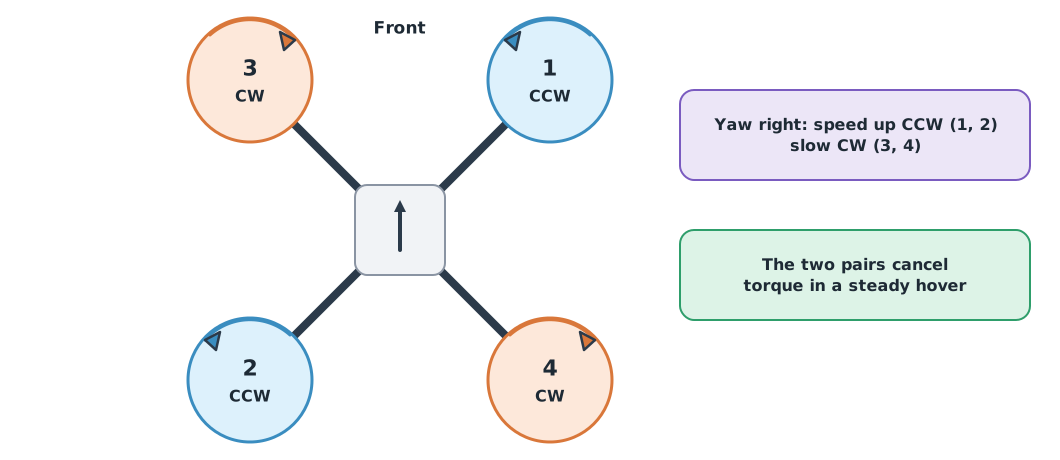
In ArduPilot’s Quad X layout, motors 1 (front right) and 2 (rear left) spin counter-clockwise, and motors 3 (front left) and 4 (rear right) spin clockwise.
- Up or down: speed up or slow all motors together
- Roll and pitch: speed up the motors on one side and slow the other, so the aircraft tilts
- Yaw: a spinning propeller twists the body the opposite way. In a steady hover, the torques of the counter-clockwise and clockwise pairs cancel. Speed up one pair and slow the other, and the torque imbalance turns the aircraft
If motors are wired in the wrong order or propellers fitted upside down, the drone flips as soon as it lifts off. This is why each motor is tested individually, with propellers removed, as the manual requires before the first flight.
Example 1 Hover thrust and fixed-wing speed
import math

g, rho = 9.81, 1.225                  # m/s², kg/m³ (standard sea-level air)

quad_mass, motors = 1.4, 4            # kg
hover_per_motor = quad_mass * g / motors
print(f"quad {quad_mass} kg: each motor must give {hover_per_motor:.2f} N ({hover_per_motor / g * 1000:.0f} gf) to hover")

wing_mass, wing_area, cl = 2.5, 0.5, 0.8   # kg, m², lift coefficient
v_min = math.sqrt(2 * wing_mass * g / (rho * wing_area * cl))
print(f"fixed-wing {wing_mass} kg: lift equals weight at {v_min:.1f} m/s ({v_min * 3.6:.0f} km/h)")
quad 1.4 kg: each motor must give 3.43 N (350 gf) to hover
fixed-wing 2.5 kg: lift equals weight at 10.0 m/s (36 km/h)A quadcopter must use thrust all the time to hold up its weight, so it uses a lot of energy. The fixed-wing aircraft must fly faster than about 10 m/s for its wing to carry its weight; slower, and it loses lift (stalls). The in the example is an assumed value; the real value depends on the wing and angle of attack.
Choosing an aircraft for the mission
Score each option against the criteria that matter to the mission, weighted by importance. Check must-have conditions first: if the mission must hover, options that cannot hover are excluded at once.
Example 2 Different missions, different answers
Scores of 0–3 for each option (hover, endurance, small take-off space, ease), from the table in Figure 1.
options = {"multirotor": (3, 1, 3, 3), "fixed-wing": (0, 3, 1, 2), "VTOL": (3, 3, 3, 1)}
missions = {
    "building inspection": {"weights": (0.4, 0.1, 0.3, 0.2), "must_hover": True},
    "5 km² field mapping": {"weights": (0.0, 0.5, 0.2, 0.3), "must_hover": False},
}
for name, m in missions.items():
    scores = {}
    for opt, s in options.items():
        if m["must_hover"] and s[0] == 0:
            continue                                   # fails the must-have condition
        scores[opt] = sum(w * v for w, v in zip(m["weights"], s))
    ranked = sorted(scores.items(), key=lambda kv: kv[1], reverse=True)
    print(f"{name}: " + ", ".join(f"{o} {v:.2f}" for o, v in ranked))
building inspection: multirotor 2.80, VTOL 2.60
5 km² field mapping: VTOL 2.40, fixed-wing 2.30, multirotor 2.00Our team’s building inspection points to a multirotor, while for wide-area mapping VTOL and fixed-wing score higher. The weights and scores are the team’s own judgements; write down the reasons, and try changing the weights to see whether the answer changes.
Module lab
Lab: comparing aircraft types in the simulator
- Start ArduPilot SITL as Copter and as Plane (with the instructor’s help setting up). Observe take-off, turning and landing for each.
- Record the slowest speed at which the Plane can fly in the simulator, and compare it with the idea of the speed at which lift equals weight.
- Look at the Quad X layout in the ArduPilot manual and explain which motor pair must speed up to yaw left.
- Use the code in Example 2 for two missions the group invents, with reasoned weights.
- Conclude which aircraft type the team’s building photo mission should use.
Common mistakes
Watch out
- Choosing an aircraft by preference before writing down the mission’s needs
- Letting a total score make up for a must-have, such as choosing a fixed-wing when hovering is required
- Fitting propellers the wrong way or wiring motors in the wrong order
- Thinking multirotors yaw with a rudder, when they use propeller torque
- Applying the example or speed to a real aircraft
Summary
- Each aircraft type trades off hover, endurance, take-off space and complexity
- A multirotor tilts with differential thrust and yaws with the torque of its counter-clockwise and clockwise pairs
- Thrust per motor in a hover is , and a wing needs enough speed to carry the weight
- Choose aircraft by must-have conditions first, then a weighted table
Check your understanding
- A 3.0 kg hexacopter hovers. How much thrust must each motor give ()?
- If the wing area doubles, how does the speed at which lift equals weight change?
- In ArduPilot’s Quad X layout, which motors spin clockwise?
- For close-up photos of a building’s windows, which aircraft type should be used, and why?
- Why does a fixed-wing aircraft fly longer than a multirotor with the same battery?
Answers
- N
- It falls to of the original
- Motors 3 (front left) and 4 (rear right)
- A multirotor, because it can hover and approach closely in tight spaces
- The wing makes lift from forward motion, so the propeller only has to overcome drag rather than hold up the whole weight
Key formulas
| Thrust per motor in a hover | |
| Lift | |
| Speed at which lift equals weight |
Key references
- Barnhart, R. K., Marshall, D. M., & Shappee, E. (Eds.). (2021). Introduction to unmanned aircraft systems (3rd ed.). CRC Press. link
- Fahlstrom, P. G., Gleason, T. J., & Sadraey, M. H. (2022). Introduction to UAV systems (5th ed.). Wiley. link
- ArduPilot Dev Team. Connect ESCs and motors (motor test). ArduPilot Copter documentation. link
- สำนักงานการบินพลเรือนแห่งประเทศไทย. (2569). ประกาศ กพท. เรื่อง หลักเกณฑ์และวิธีการในการอนุญาตให้ผู้บังคับหรือปล่อยอากาศยานซึ่งไม่มีนักบิน ประเภทอากาศยานที่ควบคุมการบินจากภายนอก ที่มีน้ำหนักไม่เกิน 25 กิโลกรัม ปฏิบัติแตกต่างไปจากเงื่อนไขที่กำหนด พ.ศ. 2569 (มีผล 17 พฤษภาคม 2569). link
- Anderson, J. D. (2016). Introduction to flight (8th ed.). McGraw-Hill.
Further reading
Study the assigned knowledge units in advance, review media and take the module quiz
UAV/UAS fundamentals and flight simulation
Drone technology landscape: autonomy, AI, target search and tracking, anti-drone, data links and disaster applications
In class / field
Lab or field practice from worksheets with a safety checklist
Learning evidence: Checked worksheets and quiz results