Propulsion matching
UAT 203 Electrical and Electronic Systems for UAS
Lesson
By the end of this module you will be able to
- Use the thrust coefficient C_T and power coefficient C_P to calculate the propeller speed and power needed to hover
- Compare two propeller sizes by power use and flight time
- Check the compatibility of motor KV, voltage, ESC and battery with margin
- Use calculators such as eCalc knowing their limits, and confirm with real measurements
Why this matters
The propulsion set (motors, propellers, ESCs and battery) uses almost all of a drone’s energy. Good matching can greatly extend flight time without adding battery; poor matching overheats motors, burns out ESCs or leaves too little thrust to fight wind. This module ties modules 1–3 together.
Propeller coefficients
The University of Illinois propeller database (UIUC Propeller Database) describes performance with the dimensionless (thrust) and (power), where is revolutions per second and is diameter (m):
Thrust grows with the square of speed but power with the cube, so a large, slow propeller gives the same thrust for less power than a small, fast one.
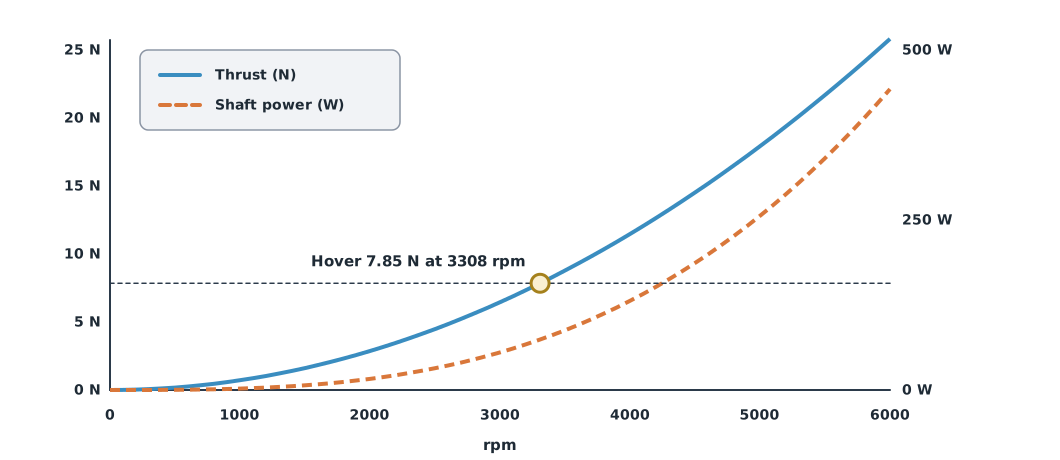
Example 1 A 15-inch versus a 13-inch propeller at 3.2 kg
Assumed and for both propellers, to show the effect of size; real values must come from the UIUC database or test data for the model used. Motor and ESC efficiency together is 80%, and the electronics draw 26 W from module 1.
import math

g, rho, mass = 9.81, 1.225, 3.2
thrust_each = mass * g / 4
ct, cp, eta, avionics_w, usable_wh = 0.10, 0.045, 0.80, 26, 222 * 0.8
for name, d in (("15 in", 0.381), ("13 in", 0.3302)):
    n = math.sqrt(thrust_each / (ct * rho * d ** 4))      # rev/s
    shaft_w = cp * rho * n ** 3 * d ** 5
    total_w = 4 * shaft_w / eta + avionics_w
    print(f"{name}: {n * 60:.0f} rpm, shaft {shaft_w:.1f} W per motor, total {total_w:.0f} W, "
          f"hover time ≈ {usable_wh / total_w * 60:.1f} min")
15 in: 3308 rpm, shaft 74.2 W per motor, total 397 W, hover time ≈ 26.8 min
13 in: 4405 rpm, shaft 85.6 W per motor, total 454 W, hover time ≈ 23.5 minThe 15-inch propeller turns slower and uses about 13% less power, hovering several minutes longer. But a large propeller needs a low-KV motor with high torque, responds more slowly and needs a frame with enough spacing.
Checking the whole set
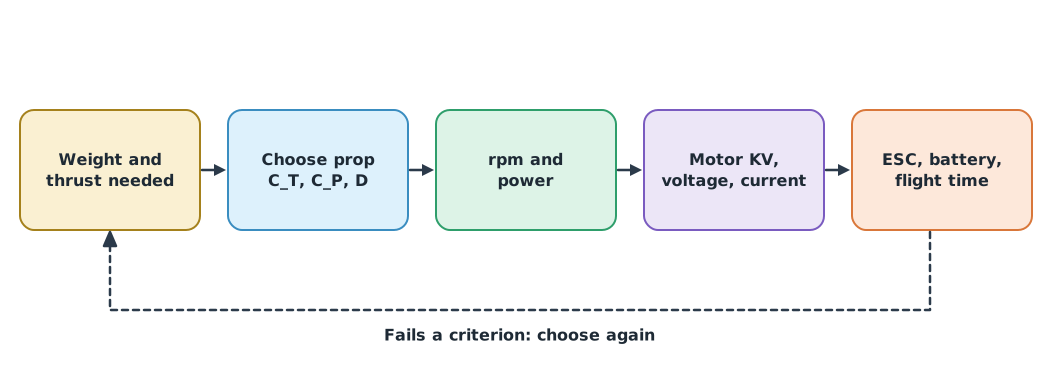
Criteria to check:
- Thrust reserve: total maximum thrust should exceed weight enough to climb and fight wind (see TWR in UAT 321)
- Speed headroom: hover speed should be well below the maximum the motor can reach at operating voltage. A 400 KV motor at 22.2 V reaches about 8,880 rpm without load, against 3,308 rpm needed to hover on the 15-inch propeller, leaving plenty of headroom
- Current: the maximum current of that motor and propeller must be below the ESC’s continuous rating with margin, and the pack must supply the total
- Heat: motors and ESCs need airflow in their actual mounting position
Tools such as eCalc xcopterCalc calculate the whole set from databases of motors, propellers and batteries. The developer states an accuracy of about ±15%, so use it to shortlist options, then confirm with a thrust stand and real flight logs.
Module lab
Lab: matching the survey drone’s propulsion
- Open the UIUC database, choose two propellers near the training drone’s size, and read their static and .
- Put the real values into the code in Example 1 to calculate speed, power and hover time.
- Use eCalc (or the motor manufacturer’s test tables) for the same set and compare with the hand calculation.
- Measure thrust, current and speed on the caged test stand (continuing from module 3) and compare with the calculation.
- Build a table against the four criteria above and conclude which set suits our survey drone.
Common mistakes
Watch out
- Using in rpm in a formula that needs revolutions per second
- Using and from another propeller, or forward-flight values instead of static ones
- Looking only at hover time, forgetting thrust reserve and maximum current
- Trusting calculator results without measuring
- Fitting a larger propeller without checking motor and ESC current
Summary
- Thrust grows with and power with , so large slow propellers save power
- Calculate the required speed from thrust, then power and flight time
- Check thrust reserve, speed headroom, current and heat before concluding
- Calculators have errors; confirm with real measurements
Check your understanding
- If speed doubles, by how many times do thrust and power increase?
- If diameter doubles at the same speed, by how many times does thrust increase?
- A 2.0 kg quadcopter hovers. How much thrust per motor is needed?
- A system uses 400 W in total with 160 Wh usable. About how many minutes can it hover?
- What accuracy does eCalc state, and how should it be used?
Answers
- Thrust times and power times
- times
- N
- minutes
- About ±15%; use it to shortlist options, then confirm by measurement
Key formulas
| Propeller thrust | |
| Propeller shaft power | |
| Speed for a required thrust |
Key references
- Brandt, J. B., Deters, R. W., Ananda, G. K., Dantsker, O. D., & Selig, M. S. UIUC propeller database (Vols. 1–4). University of Illinois Urbana-Champaign. link
- Quan, Q. (2017). Introduction to multicopter design and control. Springer Singapore. link
- eCalc. xcopterCalc multicopter calculator. link
- ArduPilot Dev Team. Connect ESCs and motors (motor test). ArduPilot Copter documentation. link
Further reading
Study the assigned knowledge units in advance, review media and take the module quiz
Comparing propulsion sets
Designing and integrating drone systems
Rotors, airframe and payload: when parts block each other's airflow
Payload mass, centre of gravity and energy
In class / field
Lab or field practice from worksheets with a safety checklist
Learning evidence: Checked worksheets and quiz results