Innovation and entrepreneurship
UAT 316 Technology Project Management, Innovation and Entrepreneurship
Lesson
By the end of this module you will be able to
- Distinguish sustaining from disruptive innovation, and assess technology readiness with TRL
- Design a Lean Startup experiment with an MVP and criteria set before seeing results
- Write a Business Model Canvas and value proposition for a drone service, and calculate the unit contribution margin
- Explain intellectual-property protection in Thailand
Why this matters
Anyone can buy a drone, so a business’s advantage does not come from owning one. It comes from solving a customer’s problem better than the existing way, at a price the customer will pay. Most new ventures fail because they build something nobody wants, not because the technology does not work. This module gives you a systematic way to test a business idea before committing large sums.
Two kinds of innovation
In The Innovator’s Dilemma (1997), Clayton Christensen distinguishes two kinds of innovation:
- Sustaining innovation makes existing products better for existing customers, such as a higher-resolution survey camera
- Disruptive innovation starts out inferior in the eyes of existing customers but cheaper, simpler or opening a new market, then improves until it replaces the incumbent. Low-cost drones that map well enough are an example challenging large aircraft survey work over small areas
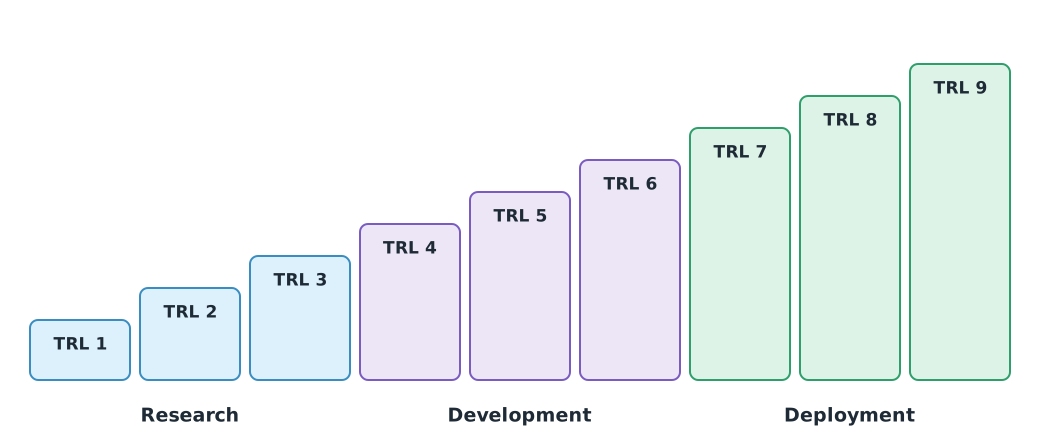
NASA’s Technology Readiness Levels (TRL) run from TRL 1, where basic research is just starting to be turned toward applications, to TRL 9, where the system is proven in real use. A business selling a service should use high-TRL technology; low-TRL technology suits research or innovation grants, not service contracts with delivery deadlines.
Lean Startup and the MVP
In The Lean Startup (2011), Eric Ries proposes running a business as continuous experiments in a Build–Measure–Learn loop. Start with a minimum viable product (MVP), measure how customers respond, and then decide whether to persevere or pivot. Steve Blank and Bob Dorf propose customer development: going out to real customers to confirm the problem before building the full product.
Example 1 Testing a drone solar-panel inspection service
The team assumes that owners of medium-sized solar farms will pay to find overheating panels with a thermal camera. The MVP is not an expensive drone purchase but an offer of a paid pilot service. Before contacting anyone, the team sets the criterion: if fewer than 20% of those offered agree to pay, pivot.
from scipy import stats

contacted, paid = 40, 9
rate = paid / contacted
ci = stats.binomtest(paid, contacted).proportion_ci(confidence_level=0.95)
print(f"paid pilot rate {rate:.1%}   95% CI [{ci.low:.1%}, {ci.high:.1%}]   criterion 20%")
paid pilot rate 22.5% 95% CI [10.8%, 38.5%] criterion 20%A 22.5% rate passes the criterion, but, as in UAT 106, the confidence interval runs from about 11% to 39%. Treat it as early evidence to keep testing, not proof that the market is big enough. These figures are hypothetical.
The Business Model Canvas
The Business Model Canvas of Osterwalder and Pigneur (2010) summarises a business model on one page in nine blocks: customer segments, value propositions, channels, customer relationships, revenue streams, key resources, key activities, key partnerships and cost structure. Value Proposition Design (2014) helps match the value proposition to the jobs, pains and gains of customers.
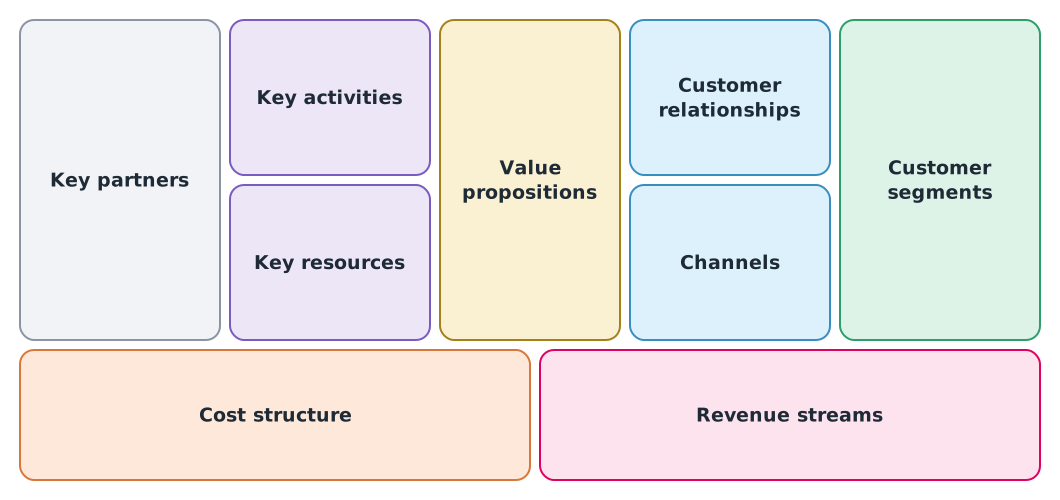
The right side of the canvas is about customers and revenue, the left side about delivery and cost, with the value proposition in the middle linking them. For a solar-panel inspection service, the value proposition might be “know which panels are faulty within 48 hours, without stopping generation”, far more specific than “high-quality drone services”.
Example 2 Contribution margin per job
An inspection costs the customer 3,500 baht per farm. Variable cost per job (travel, batteries, processing labour) is 1,400 baht. Fixed cost per month (salaries, insurance, software) is 60,000 baht.
import math

price, variable_cost, fixed_cost = 3_500, 1_400, 60_000
margin = price - variable_cost
print(f"contribution margin {margin:,} baht per job ({margin / price:.0%} of price)")
print(f"jobs per month to cover fixed cost: {fixed_cost / margin:.2f} -> {math.ceil(fixed_cost / margin)}")
contribution margin 2,100 baht per job (60% of price)
jobs per month to cover fixed cost: 28.57 -> 29At least 29 jobs a month, almost one a day, are needed to cover fixed costs. If the tested market has too few customers, revisit the price, costs or customer segment before hiring.
Intellectual property in Thailand
Intellectual property (IP) protects the products of ideas. In Thailand it is administered by the Department of Intellectual Property, Ministry of Commerce. Terms of protection in summary:
| Type | Protects | Term |
|---|---|---|
| Invention patent | New inventions with an inventive step | 20 years from filing |
| Petty patent | New inventions capable of industrial application | 6 years, renewable twice for 2 years each |
| Design patent | The shape or pattern of a product | 10 years |
| Copyright | Creative works such as software, manuals and images | The author’s life plus 50 years |
| Trademark | Business names and marks | 10 years, renewable for 10-year periods |
These terms follow the Department of Intellectual Property’s information, and an amendment to the patent law is under consideration. Check the current rules with the Department before filing. A common mistake by new entrepreneurs is disclosing an invention publicly before filing a patent application, which can destroy its novelty. Agree ownership of work with co-developers and clients in writing from the start.
Class activity
Activity: designing a drone service business
- Each group chooses a drone service, completes all nine blocks of a Business Model Canvas, and writes the value proposition as a measurable sentence.
- Choose the riskiest assumption in the business and design an MVP that tests it within two weeks, with a decision criterion set before seeing results.
- Calculate the contribution margin per job and the jobs needed per month using the group’s own assumed figures.
- Name which of the team’s work should be protected by which kind of IP, and what must not be disclosed before filing.
Common mistakes
Watch out
- Building the full product before confirming anyone wants it
- Setting the decision criterion after seeing results, so there is always a reason to continue
- Treating praise or “sounds interesting” as evidence; stronger evidence is willingness to pay money or time
- Selling a service on low-TRL technology without telling customers the risk
- Disclosing an invention before filing a patent
Summary
- Sustaining innovation improves existing products; disruptive innovation starts from overlooked markets. TRL shows technology readiness
- Lean Startup uses an MVP and the Build–Measure–Learn loop, with criteria set before seeing results
- The Business Model Canvas summarises a business in nine blocks, and the contribution margin shows how many jobs cover fixed costs
- Each kind of IP protects different things; beware disclosure before filing a patent
Check your understanding
- A higher-resolution survey camera for existing customers is which kind of innovation?
- At which TRL is a system proven in real use?
- A service costs 5,000 baht, variable cost is 2,000 baht and fixed cost 90,000 baht per month. How many jobs a month are needed?
- Which block sits in the centre of the Business Model Canvas?
- What is the longest protection a Thai petty patent can have once fully renewed?
Answers
- Sustaining innovation
- TRL 9
- jobs
- Value propositions
- years
Key formulas
| Contribution margin per unit | |
| Jobs needed to cover fixed cost |
Key references
- Christensen, C. M. (1997). The innovator's dilemma: When new technologies cause great firms to fail. Harvard Business School Press.
- National Aeronautics and Space Administration. (2023). Technology readiness levels. link
- Ries, E. (2011). The lean startup. Crown Business. link
- Blank, S., & Dorf, B. (2012). The startup owner's manual: The step-by-step guide for building a great company. K&S Ranch.
- Osterwalder, A., & Pigneur, Y. (2010). Business model generation. Wiley. link
- Osterwalder, A., Pigneur, Y., Bernarda, G., & Smith, A. (2014). Value proposition design. Wiley. link
- กรมทรัพย์สินทางปัญญา กระทรวงพาณิชย์. สิทธิบัตร อนุสิทธิบัตร ลิขสิทธิ์ และเครื่องหมายการค้า. link
Further reading
Study the assigned knowledge units in advance, review media and take the module quiz
In class / field
Lecture, case discussion and in-class problem solving
Learning evidence: Quiz results and submitted exercises