Governance and monitoring
UAT 316 Technology Project Management, Innovation and Entrepreneurship
Lesson
By the end of this module you will be able to
- Measure performance with earned value management (EVM) and forecast the cost at completion
- Set KPIs with a definition, denominator, data source and review frequency
- Build a risk register following the ISO 31000 process and rank risks with a likelihood–impact matrix
- Analyse stakeholders, control changes and set conditions for stopping a project
Why this matters
The best plan drifts once real work starts. The question executives ask is not “are you following the plan?” but “how far ahead or behind are you, and where will you end up if this continues?” Saying “we have spent half the money” means nothing without knowing how much work has been done. This module gives you the numbers to answer that, and the mechanisms that let a project stop in time when it should.
Earned value management
Earned value management (EVM) compares three values at the same point in time, as set out in the cost-estimating guide of the US Government Accountability Office (GAO):
- PV (planned value): the value of work the plan says should be done by now
- EV (earned value): the value of work actually done, at its budgeted cost
- AC (actual cost): the money actually spent
- BAC (budget at completion): the total project budget
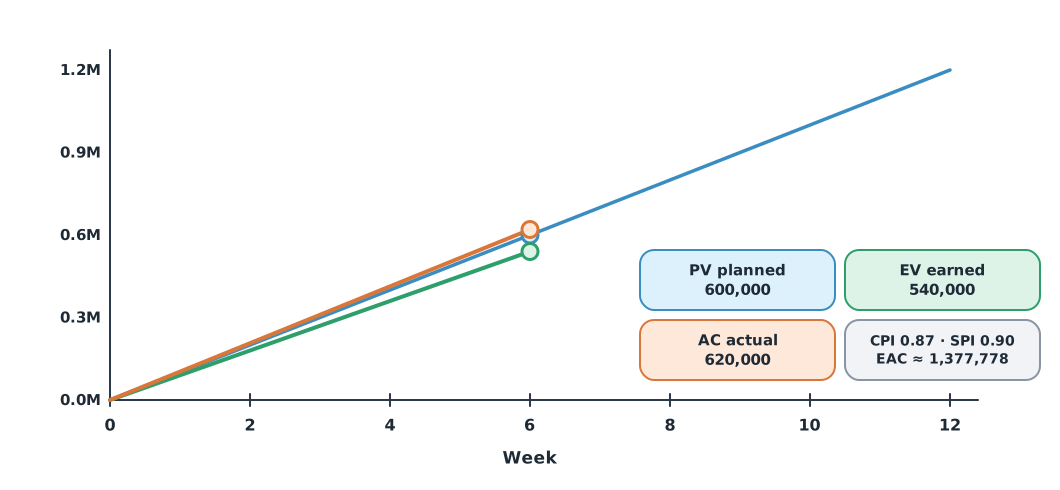
Example 1 Project status at week 6
The service-unit project has a total budget of 1,200,000 baht, planned to be spent evenly over 12 weeks. At week 6, 45% of the work is done and 620,000 baht has been spent.
bac = 1_200_000
pv = bac * 6 / 12
ev = bac * 0.45
ac = 620_000
cv, sv = ev - ac, ev - pv
cpi, spi = ev / ac, ev / pv
eac = bac / cpi
print(f"PV {pv:,.0f}  EV {ev:,.0f}  AC {ac:,.0f}")
print(f"CV {cv:+,.0f}  SV {sv:+,.0f}  CPI {cpi:.3f}  SPI {spi:.3f}")
print(f"EAC {eac:,.0f}   VAC {bac - eac:+,.0f}")
PV 600,000 EV 540,000 AC 620,000
CV -80,000 SV -60,000 CPI 0.871 SPI 0.900
EAC 1,377,778 VAC -177,778The negative CV and SV show the project is both over budget and behind schedule. A CPI of 0.871 means each baht spent earns only 0.87 baht of work. If performance continues like this, the project will finish at about 1.38 million baht, almost 178,000 baht over budget. EAC = BAC/CPI assumes past efficiency continues; if the cause has been fixed, use another forecast. SV is measured in money, not time.
KPIs you can decide with
A key performance indicator (KPI) needs a definition, a denominator, a data source, an owner and a review frequency. An example from the drone knowledge hub’s unit on project governance and monitoring: a survey project delivered 20 sets, 15 passed the first check, 18 were on time, and 2 are still waiting for coordinate confirmation.
delivered, first_pass, on_time, pending = 20, 15, 18, 2
print(f"first-pass acceptance {first_pass / delivered:.0%}")
print(f"on-time delivery      {on_time / delivered:.0%}")
print(f"pending confirmation  {pending} sets (not counted as passed)")
first-pass acceptance 75%
on-time delivery 90%
pending confirmation 2 sets (not counted as passed)On-time delivery is 90% but first-pass acceptance only 75%: two different dimensions. Watching only timeliness hides that one job in four needs rework, and pending items must be counted separately, not as passed. More flights do not mean the users’ problem is being solved better either. KPIs must measure the outcome users need.
Risks and stakeholders
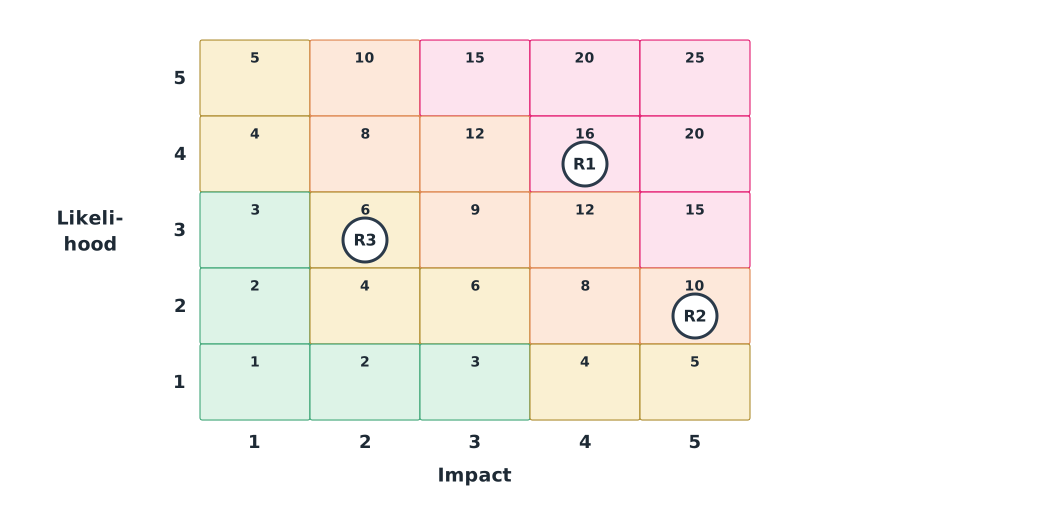
ISO 31000:2018 sets the risk-management process as identifying, analysing, evaluating and treating risks, with continuous communication and monitoring. A risk register records each risk, separating cause, event and impact, as in UAT 313 module 3.
risks = [
    ("R1", "permit delayed", 4, 4, "file early, assign an owner, weekly follow-up"),
    ("R2", "drone crash during pilot service", 2, 5, "OM, checklists, insurance, geofence"),
    ("R3", "mapping software price rises", 3, 2, "compare two vendors, budget reserve"),
]
for rid, event, likelihood, impact, response in sorted(risks, key=lambda r: r[2] * r[3], reverse=True):
    score = likelihood * impact
    level = "high" if score >= 15 else "medium" if score >= 8 else "low"
    print(f"{rid} score {score:>2} ({level:<6}) {event:<32} -> {response}")
R1 score 16 (high ) permit delayed -> file early, assign an owner, weekly follow-up
R2 score 10 (medium) drone crash during pilot service -> OM, checklists, insurance, geofence
R3 score 6 (low ) mapping software price rises -> compare two vendors, budget reserveScores help rank risks but are not the whole story. R2 scores 10, lower than R1, but has the highest impact (people could be hurt), so it needs controls even though it is unlikely. The level bands here are practice thresholds; each organisation must set its own.
Stakeholders of the service unit include the mayor, communities being flown over, the Civil Aviation Authority of Thailand (CAAT), equipment vendors and the pilot team. A common tool is the power–interest grid: high-power, high-interest groups need close management, while low-power groups that are affected, such as communities, need regular information.
Change control and stop conditions
Every change to scope, time or budget must go through change control: log the request, assess its impact, have someone with authority approve it, then update the plan. Accepting small additions bit by bit without the process is scope creep, a leading cause of cost overruns.
A good project sets stop or review conditions from the start, such as “if CPI is below 0.85 for two reviews in a row, review the scope” or “if first-pass acceptance in the pilot is below 70%, stop expanding”. Stopping an ineffective project early is a good decision, not a failure.
Class activity
Activity: a project review meeting
- Take the roles of project manager, executive and reviewer. The project manager reports the week-6 status from Example 1 using EVM figures.
- The executive asks what CPI the remaining work needs to finish within the original budget. Groups calculate it (remaining work divided by remaining money).
- Add two more risks to the register, each with an owner and a response.
- Write three KPIs and two stop conditions for the project, following the hub’s unit on project governance and monitoring.
Common mistakes
Watch out
- Reporting money spent without work done, so nobody knows if the project is over budget
- Reading SV as days, when it is in money
- Setting KPIs that count activity, such as flights, instead of outcomes users need
- Ranking risks by score alone, overlooking risks with severe impact
- Adding work without change control
Summary
- EVM compares PV, EV and AC to give CV, SV, CPI and SPI, and forecasts the final cost with EAC = BAC/CPI
- KPIs need a definition, denominator, data source and review frequency, and must measure what users need
- The risk register separates cause, event and impact, ranked by likelihood × impact plus judgement
- Control every change, and set stop or review conditions at the start of the project
Check your understanding
- With EV = 300,000 baht and AC = 250,000 baht, what are CPI and CV?
- With EV = 400,000 baht and PV = 500,000 baht, is the project ahead of or behind schedule?
- With BAC = 2,000,000 baht and CPI = 0.8, what is EAC?
- A risk has likelihood 3 and impact 5. What is its score?
- Of 40 sets delivered, 30 pass the first check. What is the first-pass acceptance rate?
Answers
- CPI and CV baht, under budget
- Behind schedule, because SPI (SV baht)
- baht
Key formulas
| Cost and schedule variance | |
| Performance indices | |
| Estimate at completion (constant CPI) | |
| Risk score |
Key references
- U.S. Government Accountability Office. (2020). Cost estimating and assessment guide: Best practices for developing and managing program costs (GAO-20-195G). link
- Project Management Institute. (2025). A guide to the project management body of knowledge (PMBOK guide) (8th ed.). link
- International Organization for Standardization. (2018). Risk management – Guidelines (ISO 31000:2018). link
- Kerzner, H. (2025). Project management: A systems approach to planning, scheduling, and controlling (14th ed.). Wiley. link
- ISO. (2020). ISO 21502:2020 Project, programme and portfolio management — Guidance on project management. link
Further reading
Study the assigned knowledge units in advance, review media and take the module quiz
In class / field
Lecture, case discussion and in-class problem solving
Learning evidence: Quiz results and submitted exercises