Pitching and decisions
UAT 316 Technology Project Management, Innovation and Entrepreneurship
Lesson
By the end of this module you will be able to
- Assess project feasibility in five dimensions, market, technical, financial, legal and operational
- Estimate market size as TAM, SAM and SOM from disclosed assumptions
- Choose among options with must-have conditions and a weighted matrix, and test how sensitive the decision is
- Structure a project pitch with the ask and stop conditions
Why this matters
The best proposal never happens if the decision makers do not believe it. Municipal executives, grant committees and investors have a few minutes and want to know only a few things: what problem it solves, what evidence there is, how much it costs, what the risks are, and how they will know when to stop. This module combines the tools of the first four modules into a proposal where every number can be traced back.
Five dimensions of feasibility
A feasibility study answers whether a project should go ahead before full investment.
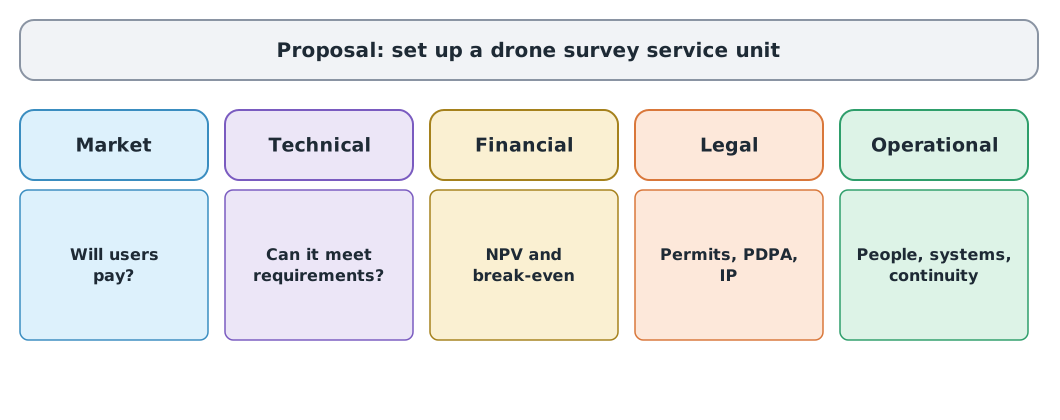
| Dimension | Key question | Evidence from this and other courses |
|---|---|---|
| Market | Are there users who will pay, and enough of them? | MVP and market size (modules 3 and 5) |
| Technical | Can it meet the requirements and acceptance criteria? | TRL (module 3), pilot results, UAT 106 |
| Financial | Is it worthwhile, and robust to changing assumptions? | TCO, NPV, break-even (module 4) |
| Legal | Is it permitted, and how are personal data and IP handled? | UAT 313, module 3 |
| Operational | Are the people, systems and continuity in place? | WBS, risk register (modules 1–2) |
Failing one dimension can make a project unwise even if the others are excellent: for example, financially worthwhile but not permitted to fly in the area.
Market size
TAM–SAM–SOM starts from the whole market and narrows it layer by layer. TAM (total addressable market) is the value if everyone who might use the service did. SAM (serviceable available market) is the part we can actually serve given area and capability. SOM (serviceable obtainable market) is the part we are likely to win in the planning period.
local_bodies = 120
jobs_per_body = 6
price_per_job = 12_000
tam = local_bodies * jobs_per_body * price_per_job
sam = tam * 0.45
som = sam * 0.15
print(f"TAM {tam:,.0f}  SAM {sam:,.0f}  SOM {som:,.0f} baht per year")
print(f"SOM is about {som / price_per_job:.1f} jobs per year (break-even from module 4: 17 jobs)")
TAM 8,640,000 SAM 3,888,000 SOM 583,200 baht per year
SOM is about 48.6 jobs per year (break-even from module 4: 17 jobs)Every figure is an assumption about a hypothetical province: 120 local government bodies with 6 jobs a year each, 45% within service range and with budget, and an expected 15% share of that. SOM is about 49 jobs a year, well above the 17-job break-even, which strengthens the proposal, but the 45% and 15% need evidence, such as MVP results, not guesses. When quoting real statistics, use official sources and always cite them.
Choosing with evidence
The drone knowledge hub’s unit on choosing drone missions to fit the problem compares three options: in-house, a hired service and the existing method. The first step is to check must-have conditions: options that cannot deliver to the requirement are excluded first, however high their total score. Only then use a weighted decision matrix.
criteria = ["meets deliverable", "3-year cost", "team readiness", "continuity"]
scores = {"in-house": (4, 4, 2, 4), "service": (4, 3, 5, 2), "existing method": (1, 5, 4, 5)}
meets_requirement = {"in-house": True, "service": True, "existing method": False}


def rank(weights):
    total = {name: sum(w * s for w, s in zip(weights, sc)) for name, sc in scores.items()}
    return sorted(total.items(), key=lambda kv: kv[1], reverse=True)


for label, weights in [("base weights", (0.35, 0.25, 0.20, 0.20)), ("readiness weighted more", (0.30, 0.20, 0.30, 0.20))]:
    print(label)
    for name, total in rank(weights):
        note = "" if meets_requirement[name] else "  (excluded: fails deliverable requirement)"
        print(f"  {name:<16} {total:.2f}{note}")
base weights
in-house 3.60
service 3.55
existing method 3.40 (excluded: fails deliverable requirement)
readiness weighted more
service 3.70
existing method 3.50 (excluded: fails deliverable requirement)
in-house 3.40With the base weights, in-house scores highest, but only 0.05 ahead of the service. Give team readiness more weight and the decision flips to the service. The honest conclusion is “the two options are close, depending on how ready the team is”, and the proposal should recommend checking team readiness before deciding. The existing method is excluded at the first step even though its total score is not low. Showing how sensitive the decision is to the weights makes executives trust the analysis more than a single answer.
Structuring the pitch
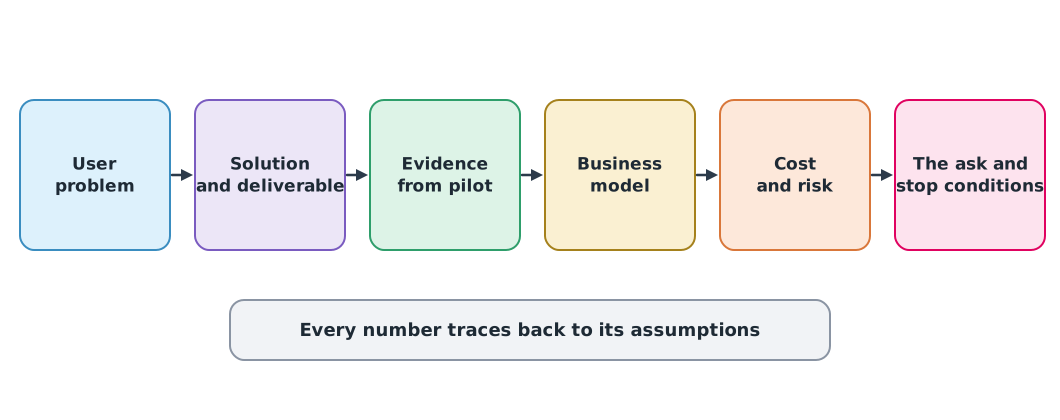
- User problem: who has what problem, and what the current way lacks
- Solution and deliverable: what is delivered, by when, and how it is accepted
- Evidence: MVP or pilot results, with their uncertainty
- Business model: who pays, market size and contribution margin per job
- Cost and risk: TCO, NPV, sensitivity, and key risks with responses
- The ask and stop conditions: how much money, people or approval is requested, and when the project will stop or be reviewed
Principles of a good proposal
Separate three things clearly: checked facts, assumptions and what still needs checking. Every number must be traceable, with no claims of returns or certification without evidence, and with measurable stop conditions. The drone knowledge hub’s unit for executives and policymakers uses the same principles to assess proposals.
Class activity
Activity: pitching the service-unit proposal
- Each group combines its results from modules 1 to 4 into a five-minute proposal following the structure in Figure 2.
- Build a five-dimension feasibility table, listing the evidence you have and what still needs checking in each.
- Build the group’s weighted matrix and find how much the weights must change for the decision to flip.
- Swap roles to act as a committee: ask other groups at least three questions challenging their most important assumptions, then score them with the criteria in the hub’s unit on choosing drone missions.
Common mistakes
Watch out
- Assessing only the finances, forgetting the law or team readiness
- Sizing the market with unsourced figures, or treating market-research press releases as evidence
- Letting a total score compensate for a failed must-have
- Offering a single answer without saying how sensitive the decision is to assumptions
- Having no stop conditions, so decision makers do not know when to pull back
Summary
- Feasibility must pass all five dimensions: market, technical, financial, legal and operational
- TAM–SAM–SOM narrows market size layer by layer, and every share needs supporting evidence
- Exclude options that fail must-haves first, then use a weighted matrix and test its sensitivity
- A good proposal separates facts, assumptions and open questions, and ends with the ask and stop conditions
Check your understanding
- A project is financially worthwhile but not permitted to fly in the area. Which feasibility dimension fails?
- TAM is 10 million baht, SAM is 40% of TAM and the expected share is 10% of SAM. What is SOM?
- With weights 0.5 and 0.5, an option scores 4 and 2. What is its weighted score?
- Should you choose the option with the highest total score if it fails the deliverable requirement?
- What should the last part of a project pitch contain?
Answers
- Legal and regulatory
- million baht, or 400,000 baht
- No: must-have conditions come first, and a total score cannot compensate
- The ask (money, people, approval) and measurable stop or review conditions
Key formulas
| Weighted score | |
| Market size |
Key references
- Project Management Institute. (2025). A guide to the project management body of knowledge (PMBOK guide) (8th ed.). link
- Osterwalder, A., & Pigneur, Y. (2010). Business model generation. Wiley. link
- Blank, S., & Dorf, B. (2012). The startup owner's manual: The step-by-step guide for building a great company. K&S Ranch.
- Ries, E. (2011). The lean startup. Crown Business. link
- Kneifel, J., & Webb, D. (2022). Life cycle costing manual for the Federal Energy Management Program (NIST Handbook 135, 2022 ed.). National Institute of Standards and Technology. link
- International Organization for Standardization. (2018). Risk management – Guidelines (ISO 31000:2018). link
- กรมทรัพย์สินทางปัญญา กระทรวงพาณิชย์. สิทธิบัตร อนุสิทธิบัตร ลิขสิทธิ์ และเครื่องหมายการค้า. link
Further reading
Study the assigned knowledge units in advance, review media and take the module quiz
In class / field
Lecture, case discussion and in-class problem solving
Learning evidence: Quiz results and submitted exercises