Preventive and corrective maintenance
UAT 321 Unmanned Aircraft Systems Installation, Integration, Inspection and Maintenance Laboratory
Lesson
By the end of this module you will be able to
- Distinguish preventive from corrective maintenance, and explain intervals set in hours, cycles and days
- Calculate which items are due on a "whichever comes first" basis with a program
- Write a job card citing the manufacturer's manual, and decide from evidence whether to return to service or hold
- Calculate observed event rate and availability, and state the limits of these figures
Why this matters
A car’s service book says to change the oil every 10,000 kilometres or every 6 months, whichever comes first. Drones need the same system. A propeller with a hairline crack or a bolt slowly loosening from vibration gives no warning until something happens. Good maintenance finds problems before they cause incidents, and records every job so it can be traced.
Two kinds of maintenance
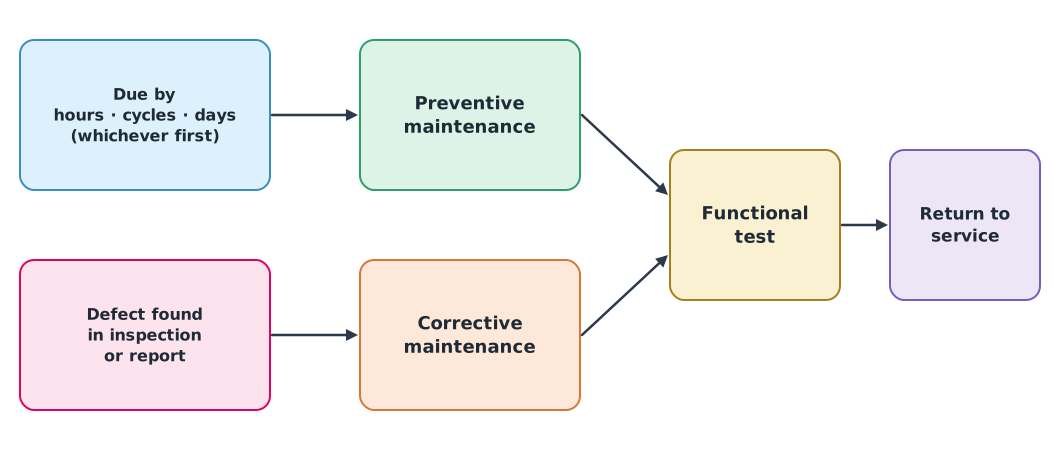
- Preventive maintenance is done on a schedule to stop parts failing in service, such as inspecting propellers every 5 flight hours
- Corrective maintenance is done when a defect is found, from a pre-flight check, a pilot report or the diagnosis in module 3
Maintenance intervals can be set in three ways, used together:
| Unit | Suits | Example |
|---|---|---|
| Flight hours | Wear from rotation and vibration | Motor bearings |
| Cycles | Stress from take-offs and landings or charging | Landing gear, battery charge cycles |
| Calendar days | Deterioration over time even when unused | Rubber, seals, firmware review |
Real intervals must come from the manufacturer’s manual for that model. ASTM F2909, the standard on continued airworthiness of lightweight unmanned aircraft systems, likewise relies on maintenance information from the manufacturer. The figures in this lesson are hypothetical values for practice.
Example 1 Items that are due
A hypothetical drone has 48.6 flight hours and 131 cycles, and today is 27 September 2026. Each task has intervals in different units.
from datetime import date

now = {"hours": 48.6, "cycles": 131, "date": date(2026, 9, 27)}
tasks = [  # task, last done (hours, cycles, date), interval (hours, cycles, days); None = unit not used
    ("propeller inspection", (45.0, 118, date(2026, 9, 10)), (5, 20, 30)),
    ("motor bearing check", (25.0, 70, date(2026, 7, 1)), (25, None, 90)),
    ("frame bolt torque check", (40.0, 100, date(2026, 6, 20)), (20, None, 90)),
    ("firmware and parameter review", (30.0, 90, date(2026, 8, 1)), (None, None, 180)),
]
for name, (h0, c0, d0), (dh, dc, dd) in tasks:
    left = []
    if dh:
        left.append(("h", round(h0 + dh - now["hours"], 1)))
    if dc:
        left.append(("cycles", c0 + dc - now["cycles"]))
    if dd:
        left.append(("days", (d0 - now["date"]).days + dd))
    status = "DUE" if any(v <= 0 for _, v in left) else "ok"
    print(f"{name:<30} {status:<4} " + ", ".join(f"{v:+g} {k}" for k, v in left))
propeller inspection ok +1.4 h, +7 cycles, +13 days
motor bearing check ok +1.4 h, +2 days
frame bolt torque check DUE +11.4 h, -9 days
firmware and parameter review ok +123 daysThe frame bolt torque check still has 11.4 flight hours left but is 9 days past its calendar limit, so it is due, because whichever comes first applies. The propeller and bearing checks have little time left and should be done in the same visit to reduce downtime.
The job card
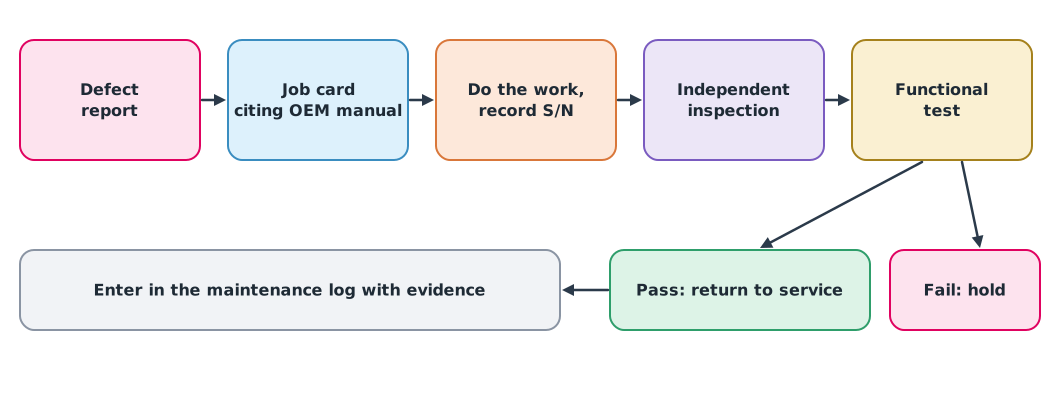
A job card links the assigned task, the steps from the manual, the inspection results and the person authorised to sign off, in one document.
A good job card states:
- Aircraft identity: serial number, firmware version and the manual revision used
- Steps and specified values: citing the manufacturer’s manual, such as torque values and test criteria. No generic torque value can replace the manual for every model
- Parts: part numbers and serial numbers (S/N) of both the removed and the installed parts
- Results and signatures: the person doing the work and the inspector should be different people, as far as resources allow
- Functional test after the repair, before return to service
The Thai CAAT guidance for developing an operations manual requires a maintenance log and a functional test after maintenance before the aircraft is used again. If key information is missing, such as a part number or test criteria, the job must be held. Never sign a job off in place of an actual inspection.
Reliability figures
With enough records, you can calculate fleet indicators. The observed event rate is the number of events divided by operating hours, and availability is the fraction of time the aircraft was ready for service.
events, operating_hours = 2, 100
up_hours, down_hours = 90, 10
print(f"observed event rate {events / operating_hours:.2f} per hour "
      f"({events / operating_hours * 100:.0f} per 100 h)")
print(f"observed availability {up_hours / (up_hours + down_hours):.0%}")
observed event rate 0.02 per hour (2 per 100 h)
observed availability 90%The NIST engineering statistics handbook separates repairable systems from non-repairable parts. For a repairable system, the rate to track is the rate of occurrence of failures over time (ROCOF), which may rise as the aircraft ages, so do not simply invert the rate and call it “mean time between failures”. Finding no events in 100 hours does not prove the risk is zero. You must also define what counts as an “event” and how repeated alarms from one event are counted.
Module lab
Lab: a maintenance programme and a job card repair
- From the training drone’s manufacturer manual, build a preventive maintenance table with intervals in hours, cycles or days and the manual section for each.
- Enter the lab aircraft’s usage into the code in Example 1 to find which items are due.
- Write a job card for a defect found in module 3, such as replacing a propeller or motor, recording the part numbers removed and installed.
- Do the work on the job card, with a member of another group as inspector, then run a bench functional test (propellers removed) and a supervised test hover.
- Decide to return to service or hold, with reasons, and enter it in the maintenance log.
Common mistakes
Watch out
- Tracking intervals in only one unit, forgetting items due by calendar
- Using torque values or criteria from another model instead of the manual for the model being repaired
- Returning to service without a functional test
- Signing as inspector without actually inspecting, or writing records after the fact
- Reporting infinite mean time between failures when no event has occurred yet
Summary
- Preventive maintenance follows a schedule; corrective maintenance follows a defect; both end with a functional test
- Intervals can use hours, cycles and days together, and are due when any unit is reached first
- A job card cites the manufacturer’s manual and records parts, results and signatures; hold the job if information is missing
- Event rate and availability are observed values that need definitions and limits stated
Check your understanding
- A task is due every 10 hours or 60 days. It was last done at 20 flight hours, 50 days ago. The aircraft now has 29 hours. Is it due?
- In question 1, if 12 more days pass with only 0.5 more flight hours, is it due?
- 3 events occur in 150 operating hours. What is the observed event rate?
- An aircraft is ready for 170 hours and not ready for 30 hours. What is its availability?
- A job card has no post-repair test criteria. What should you do?
Answers
- Not yet: 1 flight hour and 10 days remain
- Yes, it is due, because 62 days have passed, exceeding 60 days, even though 0.5 flight hours remain
- per hour
- Hold the job and obtain criteria from the manufacturer’s manual or the responsible person first; do not return the aircraft to service
Key formulas
| Due, whichever comes first | |
| Observed event rate | |
| Observed availability |
Key references
- ASTM International. (2019). Standard specification for continued airworthiness of lightweight unmanned aircraft systems (ASTM F2909-19). link
- สำนักงานการบินพลเรือนแห่งประเทศไทย. (2565). รูปแบบคู่มือปฏิบัติการบินของอากาศยานซึ่งไม่มีนักบิน (CAAT-GM-UAS-001, Issue 01 Rev 00). link
- NIST/SEMATECH. Repairable systems, 8.1.2.1. e-Handbook of statistical methods. link
- Federal Aviation Administration. (2023). Aviation maintenance technician handbook – General (FAA-H-8083-30B). link
Further reading
Study the assigned knowledge units in advance, review media and take the module quiz
Maintenance programmes and records
Maintenance work and post-repair checks
In class / field
Intensive lab and field practice recorded in a lab notebook
Learning evidence: Lab notebook signed by the instructor