Batteries and records
UAT 321 Unmanned Aircraft Systems Installation, Integration, Inspection and Maintenance Laboratory
Lesson
By the end of this module you will be able to
- Explain the per-cell voltage ranges of lithium-polymer batteries and the principles of charging, storage and retirement
- Analyse a battery register with a program to assign each pack a status against criteria set by the organisation
- Calculate energy in Wh and classify batteries under IATA air transport guidance
- Link aircraft and battery records so they can be traced, and assess readiness before operations
Why this matters
The battery is the fastest-wearing and most dangerous part of a drone. A lithium battery that is overcharged, punctured or swollen can catch fire and is hard to extinguish. An organisation with dozens of packs must know each pack’s history, and which ones to retire before they retire themselves in the air.
Voltage per cell
A lithium-polymer (LiPo) pack consists of several cells in series; 6S, for example, means 6 cells. Care is therefore thought of in voltage per cell.
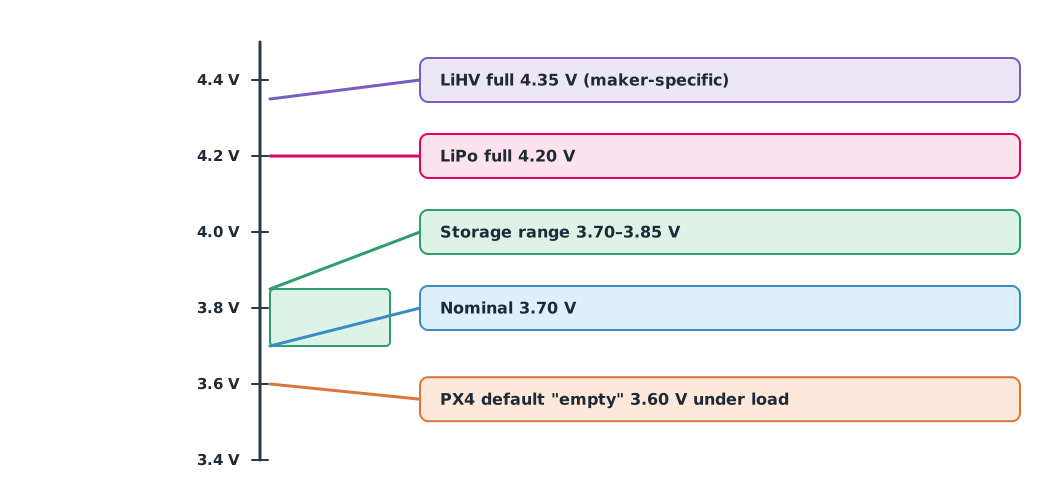
- Nominal 3.7 V per cell, used to calculate energy
- Fully charged 4.2 V per cell. High-voltage packs (LiHV) charge to 4.35 V or higher as the manufacturer specifies; the charger must be set to the right type
- Storage about 3.7–3.85 V per cell. If a pack will not be used for several days, do not store it fully charged; most chargers have a storage mode
- In flight the measured voltage is lower than the resting voltage because of internal resistance. PX4’s default treats 3.6 V per cell under load as “empty”
Lithium battery safety
Charge on a non-flammable surface under supervision, using balance mode. Never charge or use a pack that is swollen, punctured or abnormally hot, and isolate damaged packs in a fire-resistant container until disposed of by the organisation’s procedure.
The battery register
The Thai CAAT guidance for developing an operations manual requires a battery record for every charge. A good register shows each pack’s wear trend, such as falling measured capacity and rising internal resistance.
Example 1 Assigning battery status from the register
The file battery_log.csv is a hypothetical register of eight 6S 5000 mAh packs (download from /downloads/uat-321/). The criteria in the code are a hypothetical organisation’s criteria for practice; a real organisation must set them from the manufacturer’s data and its own history.
import pandas as pd

packs = pd.read_csv("battery_log.csv")
packs["capacity_pct"] = packs["measured_mAh"] / packs["rated_mAh"] * 100


def status(p):
    if p["swelling"] == "yes":
        return "remove: swelling"
    if p["capacity_pct"] < 80:
        return "remove: capacity"
    notes = []
    if p["ir_mohm_pack"] > 30:
        notes.append("watch: resistance")
    if not 3.70 <= p["storage_v_per_cell"] <= 3.85:
        notes.append("fix storage voltage")
    return "; ".join(notes) or "ok"


packs["status"] = packs.apply(status, axis=1)
cols = ["pack_id", "cycles", "capacity_pct", "ir_mohm_pack", "storage_v_per_cell", "status"]
print(packs[cols].round({"capacity_pct": 1}).to_string(index=False))
print(f"correlation of cycles with capacity: {packs['cycles'].corr(packs['capacity_pct']):.2f}")
pack_id cycles capacity_pct ir_mohm_pack storage_v_per_cell status
B6S-01 12 99.2 16.8 3.82 ok
B6S-02 48 97.4 18.1 3.80 ok
B6S-03 95 92.8 21.5 3.84 ok
B6S-04 160 86.2 27.9 3.79 ok
B6S-05 210 77.2 38.4 3.81 remove: swelling
B6S-06 74 95.6 19.6 4.18 fix storage voltage
B6S-07 133 90.4 24.2 3.78 ok
B6S-08 188 80.4 33.0 3.52 watch: resistance; fix storage voltage
correlation of cycles with capacity: -0.98Pack B6S-05 is swollen and must be removed immediately, whatever its other figures. B6S-06 was stored almost full and must be discharged to storage level. B6S-08 has 80.4% capacity, close to the limit, and high resistance; it should be used only for training and watched closely. Capacity falls almost linearly with cycles in this hypothetical data; real data is usually more scattered.
Carrying batteries by air
Travelling to field work by air must follow IATA’s lithium battery guidance (the International Air Transport Association), which classifies batteries by energy in Wh; airlines may impose stricter rules. In summary, for spare batteries carried by passengers:
| Energy | Passenger spare batteries |
|---|---|
| Up to 100 Wh | Carry-on allowed without approval (up to 20 per person) |
| Over 100 up to 160 Wh | Carry-on with airline approval, up to 2 per person |
| Over 160 Wh | Not allowed with passengers; must be shipped as cargo under dangerous goods rules |
Spare batteries must be in carry-on baggage only, never in checked baggage, and each must be protected from short circuit, for example in a pouch or with covered terminals. Lithium-ion batteries shipped on their own as cargo must be at a state of charge not exceeding 30%.
def iata_category(volts, mah):
    wh = volts * mah / 1000
    if wh <= 100:
        rule = "carry-on spare, no approval needed"
    elif wh <= 160:
        rule = "carry-on spare with airline approval, max 2"
    else:
        rule = "not allowed with passengers; ship as cargo"
    return wh, rule


for name, volts, mah in [("4S 5200 mAh", 14.8, 5200), ("6S 5000 mAh", 22.2, 5000), ("12S 16000 mAh", 44.4, 16000)]:
    wh, rule = iata_category(volts, mah)
    print(f"{name:<14} {wh:6.1f} Wh -> {rule}")
4S 5200 mAh 77.0 Wh -> carry-on spare, no approval needed
6S 5000 mAh 111.0 Wh -> carry-on spare with airline approval, max 2
12S 16000 mAh 710.4 Wh -> not allowed with passengers; ship as cargoThe 6S 5000 mAh battery of this course’s drone is 111 Wh, so it needs airline approval and is limited to 2 per person. The rules can change every year; check the latest IATA guidance and the airline’s rules before every trip.
The records chain and readiness
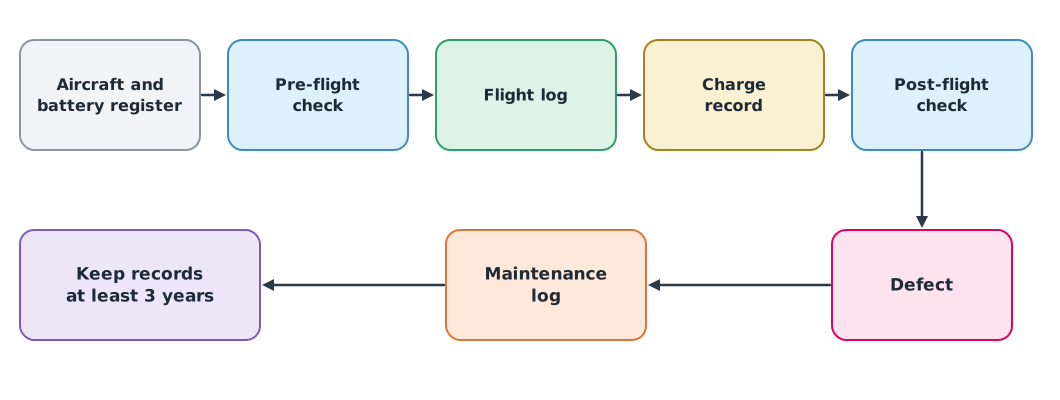
Each kind of record must refer to the others by code. For example, flight F-0412 used battery B6S-03 with pre-flight check PF-0412, and found defect DEF-021, closed by job card JC-017. When someone asks what this battery has been through, the documents answer at once. The CAAT guidance requires pre-flight and post-flight checks and records kept for at least 3 years.
Readiness before operations
An aircraft is ready when no maintenance item is overdue, no open defect affects safety, every battery to be used has a usable status, the pre-flight check has fully passed, and the documents match the aircraft model and firmware. If any field has no data yet, its status is “unknown”, not “pass”.
Module lab
Lab: battery register and readiness file
- Measure the real capacity of the training batteries with a charger’s discharge mode, and internal resistance where the charger supports it, and record them in the register.
- Assign statuses with the code in Example 1, then propose the group’s retirement criteria with reasons and sources.
- Bring batteries that will not be used down to storage voltage and record the results.
- Calculate the Wh of every battery in the lab and classify each under the IATA table.
- Assemble a readiness file for one training drone, linking the record codes from modules 1–4 so the instructor can trace them.
Common mistakes
Watch out
- Storing batteries fully charged for long periods
- Setting the charger to the wrong type, such as charging a standard LiPo in LiHV mode
- Continuing to use a swollen battery because it still flies
- Putting spare batteries in checked baggage, or not seeking approval above 100 Wh
- Records that cannot refer to each other, so no one can tell which pack flew which flight
Summary
- LiPo cells are 3.7 V nominal and 4.2 V full, stored at about 3.7–3.85 V; LiHV charges higher as the manufacturer specifies
- The battery register tracks capacity, resistance, cycles and condition, and a swollen battery must be retired at once
- Energy in Wh is nominal voltage times Ah, and determines how batteries may travel by air under IATA
- All records must refer to each other, and readiness must be confirmed with evidence in every field
Check your understanding
- What is the total voltage of a fully charged 6S pack?
- How many Wh is a 22.2 V 4500 mAh battery, and how can it be carried on a flight as a spare?
- Rated capacity is 5000 mAh and measured capacity 3900 mAh. What percentage remains?
- A battery will not be used for two weeks. At about what voltage per cell should it be stored?
- An aircraft has passed its pre-flight check, but no one knows whether a due bolt-torque check has been done. What is its readiness status?
Answers
- V
- Wh, not over 100 Wh, so it may be carried on without approval, never in checked baggage, with terminals protected from short circuit
- About 3.7–3.85 V per cell
- Unknown, so not ready: check the maintenance log or do the task first
Key formulas
| Energy in watt-hours | |
| Remaining capacity |
Key references
- Grepow. What is the voltage of a LiPo battery? link
- PX4 Autopilot. Battery estimation tuning. PX4 user guide. link
- ArduPilot Dev Team. Battery failsafe. ArduPilot Copter documentation. link
- International Air Transport Association. (2026). Lithium batteries: Passenger guidance. link
- International Air Transport Association. (2026). Lithium battery guidance document. link
- สำนักงานการบินพลเรือนแห่งประเทศไทย. (2565). รูปแบบคู่มือปฏิบัติการบินของอากาศยานซึ่งไม่มีนักบิน (CAAT-GM-UAS-001, Issue 01 Rev 00). link
Further reading
Study the assigned knowledge units in advance, review media and take the module quiz
Lithium battery safety
Condition inspection and maintenance records
Checklists tied to people, aircraft and manuals
Logs, handover and post-mission debrief
In class / field
Intensive lab and field practice recorded in a lab notebook
Learning evidence: Lab notebook signed by the instructor