Command and coordination
UAT 364 Unmanned Aircraft Systems Technology for Public Safety and Emergency Management
Lesson
By the end of this module you will be able to
- Write a mission request stating the question, area, urgency, data recipient and stop conditions
- Separate the roles of requester, coordinator, pilot, analyst and recipient
- Check overlap of altitude and time blocks between drones and other aircraft
- Assess the site before flight and decide HOLD when key information is unconfirmed
Why this matters
In a large incident, several drone teams from different agencies, rescue helicopters and boats may work in the same area. Without coordination, drones may collide or block helicopter routes, halting life-saving work. The knowledge unit on coordination cites the FAA’s warning that uncoordinated drones force firefighting aircraft to stop working. Coordination is therefore part of safety, not paperwork.
Mission requests and roles
A good mission request states the question to be answered, the area, the urgency, the data recipient and the deliverable format before any decision to fly. Small teams may combine roles, but the checking function must never disappear.
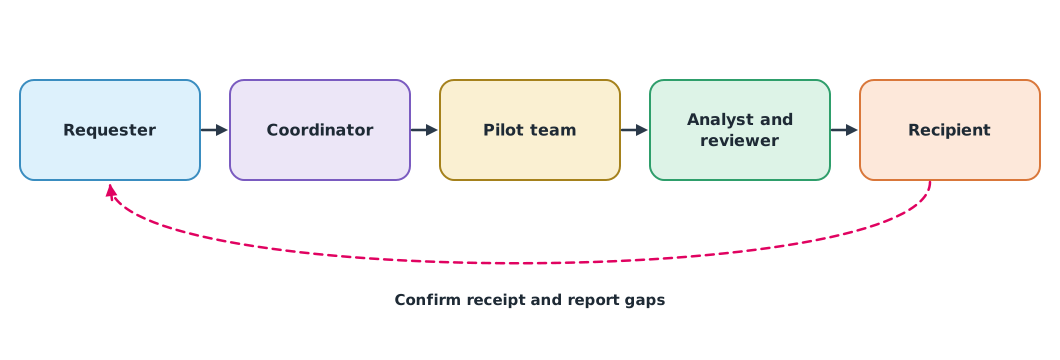
Closing a mission requires confirmation of receipt; pressing send does not mean the recipient has read and can use the data. When a mission stops part-way, the coordinator must be told which parts have been surveyed and which have no data yet.
Separating drones from other aircraft
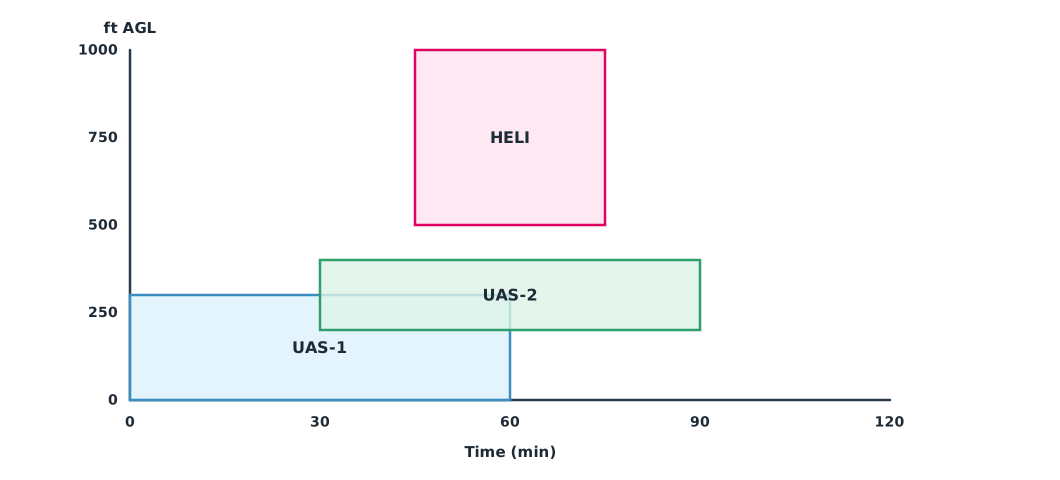
The basic method is to assign each team an altitude and time block. Two teams’ blocks must not overlap in both time and altitude at once, and a buffer is needed. The coordinator in the command post allocates them.
Example 1. Checking block overlap
from itertools import combinations

blocks = [  # name, start min, end min, floor ft, ceiling ft
    ("UAS-1", 0, 60, 0, 300),
    ("UAS-2", 30, 90, 200, 400),
    ("HELI", 45, 75, 500, 1000),
]
VERTICAL_BUFFER_FT = 100

for a, b in combinations(blocks, 2):
    time_overlap = a[1] < b[2] and b[1] < a[2]
    gap = max(b[3] - a[4], a[3] - b[4])           # vertical gap; negative = overlap
    if time_overlap and gap < VERTICAL_BUFFER_FT:
        print(f"CONFLICT {a[0]} / {b[0]}: overlap in time, vertical gap {gap} ft")
    else:
        print(f"ok {a[0]} / {b[0]}")
CONFLICT UAS-1 / UAS-2: overlap in time, vertical gap -100 ft
ok UAS-1 / HELI
ok UAS-2 / HELIUAS-1 and UAS-2 overlap in both time and altitude and must be separated, for example by starting UAS-2 at 400 ft or after minute 60. UAS-2 and the helicopter are exactly 100 ft apart, meeting the assumed buffer. In practice the buffer must come from the coordinator and agency requirements.
Site assessment and stop conditions
The knowledge unit on site assessment draws on the site safety assessment section of CAAT’s operations manual guidance (CAAT-GM-UAS-001). Risk is written as a chain: hazard → who is exposed → possible harm → control → owner → evidence of checking. HOLD is used when key information is unconfirmed, for example when the altitude block has not yet been received from the coordinator. Stop conditions agreed in advance include another aircraft entering the area, abnormal communications, or weather departing from the plan.
Delivering emergency equipment
Drones can deliver automated external defibrillators (AEDs) faster than ambulances in some cases. In the Swedish study by Schierbeck and colleagues (2023), drones were dispatched 72 times and delivered the AED in 58; where comparison was possible, the drone arrived before the ambulance in 67% of cases, with a median lead of 3 minutes 14 seconds. Results depend on distance and dispatch time.
Example 2. Drone versus ambulance arrival time
Assumed values: 2 minutes to dispatch the drone, flying at 15 m/s; the ambulance leaves after 3 minutes and averages 8 m/s on roads that are 1.4 times the straight-line distance.
for km in (2, 4, 8):
    drone_min = 2 + km * 1000 / 15 / 60
    ambulance_min = 3 + km * 1.4 * 1000 / 8 / 60
    print(f"{km} km: drone {drone_min:.1f} min, ambulance {ambulance_min:.1f} min, "
          f"drone ahead by {ambulance_min - drone_min:.1f} min")
2 km: drone 4.2 min, ambulance 8.8 min, drone ahead by 4.6 min
4 km: drone 6.4 min, ambulance 14.7 min, drone ahead by 8.2 min
8 km: drone 10.9 min, ambulance 26.3 min, drone ahead by 15.4 minThe advantage grows with distance, and may be larger in a flood when roads are cut. But lowering or releasing the load requires permission (UAT 363), and someone able to use the AED must be at the destination.
Module lab
Lab: tabletop mission coordination
- Assign the five roles and write one hypothetical mission request
- The coordinator allocates altitude and time blocks to two teams and a helicopter; check them with Example 1
- The pilot team assesses the site, writes the risk chains and decides ready or HOLD with reasons
- Inject “the helicopter enters the area early” and have the team act on its stop conditions and report status
- Close the mission with confirmation of receipt and a list of areas still without data
Common mistakes
Watch out
- Flying before receiving a block from the coordinator
- Treating “sent” as “delivered”
- No stop conditions agreed in advance
- Turning HOLD into ready under time pressure
- Delivering equipment with nobody able to use it
Summary
- A mission request states the question, area, urgency, recipient and deliverable, and closes with confirmation of receipt
- Altitude and time blocks must not overlap in both dimensions at once, and need a buffer
- Risk is written as owned chains of reasoning; use HOLD when key information is unconfirmed
- Drones can deliver AEDs before ambulances in many cases; the advantage depends on distance and dispatch time
Check your understanding
- Block A is 0–40 min at 0–200 ft and block B is 30–60 min at 150–300 ft. Do they overlap?
- Using question 1, if B starts at minute 40, do they still overlap?
- At 6 km, with 2 minutes to dispatch and 15 m/s flight, how many minutes until the drone arrives?
- What does HOLD mean?
- Why does sending a file not count as delivery?
Answers
- Yes, in both time (30–40) and altitude (150–200)
- No, because the times no longer overlap (A ends at 40, B starts at 40)
- minutes
- Not starting because key information is unconfirmed
- The recipient may not have opened it or may be unable to use it; receipt must be confirmed
Key formulas
| Overlap condition for two blocks | |
| Time to arrive |
Key references
- Federal Emergency Management Agency. (2017). National incident management system (3rd ed.). U.S. Department of Homeland Security. link
- สำนักงานการบินพลเรือนแห่งประเทศไทย. (2565). รูปแบบคู่มือปฏิบัติการบินของอากาศยานซึ่งไม่มีนักบิน (CAAT-GM-UAS-001, Issue 01 Rev 00). link
- สำนักงานการบินพลเรือนแห่งประเทศไทย. (2569). ประกาศ กพท. เรื่อง หลักเกณฑ์และวิธีการในการอนุญาตให้ผู้บังคับหรือปล่อยอากาศยานซึ่งไม่มีนักบิน ประเภทอากาศยานที่ควบคุมการบินจากภายนอก ที่มีน้ำหนักไม่เกิน 25 กิโลกรัม ปฏิบัติแตกต่างไปจากเงื่อนไขที่กำหนด พ.ศ. 2569 (มีผล 17 พฤษภาคม 2569). link
- Schierbeck, S., et al. (2023). Drone delivery of automated external defibrillators compared with ambulance arrival in real-life suspected out-of-hospital cardiac arrests: A prospective observational study in Sweden. The Lancet Digital Health, 5(12), e862–e871. link
- International Civil Aviation Organization. (2018). Safety management manual (Doc 9859, 4th ed.). link
Further reading
Study the assigned knowledge units in advance, review media and take the module quiz
UAS mission planning for emergencies
Coordinating missions and rescue airspace
Site assessment and go/no-go decisions
In class / field
Intensive lab and field practice recorded in a lab notebook
Learning evidence: Lab notebook signed by the instructor