Authorisation dossiers
UAT 402 Advanced UAS Technology and BVLOS Operations
Lesson
By the end of this module you will be able to
- Compute the outer limit of the adjacent area under SORA 2.5 Step 8
- Read the containment tables and explain why a low SAIL may need high containment
- Check gaps between evidence held and the OSO robustness a SAIL requires
- Organise an authorisation dossier that traces from conclusions to source evidence
Why this matters
The drone knowledge base’s unit on reviewing dossiers and explaining limitations advises that a reviewable dossier should start with conclusions and trace straight to source evidence, that every document needs a version and change log, and that open issues should not be hidden to make the dossier look complete. UAT 401 derived the SAIL from ground and air risk. This module continues with two often-overlooked steps: containment (what happens to neighbouring areas if the drone leaves its area) and OSOs (the evidence required by the SAIL).
Adjacent area and containment
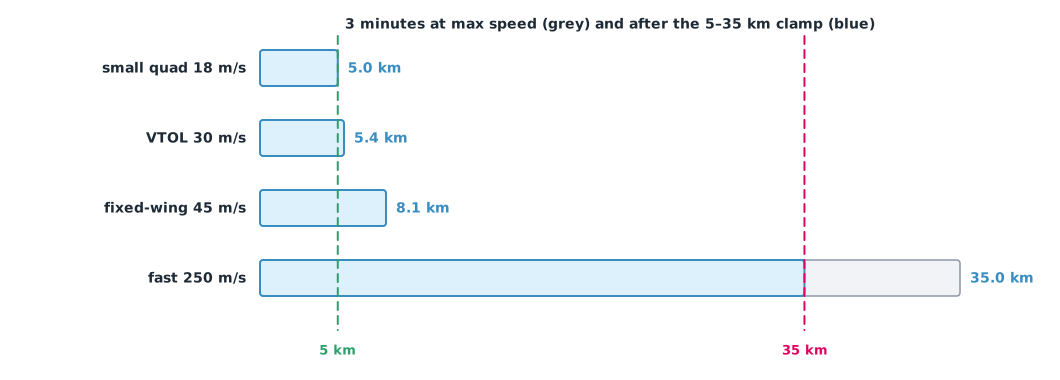
Step 8 of SORA 2.5 asks how much risk a drone that leaves its operational volume poses to neighbouring areas. The outer limit of the adjacent area is the distance the drone can fly in 3 minutes at maximum speed, but no less than 5 km and no more than 35 km. A drone of 250 g or less gets Low containment with no conditions. For others, the average population density in the adjacent area and outdoor assemblies within 1 km of the operational volume are assessed, then a table is chosen by aircraft size and SAIL.
Example 1 Adjacent area size and containment level
Compare four drones and read SORA 2.5 Table 9 (3 m aircraft, sheltering applies). Column 3 is average density below 5,000 people/km² with assemblies below 40,000; column 1 is a denser adjacent area.
# adjacent area outer limit = distance flown in 3 minutes at max speed, clamped to 5–35 km (SORA 2.5 Step 8)
def adjacent_km(vmax_ms):
    return min(max(vmax_ms * 180 / 1000, 5.0), 35.0)

for name, v in [("small quad", 18), ("VTOL mapper", 30), ("fixed-wing", 45), ("fast fixed-wing", 250)]:
    print(f"{name:16s} {v:>3} m/s -> adjacent area out to {adjacent_km(v):.1f} km")

# Table 9 (3 m UA, sheltering applies): columns from high to low density/assemblies
TABLE9 = {"I-II": ["out of scope", "High", "Medium", "Low"],
          "III": ["out of scope", "Medium", "Low", "Low"],
          "IV": ["Medium", "Low", "Low", "Low"],
          "V-VI": ["Low", "Low", "Low", "Low"]}
col = 3                       # rightmost column: average density below 5,000 people/km² and assemblies below 40,000
for sail in TABLE9:
    print(f"SAIL {sail:5s} -> containment {TABLE9[sail][col]} (column {col}),"
          f" {TABLE9[sail][1]} (column 1)")
small quad 18 m/s -> adjacent area out to 5.0 km
VTOL mapper 30 m/s -> adjacent area out to 5.4 km
fixed-wing 45 m/s -> adjacent area out to 8.1 km
fast fixed-wing 250 m/s -> adjacent area out to 35.0 km
SAIL I-II -> containment Low (column 3), High (column 1)
SAIL III -> containment Low (column 3), Medium (column 1)
SAIL IV -> containment Low (column 3), Low (column 1)
SAIL V-VI -> containment Low (column 3), Low (column 1)Most small drones get the 5 km minimum, while fast fixed-wing aircraft hit the 35 km ceiling. The table also shows something counter-intuitive: a lower SAIL needs higher containment when the adjacent area is dense, because a low SAIL carries few other reliability requirements and so relies more on keeping the drone in its area. Some cells read “out of scope”, meaning the operation cannot be done in the Specific category.
OSOs and evidence gaps
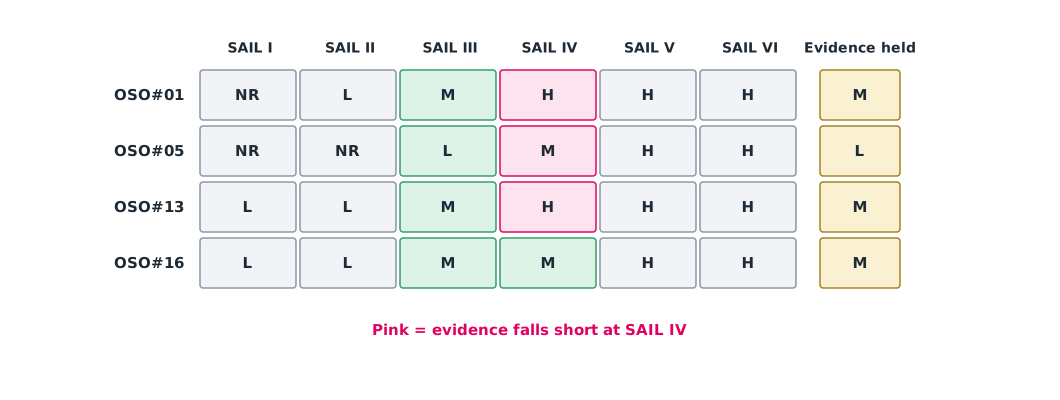
SORA 2.5 has 17 OSOs (Operational Safety Objectives). Table 14 gives the evidence robustness required by SAIL, from NR (not required) through L and M to H. Examples are OSO#01, the operator is competent; OSO#05, the UAS is designed considering system safety and reliability; OSO#13, external services supporting the operation are adequate; and OSO#16, multi-crew coordination. A good dossier is therefore not a list of documents but a table comparing “level required” with “level evidenced”, item by item.
Example 2 Evidence enough for SAIL III but not for SAIL IV
The team holds evidence at Medium for OSO#01, Low for OSO#05, Medium for OSO#13 and Medium for OSO#16. If a new route raises SAIL from III to IV, what must be added? (Training case.)
SAILS = ["I", "II", "III", "IV", "V", "VI"]
OSO = {   # required robustness from SORA 2.5 Table 14
    "OSO#01 operator competent": ["NR", "L", "M", "H", "H", "H"],
    "OSO#05 system safety and reliability": ["NR", "NR", "L", "M", "H", "H"],
    "OSO#13 external services adequate": ["L", "L", "M", "H", "H", "H"],
    "OSO#16 multi-crew coordination": ["L", "L", "M", "M", "H", "H"],
}
LEVEL = {"NR": 0, "L": 1, "M": 2, "H": 3}
claims = {"OSO#01 operator competent": "M", "OSO#05 system safety and reliability": "L",
          "OSO#13 external services adequate": "M", "OSO#16 multi-crew coordination": "M"}

for sail in ("III", "IV"):
    i = SAILS.index(sail)
    gaps = [f"{k} needs {v[i]}, has {claims[k]}" for k, v in OSO.items()
            if LEVEL[claims[k]] < LEVEL[v[i]]]
    print(f"SAIL {sail}: " + ("evidence meets all four" if not gaps else "; ".join(gaps)))
SAIL III: evidence meets all four
SAIL IV: OSO#01 operator competent needs H, has M; OSO#05 system safety and reliability needs M, has L; OSO#13 external services adequate needs H, has MAt SAIL III all four items are sufficient, but at SAIL IV three fall short: operator competence, system reliability evidence, and evidence for external services such as the mobile network used for C2. This is why redesigning the route to lower the SAIL is often cheaper than gathering more evidence, and it is an open issue that must be stated plainly in the dossier.
Module lab
Lab: a reviewable authorisation dossier
- Write the dossier’s first page as conclusions: SAIL, containment and limitations of the pipeline mission
- Compute the training drone’s adjacent area with Example 1 and find average population density from open sources
- Build a table of all 17 OSOs comparing required levels with evidence held, linking to source documents
- Give every document a version and change log, and keep a separate section of open issues
- Swap dossiers with another group and time how long reviewers take to find the evidence for each conclusion
Common mistakes
Watch out
- Skipping Step 8 because the drone “won’t leave its area”
- Assuming a low SAIL means every requirement is low
- Making the dossier a pile of documents without saying which OSO each proves
- Claiming higher evidence levels than held
- Hiding open issues to make the dossier look complete
Summary
- The adjacent area extends to 3 minutes of flight at maximum speed, clamped to 5–35 km
- Containment depends on aircraft size, neighbouring population, assemblies and SAIL, and a low SAIL may need high containment
- The 17 OSOs have required evidence levels by SAIL
- A good dossier traces from conclusions to evidence, carries versions and discloses open issues
Check your understanding
- A drone with a maximum speed of 40 m/s has what adjacent area outer limit?
- A drone with a maximum speed of 15 m/s has what outer limit?
- How many OSOs does SORA 2.5 have?
- What level does OSO#05 require at SAIL IV?
- Why might a low SAIL need higher containment?
Answers
- m = 7.2 km
- km, so the 5 km minimum applies
- 17
- Medium (M)
- A low SAIL has few other reliability requirements, so it relies more on keeping the drone in its area
Key formulas
| Adjacent area outer limit | |
| Sufficient evidence |
Key references
- Joint Authorities for Rulemaking on Unmanned Systems. (2024). JARUS guidelines on Specific Operations Risk Assessment (SORA), main body, edition 2.5 (JAR-DEL-SRM-SORA-MB-2.5). link
- สำนักงานการบินพลเรือนแห่งประเทศไทย. (2569). ประกาศ กพท. เรื่อง หลักเกณฑ์และวิธีการในการอนุญาตให้ผู้บังคับหรือปล่อยอากาศยานซึ่งไม่มีนักบิน ประเภทอากาศยานที่ควบคุมการบินจากภายนอก ที่มีน้ำหนักไม่เกิน 25 กิโลกรัม ปฏิบัติแตกต่างไปจากเงื่อนไขที่กำหนด พ.ศ. 2569 (มีผล 17 พฤษภาคม 2569). link
- สำนักงานการบินพลเรือนแห่งประเทศไทย. (2565). รูปแบบคู่มือปฏิบัติการบินของอากาศยานซึ่งไม่มีนักบิน (CAAT-GM-UAS-001, Issue 01 Rev 00). link
- Federal Aviation Administration UAS BVLOS Aviation Rulemaking Committee. (2022, March 10). Final report. link
Further reading
Study the assigned knowledge units in advance, review media and take the module quiz
In class / field
Lab or field practice from worksheets with a safety checklist
Learning evidence: Checked worksheets and quiz results