Inspection reporting and data delivery
UAT 453 UAS for Infrastructure, Energy and Utility Inspection
Lesson
By the end of this module you will be able to
- Build a defect register giving location, type, size, severity and images
- Summarise condition per structural element and identify urgent items
- Write an inspection report stating scope, method, results and limitations honestly
- Deliver data with hashes so the recipient can check completeness
Why this matters
Users see the report, not thousands of images. If the report cannot say where defects are, how severe they are and what to do next, all the flying does not help anyone decide. And if delivered data are altered later without anyone knowing, comparison with the next inspection becomes untrustworthy.
The defect register
The defect register is the report’s main table. Each defect has
- A code that is unique and used again at the next inspection
- A location in the structure’s reference system, such as element, span, pier, or face, floor and bay
- Type and size, such as a crack 0.6–1.2 mm wide and 80 cm long, with uncertainty
- Severity on the owner’s scale; this module uses four levels, from 1 (minor) to 4 (urgent action)
- Images: the detail image plus a wide image showing where it is
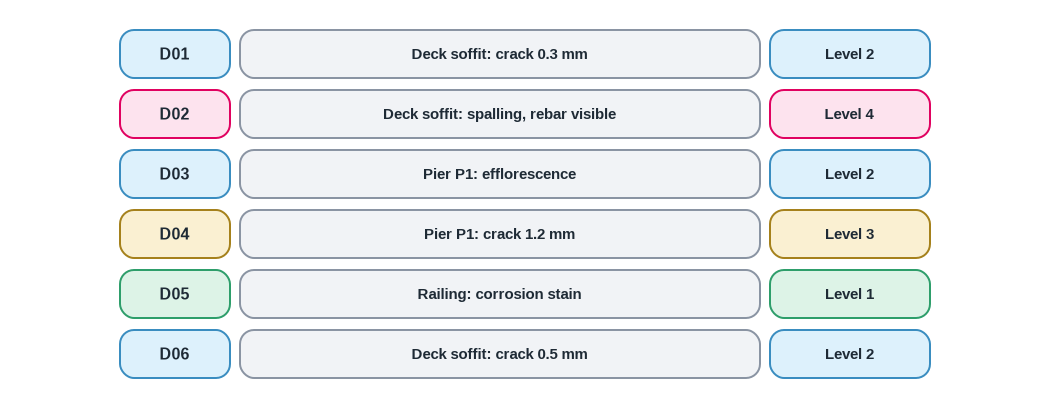
Example 1 Summarising the bridge by element
The example rule takes the worst severity in an element as its condition, because one severe defect matters more than many minor ones.
defects = [   # (code, element, type, severity level 1-4)
    ("D01", "deck soffit", "crack 0.3 mm", 2), ("D02", "deck soffit", "spalling, rebar visible", 4),
    ("D03", "pier P1", "efflorescence", 2), ("D04", "pier P1", "crack 1.2 mm", 3),
    ("D05", "railing", "corrosion stain", 1), ("D06", "deck soffit", "crack 0.5 mm", 2),
]
elements = {}
for code, element, kind, level in defects:
    elements.setdefault(element, []).append(level)
for element, levels in elements.items():
    print(f"{element:<12} {len(levels)} defects, worst level {max(levels)}")
urgent = [d[0] for d in defects if d[3] >= 4]
print(f"urgent follow-up: {', '.join(urgent)}")
deck soffit 3 defects, worst level 4
pier P1 2 defects, worst level 3
railing 1 defects, worst level 1
urgent follow-up: D02The deck soffit has three items, the worst at level 4 from D02, spalling that exposes rebar. Facilities must be told immediately without waiting for the full report, and an engineer should inspect on site. Pier P1 at level 3 should have its crack width tracked at the next inspection.
Report contents
- Scope: what was and was not inspected, and why, for example the mid-canal soffit could not be flown because of no signal and poor light
- Method: equipment, lens, GSD, distance, date and time, weather, AI model version and threshold
- Results: defect register, element summary, location plan and images
- Comparison with the previous inspection: for example, crack D04 widened from 0.8 to 1.2 mm in 12 months, about 0.03 mm per month (if the measurement methods are comparable)
- Limitations: what the method cannot see, such as delamination needing sounding, and measurement uncertainty
- Recommendations: items for engineers to follow up and the next inspection interval
The report must separate what is seen in images from engineering conclusions. Pilots and image analysts report what they see and measure; judging whether the structure is safe is the job of a qualified engineer.
Count coverage by target, not by image
A large number of delivered images can still leave parts the inspector cannot reopen, because many images may show the same element while another has none. The recipient needs to know how many targets have enough evidence to reopen, so count from the target register. A target is complete when it has both an overview image that shows its location and context and a detail image that shows the material surface. A target with only an overview can be located but not examined, and a target with no image must be recorded as unknown, never as “no damage found”. Enlarging an overview afterwards does not add detail that was not recorded when the image was taken (the damage size that must be visible versus GSD is in module 1).
Example 2 Fifteen images, how many targets covered
A bridge has six targets, and the table holds the number of overview and detail images for each.
# number of images per target: (overview, detail)
shots = {"P1 top": (1, 4), "P1 base": (1, 2), "deck soffit mid": (1, 0),
         "deck soffit end": (1, 1), "pier cap": (0, 0), "railing": (1, 3)}
images = sum(o + d for o, d in shots.values())
paired = [k for k, (o, d) in shots.items() if o >= 1 and d >= 1]
unknown = [k for k, (o, d) in shots.items() if o == 0 and d == 0]
partial = [k for k in shots if k not in paired and k not in unknown]
print(f"images {images}, targets {len(shots)}, avg {images / len(shots):.1f} per target")
print(f"targets with overview+detail pair: {len(paired)}/{len(shots)} = {len(paired) / len(shots):.1%}")
print("partial:", ", ".join(partial))
print("unknown (not imaged):", ", ".join(unknown))
images 15, targets 6, avg 2.5 per target
targets with overview+detail pair: 4/6 = 66.7%
partial: deck soffit mid
unknown (not imaged): pier capFifteen images average 2.5 per target, yet only 4 of 6 targets, or 66.7%, have a complete pair. The mid-span deck soffit has an overview without a detail image, so it needs more images or another way of access. The pier cap has no image at all, so the report must say “not yet inspected” with the reason and who will inspect it next.
Delivering data with hashes
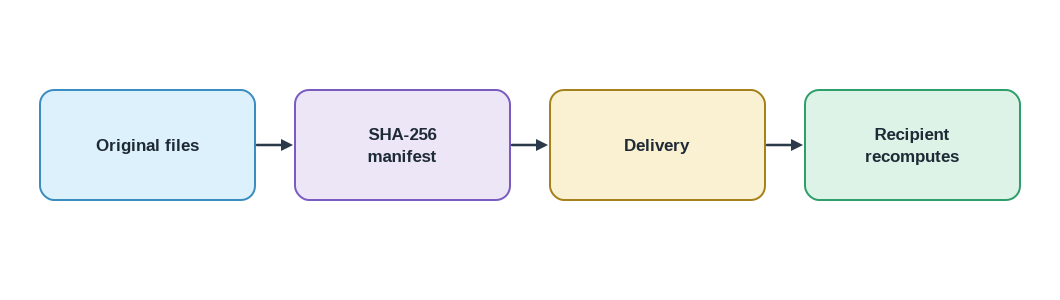
The recipient must be able to check that the files are complete and unaltered. A hash function such as SHA-256, specified in FIPS 180-4, computes a “fingerprint” of a file; if even one byte changes, the hash changes. A matching hash only proves the file matches what was listed, not that its content is correct.
Example 3 A hash manifest for the delivery
Short sample data stand in for real files.
import hashlib

files = {"DJI_0001.JPG": b"raw image bytes 1", "DJI_0002.JPG": b"raw image bytes 2", "report.pdf": b"inspection report v1"}
manifest = {name: hashlib.sha256(data).hexdigest() for name, data in files.items()}
for name, h in manifest.items():
    print(f"{h[:16]}...  {name}")
files["report.pdf"] = b"inspection report v2"          # someone edits the file after handover
changed = [n for n, d in files.items() if hashlib.sha256(d).hexdigest() != manifest[n]]
print(f"changed after handover: {changed}")
0392f1a7e130ba30... DJI_0001.JPG
6e0ad73ea1b97ac3... DJI_0002.JPG
573358e5366f4337... report.pdf
changed after handover: ['report.pdf']The recipient recomputes each file’s hash and compares it with the manifest. If the report was edited after handover, the hashes no longer match and this is seen at once. Good delivery keeps the original images untouched and works only on copies.
Module lab
Lab: a short inspection report
- Enter the defects from modules 3 and 4 in a defect register with code, location, type, size with uncertainty, severity and images
- Summarise condition by element with the code in Example 1 and identify urgent items
- Count coverage by target with the code in Example 2, mark each incomplete target as to be re-imaged or unknown, and write a short report under the six headings, separating what was seen from engineering conclusions
- Organise the delivery folder and make a SHA-256 manifest of every file following Example 3
- Have another group check the hashes and read the report, then record questions the report cannot answer
Common mistakes
Watch out
- Not locating defects in the structure’s reference system
- Waiting for the full report when an urgent defect is found
- Not stating what was not inspected, so users assume full coverage
- Declaring the structure safe when you are the data collector, not the judging engineer
- Editing original images or delivering without a hash manifest
Summary
- A defect register gives code, location, type, size with uncertainty, severity and images
- Summarise each element by its worst severity and report urgent items immediately
- Reports cover scope, method, results, comparison with the previous inspection, limitations and recommendations, separating what was seen from engineering conclusions
- SHA-256 hashes let recipients check files are unaltered, but do not prove content is correct
Check your understanding
- An element has defects at levels 1, 2, 2 and 3. What is its condition under this module’s rule?
- A crack widened from 0.5 to 0.9 mm in 8 months. What is the growth rate?
- What does a matching hash prove, and what does it not prove?
- Why must the report state what was not inspected?
- Who decides whether the structure is safe?
Answers
- Level 3
- mm per month
- It proves the file matches the manifest and was not altered, but not that its content is correct
- So users do not assume full coverage and can plan to inspect those parts by other means
- A qualified engineer-inspector
Key formulas
| Element condition | |
| Crack growth rate |
Key references
- Federal Highway Administration. (2022). National bridge inspection standards (Final rule). Federal Register, 87(88), 27396. 23 CFR 650 Subpart C. link
- National Institute of Standards and Technology. (2015). Secure hash standard (SHS) (FIPS 180-4). link
- Barnhart, R. K., Marshall, D. M., & Shappee, E. (Eds.). (2021). Introduction to unmanned aircraft systems (3rd ed.). CRC Press. link
- OpenDroneMap Authors. Outputs. OpenDroneMap documentation (Version 3.6.0). link
Further reading
Study the assigned knowledge units in advance, review media and take the module quiz
Accepting and packaging deliverables
Preserving evidence and handing over data
Case lab: a road after rain and data quality
M04 Condition inspection: from image angles to a list for the next inspector
Originals, hashes and traceable reports
In class / field
Lab or field practice from worksheets with a safety checklist
Learning evidence: Checked worksheets and quiz results