Weight and energy calculations
UAT 457 UAS for Transportation and Autonomous Delivery
Lesson
By the end of this module you will be able to
- Build a mass budget and find the allowable goods mass from the maximum take-off mass
- Compute the centre of gravity along the body axis and check that mass and CG pass together
- Compute hover power with momentum theory and explain how site elevation affects it
- Compute fixed-wing cruise power from the lift-to-drag ratio
- Build an energy budget by mission phase with a reserve and find the longest round trip
Why this matters
In Module 1 we chose a VTOL fixed-wing advertised to fly 80 km. That figure does not say what it carried, at what altitude, in what wind, or with how much reserve. Real delivery work has to answer “on this trip, with this load, to this point, does the drone get home with enough energy left?” The answer comes from two budgets: a mass budget and an energy budget. This module works out both for the route to Pha Tang SHPH (C), the hardest one because it is on a ridge and needs a winch hand-off. Basic power and efficiency were covered in UAT 102 Module 4; here we apply them to a real mission.
Mass budget
The maximum take-off mass (MTOM) is the highest total mass the manufacturer certifies as safe to fly. Everything on board counts: structure, motors, flight control, battery, payload equipment and goods. What remains for goods is MTOM minus every item that flies. Besides total mass, the box position shifts the centre of gravity, which must stay within the manufacturer’s limits; centre of gravity and payload installation were covered in UAT 302 Module 4.
Example 1 Mass budget of the VTOL drone
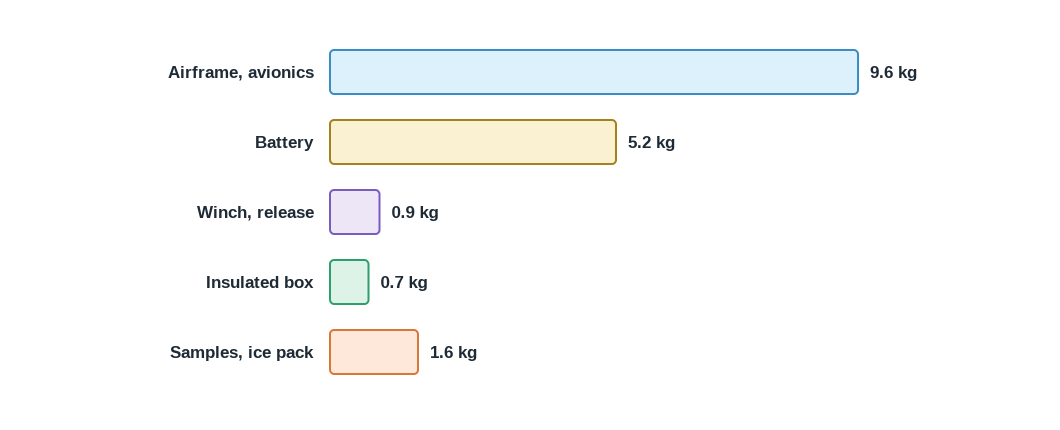
MTOM is 18.5 kg. Airframe and avionics 9.6 kg, battery 5.2 kg, winch and release 0.9 kg, insulated box 0.7 kg. On the return trip the goods are 1.2 kg of blood samples plus a 0.4 kg ice pack (all assumed).
# mass budget (kg), assumed values
mtom = 18.5
parts = {"airframe + avionics": 9.6, "battery": 5.2, "winch + release": 0.9, "insulated box": 0.7}
contents = {"samples": 1.2, "ice pack": 0.4}
empty = sum(parts.values())            # mass that flies every trip, even without goods
allow = mtom - empty
load = sum(contents.values())
m = empty + load
print(f"operating mass without goods {empty:.1f} kg")
print(f"allowed goods {allow:.1f} kg, planned {load:.1f} kg, margin {allow - load:.1f} kg")
print(f"take-off mass {m:.1f} kg = {m / mtom:.0%} of MTOM")
operating mass without goods 16.4 kg
allowed goods 2.1 kg, planned 1.6 kg, margin 0.5 kg
take-off mass 18.0 kg = 97% of MTOMOnly 2.1 kg of goods fit on an 18.5 kg aircraft, about 11% of the total, so every gram of payload equipment counts. The 0.9 kg winch flies on every trip, even where the drone could land. If routes A and B never need it, the team could remove it and use the difference for goods or a bigger battery. At 18.0 kg the aircraft is at 97% of MTOM, close to the limit, so not even one extra bag may be added beyond the plan.
Centre of gravity and the conditions that must pass together
A mass budget only says the aircraft is not too heavy; it does not say the aircraft is balanced. The centre of gravity (CG) is the mass-weighted average position of every item. If each item’s position is measured along the body axis from a reference point (positive toward the nose), then (Serway & Jewett, 2018), and the result must stay inside the window the manufacturer sets for that model. A pre-flight check therefore has three conditions that must all pass and cannot stand in for one another: total mass within MTOM, CG within its window, and enough energy (the energy budget is at the end of this module).
Example 1 (continued) Mass passes but the CG is out of range
Take the same parts as Example 1 and add positions along the body axis (assumed). The battery sits 0.08 m behind the reference point; the winch, box and goods sit 0.10 m ahead of it. The allowed CG window is assumed to be ±0.015 m. Then try moving the goods box to 0.40 m.
mtom = 18.5
items = {            # mass (kg), position x along the body axis (m, forward positive from the datum) - assumed values
    "airframe + avionics": (9.6, 0.00),
    "battery":             (5.2, -0.08),
    "winch + release":     (0.9, 0.10),
    "insulated box":       (0.7, 0.10),
    "samples + ice pack":  (1.6, 0.10),
}
CG_LIMIT = 0.015     # assumed manufacturer window: -0.015 m to +0.015 m

def check(parts, label):
    if any(mass is None for mass, _ in parts.values()):
        print(f"{label}: a mass is unknown, so total mass and CG are unknown (not zero)")
        return
    m = sum(mass for mass, _ in parts.values())
    cg = sum(mass * x for mass, x in parts.values()) / m
    print(f"{label}: mass {m:.1f} kg ({'ok' if m <= mtom else 'over'}), CG {cg:+.3f} m ({'ok' if abs(cg) <= CG_LIMIT else 'OUT'})")

check(items, "planned")
moved = {**items, "samples + ice pack": (1.6, 0.40)}      # box fitted further forward
check(moved, "goods at x=+0.40")
others = [v for k, v in moved.items() if k != "samples + ice pack"]
m_o = sum(m for m, _ in others); mom_o = sum(m * x for m, x in others)
x_max = (CG_LIMIT * (m_o + 1.6) - mom_o) / 1.6
print(f"goods may sit no further forward than x = {x_max:+.3f} m")
check({**items, "samples + ice pack": (None, 0.10)}, "sample mass not yet weighed")
planned: mass 18.0 kg (ok), CG -0.005 m (ok)
goods at x=+0.40: mass 18.0 kg (ok), CG +0.021 m (OUT)
goods may sit no further forward than x = +0.329 m
sample mass not yet weighed: a mass is unknown, so total mass and CG are unknown (not zero)The original plan passes both mass and CG (the CG is slightly behind the reference point because the battery is heavy). With the goods moved to 0.40 m, total mass is still 18.0 kg and passes, but the CG shifts to +0.021 m and leaves the window. Moving 1.6 kg another 0.30 m forward shifts the CG by 1.6 × 0.30 ÷ 18.0 ≈ 0.027 m. The fix is to place the goods no further forward than +0.329 m, or to move the battery to counterbalance. The last line warns about something else: if any item has not been weighed, the total and the CG are unknown. Never substitute 0, because that gives a figure that looks complete but is wrong. The positions and the window in the example are assumed; real work uses the model’s manual and actual weighing.
Hover power
During take-off, landing and lowering goods, the lift rotors carry the whole weight. Rotor momentum theory gives the ideal induced power , where is total thrust, air density and total disc area (Leishman, 2006). Electrical power is found by dividing by an overall efficiency , which UAT 102 approximates as 0.52 (speed controller, motor and rotor figure of merit).
The formula says two important things. First, power grows as : 10% more mass needs about 15% more power. Second, thinner air raises power as . Pha Tang is almost 1,000 m above sea level. Density comes from the standard atmosphere, , valid in the troposphere (International Civil Aviation Organization, 1993). On hot days the air is thinner still.
Example 2 Hover power at different elevations
Four lift rotors of 0.66 m diameter, overall efficiency 0.52, mass from Example 1 (assumed).
import math
g = 9.81
def rho_isa(h):
    # standard air density (kg/m3) at h metres in the troposphere
    return 1.225 * (1 - 2.25577e-5 * h) ** 4.25588
def hover_power(mass, h, n_rot=4, d=0.66, eta=0.52):
    # electrical hover power from momentum theory (W)
    t = mass * g
    a = n_rot * math.pi * (d / 2) ** 2
    return t ** 1.5 / math.sqrt(2 * rho_isa(h) * a) / eta
for h in (0, 500, 1000):
    print(f"elev {h:4d} m: rho {rho_isa(h):.3f} kg/m3, hover {hover_power(m, h):.0f} W")
print(f"empty box, 1000 m: hover {hover_power(m - load, 1000):.0f} W")
elev 0 m: rho 1.225 kg/m3, hover 2464 W
elev 500 m: rho 1.167 kg/m3, hover 2525 W
elev 1000 m: rho 1.112 kg/m3, hover 2587 W
empty box, 1000 m: hover 2250 WHovering at 1,000 m takes 2,587 W, 123 W (5%) more than at sea level. Without the 1.6 kg of goods it falls to 2,250 W. Both effects feed directly into the energy for lowering goods at Pha Tang.
Cruise power
In cruise the wing provides lift instead of the rotors. Drag equals weight divided by the lift-to-drag ratio . Power is drag times speed, divided by the efficiency of the pusher propeller, motor and speed controller , so (Anderson, 2016; Beard & McLain, 2012). A VTOL keeps its lift rotors and landing gear in cruise, so its is lower than a pure fixed-wing of the same size; use values from flight tests of the actual model.
Example 3 Cruise power compared with hover power
Cruise at 22 m/s with of 9 and (assumed).
v, ld, eta_c = 22.0, 9.0, 0.55          # m/s, L/D, overall cruise efficiency (assumed)
p_cruise = m * g * v / (ld * eta_c)
print(f"cruise power {p_cruise:.0f} W, {p_cruise / v / 3.6:.2f} Wh/km")
print(f"1 min hover = {hover_power(m, 1000) / p_cruise:.1f} min cruise")
cruise power 785 W, 9.91 Wh/km
1 min hover = 3.3 min cruiseCruise takes 785 W, or 9.91 Wh per kilometre. One minute of hover at Pha Tang costs as much as 3.3 minutes of cruise. That is why a VTOL fixed-wing outranges a multicopter, and why hover time at the hand-off must be kept as short as possible.
Energy budget by mission phase
A battery does not deliver its label energy, because it cannot be drained completely, voltage sags in cold or ageing packs, and a reserve is needed for headwinds, holding and diverting to an emergency site. Energy available for planning is , where is the usable fraction and the reserve fraction set by the organisation’s policy. Autopilots have a battery failsafe that returns or lands the aircraft when voltage or remaining capacity falls below a threshold (ArduPilot Dev Team, n.d.); set it to match the reserve in the plan.
A VTOL mission has phases with different power, so compute each and add them up.
| Phase | Power | Duration or amount (assumed) |
|---|---|---|
| Take-off and transition | Hover power at base plus energy to rise 40 m | 20 s climb and 15 s transition |
| Terrain climb | Potential energy | 760 m up outbound, 220 m up on return, from the Module 3 profile |
| Cruise | 28 km round trip at 22 m/s, no wind | |
| Winch hand-off | Hover power at 1,000 m | 15 s transition, 75 s lowering and reeling in, 15 s transition |
| Landing at base | Hover power at base | 15 s transition, 40 s descent |
Example 4 Energy budget for H to C and back
Li-ion battery, 12 cells in series, 44.4 V nominal, 22 Ah, 85% usable and 25% reserve (assumed). Base H is at 420 m; the hand-off at C uses density at 1,000 m. The team uses the same mass both ways, because the drone carries medicines out and blood samples back, and takes no credit for energy recovered while descending.
e_bat = 44.4 * 22.0                       # Wh
e_avail = e_bat * 0.85 * (1 - 0.25)       # 85% usable, 25% reserve
def mission(d_km, climb_out, climb_back, h_site, h_home):
    ph = {}
    ph["take-off + transition"] = (hover_power(m, h_home) * 35 + m * g * 40 / 0.52) / 3600
    ph["climb"] = m * g * (climb_out + climb_back) / eta_c / 3600
    ph["cruise"] = p_cruise * 2 * d_km * 1000 / v / 3600
    ph["hand-over (winch)"] = hover_power(m, h_site) * (15 + 75 + 15) / 3600
    ph["landing"] = hover_power(m, h_home) * (15 + 40) / 3600
    return ph
ph = mission(14.0, 760, 220, 1000, 420)
for k, e in ph.items():
    print(f"{k:22s} {e:6.1f} Wh")
tot = sum(ph.values())
print(f"battery {e_bat:.0f} Wh, available {e_avail:.0f} Wh, mission {tot:.0f} Wh, margin {e_avail - tot:.0f} Wh")
# how far can a flat site with a landing hand-off (90 s hover) be?
fixed_flat = ph["take-off + transition"] + hover_power(m, 420) * 90 / 3600 + ph["landing"]
wh_km = p_cruise / v / 3.6
print(f"flat site, landing hand-over: longest out-and-back {(e_avail - fixed_flat) / wh_km / 2:.1f} km each way")
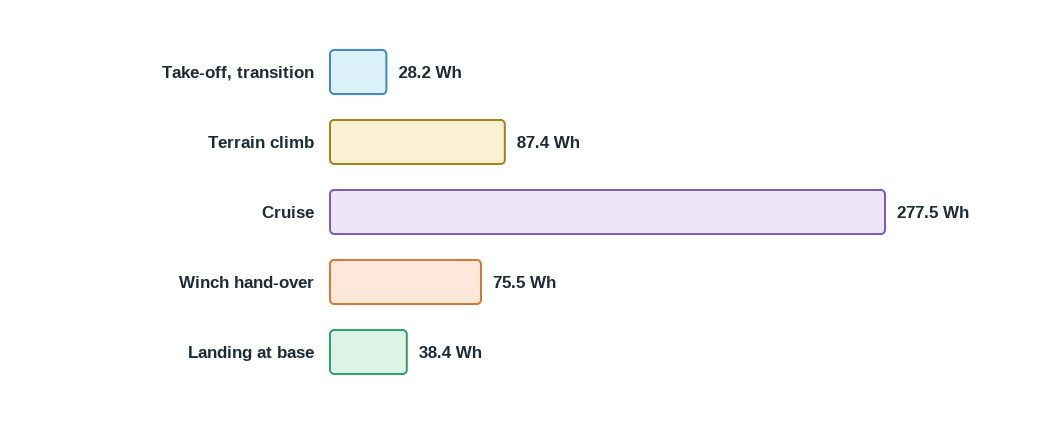
take-off + transition 28.2 Wh
climb 87.4 Wh
cruise 277.5 Wh
hand-over (winch) 75.5 Wh
landing 38.4 Wh
battery 977 Wh, available 623 Wh, mission 507 Wh, margin 116 Wh
flat site, landing hand-over: longest out-and-back 24.9 km each wayThe mission to C uses 507 Wh of the 623 Wh available, leaving 116 Wh. Cruise takes the most (277.5 Wh), but the climb over the ridge (87.4 Wh) and the winch hand-off (75.5 Wh) together take 162.9 Wh, more than half the cruise energy, in only a few minutes. The last line says a flat site with a landing hand-off can be at most about 24.9 km away. Route B, at 24.0 km, passes only just, and only on calm days; the real figure is nowhere near the advertised 80 km. The team needs a rule that route B flies only when the headwind is below a computed limit, or with less load, or with a bigger battery.
A study of the energy use of drone delivery found small drones use little energy per parcel-kilometre, but the advantage can disappear if extra warehouses or way stations are needed to keep customers within range (Stolaroff and colleagues, 2018). Real range therefore decides how many bases are needed; it is not just a technical number.
Battery safety in delivery work
A system flying many trips a day swaps batteries all day. Charge on a balance charger in a fire-resistant container, let packs cool before charging, log cycles and internal resistance for every pack, and remove swollen or unusually hot packs at once. If batteries must be shipped to another base by air, check the current IATA guidance (International Air Transport Association, 2026), because a 977 Wh pack is far above what a passenger may carry.
Module lab
Lab: weigh and measure real energy
- Weigh every part of the department’s training drone and payload equipment (box, release, dummy goods), build a mass budget with the code in Example 1, and check that the centre of gravity is within the manufacturer’s limits
- Hover steadily for 60 s within visual line of sight, twice: once without goods and once with dummy goods; read the average power from the power-monitor log
- Compare measured power with the code in Example 2 and adjust the efficiency to match the real aircraft
- With the adjusted value, build an energy budget for the route your group chose in Module 1 using the code in Example 4, and find the longest round trip with reserve
Common mistakes
Watch out
- Forgetting payload equipment not used on that trip, such as a winch or parachute that stays fitted
- Using sea-level hover power for a mountain hand-off point, where the air is thinner
- Counting cruise only, without climbing over terrain and hovering to deliver
- Cutting the reserve to make the plan pass, instead of reducing load or splitting trips
- Using advertised range instead of a value computed from real mass and confirmed in flight tests
- Setting the autopilot battery failsafe out of step with the plan, so the drone returns too late or too early
Summary
- Allowable goods mass is MTOM minus every item that flies, including payload equipment
- Hover power grows with mass to the power 3/2 and rises in thin air
- Cruise power is several times lower than hover power, so minimise hover time
- The energy budget covers every mission phase and is compared with , not the label energy
- Real range with a full load and reserve is usually far shorter than advertised range
Check your understanding
- MTOM 25 kg, everything except goods 21.3 kg: how much can the goods weigh?
- If mass rises from 16 kg to 18 kg, by what percentage does hover power rise?
- A 10 kg drone cruises at 20 m/s with = 10 and = 0.5: what is the cruise power?
- An 800 Wh battery, 85% usable, 25% reserve: how much energy is available for planning?
- Why does hovering at a mountain hand-off point need more power than at the valley base?
Answers
- kg
- , about 19% more
- W
- Wh
- Air density is lower at altitude, and hover power varies as , so the rotors must accelerate more air to make the same thrust
Key formulas
| Centre of gravity along the body axis | |
| Allowable goods mass | |
| Electrical hover power (momentum theory) | |
| Standard air density in the troposphere | |
| Fixed-wing cruise power | |
| Energy available for planning |
Key references
- Serway, R. A., & Jewett, J. W. (2018). Physics for scientists and engineers (10th ed.). Cengage.
- Leishman, J. G. (2006). Principles of helicopter aerodynamics (2nd ed.). Cambridge University Press.
- Anderson, J. D. (2016). Introduction to flight (8th ed.). McGraw-Hill.
- Beard, R. W., & McLain, T. W. (2012). Small unmanned aircraft: Theory and practice. Princeton University Press. link
- International Civil Aviation Organization. (1993). Manual of the ICAO standard atmosphere: Extended to 80 kilometres (262 500 feet) (Doc 7488, 3rd ed.). link
- ArduPilot Dev Team. Battery failsafe. ArduPilot Copter documentation. link
- International Air Transport Association. (2026). Lithium battery guidance document. link
- Stolaroff, J. K., Samaras, C., O'Neill, E. R., Lubers, A., Mitchell, A. S., & Ceperley, D. (2018). Energy use and life cycle greenhouse gas emissions of drones for commercial package delivery. Nature Communications, 9, 409. link
Further reading
Study the assigned knowledge units in advance, review media and take the module quiz
Payload mass, centre of gravity and energy
Rotors, airframe and payload: when parts block each other's airflow
ความปลอดภัยของแบตเตอรี่ลิเธียม
C03 Synthetic payload kit: the mass fits, but what about balance and energy
Getting started with payload missions and drone light shows
Downloads and bibliography for payloads and drone shows
In class / field
Lab or field practice from worksheets with a safety checklist
Learning evidence: Checked worksheets and quiz results