C03 Synthetic payload kit: the mass fits, but what about balance and energy
One-dimensional CG calculation and an energy budget, keeping unknown masses unknown, with restoration of the baseline parameters, plus KSEC criteria and a B/O/D practice kit.
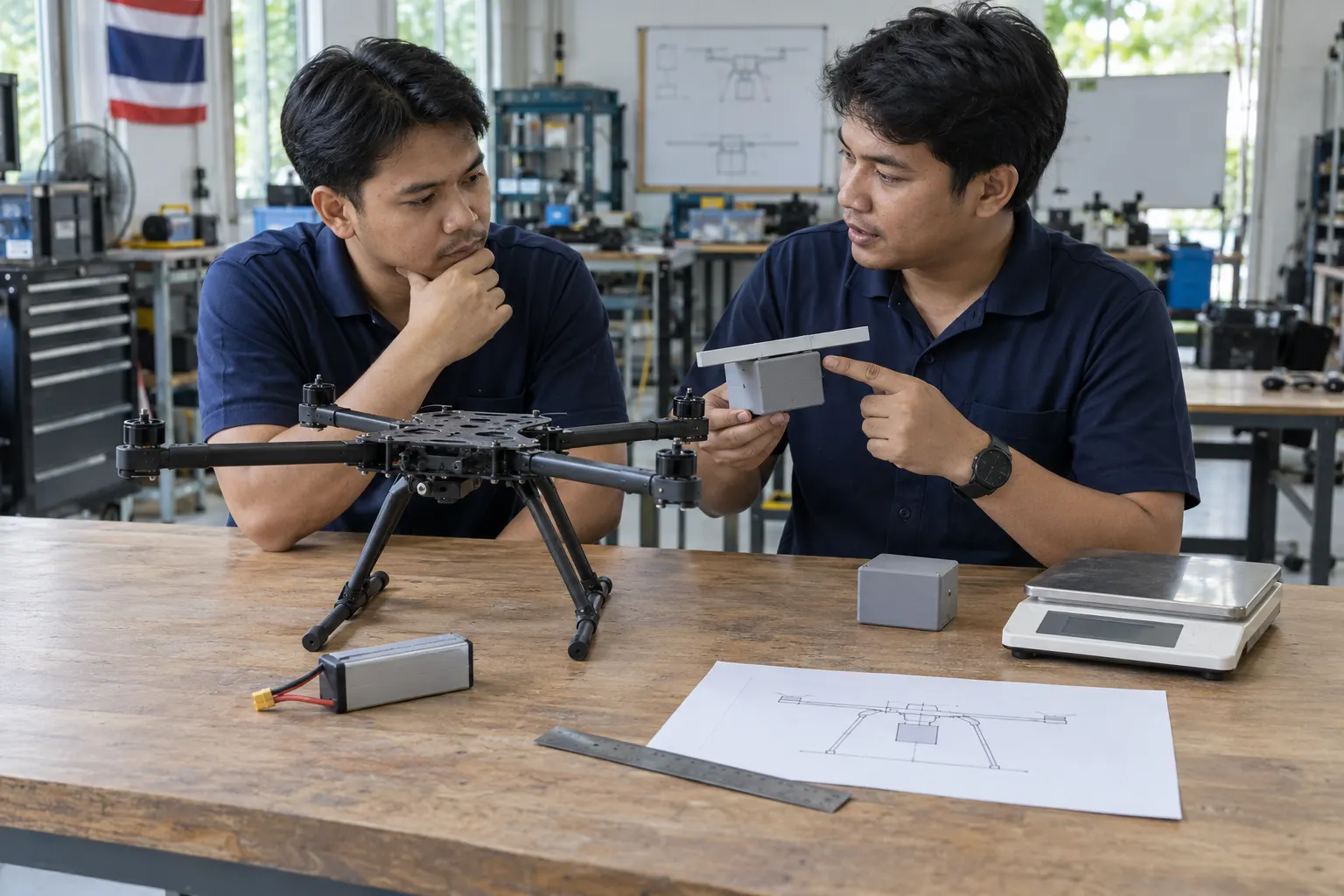
Start from what the recipient needs
The planner must separate requests that pass the mass ledger and the fictitious balance and energy checks from requests that need correcting or are waiting for data, before handing them to the person responsible for the real kit. A total mass below the limit does not show that the kit is balanced or has enough energy. This exercise uses a three-component list to reveal the conditions that must be met together, and what must be held pending when any part is unknown.
Choose B Read the scenario and choose the kit, O Plan resources or D Check the change and the evidence All three use the same case; you may also read the baseline M09 Logistics alongside.
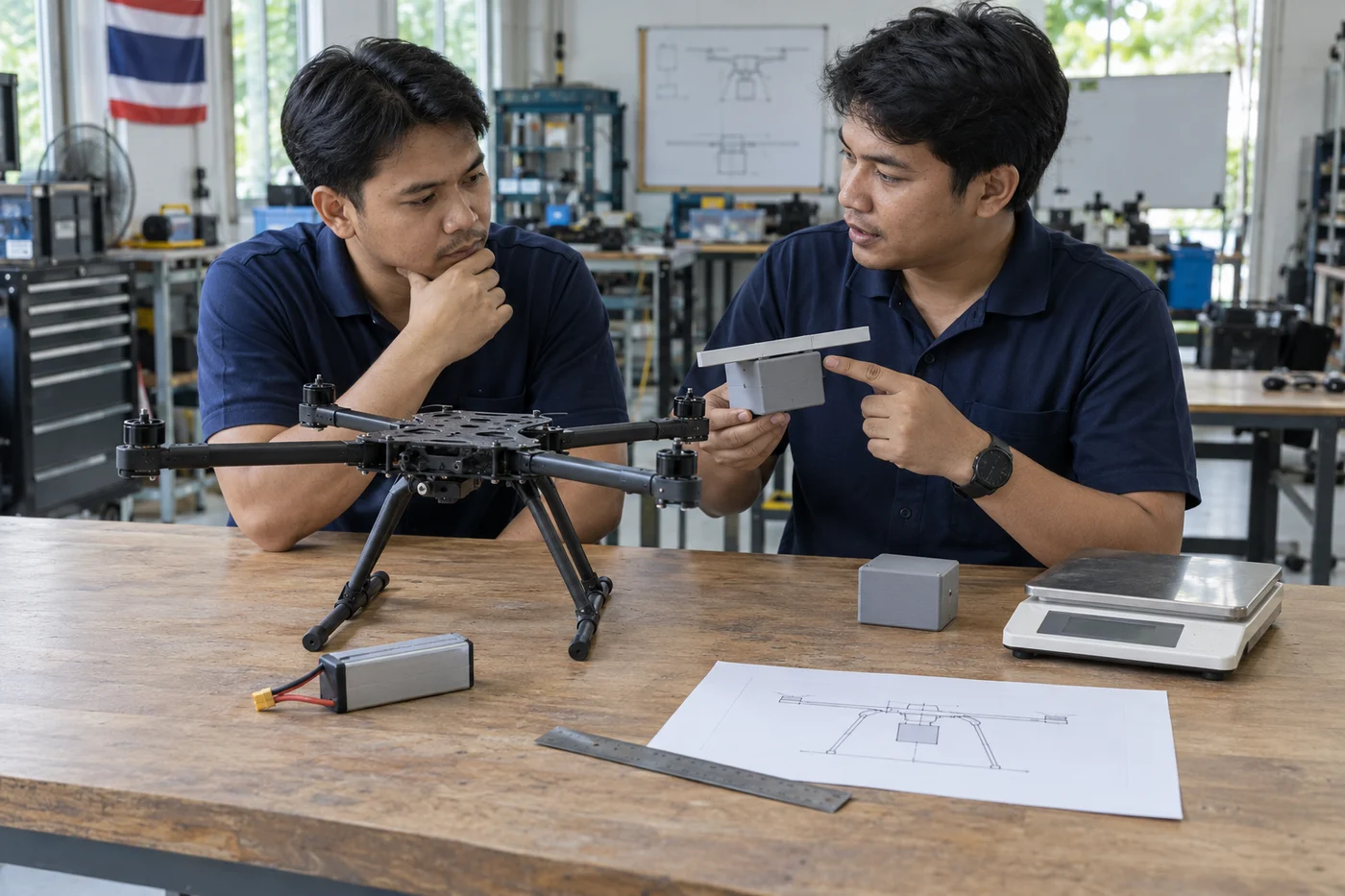
The AI image is only for explaining context. It is not equipment used in the fixture and not evidence of compatibility. Open the full-size context image
Baseline, change, and what the formulas can tell
Every number, including margins and the reserve, is a fabricated parameter of p4-toy-1 and not a safety margin of any aircraft. Define a one-dimensional datum: FRAME 5 kg at 0 m, BATTERY 1 kg at −0.1 m and PAYLOAD 1 kg at 0.5 m. The total mass is 7 kg which is below the fabricated 8 kg limit, but CG = Σ(m × x) ÷ Σm = (0 − 0.1 + 0.5) ÷ 7 = 0.057142857 m which exceeds the limit |CG| ≤ 0.05 m.
PAY02 changes the fictitious PAYLOAD position to 0.3 m, giving CG = (−0.1 + 0.3) ÷ 7 = 0.028571429 m which is within the limit, but energy still fails: 200 Wh × (1 − 0.2) = 160 Wh which is below the fabricated requirement of 180 Wh. PAY03 changes the requirement in the scenario to 150 Wh so numeric_fit must explain that the fictitious requirement was changed; it does not prove that the aircraft became more energy-efficient.
PAY04 sets the PAYLOAD mass to null, which makes the total mass, the CG and both flags null, while the energy of 160 Wh can still be calculated independently. PAY05 restores the baseline list and requirement PAY01. Never fill a missing mass with zero, and never report a total of only the known parts as the full mass. This formula is one-dimensional statics. It does not model structure, mounting, vibration, heat, 3D dynamics or endurance, and it is not advice on real mounting positions. There is no procedure for releasing or dropping a payload.
Source and version of every parameter value: written by the author for teaching on 12 October 2569 B.E. (2026) in fixture.json version p4-toy-1 There are no manufacturer parameters. The numbers and expected results in this lesson are explanatory calculations, not the output of a program that has been run.
Interface ledger and resources still to be requested
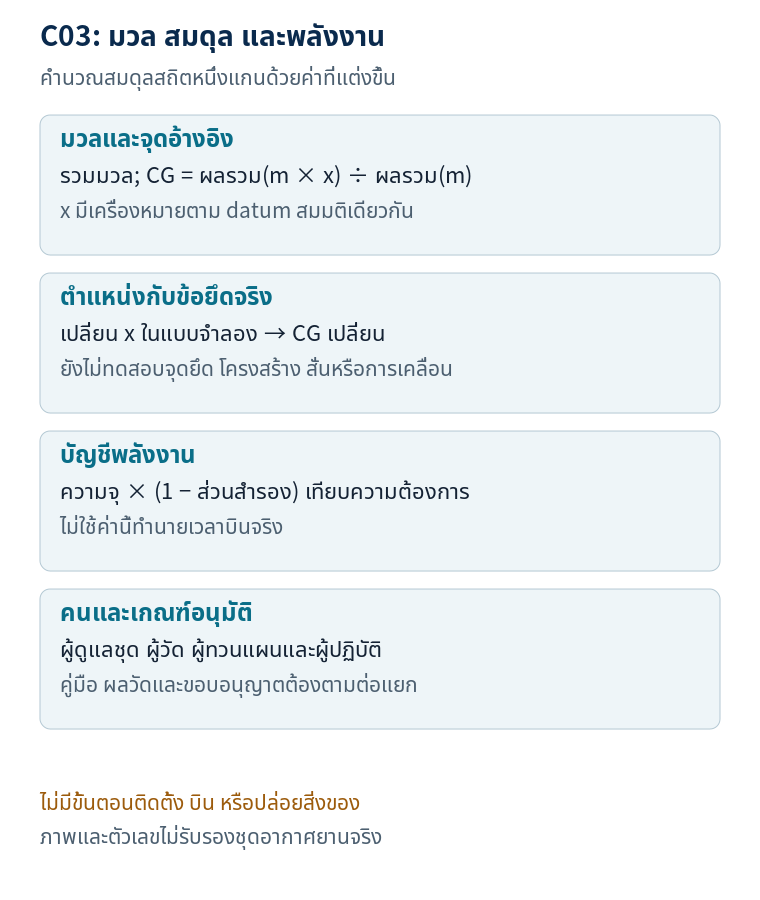
Open the full-size interface diagram
Scroll the table horizontally to see every column. When the table has keyboard focus, use the left or right arrow keys.
| Aspect/resource | Baseline data → proposal | Source/unknowns | Role and check |
|---|---|---|---|
| mechanical: attachment/strength/vibration | unknown → unknown | No test or manual | D: ask for the person responsible for the real kit and for the check method |
| electrical: voltage/connector/current | unknown → unknown | No hardware specification | D: hold the connection of the real kit |
| data: manifest/datum | FRAME BATTERY PAYLOAD;1D → same fictional datum | authored p4-toy-1 PAY01-PAY03 | B: state the unit, source and version in every row |
| mass_cg: masses/coordinates | 5@0;1@-0.1;1@0.5 → 5@0;1@-0.1;1@0.3 | authored kg/m p4-toy-1 | D: re-check the total and the PAY04 null |
| energy: capacity/reserve/required | 200 Wh;0.2;180 Wh → 200 Wh;0.2;150 Wh | authored p4-toy-1 PAY01/PAY03 | O: request evidence for the new scenario before real use |
| time: mission/charging/handover | unknown → unknown | No measurement | O: ask for the task time and the two-ended ledger |
| constraints: mass/CG bounds | 8 kg;0.05 m → 8 kg;0.05 m | authored p4-toy-1 | D: ask for the model manual and real check results |
| permissions: receiver/authorization | unknown → unknown | NOT_CONFIRMED | O: ask for the person responsible and the acceptance criteria |
B/O/D in the table are the proposed persons responsible for the training task. No real person has been assigned (owner_status=not_assigned). A value that is unknown is not zero. Before deciding anything about a real kit, request the model manual, measurement evidence, check method or authorization confirmation from the person responsible. There is no weighing, structural test, installation, flight, endurance measurement or real acceptance; the 20% reserve is not a universal safety value.
Predict before running, then check the evidence before concluding
Scroll the table horizontally to see every column. When the table has keyboard focus, use the left or right arrow keys.
| Case | Expected disposition before running | Expected metrics |
|---|---|---|
| PAY01 | outside_bounds | {"total_mass_kg":7,"cg_m":0.057142857,"mass_ok":true,"cg_ok":false,"usable_wh":160,"energy_ok":false} |
| PAY02 | outside_bounds | {"total_mass_kg":7,"cg_m":0.028571429,"mass_ok":true,"cg_ok":true,"usable_wh":160,"energy_ok":false} |
| PAY03 | numeric_fit | {"total_mass_kg":7,"cg_m":0.028571429,"mass_ok":true,"cg_ok":true,"usable_wh":160,"energy_ok":true} |
| PAY04 | unknown | {"total_mass_kg":null,"cg_m":null,"mass_ok":null,"cg_ok":null,"usable_wh":160,"energy_ok":true} |
| PAY05 | outside_bounds | {"total_mass_kg":7,"cg_m":0.057142857,"mass_ok":true,"cg_ok":false,"usable_wh":160,"energy_ok":false} |
Edges to understand: mass = limit, |CG| = limit and required = usable pass on the numbers; reserve = 1 or mass 0 is rejected; a null payload mass is unknown. These edges are teaching rules, not an operating envelope. Read the C03 test-plan and the full lab contract before using the program.
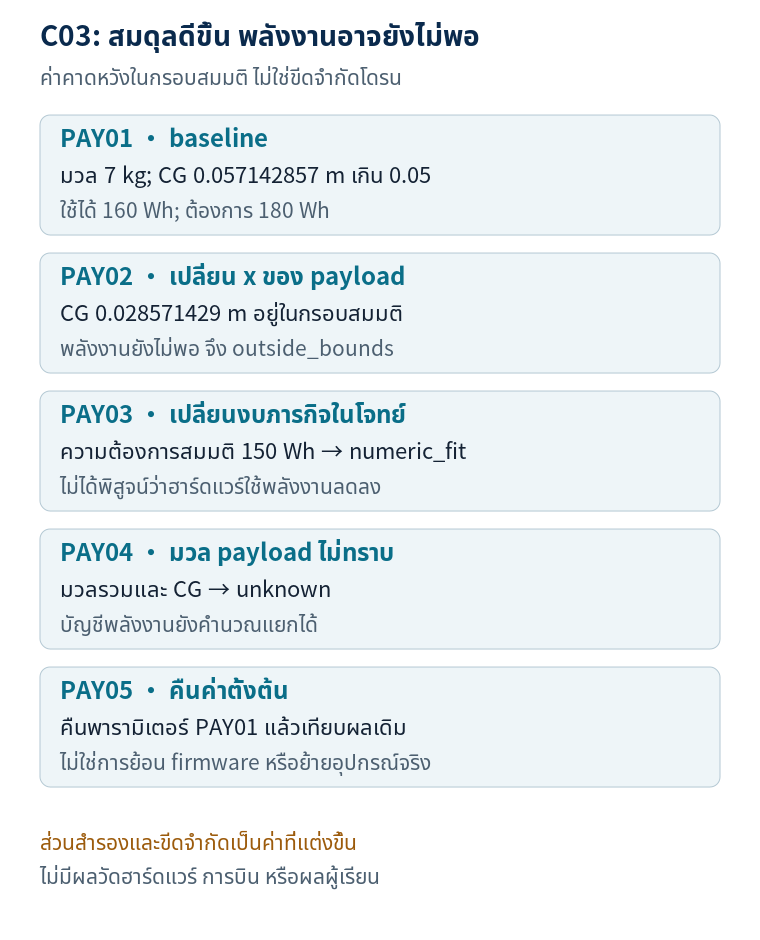
Open the full-size evidence diagram
- Keep the baseline requirements, fixture and script, with version and SHA-256, before editing. The hash is used to compare bytes; it does not confirm the author's identity.
- Record the expected results and the reason for choosing the change before running. Keep the raw stdout, the command, the time, the Python version and the exit code of your own work.
- Compare the disposition and metrics of every case against expected. Separate errors from the formula from errors from the input. Do not edit expected merely to match the actual result.
- Re-run the same input and compare the output bytes. Then restore the baseline fixture copy, compare the hash and run again. Review the baseline/rollback pair without counting case_id.
- Keep v0/v1 under the same outcome ID, together with the comment, the reply, the reason for the fix and the retest. If it has not been run, set actual=NOT_RUN and do not fill expected values into results.csv.
Author's evidence: host_calculation The author ran Python 3.14.3 on 12 October 2026 at 16:20:43 UTC. All 17 cases matched expected, the re-run gave the same output bytes, and all three baseline-restoration pairs matched. Read the raw results, the host and hash record and this case's results The author's results are in the host record; for content status and outstanding work see the overview page Hardware/flight/RF/field=NOT_RUN; permissions/receiver=NOT_CONFIRMED; learner=NOT_RUN. Passing numeric_fit does not certify safety, legality, accuracy or detection. The author's results are not evidence that learners can do it.
Produce the role work and review KSEC
K = Knowledge, S = Skills, E = Ethics, C = Character. Record each ID's status as NOT_RUN before starting, then use meets / needs_revision / insufficient_evidence with reasons and real evidence. The pass criteria require an output matching the code that can be checked. Do not average a missing Ethics/Character result away with a computed score. Learners must resubmit under the same ID when the evidence is insufficient.
B: Beginner
K baseline: can distinguish UAV/UAS and the recipients of results; review Fundamentals then name one person, one piece of equipment and one data item. S baseline: can read units and separate observations from conclusions; review Observation then write what is known and what is pending.
Baseline check before starting: write one baseline K answer and one baseline S example. If you cannot yet, read the baseline links, then resubmit your answers before doing this role's work.
Make a one-page brief: recipient, question, deliverable. Compare the baseline with the proposal using the same criteria, and explain which numerical results help the recipient's work and which do not yet. Use the same C03 case; do not change the scenario to pass without recording it. Correct the statement 'PAY03 passes so it can be installed and flown' by keeping the real kit check and authorization as outstanding items.
Scroll the table horizontally to see every column. When the table has keyboard focus, use the left or right arrow keys.
| Outcome ID | KSEC | Check criteria and evidence that must be seen | Before/after work |
|---|---|---|---|
| APP-C03-B-K01 | Knowledge | Explain the recipient's scenario and the reason for choosing the baseline/proposal, with at least two limitations of the model | B-K-v0 → B-K-v1 under the same ID |
| APP-C03-B-S01 | Skills | Calculate the main example with units, then choose the proposal or hold, citing the case_id and complete criteria | B-S-v0 → B-S-v1 under the same ID |
| APP-C03-B-E01 | Ethics | Correct claims that go beyond the evidence for this case only, and state the data or authorization still to be requested | B-E-v0 → B-E-v1 under the same ID |
| APP-C03-B-C01 | Character | Keep brief v0/v1, comments, replies, the reason for the fix, the person responsible to be assigned, and the re-review conditions | B-C-v0 → B-C-v1 under the same ID |
O: Operator/planner
K baseline: knows the roles of the recipient and of the person who decides to stop; review mission brief then identify the duties in this case. S baseline: can build a requested/confirmed ledger; review Choosing the kit and resources then write one resource request.
Baseline check before starting: write one baseline K answer and one baseline S example. If you cannot yet, read the baseline links, then resubmit your answers before doing this role's work.
Build a resource plan: people/skills, time, tools, storage, energy, budget, authorization and fallback plan. Tie each request to the confirmer, the acknowledgement evidence, the outstanding items and the deliverable the recipient needs. Use the same C03 case; do not change the scenario to pass without recording it. The field for the real operator's name is still not_assigned; never treat a role name as already confirmed.
Scroll the table horizontally to see every column. When the table has keyboard focus, use the left or right arrow keys.
| Outcome ID | KSEC | Check criteria and evidence that must be seen | Before/after work |
|---|---|---|---|
| APP-C03-O-K01 | Knowledge | Explain the impact of the change on time, data, energy and the recipient, separating fabricated data from real resources | O-K-v0 → O-K-v1 under the same ID |
| APP-C03-O-S01 | Skills | Complete the interface ledger and the resource plan, including the person responsible in the requested/confirmed roles, the hold points and the fallback method | O-S-v0 → O-S-v1 under the same ID |
| APP-C03-O-E01 | Ethics | Hold work whose authorization/compatibility/recipient is not yet confirmed, and do not turn numeric_fit into permission to operate | O-E-v0 → O-E-v1 under the same ID |
| APP-C03-O-C01 | Character | Keep plan v0/v1, the reason for the fix, comments and replies, together with the list of notifications to users of the old version and the people responsible for outstanding items | O-C-v0 → O-C-v1 under the same ID |
D: Developer/tuner
K baseline: knows system integration and the effects of changing a component; review integration then link the change to both sides of the interface. S baseline: can separate expected/actual and make a baseline copy; review testing then write one case with actual NOT_RUN before the experiment.
Baseline check before starting: write one baseline K answer and one baseline S example. If you cannot yet, read the baseline links, then resubmit your answers before doing this role's work.
Check the contract and the interface. Record expected before running. Keep the version/hash/script/fixture/raw results. Check every case in the case set and replay from the original input, then restore the baseline copy and compare the results. Keep a discrepancy log and a separate hardware check plan. Use the same C03 case; do not change the scenario to pass without recording it. The author's host results are an example of evidence, not a learner's work. Skills can be assessed only after you run it and record your own work.
Scroll the table horizontally to see every column. When the table has keyboard focus, use the left or right arrow keys.
| Outcome ID | KSEC | Check criteria and evidence that must be seen | Before/after work |
|---|---|---|---|
| APP-C03-D-K01 | Knowledge | Explain the formula, the edges, the meaning of null and the changed interface, without citing results that come from rounding | D-K-v0 → D-K-v1 under the same ID |
| APP-C03-D-S01 | Skills | Show expected/actual separately, with source/input hashes, time, command, exit code and the replay/rollback result, or keep NOT_RUN if not yet run | D-S-v0 → D-S-v1 under the same ID |
| APP-C03-D-E01 | Ethics | Disclose limitations, do not fabricate actual/learner/hardware results, and reject a wrong fixture instead of filling in missing values | D-E-v0 → D-E-v1 under the same ID |
| APP-C03-D-C01 | Character | Keep change-record v0/v1, comments, replies, the reason for the fix, the retest result and the baseline-restoration evidence under the same outcome ID | D-C-v0 → D-C-v1 under the same ID |
CLO/PLO are left blank (pending_design). Use curriculum mapping and the KSEC record to link evidence; having a code does not certify the curriculum.
Downloads and next steps
- Requirements and a 12-code rubric
- The interfaces.csv ledger
- Change and baseline-restoration record
- Test plan with expected results
- Actual results results.csv
- Usage steps readme
Use calculator.py, fixture.json, expected.csv and the lab readme together. The program computes only locally; no additional runtime is added on the website.
Start from the requirements of your own role and fill in the unknowns in interfaces before running. Go back to M09 Logistics to review handing results to the recipient. The P3 criteria remain pending_field_review; specialist=not_assigned. P5 only prepares the trial kit; there are no real learners yet and no results are filled in on a learner's behalf. CPX-Sim remains on hold.