Mission requirements, aircraft and payload selection
UAT 457 UAS for Transportation and Autonomous Delivery
Lesson
By the end of this module you will be able to
- Write delivery mission requirements covering goods, distance, time, frequency, environment, hand-off method and law
- Compare road and air delivery times to judge whether a drone is worthwhile
- Select an aircraft type with must-have criteria and a weighted scoring matrix
- Select payload equipment (triple packaging, insulated box, release, winch, parachute) and compute how long the box stays cold
- Screen candidate transport applications (emergency medical, routine health logistics, parcels) against payload, radius, time limit and the road alternative
Why this matters
Most failed delivery drones do not fail because they cannot fly. They fail because the project started with the wrong question, such as “how many kilograms can this drone carry?”, instead of “what goes to whom, within how many minutes, in what conditions, and how is it handed over?” Without clear mission requirements we end up with an aircraft that flies far but cannot deliver into a small space, or a box that is light but cannot stay cold. This course looks at delivery systems from the aircraft and mission side: requirements, aircraft, weight, energy, routes, pickup and delivery points, hand-off methods, tracking, fleets and safety assessment. Order-intake software, scheduling, docking stations and integration with an organisation’s information systems are covered in modules 6–10 of this course Automated Delivery Systems.
Modules 1 to 5 of this course follow one fictional case through all of them: the health service network of Doi Mok Province (a fictional northern province) uses drones to move goods between hospitals. The hub is Doi Mok Hospital, with the central laboratory and pharmacy store (called H). There are three destinations: Mae Lan Hospital (A), Huai Phueng Hospital (B) and the Ban Pha Tang sub-district health promoting hospital (SHPH) on a mountain ridge (C). Outbound, the drone carries medicines and supplies; on the way back it brings patients’ blood samples to the central lab. Mountain roads wind, and landslides close them in the rainy season, so road routes are much longer than straight-line distances. All place names, distances and figures in this course are fictional. The Python code can be downloaded from /downloads/uat-457/.
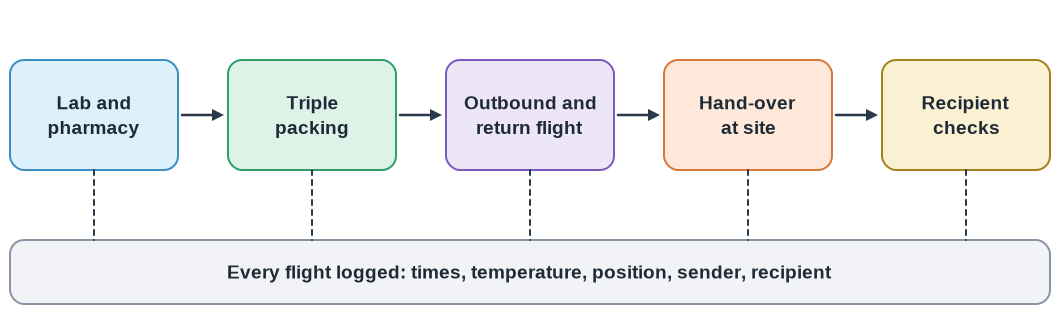
Transport and delivery mission requirements
Mission requirements are the list of things the system must do, written as checkable numbers rather than loose words like “fast” or “safe”. A survey of optimisation research on civil drones shows that system decisions such as base locations, fleet size and routes must be made together with the limits of the aircraft (Otto and colleagues, 2018). Good requirements therefore cover every aspect from the start.
| Aspect | Question | Doi Mok network example (assumed) |
|---|---|---|
| Goods | What, how heavy, how big, what temperature | Blood tubes in triple packaging, up to 1.2 kg; some items must stay at 2–8 °C as set by the lab |
| Distance and route | From where to where, over what terrain | Straight-line 14–24 km across a 1,180 m ridge |
| Time | Arrive within how many minutes | Samples must reach the lab within 2 hours of collection |
| Frequency | Trips per day, peak periods | 15 trips a day in total, busiest in the morning |
| Environment | Wind, rain, temperature, site elevation | Rainy season, ridge-top wind, 35 °C in the valleys |
| Hand-off | Can it land? Is someone there to receive? | A and B have landing pads; C has no room |
| Law and permission | What kind of flight, what permits | BVLOS flight and lowering goods from an aircraft need permission |
| Evidence | What must be recorded | Times, temperature, sender and recipient for every trip |
On the legal side, CAAT Regulation No. 114 (the Rules of the Air, TCAR ANS Part ROA; Royal Gazette 15 December 2025, in force from the next day) allows, under ROA.3115, dropping or spraying from an aircraft in flight only in accordance with CAAT regulations and any air traffic services clearance, and ROA.3120 sets the same condition for towing (Civil Aviation Authority of Thailand, 2025). It replaced the earlier Civil Aviation Board Regulation No. 94. Before lowering a box on a winch or dropping it by parachute, ask CAAT in writing whether the operation counts as dropping and what approval it needs. Flights that differ from the general conditions, such as beyond visual line of sight, fall under the CAAT 2026 (B.E. 2569) notification on authorising operations that differ from the conditions, in force from 17 May 2026 (Civil Aviation Authority of Thailand, 2026). The law is covered in UAT 401 and is used again for the safety assessment in Module 5.
Evidence that drones can carry specimens
The first question doctors and medical technologists ask is “does the flight change the results?” Amukele and colleagues (2015) collected paired samples from 56 volunteers; one set flew on a drone for 6–37.5 minutes and the other stayed still, and 33 chemistry, haematology and coagulation tests were run. Results from the two sets were similar for every test. The samples travelled in triple packaging following the guidance for infectious substances. Later work by the same group tested blood and blood components carried by drone and found no harm to quality, with temperature maintained throughout (Amukele and colleagues, 2017). These results come from specific trial conditions, so our own lab must still run comparison tests before real use.
When is a drone worthwhile?
Drones win when the road route is much longer than the straight line, or when roads are congested or cut. Approximate flight time is , where is straight-line distance, cruise speed and a fixed time for take-off, transition, climb, descent and hand-off.
Example 1 Road versus air time
Route data (assumed): A is 38 km by road in 65 minutes, 21.0 km straight · B is 52 km by road in 80 minutes, 24.0 km straight · C is 31 km of mountain road in 95 minutes, 14.0 km straight. The drone cruises at 22 m/s with a fixed 6 minutes per trip (assumed, no wind yet).
# road versus air time (assumed): (road km, road minutes, straight-line km)
sites = {"A": (38, 65, 21.0), "B": (52, 80, 24.0), "C": (31, 95, 14.0)}
cruise = 22.0          # cruise speed m/s (assumed, no wind)
overhead = 6.0         # take-off, transition, climb, descent and hand-off, minutes (assumed)
for name, (road_km, road_min, air_km) in sites.items():
    fly = air_km * 1000 / cruise / 60 + overhead
    print(f"site {name}: road {road_km} km {road_min} min | air {air_km} km {fly:.1f} min | saves {road_min - fly:.1f} min ({(road_min - fly) / road_min:.0%})")
site A: road 38 km 65 min | air 21.0 km 21.9 min | saves 43.1 min (66%)
site B: road 52 km 80 min | air 24.0 km 24.2 min | saves 55.8 min (70%)
site C: road 31 km 95 min | air 14.0 km 16.6 min | saves 78.4 min (83%)Every route is about two thirds faster or better. Route C gains most: the mountain road takes 95 minutes, the flight only 16.6 minutes, a saving of 78.4 minutes (83%). The figures do not include waiting for the next vehicle, which in practice is often longer than the drive, but they also ignore days when wind or heavy rain ground the drone. A drone system therefore always needs a road backup plan.
Selecting the aircraft
Delivery aircraft fall into three main groups, each strong in a different way.
| Type | Strengths | Limitations | Best for |
|---|---|---|---|
| Multicopter | Vertical take-off and landing, steady hover, any hand-off method, simple structure | High power draw all the time, short range | A few kilometres, in towns or tight spaces |
| VTOL fixed-wing | Takes off and lands vertically, cruises efficiently on the wing | More complex, transition is a risky phase, expensive | Tens of kilometres where the destination has no runway |
| Pure fixed-wing | Longest range and fastest | Needs a launcher or recovery system, cannot hover, so usually delivers by parachute drop | Very long range to open destinations |
Commercial systems show the design direction. Wing states that its aircraft cruise at up to 60 mph, fly up to 12 miles round trip and lower orders on a tether (Wing, n.d.). Zipline unveiled a second-generation system that hovers more than 300 ft up and sends a delivery droid down a tether, carrying 6–8 lb within a 10-mile radius of one dock (Zipline, 2023). These are manufacturer figures, not independent test results.
Must-have criteria before scoring
A sound selection has two stages. First, remove options that fail a must-have criterion, such as round-trip range with reserve. Only then score the rest with a weighted scoring matrix, , with weights summing to 1. Skip the first stage and an option that scores well elsewhere can win even though it cannot do the job.
Example 2 Choosing an aircraft type for the Doi Mok network
The longest route is B, 24 km straight, 48 km round trip. The team adds 30% for wind, detours and reserve (assumed), which sets the must-have range. The team weights five criteria and scores each 1–5 from manufacturer documents and demonstrations (assumed). The range in the table is the manufacturer’s claim.
# criterion weights (sum 1.0) and 1-5 scores for each type (assumed)
weights = {"range": 0.30, "handover": 0.25, "payload": 0.15, "weather": 0.15, "cost": 0.15}
options = {
    "multicopter": {"range_km": 18, "range": 2, "handover": 5, "payload": 3, "weather": 3, "cost": 4},
    "VTOL fixed-wing": {"range_km": 80, "range": 5, "handover": 4, "payload": 4, "weather": 4, "cost": 2},
    "fixed-wing + drop": {"range_km": 120, "range": 5, "handover": 2, "payload": 3, "weather": 4, "cost": 3},
}
need_km = 2 * 24.0 * 1.3          # round trip on route B plus 30%
print(f"must-have range: {need_km:.1f} km")
for name, o in options.items():
    score = sum(w * o[k] for k, w in weights.items())
    status = "pass" if o["range_km"] >= need_km else "FAIL must-have"
    print(f"{name:18s} score {score:.2f}  range {o['range_km']:3d} km  {status}")
must-have range: 62.4 km
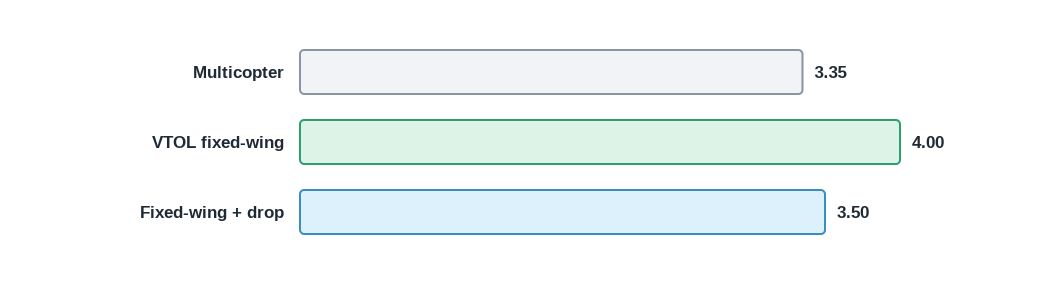
multicopter score 3.35 range 18 km FAIL must-have
VTOL fixed-wing score 4.00 range 80 km pass
fixed-wing + drop score 3.50 range 120 km passThe multicopter scores best on hand-off but covers only 18 km round trip, so it fails the must-have at once. Of the remaining two, the VTOL fixed-wing scores 4.00 against 3.50 for the fixed-wing with parachute drop, because it can hover to lower goods at Pha Tang and land at the hospitals. The team chooses the VTOL fixed-wing, but the 80 km is an advertised figure. Module 2 computes the real range with a full load and an energy reserve.
Criterion weights are a team decision. Agree them with the users before scoring, then vary them to see whether the result holds. If a small change in weights swaps the ranking, the options are close and you need more data, for example a demonstration flight in the real area.
Payload equipment
Payload equipment is everything fitted to the aircraft to contain, secure and hand over the goods:
- Triple packaging. Patient specimens classed as Biological Substance, Category B (UN 3373) must be packed in three layers: a leak-proof primary receptacle with enough absorbent material for all the liquid, a second watertight, leak-proof receptacle, and a rigid outer packaging strong enough for the weight and handling. Under packing instruction P650 the complete package must be capable of passing a 1.2 m drop test, and the primary or secondary receptacle must be capable of withstanding a 95 kPa internal pressure difference (World Health Organization, 2026). The itemised list of contents goes between the secondary and outer layers.
- Insulated box with insulated walls, ice packs or phase-change material, and a temperature logger.
- Mounts and release, a hook or servo mechanism that can be commanded open, locked firmly in flight, with a status signal.
- Winch, with motor, spool, brake and line-length sensor, to lower the box while hovering.
- Cargo parachute, for drops from height, sized so the box falls slowly enough.
Every item flies on every trip, even when not used, so it eats payload and energy (computed in Module 2). Winch and parachute operation are covered in detail in Module 4.
How long does the box stay cold?
Heat leaks through an insulated wall by conduction, , where is the insulation’s thermal conductivity, the surface area, the outside-inside temperature difference and the wall thickness (Serway & Jewett, 2018). An ice pack melting at about 0 °C absorbs , where for ice is about 334 kJ/kg. The holding time is therefore roughly .
Example 3 How long does a 0.4 kg ice pack last?
An EPS foam box with 25 mm walls, thermal conductivity 0.035 W/(m·K) and 0.18 m² of surface keeps 5 °C inside with 35 °C outside, using a 0.4 kg ice pack (assumed; the model ignores heat stored in the box and samples and ignores sunlight).
# heat leak through the box wall Q = k A dT / d
k, area, thick = 0.035, 0.18, 0.025    # W/(m K), m2, m (assumed)
t_in, t_out = 5.0, 35.0                 # inside and outside temperature C
ice_kg, latent = 0.40, 334e3            # ice pack kg, latent heat of fusion J/kg
q = k * area * (t_out - t_in) / thick
hold_s = ice_kg * latent / q
print(f"heat leak {q:.2f} W, ice lasts {hold_s / 3600:.1f} h")
for t_out in (30.0, 35.0, 40.0):
    q = k * area * (t_out - t_in) / thick
    print(f"outside {t_out:.0f} C: {ice_kg * latent / q / 3600:.1f} h")
heat leak 7.56 W, ice lasts 4.9 h
outside 30 C: 5.9 h
outside 35 C: 4.9 h
outside 40 C: 4.2 hThe longest round trip is about 40 minutes, but the box also waits for packing, take-off and the recipient. A 0.4 kg ice pack gives about 4.9 hours at 35 °C, enough for one cycle. Left in the sun or at 40 °C, it drops to 4.2 hours. This is a first estimate and must be confirmed by testing the real box with a temperature logger.
Where drone transport is used, and what fits
Drone transport is several markets, not one, and the deciding requirement differs between them.
| Application | Why a drone | Evidence |
|---|---|---|
| Emergency medical | Minutes matter and an ambulance may be late | In western Sweden, drones placed ready and flying autonomously carried defibrillators to suspected cardiac arrests; in the 55 cases with both times recorded, the drone arrived first in 37 (67%), a median of 3 min 14 s earlier (Schierbeck et al., 2023) |
| Routine health logistics | Roads are cut, or the site is on an island or a mountain | UNICEF reports drones carrying vaccines, medicines and blood samples to such places, and checks the whole supply chain with a decision tree before adding drones (UNICEF, n.d.); the evidence on carrying specimens appears earlier in this module |
| Parcels | Dense demand near a base | Multicopters had a practical range of about 4 km on the batteries of 2018, which needs urban warehouses or way stations; that extra warehousing and the longer distances per package greatly raise the life-cycle impacts, although small drones still came out below ground delivery in most cases examined (Stolaroff et al., 2018) |
Site logistics inside an estate or a port, covered in the second half of the course, is a fourth group. All four start with the same screen of four questions: can the aircraft carry the goods, can it fly that far with a reserve, is the flight time inside the time limit, and is it faster than the road? A case that fails any of them is redesigned or dropped.
Example 4 Screening six cases against one aircraft
The VTOL fixed-wing of Example 2 is screened with the goods limit (2.1 kg) and the each-way radius (24.9 km) that Module 2 will compute, at 22 m/s. Each case has its own fixed time and road time (all case data assumed).
import math
# first screen of candidate applications against the aircraft chosen in this module (all case data assumed)
speed, max_kg, radius_km = 22.0, 2.1, 24.9        # cruise m/s; goods limit and each-way radius found in Module 2
cases = [   # name, goods kg, one-way km, time limit min, road minutes, fixed time t0 min
    ("blood samples to site B", 1.6, 24.0, 120, 80, 6),
    ("defibrillator, 6 km, 8 min", 1.5, 6.0, 8, 15, 6),
    ("same, from a pre-armed dock", 1.5, 6.0, 8, 15, 2),
    ("12 kg of rice to an island", 12.0, 18.0, 240, 300, 6),
    ("spare parts, mountain village", 1.8, 40.0, 180, 240, 6),
    ("parcel to a town 3 km away", 1.0, 3.0, 30, 8, 6),
]
for name, kg, dist, limit, road, t0 in cases:
    t = dist * 1000 / speed / 60 + t0
    fails = []
    if kg > max_kg:
        fails.append(f"{kg} kg over {max_kg} kg ({math.ceil(kg / max_kg)} trips)")
    if dist > radius_km:
        fails.append(f"{dist} km beyond {radius_km} km")
    if t > limit:
        fails.append(f"{t:.1f} min over the {limit} min limit")
    if t >= road:
        fails.append(f"no faster than the road ({road} min)")
    print(f"{name:30s} {t:5.1f} min  {'fits' if not fails else 'FAILS: ' + '; '.join(fails)}")
blood samples to site B 24.2 min fits
defibrillator, 6 km, 8 min 10.5 min FAILS: 10.5 min over the 8 min limit
same, from a pre-armed dock 6.5 min fits
12 kg of rice to an island 19.6 min FAILS: 12.0 kg over 2.1 kg (6 trips)
spare parts, mountain village 36.3 min FAILS: 40.0 km beyond 24.9 km
parcel to a town 3 km away 8.3 min FAILS: no faster than the road (8 min)Blood samples to site B fit, with almost no spare radius (24.0 of 24.9 km). The defibrillator case fails for a reason that is not distance: the 6 minutes of fixed time for take-off, transition and hand-off are longer than the 4.5 minutes of cruise, so only a drone that is already armed at a dock (2 minutes) meets the 8-minute limit, which is why the Swedish drones waited ready. The rice fails on payload, the mountain village on radius, and the parcel flight loses to the road by 0.3 minutes, so a drone is not automatically the faster choice. Each failure points to a different remedy: a larger aircraft, a relay base halfway, or no drone at all.
Module lab
Lab: write mission requirements and choose an aircraft
- In groups, choose one Doi Mok route or a real local route the group proposes (between hospitals, or to an island off the coast), and write a requirements table covering all eight aspects as checkable numbers
- Compare road and air time with the code in Example 1, using road distance from a map and straight-line distance from a mapping tool
- Set must-have criteria and weights, score at least three aircraft from manufacturer documents, and vary the weights to see whether the ranking changes
- Assemble a real insulated box with a temperature logger, leave it indoors or outdoors for 2 hours, and compare the measured temperature with the time computed in Example 3
Common mistakes
Watch out
- Starting from a drone model instead of requirements, then hunting for work for a drone already bought
- Writing requirements as adjectives, such as “fast” instead of “within 2 hours of collection”
- Scoring without removing options that fail a must-have, so an option that cannot do the job wins
- Believing advertised range, usually measured without payload, without wind and without reserve
- Forgetting that lowering or dropping goods needs permission, even on hospital land
- Carrying patient specimens in an ordinary box instead of tested triple packaging
- Assuming every transport job suits a drone, without screening payload, radius, fixed time and the road alternative
Summary
- Mission requirements cover goods, distance, time, frequency, environment, hand-off, law and evidence, written as checkable numbers
- Drones pay off when road routes are much longer than the straight line; flight time is roughly
- Select aircraft in two stages: must-have criteria first, then a weighted score
- Payload equipment includes triple packaging, an insulated box, a release, a winch and a parachute, all carried on every trip
- Cold-holding time is roughly and must be confirmed by testing
- Drone transport splits into emergency, routine health and parcel uses; screen every case for payload, radius, time limit and road speed, because fixed time can defeat a short emergency flight and a nearby road can beat the drone
Check your understanding
- Straight-line 33 km, cruise 22 m/s, fixed time 6 minutes: how long is one trip?
- Weights 0.5, 0.3 and 0.2 with scores 4, 3 and 5: what is the weighted score?
- Why must options be filtered by must-have criteria before scoring?
- If the box wall goes from 25 mm to 50 mm with everything else the same, how does the holding time change?
- What makes up triple packaging for UN 3373?
Answers
- minutes
- An option that cannot do the core job, for example cannot reach the destination, may still score high on other criteria; without filtering first, the wrong option is chosen
- Heat leak is inversely proportional to thickness, so doubling it halves the leak and doubles the holding time (about 9.8 hours at 35 °C), at the cost of a bigger, heavier box
- A leak-proof primary receptacle with absorbent, a watertight leak-proof secondary receptacle, and a strong outer packaging; the package passes a 1.2 m drop test and the primary or secondary receptacle withstands 95 kPa
Key formulas
| Approximate flight time | |
| Weighted score | |
| Heat leak through the box wall | |
| Holding time of the ice pack |
Key references
- Otto, A., Agatz, N., Campbell, J., Golden, B., & Pesch, E. (2018). Optimization approaches for civil applications of unmanned aerial vehicles (UAVs) or aerial drones: A survey. Networks, 72(4), 411–458. link
- Amukele, T. K., Sokoll, L. J., Pepper, D., Howard, D. P., & Street, J. (2015). Can unmanned aerial systems (drones) be used for the routine transport of chemistry, hematology, and coagulation laboratory specimens? PLOS ONE, 10(7), e0134020. link
- Amukele, T., Ness, P. M., Tobian, A. A. R., Boyd, J., & Street, J. (2017). Drone transportation of blood products. Transfusion, 57(3), 582–588. link
- World Health Organization. (2026). Guidance on regulations for the transport of infectious substances 2025-2026: Applicable as from 1 October 2025. WHO. link
- Wing. Technology: How Wing delivers. link
- Zipline. (2023, March 15). Zipline unveils new autonomous system capable of quiet, fast and precise home delivery [Press release]. link
- สำนักงานการบินพลเรือนแห่งประเทศไทย. (2568, 15 ธันวาคม). ข้อกำหนดของสำนักงานการบินพลเรือนแห่งประเทศไทย ฉบับที่ 114 ว่าด้วยการเดินอากาศและการทำการบินของอากาศยาน การป้องกันความเสียหายต่อบุคคลและทรัพย์สินบนภาคพื้น และแผนการบิน (Thailand Civil Aviation Regulation, Air Navigation Service Part Rules of the Air, TCAR ANS Part ROA, Revision 01, 17 พฤศจิกายน 2568). ราชกิจจานุเบกษา, 142 (ตอนพิเศษ 390 ง), 54. link
- สำนักงานการบินพลเรือนแห่งประเทศไทย. (2569). ประกาศ กพท. เรื่อง หลักเกณฑ์และวิธีการในการอนุญาตให้ผู้บังคับหรือปล่อยอากาศยานซึ่งไม่มีนักบิน ประเภทอากาศยานที่ควบคุมการบินจากภายนอก ที่มีน้ำหนักไม่เกิน 25 กิโลกรัม ปฏิบัติแตกต่างไปจากเงื่อนไขที่กำหนด พ.ศ. 2569 (มีผล 17 พฤษภาคม 2569). link
- Serway, R. A., & Jewett, J. W. (2018). Physics for scientists and engineers (10th ed.). Cengage.
- Schierbeck, S., et al. (2023). Drone delivery of automated external defibrillators compared with ambulance arrival in real-life suspected out-of-hospital cardiac arrests: A prospective observational study in Sweden. The Lancet Digital Health, 5(12), e862–e871. link
- United Nations Children's Fund, Supply Division. Drones to reach the last mile [Web page]. UNICEF. link
- Stolaroff, J. K., Samaras, C., O'Neill, E. R., Lubers, A., Mitchell, A. S., & Ceperley, D. (2018). Energy use and life cycle greenhouse gas emissions of drones for commercial package delivery. Nature Communications, 9, 409. link
Further reading
Study the assigned knowledge units in advance, review media and take the module quiz
ระบบขนส่งและจัดส่งด้วยโดรน
Delivering medical supplies and essentials
M09 Delivery: from the request to verifiable hand-over evidence
In class / field
Lab or field practice from worksheets with a safety checklist
Learning evidence: Checked worksheets and quiz results