Indoor route planning
UAT 459 UAS, Internet of Things and Smart Warehouse Systems
Lesson
By the end of this module you will be able to
- Define the constraints on flight routes in a warehouse, including rack clearance, ceiling limit, no flying over racks, and aisle locking
- Choose a rack-face scan pattern, compute the time per aisle and check that each sortie fits the usable energy
- Order a re-flight to several locations in a warehouse where aisles can be crossed only at cross-aisles, using nearest neighbour and 2-opt
- Share sorties among several drones with the LPT rule and judge whether they fit the time window
Why this matters
Modules 2 and 3 told us how far the camera must be from the labels, how fast the drone may fly, and that beam labels must be read along the way. The next question: one night, 3,360 locations in six aisles must be scanned. Which way should the drones fly, in what order, in how many sorties, with how many drones, and will they finish before the morning forklift shift starts? A poorly planned route drains the battery in the middle of an aisle, forces an emergency landing on a floor with goods on it, or leaves work unfinished so the morning team has to wait.
This module covers “indoor route planning” at application level: planning where and when to fly. How the drone knows its own position, holds altitude and avoids obstacles in real time is taught in UAT 458.
Constraints on routes in a warehouse
A high-bay warehouse is not an empty hall. Routes must respect several constraints that the team sets before planning (all values in this case are assumed):
- Side clearance: the aisle is 3.0 m wide and the drone with propeller guards is 0.7 m wide. Flying along the centre leaves m on each side. Subtract 0.15 m for the 95% lateral position error and allow 0.10 m for pallets overhanging the beam, and the real safety gap is 0.90 m
- Ceiling limit: level 6 labels are at about 9.6 m and the fire sprinkler heads at 12.0 m. The team sets a geofence so that the drone never flies above 11.0 m
- No flying over racks: there is less than two metres between the pallet tops and the sprinklers, with lights and pipes, and rotor wash can blow items off the rack tops. The drone may move from one aisle to another only at the front and back cross-aisles, just like a picker who cannot walk through racks
- Speed: at most 0.5 m/s while scanning, from the blur limit in module 2, and at most 1.0 m/s in transit
- Keep drones apart from people and forklifts: HSG76 stresses that mixing industrial trucks and pedestrians is a recipe for accidents and that the two should be separated where reasonably practicable (Health and Safety Executive, 2007). The same principle applies to drones: a drone may enter only an aisle that the WMS has locked, that has no open tasks, and that a presence sensor at its entrance confirms is clear
- Collision prevention is only an extra layer: PX4 Collision Prevention uses range-sensor data to slow and stop the vehicle before an obstacle; it restricts speed if the sensor range is not large enough and prevents motion in directions with no sensor data (PX4 Autopilot, n.d.). It helps greatly in narrow aisles but is no excuse for planning routes close to the racks
Rack-face scan patterns
The drone carries two cameras, one facing left and one right, and flies along the centre of the aisle scanning both sides at once. The portrait camera from module 2 covers the label band of one level per pass, so there are two patterns to choose from: horizontal, flying the full aisle length one level at a time and then moving up, and vertical, climbing up and down slot column by slot column. The time of the horizontal pattern is
where is the number of levels, the aisle length, the scanning speed, the level spacing, the vertical speed and the time to settle after a level change.
Each sortie must stay within the available energy. If the drone flies for and must keep a reserve fraction , the condition is , where is the flight to and from the dock including take-off and landing.
Example 1 Scan time per aisle and splitting sorties
The aisle is 78.4 m long with five levels to scan (levels 2 to 6), 1.8 m apart. The drone flies for 20 minutes and must keep a 25% reserve. The dock is 6 m in front of aisle A01, and the aisles are 5.4 m apart (assumed values).
# scan time of one aisle: horizontal passes per level vs vertical climbs per slot (assumed values)
L, SLOTS = 78.4, 56                  # m aisle length, slot columns per side
LEVELS = 5                           # levels 2 to 6 are scanned by the drone
V_SCAN, V_Z = 0.5, 0.3               # m/s along the aisle while scanning, vertical speed
PITCH_Z, SETTLE = 1.8, 4.0           # m between levels, s to settle after a level change

horizontal = LEVELS * L / V_SCAN + (LEVELS - 1) * (PITCH_Z / V_Z + SETTLE)
climb = (LEVELS - 1) * PITCH_Z / V_Z + LEVELS * 2.0          # up through 5 levels, 2 s per label
vertical = SLOTS * climb + (SLOTS - 1) * (1.4 / V_SCAN + 2.0)
print(f"horizontal passes: {horizontal:.0f} s = {horizontal / 60:.1f} min")
print(f"vertical climbs:   {vertical:.0f} s = {vertical / 60:.1f} min")

# can one battery cover a whole aisle? (dock in front of aisle 1)
USABLE = 0.75 * 20 * 60              # s, 20 min endurance with a 25 % reserve
AISLE_PITCH, DOCK, V_T, TOL = 5.4, 6.0, 1.0, 30.0   # m, m, m/s transit, s take-off and landing
for a in range(1, 7):
    transit = 2 * (DOCK + AISLE_PITCH * (a - 1)) / V_T + TOL
    need = horizontal + transit
    print(f"aisle {a}: {need:.0f} s {'fits' if need <= USABLE else 'split into two sorties'}")
horizontal passes: 824 s = 13.7 min
vertical climbs: 2168 s = 36.1 min
aisle 1: 866 s fits
aisle 2: 877 s fits
aisle 3: 888 s fits
aisle 4: 898 s fits
aisle 5: 909 s split into two sorties
aisle 6: 920 s split into two sortiesThe horizontal pattern takes 13.7 minutes, almost three times faster than the vertical one, which has to accelerate, stop and climb 56 times. The usable energy is 900 seconds. Aisles A01 to A04 fit in one sortie, but A04 leaves only 2 seconds of margin, far too little in practice because worn batteries or hot air shorten flight time. A05 and A06 are farther from the dock and must be split into two sorties: levels 2 to 4 and levels 5 to 6.
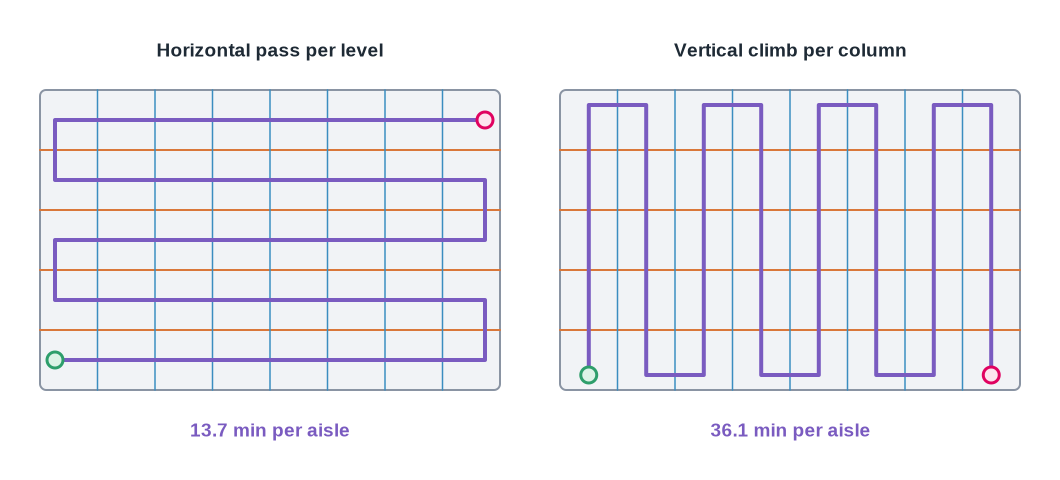
The horizontal pattern is a snake over a fixed grid. The WareVision work of Kalinov et al. (2020) proposed optimizing the path from the locations of detected barcodes instead of flying an overlapping snake grid, and reported less stocktaking time and fewer scanning mistakes. The idea pays off in warehouses where label heights are uneven.
Ordering the re-flight to unread locations
After the full scan, unread locations are usually left scattered across several aisles (module 2), and the drone must go back to photograph them closer or from another angle. This is a form of the traveling salesman problem, with a special constraint: aisles can be crossed only at the cross-aisles. Ratliff and Rosenthal (1983) studied exactly this for order pickers in a rectangular warehouse with crossovers only at the ends of aisles, and found a way to compute the shortest route with effort that grows only linearly with the number of aisles.
The distance between two locations in different aisles is the trip to the nearer cross-aisle plus the distance across:
where and are the positions of the front and back cross-aisles, is the spacing between aisles and the aisle number. In the same aisle, . Travel time also includes climbing. This course uses a simple two-step method that works well in practice. First, nearest neighbour: always go next to the closest location not yet visited. Second, 2-opt, proposed by Croes (1958): try reversing a segment of the route, keep the change if the time drops, and repeat until no reversal helps.
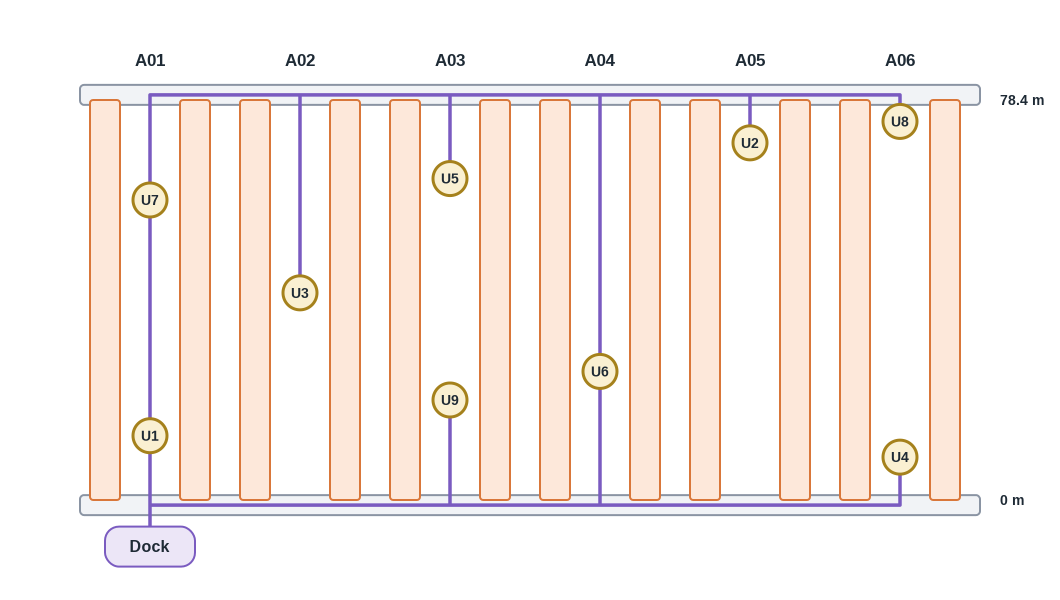
Example 2 Re-flight route to nine locations
Nine unread locations, U1 to U9, remain. Each needs a 5-second photo stop; travel is 1.0 m/s and climbing 0.3 m/s. Horizontal and vertical travel times are added, a conservative estimate (assumed values).
# re-flight to 9 unread locations: the drone may cross between aisles only at the front or back
L, PITCH, V, VZ, STOP = 78.4, 5.4, 1.0, 0.3, 5.0     # m, m, m/s, m/s, s per location (assumed)
XF, XB = -1.0, L + 1.0                               # front and back cross-aisle lines
P = {"dock": (1, -6.0, 0.0),
     "U1": (1, 12.6, 6.0), "U2": (5, 70.0, 2.4), "U3": (2, 40.6, 9.6), "U4": (6, 8.4, 4.2),
     "U5": (3, 63.0, 7.8), "U6": (4, 25.2, 2.4), "U7": (1, 58.8, 9.6), "U8": (6, 74.2, 6.0),
     "U9": (3, 19.6, 4.2)}                           # (aisle, metres along the aisle, height)

def t(p, q):
    (a1, x1, z1), (a2, x2, z2) = P[p], P[q]
    if a1 == a2:
        d = abs(x1 - x2)
    else:
        d = min(abs(x1 - XF) + abs(x2 - XF), abs(x1 - XB) + abs(x2 - XB)) + PITCH * abs(a1 - a2)
    return d / V + abs(z1 - z2) / VZ

def tour_time(r):
    return sum(t(a, b) for a, b in zip(r, r[1:])) + STOP * (len(r) - 2)

todo, route = set(P) - {"dock"}, ["dock"]
while todo:                                           # nearest neighbour
    nxt = min(todo, key=lambda q: t(route[-1], q))
    route.append(nxt); todo.remove(nxt)
route.append("dock")
print("nearest neighbour:", " ".join(route), f"{tour_time(route):.0f} s")

improved = True
while improved:                                       # 2-opt: reverse a segment if it helps
    improved = False
    for i in range(1, len(route) - 2):
        for j in range(i + 1, len(route) - 1):
            new = route[:i] + route[i:j + 1][::-1] + route[j + 1:]
            if tour_time(new) < tour_time(route) - 1e-9:
                route, improved = new, True
print("after 2-opt:      ", " ".join(route), f"{tour_time(route):.0f} s")
nearest neighbour: dock U1 U9 U4 U6 U2 U8 U5 U7 U3 dock 581 s
after 2-opt: dock U1 U7 U3 U5 U8 U2 U6 U4 U9 dock 567 sNearest neighbour gives 581 seconds and 2-opt cuts it to 567. The new route works up to the back of the warehouse first and then sweeps back along the front, instead of shuttling between front and back several times. The whole sortie takes under 10 minutes, comfortably inside the 900 usable seconds.
Sharing sorties among several drones
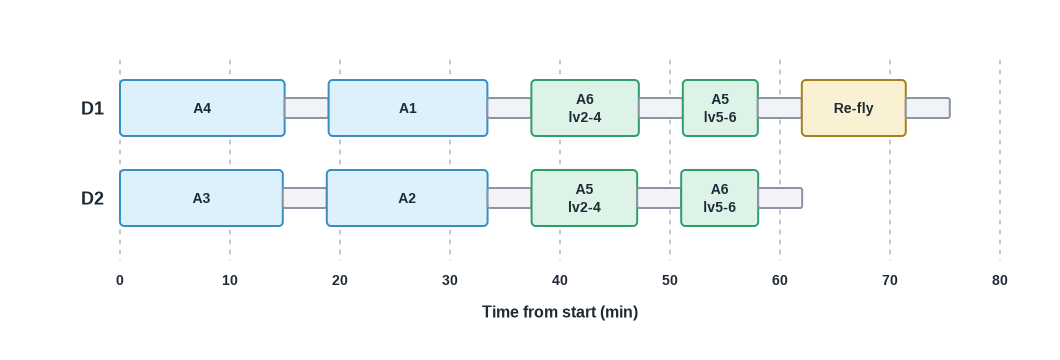
Tonight there are eight scan sorties from Example 1 (one aisle each for A01 to A04, two each for A05 and A06) and one re-flight from Example 2, and the warehouse has two drones. Finishing as early as possible is a parallel-machine scheduling problem. A simple rule that works well is LPT (longest processing time first): sort the jobs from longest to shortest and give each to the machine that becomes free first. Graham (1969) proved that LPT’s finishing time is at most times the optimum, where is the number of machines; for two drones, at most 1.17 times.
Example 3 Flight schedule for two drones
After every sortie the battery is swapped and the drone checked, taking 4 minutes. The re-flight must come after the full scan, so it is added last (assumed values).
# share tonight's sorties between two drones with longest-processing-time first (LPT)
TURN = 240                                     # s to swap the battery and check the drone (assumed)
sorties = {"A1": 866, "A2": 877, "A3": 888, "A4": 898,
           "A5 lv2-4": 576, "A5 lv5-6": 409, "A6 lv2-4": 586, "A6 lv5-6": 420}   # s, from example 1
free = {"D1": 0, "D2": 0}
plan = {"D1": [], "D2": []}
for name, s in sorted(sorties.items(), key=lambda x: -x[1]):
    d = min(free, key=free.get)                # give the next-longest sortie to the drone free first
    plan[d].append(name); free[d] += s + TURN
d = min(free, key=free.get)                    # re-flight of unread locations goes last (example 2)
plan[d].append("re-flight"); free[d] += 567 + TURN
for d in plan:
    print(d, ", ".join(plan[d]), f"-> {free[d] / 60:.1f} min")
total = sum(sorties.values()) + 567 + TURN * (len(sorties) + 1)
print(f"makespan {max(free.values()) / 60:.1f} min, lower bound {total / 2 / 60:.1f} min, "
      f"window 22:00-05:00 = 420 min")
D1 A4, A1, A6 lv2-4, A5 lv5-6, re-flight -> 75.4 min
D2 A3, A2, A5 lv2-4, A6 lv5-6 -> 62.0 min
makespan 75.4 min, lower bound 68.7 min, window 22:00-05:00 = 420 minThe whole night takes 75.4 minutes, not far above the 68.7-minute lower bound (all work divided by two, which no schedule can beat), and uses only a small part of the 7-hour window. That finding matters more than the schedule itself: the warehouse can scan its upper levels every night, not just weekly as estimated in module 1, with time to spare for aisles unlocked late because of unfinished replenishment.
A real schedule must also consider three things. First, there must be enough fully charged batteries for nine sorties within about an hour and a quarter. Second, aisles where forklifts are still working stay locked, so their sorties must be moved later. Third, two drones should not use the same cross-aisle at the same time; if they must pass, assign different heights or make one wait.
Module lab
Lab: plan one night’s routes and schedule
- Using the mock warehouse layout from module 1, set the route constraints: side clearance, ceiling limit, geofence and no-entry aisles. Show the side-clearance calculation
- Use Example 1 to compute scan times and check energy for every aisle, then require at least 60 seconds of energy margin per sortie and state which sorties must be split further
- Generate 12 random unread locations, plan the route with Example 2 and compare it with an order the students plan by hand
- Schedule two drones with LPT as in Example 3, adding the condition that aisle A02 unlocks only after minute 30. Then fly one aisle for real in a training field or a netted lab enclosure under the instructor’s supervision
Common mistakes
Watch out
- Flying over the racks as a shortcut, close to sprinklers and lights, and possibly blowing items off rack tops
- Planning sorties with zero or a few seconds of energy margin, ignoring worn batteries and hot air
- Using straight-line distances between points instead of the detour through the cross-aisles, so times are underestimated
- Relying on collision prevention instead of planning routes with clearance
- Sending a drone into an aisle that is not locked, or without checking that no one is inside
Summary
- Warehouse routes are limited by side clearance, the ceiling limit, no flying over racks, speed and aisle locking; collision prevention is an extra layer
- The horizontal pattern is much faster than the vertical one; every sortie must satisfy with a margin
- Travel between aisles must detour through the cross-aisles; use nearest neighbour and improve with 2-opt
- The LPT rule shares sorties among drones close to the best possible schedule, and shows how often the warehouse can be scanned in the time available
Check your understanding
- An aisle is 56 m long with four levels to scan at 0.5 m/s, and each level change takes 10 seconds. How long does the scan take?
- A drone flies for 18 minutes with a 25% reserve. A sortie scans for 700 seconds and needs 90 seconds of transit. Does it fit in one sortie?
- One location is in aisle 2 at m and another in aisle 5 at m, with , and m. What is the travel distance?
- Jobs of 9, 8, 7, 6, 5 and 4 minutes are shared between two drones with LPT. What is the finishing time?
- Why should a drone in a high-bay warehouse not fly over the racks as a shortcut?
Answers
- seconds
- Usable energy is seconds and the sortie needs seconds. It fits, but with only 20 seconds of margin, so split it or reduce the work
- Via the front m, via the back m; take the back and add m for 95.0 m
- The first drone gets 9, 6 and 5 for 20 minutes and the second 8, 7 and 4 for 19 minutes, so the finishing time is 20 minutes (lower bound 19.5)
- There is little room between the pallet tops and the sprinklers, lights and pipes, rotor wash can blow items off the rack tops, and a drone that fails there falls onto racking that is hard to reach, so aisles are crossed only at the cross-aisles
Key formulas
| Horizontal scan time of one aisle | |
| Sortie energy condition | |
| Distance between locations in different aisles | |
| LPT bound |
Key references
- Ratliff, H. D., & Rosenthal, A. S. (1983). Order-picking in a rectangular warehouse: A solvable case of the traveling salesman problem. Operations Research, 31(3), 507–521. link
- Croes, G. A. (1958). A method for solving traveling-salesman problems. Operations Research, 6(6), 791–812. link
- Graham, R. L. (1969). Bounds on multiprocessing timing anomalies. SIAM Journal on Applied Mathematics, 17(2), 416–429. link
- Kalinov, I., Petrovsky, A., Ilin, V., Pristanskiy, E., Kurenkov, M., Ramzhaev, V., Idrisov, I., & Tsetserukou, D. (2020). WareVision: CNN barcode detection-based UAV trajectory optimization for autonomous warehouse stocktaking. IEEE Robotics and Automation Letters, 5(4), 6647–6653. link
- PX4 Autopilot. Collision prevention. PX4 user guide (main). link
- Health and Safety Executive. (2007). Warehousing and storage: A guide to health and safety (HSG76, 2nd ed.). HSE Books. link
Further reading
Study the assigned knowledge units in advance, review media and take the module quiz
การวางแผนเส้นทางและหลบหลีกสิ่งกีดขวางอัตโนมัติ
ระบบระบุตำแหน่งภายในอาคาร
ความปลอดภัยของแบตเตอรี่ลิเธียม
In class / field
Lab or field practice from worksheets with a safety checklist
Learning evidence: Checked worksheets and quiz results