Emergency situation analysis and mission objectives
UAT 460 UAS for Public Safety, Search and Rescue, and Emergency Management
Lesson
By the end of this module you will be able to
- Describe the eight-step UAS mission-planning process and decision gates G1 to G3, and link them to the Incident Action Plan of the incident command system
- Analyse a situation as known, assumed and unknown information and set the constraint clocks of the mission
- Build a schedule backwards from the incident commander's decision time with the critical path method and find the total float of each task
- Assess the value of information from different sources with the expected value of sample information (EVSI) and find the threshold where information is worth most
- Write measurable mission objectives and choose a set of objectives within an aircraft-minute budget
Why this matters
At 16:05 the phone of the drone team leader rings. The incident commander is standing in front of Thongthan Tower, a 28-storey residential and office building in the middle of the city. The fire on the 16th floor has been burning for 13 minutes. He is brief: “In half an hour I must decide whether to send the firefighting crews up now to search and evacuate floors 17 to 19, or to wait. I need thermal pictures of all four sides before 16:35.”
A team without a plan runs to grab a drone straight away and then discovers the facts one at a time. The battery of the second aircraft is not charged. Nobody knows how strong the wind is at 80 m. The remote pilot cannot see the north side of the building. Nobody has told the air ambulance helicopter, which is on its way to land at the hospital, that a drone is in the air. And when the drone does fly, the pictures do not answer the question the commander asked. Flying well does not help if you fly the wrong task, at the wrong time or against the rules. A successful emergency mission therefore starts with a plan that can be made in a few minutes, which comes from practising a way of thinking in advance. This course teaches that way of thinking as a repeatable process, with quantitative tools to check each step.
Modules 16–20 of this course use one fictional case: the drone team of Thongthan City Municipality (a fictional name), the capital of a province that has no airport within 9 km. The team has four aircraft of three types: type A, a medium quadcopter with a zoom camera, a thermal camera and a searchlight, two aircraft (A1 and A2); type B, a small quadcopter with a thermal camera only, one aircraft; and type C, a tethered drone powered from the ground, one aircraft. The team works for the municipality’s incident commander, and the mayor is the local director. The course follows two incidents in a row: the Thongthan Tower fire (a building 95.2 m tall with a 40 by 30 m footprint) and the partial collapse of the old market wing next door at 19:40, because its structure was weakened by the fire and the firefighting water, which leads to a search and rescue operation in the collapsed building at night. All place names, times and figures are assumed values. The Python code can be downloaded from /downloads/uat-460/.
This course does not repeat what is already taught. The incident command system, situation awareness and essential information are in modules 1–5 of this course, search theory and POD in modules 6–10 of this course, the disaster cycle and data products in modules 11–15 of this course, and the physics of thermal imaging in UAT 455. This course starts with what comes before all of those: planning whether to fly, what to fly for, and how to fly.
The eight-step mission-planning process
The FEMA guide to emergency operations planning (CPG 101, version 3.1, 2025) describes planning in six steps: form a collaborative planning team, understand the situation, determine goals and objectives, develop the plan, prepare and review the plan, and implement and maintain the plan. It stresses that at least two options must be considered, not a single answer (Federal Emergency Management Agency, 2025). NFPA 2400, the standard for small unmanned aircraft systems used for public safety operations, asks the operator to assess operational needs from three things: the mission objectives, the risk assessment, and the readiness and capability of resources (National Fire Protection Association, n.d.). The US National Incident Management System (NIMS) requires the incident commander to set incident objectives and write them into the Incident Action Plan (IAP) for the next operational period (Federal Emergency Management Agency, 2017). Thailand’s National Disaster Prevention and Mitigation Plan also adopts the ICS principles (Department of Disaster Prevention and Mitigation, 2021).
This course arranges those ideas into the eight-step UAS mission-planning process. It is the framework of this course, not a standard of any agency.
| Step | Question to answer | Product of the step | Module |
|---|---|---|---|
| 1 Analyse the situation | What has happened, what is known, what is not known, and how much time is left | Table of known, assumed and unknown, and the constraint clocks | 16 |
| 2 Define the objectives | What does the decision-maker need to know, by when, and which question do we answer first | A set of measurable objectives | 16 |
| 3 Assess the site and risk | Can we really fly, under the rules and under the physics | Wind log, line of sight, SAIL and authorisation to fly | 17 |
| 4 Select aircraft and equipment | Which aircraft and which sensor can answer the objectives | Selection table with reasons | 18 |
| 5 Define routes and operating area | Where to fly, at what height, and for how long | Operating-volume map and route plan | 19 |
| 6 Plan for contingencies | If things go wrong, who does what and when | Contingency tree and return points | 19 |
| 7 Coordinate and communicate | Who needs to know what, before and during the flight | Airspace plan, communication plan, handover file | 20 |
| 8 Review after the mission | Where did the plan and reality differ, and how to fix it | Review report and corrective plan | 20 |
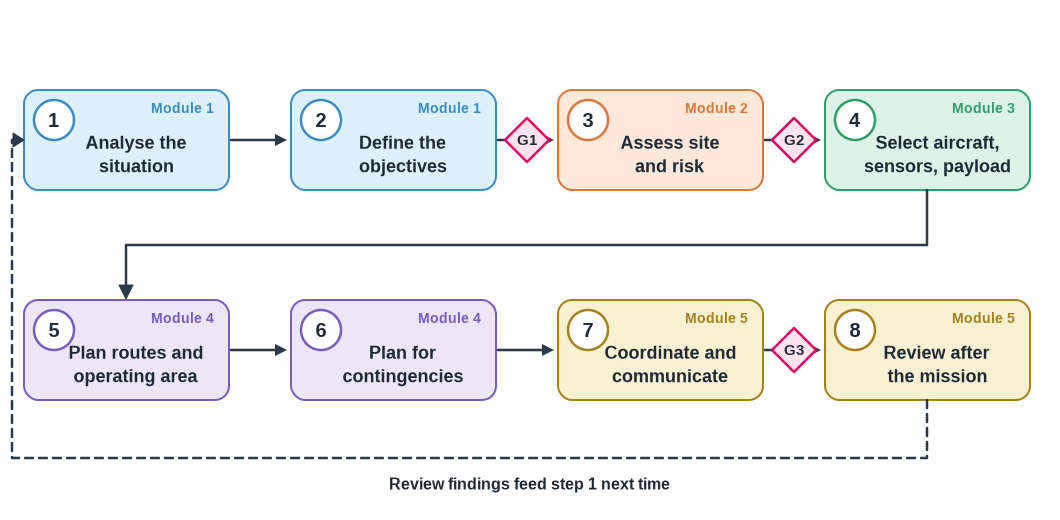
The markers G1 to G3 are decision gates, points where the team must stop and ask whether to go on, fix or abandon.
- G1, after defining the objectives: Is there information that a drone can provide in time, and with better value than other methods, for example sending a reconnaissance crew up the stairs? If not, tell the commander at once that a drone does not help with this.
- G2, after assessing the risk: Is the residual risk acceptable, and is the authorisation to fly complete under the regulations (Module 17)?
- G3, before launch: Is the checklist complete, and has no new event changed the assumptions (Module 20)?
“Do not fly” can be a correct result of planning, but the reason must be recorded and the commander informed. The eight steps are not a straight line. The result of step 3 may send the team back to step 2: if there is no position from which the pilot can see the drone along the whole north route, that objective must be changed or dropped. And the result of step 8 feeds back into step 1 next time.
Analysing the situation: known, assumed and unknown
CPG 101 always puts the step “understand the situation” before setting goals. In an incident where the time left is measured in minutes, the drone team uses a three-column table that can be written in three minutes. It separates information into known (has a source and a time), assumed (estimated from experience, and must be labelled as assumed) and unknown (must be answered, or the plan must tolerate not knowing). Here is an example for the fire at 16:05.
| Type | Information | Source | Age of the information |
|---|---|---|---|
| Known | Fire on floor 16, reported at 15:52 | Emergency call-centre log | 13 minutes |
| Known | 28-storey building, 95.2 m tall, footprint 40 × 30 m | Building drawings from the municipality | Fixed data |
| Known | South-westerly wind of about 5 m/s at 10 m height | Municipal wind station | 10 minutes |
| Known | Police closed the roads around the building at 16:00 | Traffic commander | 5 minutes |
| Assumed | The probability that the fire has already spread to floors 17 to 19 is 0.40 | Opinion of the fire officers | 16:05 |
| Assumed | Sunset at 17:50 | Sunset calendar (assumed value) | Fixed data |
| Unknown | Whether anyone is trapped at a window or on a balcony | No source yet | |
| Unknown | When the air ambulance helicopter will land | Emergency medical dispatch centre |
The table forces the team to see two things. Information marked “assumed” may be wrong and must be rechecked when new information arrives, and information marked “unknown” is what the mission objectives must answer. The idea builds on the three levels of situation awareness (Endsley, 1995) learned in modules 1–5 of this course: perception, comprehension and projection. The table above is the perception level, what the team has and what it lacks. The relation between information and decisions is measured in numbers in the section on the value of information.
Constraint clocks are times that run out by themselves without anyone giving an order. Planning must write these clocks down first, every time.
| Clock | Time (assumed values) | Effect on the plan |
|---|---|---|
| Incident commander’s decision time | 16:35 | The first product must reach the commander before this time |
| Sunset | 17:50 | The 2015 Ministry of Transport notification allows flight between sunrise and sunset, and night flight needs Specific-category authorisation (Module 17) |
| Flight time per battery set | 28 minutes (type A aircraft) | Sets the number of sorties and aircraft swaps (Module 18) |
| Schedule of the air ambulance and police helicopters | As the dispatch centre announces | The drone must stop flying or the heights must be separated (Module 20) |
| Operational period | As the commander sets it, for example 12 hours | The objectives must enter the IAP of that period |
Timeline of the case study (assumed values) 15:52 fire on floor 16 reported · 16:00 operations centre opened and roads closed · 16:05 request reaches the drone team · 16:35 commander decides about floors 17 to 19 · 17:50 sunset · 19:40 old market wing partly collapses · 20:30 the provincial collapsed-structure search and rescue team arrives
How a building collapse differs from a fire. In a collapse, the International Search and Rescue Advisory Group (INSARAG) divides the work into five assessment, search and rescue levels (ASR levels), which are usually done in order but can overlap in different areas (INSARAG, 2020, Vol. II, Manual B, section 5.7). The 2020 guidelines stay in force until a new edition, launched on 9 July 2026, takes effect on 1 January 2027; the new edition keeps the same five levels. The table below is the backbone of the objectives in the collapse incident.
| Level | Name | Purpose according to the guidelines | Where a drone can help in the case study |
|---|---|---|---|
| 1 | Wide Area Assessment | Initial survey to learn the extent of the damage, the zoning plan and the priorities | Overview of the damage around the market, access routes, sites for the base of operations |
| 2 | Worksite Triage Assessment | Find where survivors are likely to be and prioritise sending rescue teams | The structure seen from above and from the side, heat in voids |
| 3 | Rapid Search and Rescue | Search and rescue quickly in the selected sites, within one operational period | Night thermal imagery to help the search team |
| 4 | Full Search and Rescue | Search for people trapped deep that earlier levels did not find | Monitoring changes in the structure |
| 5 | Total Coverage Search and Recovery | Search and recover to cover everything | Recording imagery as evidence and as a record of progress |
The INSARAG guidance states that level 1 is done by vehicle, helicopter, boat, on foot or by taking reports from others, and it stresses a fast visual check. The team doing this level must be able to move, must not be tied up in rescue, and must report results as fast as possible. This description fits the strengths of a drone. For level 2, the guidance says it may be repeated later, for example as a night-time assessment, which opens a role for night thermal imagery from a drone.
Working back from the decision time
The commander does not ask “how many minutes does the drone fly?” He asks “will I have the information before 16:35?” Planning must therefore count backwards from the decision time, not forwards from the launch time. Every task from receiving the request to reporting the result is counted.
The method used to check this is the critical path method (CPM). The NASA schedule management handbook defines the critical path as the longest continuous chain of tasks with the least float, because it determines the earliest finish of the whole job, and defines total float as the time a task can slip without delaying the whole job. It is computed with a forward pass to find the earliest finish EF, then a backward pass to find the latest finish LF that does not delay the job. The float is (National Aeronautics and Space Administration, 2024). One caution: this calculation ignores limits on people. If two tasks done at the same time need the same person, the team must check that separately.
Example 1 Is the first product in before 16:35?
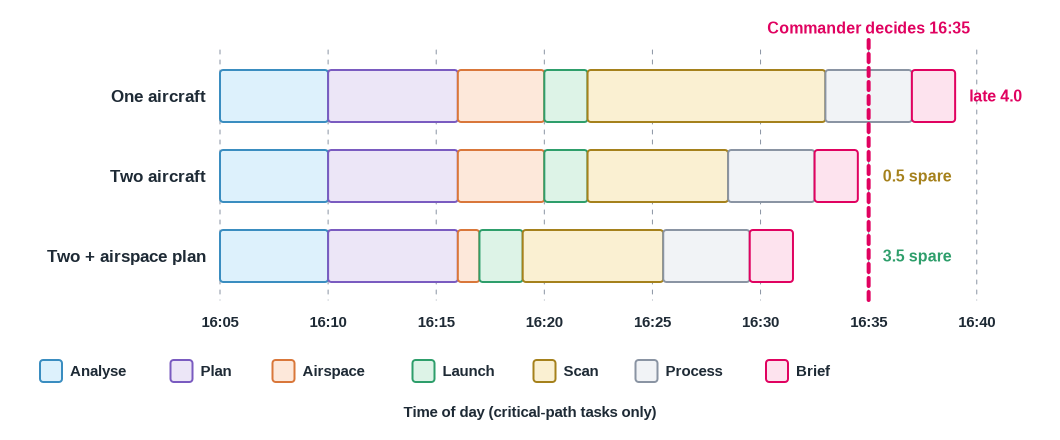
The team leader splits the work into eight tasks. The durations come from past exercises (assumed): analyse 5 minutes; plan the route and risk 6 minutes; prepare the kit and batteries 6 minutes (can be done alongside planning because it is a different person); coordinate the airspace 4 minutes; launch 2 minutes; scan the four faces 11 minutes with one aircraft and 6.5 minutes with two; process the data and prepare supporting images 4 minutes; brief the commander 2 minutes. The request arrives at 16:05. The team compares three options: one aircraft, two aircraft, and two aircraft with an airspace plan agreed in advance, so that only a 1-minute confirmation notice remains.
# critical path method (CPM) for the first 30 minutes: durations in minutes (assumed), tasks may wait for predecessors
def cpm(tasks, start):
    order = []
    while len(order) < len(tasks):                       # topological order: a task comes after all its predecessors
        for k, (d, pre) in tasks.items():
            if k not in order and all(p in order for p in pre):
                order.append(k)
    ef = {}
    for k in order:                                      # forward pass: earliest finish
        ef[k] = max([ef[p] for p in tasks[k][1]], default=start) + tasks[k][0]
    end = max(ef.values())
    lf = {k: end for k in tasks}
    for k in reversed(order):                            # backward pass: latest finish that does not delay the end
        for p in tasks[k][1]:
            lf[p] = min(lf[p], lf[k] - tasks[k][0])
    float_ = {k: lf[k] - ef[k] for k in order}           # total float: how long a task may slip without delaying the end
    return order, ef, float_, end

def clock(m):                                            # minutes after 16:00 -> hh:mm:ss
    s = round(m * 60)
    return f"{16 + s // 3600:02d}:{s % 3600 // 60:02d}:{s % 60:02d}"

base = {  # task: (duration in min, predecessors)
    "analyse": (5, []), "plan": (6, ["analyse"]), "prepare": (6, ["analyse"]),
    "airspace": (4, ["plan"]), "launch": (2, ["prepare", "airspace"]),
    "scan": (11, ["launch"]), "process": (4, ["scan"]), "brief": (2, ["process"]),
}
two = {**base, "scan": (6.5, ["launch"])}                # two aircraft, each scans two faces
two_pre = {**two, "airspace": (1, ["plan"])}             # airspace plan agreed in advance: only notify
start, decision = 5, 35                                  # request at 16:05, commander decides at 16:35
for name, t in (("one aircraft", base), ("two aircraft", two), ("two aircraft + airspace plan", two_pre)):
    order, ef, fl, end = cpm(t, start)
    crit = [k for k in order if fl[k] < 1e-9]
    print(f"{name:<29} ready {clock(end)}  margin {decision - end:+5.1f} min  critical: {' > '.join(crit)}")
order, ef, fl, end = cpm(base, start)
print("one aircraft, task by task (earliest finish, total float):")
for k in order:
    print(f"  {k:<9} {clock(ef[k])}  float {fl[k]:4.1f} min")
one aircraft ready 16:39:00 margin -4.0 min critical: analyse > plan > airspace > launch > scan > process > brief
two aircraft ready 16:34:30 margin +0.5 min critical: analyse > plan > airspace > launch > scan > process > brief
two aircraft + airspace plan ready 16:31:30 margin +3.5 min critical: analyse > plan > airspace > launch > scan > process > brief
one aircraft, task by task (earliest finish, total float):
analyse 16:10:00 float 0.0 min
plan 16:16:00 float 0.0 min
prepare 16:16:00 float 4.0 min
airspace 16:20:00 float 0.0 min
launch 16:22:00 float 0.0 min
scan 16:33:00 float 0.0 min
process 16:37:00 float 0.0 min
brief 16:39:00 float 0.0 minWith one aircraft the product is ready at 16:39, 4 minutes after the decision time. Every task except “prepare” is on the critical path with zero float. Preparation has 4 minutes of float, which means it could slip by another 4 minutes without affecting the finish, and speeding up preparation would not help, because the task that is waiting is airspace coordination. With two aircraft the scan time falls from 11 to 6.5 minutes. The product is ready at 16:34:30, leaving 30 seconds, which is too thin: a single minor fault would pass the deadline. Agreeing the airspace plan in advance cuts the coordination work from 4 to 1 minute, leaving 3.5 minutes, and the float of preparation falls to 1 minute. If the planning time were cut further, the critical path would move to preparation, so always check where the critical path moves after a fix.
The minutes of the task “coordinate the airspace” in this example are the time to notify and confirm the conditions under a permit the team already holds. They are not the time to ask the Civil Aviation Authority of Thailand (CAAT) for permission, which under the 2025 edition of the CAAT guidelines for requesting services is counted in working days (apply 14 working days in advance, and CAAT takes 9 working days to consider, not counting time to correct documents). A permission that cannot be obtained on the day of the incident must therefore be prepared before the incident, which Module 17 explains. The scan times of 11 and 6.5 minutes are estimates made before there is a route plan. Module 19 calculates the real time from the geometry of the route.
Essential information and the value of information
modules 1–5 of this course teaches how to set the essential elements of information (EEI) before flight. The next question is which information is worth fetching first when time and aircraft are limited. The answer lies in value-of-information theory (Howard, 1966), which measures information by one thing only: how much it changes the decision and reduces the expected loss.
Start with the commander’s decision. There are two options: send the firefighting crews up to floors 17 to 19 now (commit) or wait (hold). The unknown state is whether the fire has already spread to those floors. The team assigns a loss unit to each pair (option, state), assessed together with the fire officers (assumed values): commit and the fire has spread, 30; commit and it has not spread, 0; hold and it has spread, 4; hold and it has not spread, 10 (evacuation time wasted). The prior probability that the fire has spread is 0.40.
Without more information, the expected loss of each option is , and the team chooses the smaller. With perfect information the commander would choose the best option in each state. The difference in expected loss from the no-information case is the expected value of perfect information (EVPI), which is the ceiling on the value of every source. Real sources are imperfect. Each has a sensitivity (a “spread” report is correct when the fire really has spread) and a specificity (a “not spread” report is correct when it really has not). For each possible report, use Bayes’ rule to update the probability, choose the best option after that report, and weight it by how often the report occurs. The difference from the no-information case is the expected value of sample information (EVSI).
Example 2 Which source is worth the most before 16:35?
The team compares four sources: a drone thermal scan of the four faces (sensitivity 0.90, specificity 0.85, result in 7 minutes), a drone zoom camera on the windows (0.70, 0.90, 8 minutes), a reconnaissance crew walking up the stairwell (0.95, 0.95, 12 minutes) and a report from the building manager (0.55, 0.70, 3 minutes). These values are assumed; real values must come from field tests.
# expected value of sample information (EVSI) for the decision "send crews to floors 17-19 now, or hold" (all numbers assumed)
p_spread = 0.40                                   # prior probability that the fire has already spread into floors 17-19
loss = {("commit", True): 30, ("commit", False): 0, ("hold", True): 4, ("hold", False): 10}   # loss units
ACTS = ("commit", "hold")
def exp_loss(act, p): return p * loss[(act, True)] + (1 - p) * loss[(act, False)]
def best_loss(p): return min(exp_loss(a, p) for a in ACTS)
def evsi(p, sens, spec):
    """Bayes: for each possible report, update the probability, take the best action, weight by how often the report occurs."""
    after = 0.0
    for says_spread in (True, False):
        p_rep = p * (sens if says_spread else 1 - sens) + (1 - p) * ((1 - spec) if says_spread else spec)
        post = p * (sens if says_spread else 1 - sens) / p_rep
        after += p_rep * best_loss(post)
    return max(0.0, best_loss(p) - after)
best0 = best_loss(p_spread)
perfect = p_spread * min(loss[(a, True)] for a in ACTS) + (1 - p_spread) * min(loss[(a, False)] for a in ACTS)
print(f"no information: commit {exp_loss('commit', p_spread):.1f}, hold {exp_loss('hold', p_spread):.1f} -> expected loss {best0:.1f}")
print(f"perfect information: expected loss {perfect:.1f}, EVPI {best0 - perfect:.1f}")
sources = {  # name: (sensitivity, specificity, minutes until the answer is available)
    "drone thermal scan of 4 faces": (0.90, 0.85, 7.0),
    "drone zoom camera on windows":  (0.70, 0.90, 8.0),
    "crew recon in the stairwell":   (0.95, 0.95, 12.0),
    "building manager's report":     (0.55, 0.70, 3.0),
}
for name, (sn, sp, mins) in sources.items():
    v = evsi(p_spread, sn, sp)
    print(f"{name:<31} EVSI {v:4.2f}  per minute {v / mins:5.3f}  ({v / (best0 - perfect):4.0%} of EVPI)")
p_star = (loss[("hold", False)] - loss[("commit", False)]) / (
    loss[("commit", True)] - loss[("commit", False)] - loss[("hold", True)] + loss[("hold", False)])
print(f"decision threshold: commit is better only if P(spread) < {p_star:.3f}")
grid = [i / 100 for i in range(1, 100)]
top = max(grid, key=lambda p: evsi(p, 0.90, 0.85))
print(f"thermal-scan EVSI is largest at P(spread) = {top:.2f} ({evsi(top, 0.90, 0.85):.2f}); at 0.05 it is {evsi(0.05, 0.90, 0.85):.2f}, at 0.90 it is {evsi(0.90, 0.90, 0.85):.2f}")
no information: commit 12.0, hold 7.6 -> expected loss 7.6
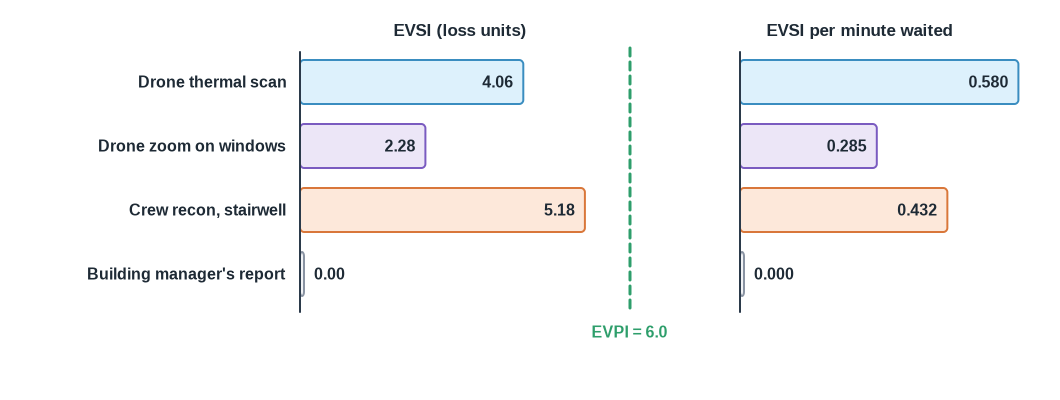
perfect information: expected loss 1.6, EVPI 6.0
drone thermal scan of 4 faces EVSI 4.06 per minute 0.580 ( 68% of EVPI)
drone zoom camera on windows EVSI 2.28 per minute 0.285 ( 38% of EVPI)
crew recon in the stairwell EVSI 5.18 per minute 0.432 ( 86% of EVPI)
building manager's report EVSI 0.00 per minute 0.000 ( 0% of EVPI)
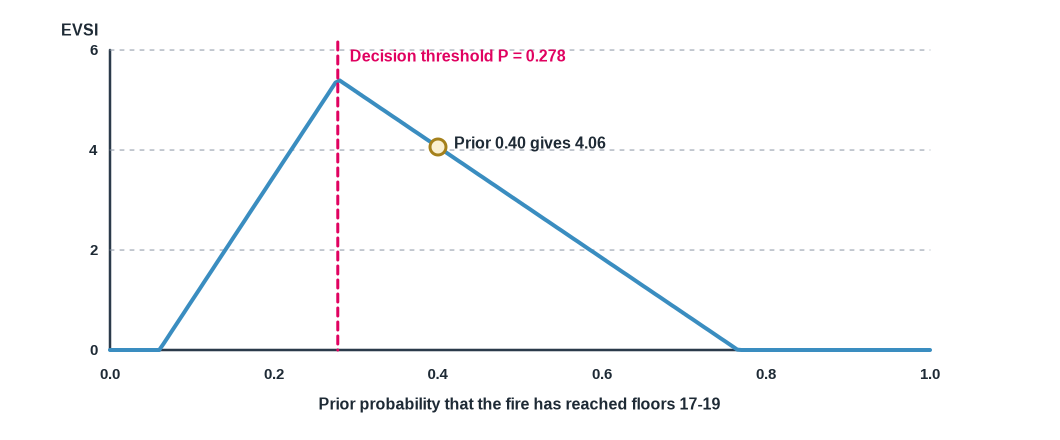
decision threshold: commit is better only if P(spread) < 0.278
thermal-scan EVSI is largest at P(spread) = 0.28 (5.39); at 0.05 it is 0.00, at 0.90 it is 0.00Without information, waiting (7.6) is better than sending the crews up at once (12.0). Perfect information would cut the loss to 1.6, so EVPI is 6.0. The thermal drone scan achieves 4.06, or 68% of the ceiling, within 7 minutes. The stairwell crew has the highest value, 5.18, because it is the most accurate, but it takes 12 minutes, which uses up much of the time left before the decision, and it sends people into a burning building. The risk to people is not in this loss-unit table. The thermal drone’s value per minute (0.580) is therefore higher than the crew’s (0.432), and the zoom camera at the windows is worse because its sensitivity is lower. The building manager’s report is worth 0.00, not because he would be wrong, but because even if he reports “not spread”, the updated probability is 0.30, which is still above the threshold of 0.278, so the commander should still wait. Information that cannot change the decision has no value.
The decision threshold is the probability at which the two options give equal loss. In this example . If the prior probability is higher than this, waiting is better. The EVSI of the thermal scan peaks at 5.39 when , exactly where the commander is most undecided. At or it is zero, because whatever the scan shows, it would not change the commander’s mind when he is already almost sure that the fire has spread or has not spread.
There are two cautions. First, the loss figures and probabilities are human judgement, so the result is used to rank sources and to warn that some information is worthless, not as a decimal figure to argue over. Record the assumptions and change the values to see whether the ranking changes. Second, sensitivity and specificity must come from the team’s own field tests, as UAT 455 and modules 6–10 of this course teach for measuring the capability of thermal imaging, not from brochures.
Writing objectives that work
CPG 101 separates a goal, a broad statement of the desired result, from an objective, a specific action that can be identified during operations. It also separates the objectives of the plan from incident objectives, which the commander sets for the next operational period (Federal Emergency Management Agency, 2025). The drone team takes the incident objectives and converts them into drone mission objectives written with six fields.
- The question or decision that this information supports
- What to image, or the area, that must be seen
- The product to deliver (image, map, list)
- The recipient
- The deadline
- The success criterion, checkable with a number or a yes or no answer
Compare three sentences. “Photograph the whole building” is an activity: it does not say what decision it feeds. “Use the thermal camera to look at the building” is a tool: it does not say what result is needed. “Send thermal images of all four sides of floors 8 to 28 to the commander before 16:35, with every window covering at least 10 pixels in the image, to decide about sending crews up to floors 17 to 19” has all six fields. The 10-pixel figure is the team’s criterion, which Module 18 converts into a lens and a distance. A good objective also makes it easier to decide to abandon a mission, because it says how “succeeded” differs from “flown”.
The table below holds the objectives for the fire incident, used in Modules 18 to 20. The cost figures are aircraft time estimated in advance.
| Code | Objective | Recipient | Deadline | Success criterion | Cost (aircraft-minutes) |
|---|---|---|---|---|---|
| O1 | Thermal status of the four faces, floors 8 to 28 | Commander | 16:35 | Every window at least 10 pixels | 12 |
| O2 | People at windows and balconies | Emergency rescue section | Continuous | Location identified by floor and face | 14 |
| O3 | Falling-debris zone and crowd line | Traffic police | 16:50 | Zone map sent within 10 minutes | 6 |
| O4 | Roof and helicopter landing point | Air operations section | 17:00 | Can answer whether landing is possible | 4 |
| O5 | The old market building next door | Planning section | 17:15 | Can state whether the fire has spread across | 8 |
| O6 | Overview video for public relations | News coordinator | When free | Faces not clearly visible in the footage | 5 |
The night-time collapse incident uses the ASR levels as its backbone, for example C1, the overview of the damage around the market for the zoning plan (level 1, recipient: the rescue coordinator), and C2, thermal images of each worksite to select the sites likely to have survivors (level 2). Modules 17 to 20 plan these further.
Choosing objectives within the aircraft-minute budget
Every objective answers a reasonable request, but aircraft time is limited. In one flight window before the batteries are changed, the team has an aircraft-minute budget, for example 30 minutes: with two aircraft, about 15 minutes each over the operating area. The task is to choose the set of objectives with the highest total value within the budget, which must include the objective the commander has declared essential (here O1). The value of each objective is in loss units avoided; for example, O1 uses 4.06 from Example 2, and the others come from joint assessment (assumed values).
A shortcut people often use is to rank by value per minute and take items from the top until the budget runs out. This does not guarantee the best set. With few objectives, try every subset (6 objectives give 64 subsets), which a computer does in an instant.
Example 3 The best set of objectives as the budget changes
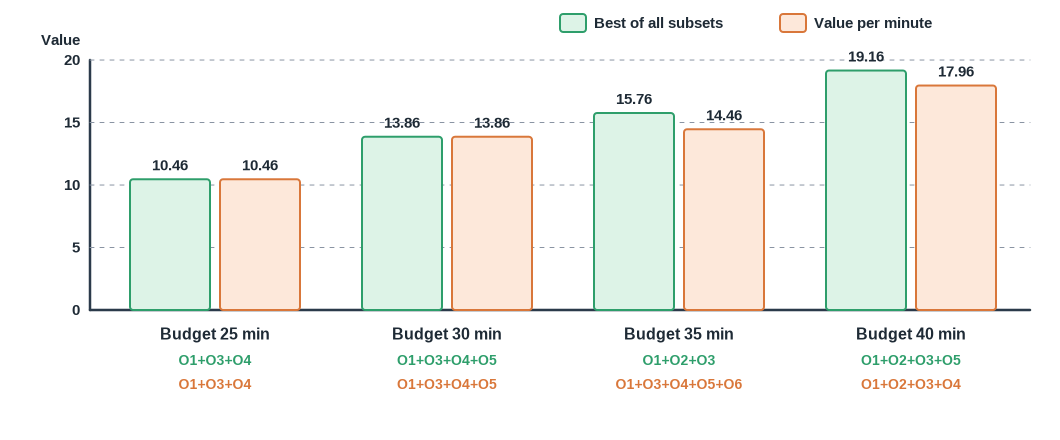
Using the table O1 to O6 above, the team compares budgets of 25, 30, 35 and 40 aircraft-minutes, trying every subset against the rank-by-value-per-minute method.
from itertools import combinations
# choose objectives for the first flight window: value in loss units avoided (assumed), cost in aircraft-minutes (assumed)
obj = {  # id: (description, value, cost)
    "O1": ("thermal status of the four faces", 4.06, 12),
    "O2": ("people at windows and balconies", 7.50, 14),
    "O3": ("falling-debris zone and crowd line", 4.20, 6),
    "O4": ("roof and helicopter landing check", 2.20, 4),
    "O5": ("old market building next door", 3.40, 8),
    "O6": ("overview video for the press office", 0.60, 5),
}
MUST = {"O1"}                                      # the commander's 16:35 decision needs O1
def best(budget):                                  # try every subset: 2**6 = 64 combinations
    top = (0, ())
    for r in range(len(obj) + 1):
        for c in combinations(obj, r):
            if MUST <= set(c) and sum(obj[k][2] for k in c) <= budget:
                v = sum(obj[k][1] for k in c)
                if v > top[0]:
                    top = (v, c)
    return top
def greedy(budget):                                # must-do first, then highest value per aircraft-minute
    chosen, used = list(MUST), sum(obj[k][2] for k in MUST)
    for k in sorted((k for k in obj if k not in MUST), key=lambda k: -obj[k][1] / obj[k][2]):
        if used + obj[k][2] <= budget:
            chosen.append(k)
            used += obj[k][2]
    return sum(obj[k][1] for k in chosen), tuple(sorted(chosen))
for budget in (25, 30, 35, 40):
    vb, cb = best(budget)
    vg, cg = greedy(budget)
    print(f"budget {budget} min: best {'+'.join(cb)} value {vb:.2f} ({sum(obj[k][2] for k in cb)} min) | greedy {'+'.join(cg)} value {vg:.2f}")
budget 25 min: best O1+O3+O4 value 10.46 (22 min) | greedy O1+O3+O4 value 10.46
budget 30 min: best O1+O3+O4+O5 value 13.86 (30 min) | greedy O1+O3+O4+O5 value 13.86
budget 35 min: best O1+O2+O3 value 15.76 (32 min) | greedy O1+O3+O4+O5+O6 value 14.46
budget 40 min: best O1+O2+O3+O5 value 19.16 (40 min) | greedy O1+O2+O3+O4 value 17.96At budgets of 25 and 30 minutes both methods give the same set. At 35 minutes the value-per-minute method picks O1, O3, O4, O5 and O6 for 14.46, while the best set is O1, O2 and O3 for 15.76, because the shortcut takes several small items and leaves too little budget for O2, which has the highest value but takes much time. At 40 minutes the difference is 19.16 against 17.96. The lesson is that an item that “looks poor per minute” may belong in the plan if its total value is high, and an objective that is dropped (such as O6, which is missing from the best set at all four budgets) must be reported to the requester together with the time when it is expected to be flown, following the principle taught in modules 1–5 of this course on receiving requests.
Once the set of objectives is chosen, the team passes gate G1 with three questions. Is there at least one objective that a drone can answer faster or more safely than other methods? Will the product reach the recipient before the deadline according to the backward schedule? And does every recipient know which objective has been postponed or dropped? If the answer to any of them is “no”, go back to step 1 or 2 and fix it before spending time planning the next steps.
Module lab
Lab: plan within thirty minutes and measure the real times
- Receive the scenario card. Teams of 4 to 5 receive the card for a high-rise fire at time T0 (the instructor hands out the 16:05 card from the case study, or a new incident card made in the same format) and start timing the planning at once.
- Table of known, assumed and unknown. Write the table as in the chapter, with at least five constraint clocks. Give the source and age of the information on every line.
- Backward clock. Split the work from receiving the request to reporting the result, add estimated durations, then run the code of Example 1 to find the critical path and the time left. Propose two options that give more time.
- Value of information. Set the loss table of the decision from the scenario card, estimate the sensitivity and specificity of three sources, then run the code of Example 2 to get the ranking of the sources and the decision threshold.
- Objectives. Write at least six objectives with all six fields, set the aircraft-minute costs, then use the code of Example 3 to choose the best set for the budget the instructor sets, and check gate G1.
- Field. On an open university field closed to outsiders, the team times the real “prepare the kit” and “launch” tasks, flying within visual line of sight, in daylight and under CAAT conditions. Then substitute the real times for the estimates in Example 1, rerun it and report whether the critical path changed.
- Submit mission file version 0. One page containing the situation table, the backward clock, the value-of-information table, the chosen set of objectives and the reasons for dropping the rest.
Common mistakes
Watch out
- Starting from the drone you have instead of the decision-maker’s question. Flying and photographing whatever can be photographed without knowing who will use it, or for what.
- Counting time from launch. Forgetting that the commander’s clock starts when the request is sent. Analysis, planning, kit preparation and coordination are all inside the time.
- Speeding up a task that is not on the critical path, for example buying more batteries when the task causing the delay is airspace coordination.
- Measuring the value of information by how impressive the picture is instead of by whether it changes the decision.
- Writing objectives as activities or tools, which cannot be checked for success.
- Forgetting that “do not fly” can be a correct result of planning, and that it must be reported to the commander with the reason.
- Using assumed numbers as facts, without recording the assumptions and without changing the values to see whether the conclusion changes.
Summary
- UAS mission planning has eight steps: analyse the situation, define the objectives, assess the site and risk, select aircraft and equipment, define the route and area, plan for contingencies, coordinate, and review. Gates G1 to G3 are the places to stop and decide, and “do not fly” can be a correct result.
- Analyse the situation as known, assumed and unknown, together with the constraint clocks. A building-collapse incident uses the INSARAG ASR levels as the backbone of the objectives.
- Build the schedule backwards from the decision time with CPM. A float of zero marks the critical path. Check where the critical path moves after a fix.
- The expected value of sample information, EVSI, measures how much information reduces the expected loss. It has the ceiling EVPI, it is highest when the probability is near the decision threshold, and it is zero if the information cannot change the decision.
- A good objective has six fields: question, what to image, product, recipient, deadline and success criterion. Choose objectives within the aircraft-minute budget by trying every subset, because ranking by value per minute can miss the best set.
Self-check questions
- Four tasks: A takes 4 minutes, B takes 5 minutes after A finishes, C takes 7 minutes after A finishes, and D takes 3 minutes after both B and C finish. Starting at minute 0, when does everything finish? What is the critical path, and what is the float of B?
- In Example 2, if the prior probability that the fire has spread is 0.90, what is the EVSI of the thermal scan, and why?
- A new loss table: commit and spread 20; commit and not spread 0; hold and spread 5; hold and not spread 12. What is the decision threshold , and at a probability of 0.40 with no extra information, which option should be chosen?
- Three objectives: A has value 7 and takes 6 minutes; B has value 5.5 and takes 5 minutes; C has value 5.5 and takes 5 minutes. The budget is 10 minutes. Which set is best, and what does the value-per-minute method give?
- A first overview of the whole collapsed market area to make the zoning plan and find a site for the base corresponds to which INSARAG ASR level?
Answers
- Everything finishes at minute 14. The critical path is A to C to D (4 + 7 + 3 = 14), while A to B to D takes 12 minutes, so B has a float of minutes.
- EVSI is 0, because at , which is above the threshold of 0.278, waiting is already better. Even if the report says “not spread”, the updated probability is , which is still above the threshold, so the commander still waits.
- and , so . At , which is below the threshold, the expected loss of committing is and the expected loss of holding is , so the crews should be sent up.
- The best set is B and C, using 10 minutes for a value of 11.0. The value-per-minute method (A 1.17, B 1.10, C 1.10) takes A first, using 6 minutes, and then cannot add B or C because that would exceed the budget, so it gets only 7.
- Level 1, Wide Area Assessment, the initial survey to learn the extent of the damage, make the zoning plan and find a site for the base of operations.
Key formulas
| Total float of a task | |
| Expected value of sample information | |
| Decision threshold for two options |
Key references
- Federal Emergency Management Agency. (2025). Developing and maintaining emergency operations plans: Comprehensive Preparedness Guide (CPG) 101, version 3.1. U.S. Department of Homeland Security. link
- Federal Emergency Management Agency. (2017). National incident management system (3rd ed.). U.S. Department of Homeland Security. link
- National Fire Protection Association. (n.d.). Small unmanned aircraft systems fact sheet [Summary of NFPA 2400, Standard for small unmanned aircraft systems (sUAS) used for public safety operations]. NFPA. link
- INSARAG. (2020). INSARAG guidelines 2020 (Vols. I–III). United Nations OCHA. link
- กรมป้องกันและบรรเทาสาธารณภัย. (2564). แผนการป้องกันและบรรเทาสาธารณภัยแห่งชาติ พ.ศ. 2564–2570. กระทรวงมหาดไทย. link
- National Aeronautics and Space Administration. (2024). NASA schedule management handbook (NASA/SP-2010-3403, Rev. 2). link
- Howard, R. A. (1966). Information value theory. IEEE Transactions on Systems Science and Cybernetics, 2(1), 22–26. link
- Endsley, M. R. (1995). Toward a theory of situation awareness in dynamic systems. Human Factors, 37(1), 32–64. link
Further reading
Study the assigned knowledge units in advance, review media and take the module quiz
การวางแผนภารกิจ UAS ในสถานการณ์ฉุกเฉิน
Deciding when the plan goes wrong
Defining the mission concept
In class / field
Lab or field practice from worksheets with a safety checklist
Learning evidence: Checked worksheets and quiz results