Presenting, Pricing, Delivery and the Law
UAT 474 Commercial Drone Media Production
Lesson
By the end of this module you will be able to
- Present the finished work to the client against the goals in the brief and record decisions in writing
- Calculate a quoted price from direct cost, overhead and profit, compare it with value-based pricing, and write a quote that states scope, review rounds, payment stages and usage rights
- Assemble a complete delivery package with rights documents
- Identify the legal, safety, ethical, copyright, image rights and privacy issues that a commission must settle
Why this matters
Silawaree’s work is edited and has passed QC, but the steps that decide whether the team is paid in full, gets the next job and stays out of legal trouble are still ahead: presenting the work, pricing so the business survives, writing a clear quote and agreement, delivering everything, and settling the rights of everyone in the images. Many teams shoot well yet lose money because they price from the drone alone, or face claims later because they have no release from someone in shot.
UAT 473 module 5 taught copyright, image rights, personal data and responsible publication, and UAT 471 module 5 taught flight law and the ethics of a single flight. This module turns those principles into agreements with a paying client. The legal content here is for learning, not legal advice; high-value real contracts should be checked by a lawyer.
Presenting the work to the client
A client presentation differs from the concept pitch in module 1: this time the client decides whether to accept the work. Mekkhao Productions follows this order:
- Restate the goal and key message from the signed brief recap, so everyone judges the work by the same criteria.
- Show the work as viewers will see it: the brand film full screen with good sound, the vertical videos on a phone, never a small clip inside an email window.
- Explain the key decisions, such as why the first shot is the morning sea and why the drone does not fly into the room.
- Take feedback systematically: note each comment with its timecode and separate what falls within the agreed review rounds from what is extra work.
- Confirm decisions in writing with a summary email after the meeting.
If the client asks for something that breaks the flight conditions, such as “one more low pass over the guests by the pool”, the answer is no, together with a safe way to get a similar image. Client pressure is one of the “external pressures” a pilot must weigh before flying, as UAT 471 taught.
Pricing
There are three main ways to set a price:
- Cost-plus: add up all costs, then add a profit percentage. Easy to understand and never loss-making, but it ignores how much the client values the work.
- Value-based: set the price from the value the client receives. Pricing texts argue that good prices start from value in the customer’s eyes rather than from costs or sales targets alone (Nagle et al., 2023). A video that helps sell high-value villas is worth more to the client than an ordinary video that took the same time to shoot.
- Packages: a fixed price per bundle, such as “half-day shoot with a 30-second video”; suited to repeat work with a clear scope.
In practice the team always works out cost first, to know the lowest price that does not lose money, then compares it with value and market prices. Overhead is cost not tied to any one job but paid all year: office rent, software subscriptions, annual insurance, equipment repair and replacement, and time spent finding work. Without overhead in the price, every job looks profitable but the year ends in a loss.
Example 1 From direct cost to quoted price
Direct cost including contingency from module 2 is 143,550 THB. The team adds 15% overhead and 20% profit (assumed; real rates differ by business and market prices vary widely).
Step 1, overhead. THB.
Step 2, full cost.
Step 3, 20% profit. THB.
Step 4, round the price. The team rounds up to the next five thousand: 200,000 THB. Actual profit after rounding is THB, or 21.2% of full cost. The price excludes VAT; a VAT-registered team must apply the rate in force on the date of the tax invoice (check with the Revenue Department).
The price equals the client’s budget cap exactly. If the client asks for a discount, the team offers to cut scope rather than price, for example dropping the launch highlight, which saves one shoot day and part of the editing. Cutting price without cutting work erases profit and sets the client’s expectation for the next job.
Calculator for the curious
import math

direct = 143_550              # direct cost with contingency from module 2 (THB, assumed)
overhead, margin = 0.15, 0.20
full_cost = direct * (1 + overhead)
price = full_cost * (1 + margin)
quote = math.ceil(price / 5000) * 5000        # round up to the next 5,000
print(f"full cost {full_cost:,.2f}")
print(f"cost-plus price {price:,.2f}, quote {quote:,}")
print(f"profit after rounding {quote - full_cost:,.2f} ({(quote - full_cost) / full_cost:.1%})")
print("payments 50/30/20:", [round(quote * p) for p in (0.5, 0.3, 0.2)])
print(f"extra review round {5000 * (1 + overhead) * (1 + margin):,.0f}")
full cost 165,082.50
cost-plus price 198,099.00, quote 200,000
profit after rounding 34,917.50 (21.2%)
payments 50/30/20: [100000, 60000, 40000]
extra review round 6,900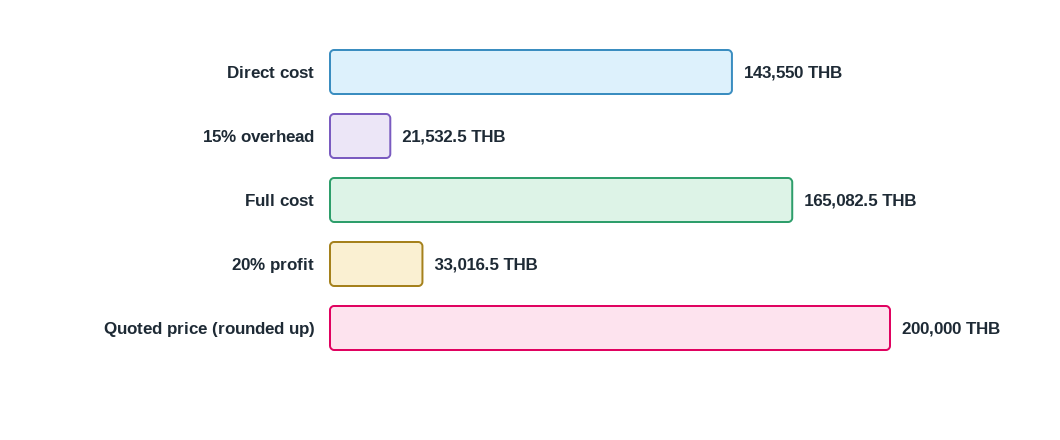
The quote and the agreement
A good quotation is more than a number: it says what the price includes and excludes. Mekkhao Productions’ quote has these sections (assumed figures):
| Section | What it says |
|---|---|
| Scope and deliverables | The deliverables table from module 1 with file specs from the module 4 delivery matrix |
| Shoot days and spare day | 2 shoot days, 1 launch event day, 1 weather day |
| Review rounds | 2 included; each extra round 6,900 THB |
| Weather delays | The pilot may cancel when unsafe; if the weather day is not enough, standby is charged at 50% of the crew’s day rates, 8,750 THB |
| Payment stages | 50% on signing, 30% on the first version, 20% on final delivery |
| Usage rights | Copyright belongs to the client; the team may use the work in its portfolio; music used within its licence |
| Not included | Paid platform advertising, flights needing permission to differ from the conditions, VAT |
| Validity | 30 days |
Payment stages help both sides: the team does not fund the whole job up front, and the client pays as work progresses. On 200,000 THB the first payment is THB, the second THB and the last THB. An extra review round is priced from one editor day of 5,000 THB plus overhead and profit as in Example 1: THB. Weather standby is THB.
Delivering the work
A complete delivery package contains:
- every file on the delivery matrix, named by its use, for example
SLW_Reel1_9x16_1080x1920_FINAL.mp4 - stills in web and print sizes, with captions for the press
- rights documents: music and font licences, credit lines, and the list of releases for people and places in shot
- a delivery note signed by the client, listing files, the date and the terms for keeping originals, for example the team keeps raw files for 1 year after delivery (as agreed)
A download link must be restricted to the recipient and set to expire, because the files contain images of people, which are personal data. This matches the delivery unit of the drone knowledge base: the recipient must be able to open and check everything, and know which items are still missing.
Copyright in commissioned work
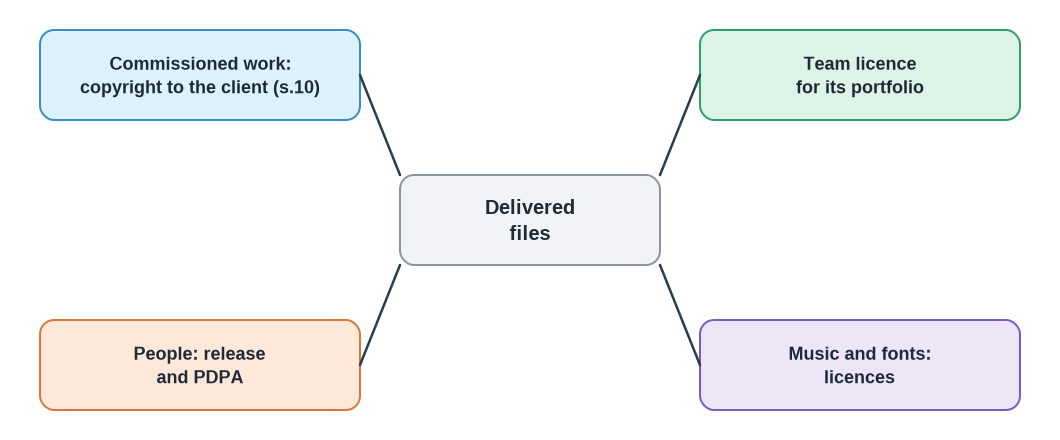
Thailand’s Copyright Act B.E. 2537 (1994) has been amended four times (Nos. 2 and 3 in 2015, No. 4 in 2018 and No. 5 in 2022). Of the principles covered in UAT 473 module 5, the most important for commissions is section 10: copyright in a work created under a commission belongs to the person who commissioned it, unless the author and that person agreed otherwise (Copyright Act B.E. 2537 as amended). In practice:
- If nothing is written, Silawaree owns the copyright in the videos and stills. Mekkhao Productions may not put them in its portfolio or sell them as stock without permission, so the quote includes a portfolio clause.
- The team may instead keep the copyright and license the client, but that must be agreed in writing, and it usually lowers the price because the client receives fewer rights.
- Music and fonts do not become the client’s just because they are in the video; they may be used only within the purchased licence. If the client wants to run the video as a TV commercial, check whether the music licence covers it.
- The author keeps the right to be identified as the author (section 18), so credits should be agreed as well.
Image rights and privacy
A model release and a property release are evidence that a recognisable person, or the owner of recognisable property, allows the image to be used commercially. Major stock agencies require a separate release for each recognisable person in a commercial image, with name, date and signature, and a parent or guardian’s signature for minors (Shutterstock, n.d.). For the Silawaree job the team collects releases from the cast, staff who appear and the owner of the show villa.
An image in which a face can be identified is personal data under Thailand’s Personal Data Protection Act B.E. 2562 (2019), PDPA. Collecting, using or disclosing it needs a lawful basis, such as consent that is explicit, in writing or electronic, and states the purpose (section 19), or another basis under section 24 (Personal Data Protection Act B.E. 2562). In a commission, the client who decides how the images will be used is usually the data controller, and the team that shoots on instruction is usually the data processor, as the drone knowledge base’s ethics and PDPA unit explains. Both sides should therefore agree who informs the people in shot, who keeps the releases and how long files are kept. The section 4 exemption for mass media, artistic or literary work done in line with professional ethics should not be assumed to cover a client’s advertising.
The privacy of people outside the job matters just as much: the neighbours next to the resort agreed to nothing. The EU data protection working party pointed out that drones can capture people without their knowledge and without them knowing who is recording (Article 29 Data Protection Working Party, 2015). The voluntary US best practices likewise advise not using drones to intentionally collect data about people where the operator knows they have a reasonable expectation of privacy, making a reasonable effort to minimise flights over private property without the owner’s consent, and not keeping data longer than necessary (National Telecommunications and Information Administration [NTIA], 2016). The team therefore never films into neighbouring homes or gardens, and blurs faces or licence plates captured by accident before delivery.
Flight law, safety and ethics in commercial work
The flight law checked in module 2 must stay true for the whole job, not only when the contract is signed. If the insurance policy expires before the launch event, renew it first. If the client adds a night shot or a shot above 90 m, it needs advance permission for operations that differ from the conditions under the 2026 CAAT notification (Civil Aviation Authority of Thailand, 2026), and the quote should list it as extra work subject to permission. These rules change, so check the version in force before every job.
Ethics in commercial work comes down to four points:
- Honesty to viewers: no retouching that distorts the facts about a product or place, and renders are labelled.
- Money never outranks safety: the pilot can always refuse a risky shot, and the quote should state that right.
- Respect for people who gain nothing from the job: neighbours, people on the beach and wildlife; no disturbing nesting birds or flying noisily near homes at dawn.
- Honesty to the client: state limits from the start, never accept work that cannot be done legally, and keep the client’s information confidential.
Example 2 Rights check before delivery
Before delivery the team goes through every piece that shows recognisable people or property (assumed):
| Deliverable | Finding | Status | Action |
|---|---|---|---|
| Brand film | 2 cast members | Releases complete | Pass |
| Vertical video 2 | 1 waiter | No release yet | Obtain a release or cut the shot |
| Villa sales video | Neighbour’s licence plate readable | Should not be in shot | Blur the plate |
| Launch highlight | Event guests | Informed via invitation and signs; client is data controller | Client confirms the lawful basis in writing |
| Music | 3 tracks | Licence covers web and social media, not TV | State this in the delivery note |
Of the 5 items, 1 passes immediately and 4 must be resolved before delivery. An item still missing evidence must never be reported as passed, just as in the module 4 QC log.
Module lab
Lab: present, quote and deliver (capstone project, no extra flying)
Use the work your team produced in modules 1 to 4. The instructor or another team plays the client.
- Hour 1: calculate a price from your module 2 direct cost plus your chosen overhead and profit, compare it with your estimate of value-based pricing, and write a quote with every section in the table (assumed prices).
- Hour 2: build a rights check table for every deliverable, draft person and property releases (with assumed data) and state who is data controller and who is processor.
- Hour 3: present the work to the “client” for 15 minutes using the five steps, take feedback and write the decision summary email.
- Hour 4: assemble the delivery package with the files on the delivery matrix, rights documents and a delivery note, then hold a team debrief on what worked and what to change next time.
Submit: the quote, rights check table, presentation summary email, delivery package and debrief notes.
Common mistakes
Watch out
- Pricing from the drone or shoot-day wages alone, forgetting post-production, overhead and contingency.
- Cutting price without cutting scope when the client negotiates.
- A quote with no limit on review rounds and no weather terms, so revisions never end and rain days become arguments.
- Putting client work in your portfolio without agreement, although copyright belongs to the client under section 10.
- Assuming purchased music can be used on every channel without reading the licence scope.
- Delivering recognisable people without releases, or a neighbour’s house and licence plate.
- Giving in to client pressure for a risky shot.
Summary
- Present by restating the goal, showing the work as it will be used, explaining decisions and confirming in writing.
- Always work out cost first, then , and compare with the value to the client; when the client negotiates, cut scope, not price.
- The quote states scope, review rounds, weather terms, payment stages, usage rights and exclusions.
- In a commission copyright belongs to the client under section 10 unless agreed otherwise; music and fonts are used within their licences.
- Recognisable people need releases and a PDPA lawful basis; respect the privacy of people outside the job; safety always outranks money.
Self-check
- Direct cost is 100,000 THB with 15% overhead and 20% profit. What is the cost-plus price?
- On a price of 200,000 THB with a 40% deposit, how much is the first payment?
- The client asks for 4 review rounds; the quote includes 2 and charges 6,900 THB per extra round. How much extra is due?
- If the quote says nothing about copyright, who owns the video, and may the team put it in its portfolio?
- Why is a notice in the invitation not enough if one staff member is the main subject of an advertising video?
Answers
- THB
- THB
- Two extra rounds: THB
- The client owns it under section 10. The team may not use it in its portfolio without permission, so a clause should be written into the quote.
- A person who is the main subject of commercial work should give an individual release that states the use clearly. A general notice in the invitation informs guests; it is not that staff member’s consent to use in advertising.
Key formulas
| Full cost | |
| Cost-plus price |
Key references
- Nagle, T. T., Müller, G., & Gruyaert, E. (2023). The strategy and tactics of pricing: A guide to growing more profitably (7th ed.). Routledge. link
- พระราชบัญญัติลิขสิทธิ์ พ.ศ. 2537 แก้ไขเพิ่มเติมโดย (ฉบับที่ 2) พ.ศ. 2558, (ฉบับที่ 3) พ.ศ. 2558, (ฉบับที่ 4) พ.ศ. 2561 และ (ฉบับที่ 5) พ.ศ. 2565 [ฉบับรวม]. WIPO Lex. link
- พระราชบัญญัติคุ้มครองข้อมูลส่วนบุคคล พ.ศ. 2562. ราชกิจจานุเบกษา, 136(69 ก), 52–95. link
- Shutterstock. (n.d.). Content publishing standards: Legal documentation. Shutterstock Contributor Support. link
- Article 29 Data Protection Working Party. (2015). Opinion 01/2015 on privacy and data protection issues relating to the utilisation of drones (WP 231). link
- National Telecommunications and Information Administration. (2016). Voluntary best practices for UAS privacy, transparency, and accountability. link
- สำนักงานการบินพลเรือนแห่งประเทศไทย. (2569). ประกาศ กพท. เรื่อง หลักเกณฑ์และวิธีการในการอนุญาตให้ผู้บังคับหรือปล่อยอากาศยานซึ่งไม่มีนักบิน ประเภทอากาศยานที่ควบคุมการบินจากภายนอก ที่มีน้ำหนักไม่เกิน 25 กิโลกรัม ปฏิบัติแตกต่างไปจากเงื่อนไขที่กำหนด พ.ศ. 2569 (มีผล 17 พฤษภาคม 2569). link
- กระทรวงคมนาคม. (2558). ประกาศกระทรวงคมนาคม เรื่อง หลักเกณฑ์การขออนุญาตและเงื่อนไขในการบังคับหรือปล่อยอากาศยานซึ่งไม่มีนักบิน ประเภทอากาศยานที่ควบคุมการบินจากภายนอก พ.ศ. 2558. ราชกิจจานุเบกษา, 132(86 ง), 6–12. link
Further reading
Study the assigned knowledge units in advance, review media and take the module quiz
In class / field
Lab or field practice from worksheets with a safety checklist
Learning evidence: Checked worksheets and quiz results