Problem definition and proposal
UAT 491 Unmanned Aircraft Systems and Automation Technology Capstone Project
Lesson
By the end of this module you will be able to
- Choose a project problem from a real user that is measurable, feasible in one semester and safe to test
- Review related work systematically with a literature matrix
- Compare the work required with the hours the team actually has, and resize the scope to fit
- Plan the review gates across the semester and prepare the project proposal
Why this matters
This is the capstone project of the four-year programme. It carries 4 credits, 4(0-8-4), meaning each student puts in 8 hours of practical work and 4 hours of self-study, 12 hours in all, every week, and everything has to be finished within one semester: from choosing the problem to demonstrating the result in 15 weeks. The continuing programme spreads its capstone over two courses in two semesters, so here time is the scarcest resource of all. If the problem is too big from the start, the team ends up on demo day with every part in hand but no working system.
The whole course follows one case through all five modules: a team of three final-year students builds a drone system that inspects the rain gutters on the roofs of four teaching buildings for the university’s facilities division. Gutters blocked with leaves and litter make rainwater overflow back into the ceilings. All figures in this lesson are hypothetical teaching data, and every Python example can be downloaded from /downloads/uat-491/.
Good problems come from real users
A stakeholder is anyone affected by the system or with authority over it. Here that means the facilities technicians, the head of the division who approves the budget, the students and staff who use the buildings, and whoever is responsible for safety on campus. The engineering design textbook by Dym and colleagues stresses that a problem should start from what users need, not from a technology the team wants to try.
A good capstone problem meets four criteria.
- It has a real user who is willing to share information and come to see the result.
- It is measurable, with a current figure (a baseline) to compare before and after.
- It is feasible in one semester with the team’s skills and budget.
- It can be tested safely and legally, as covered in UAT 401: registering the drone, getting permission for the site and keeping people clear of the flight area.
Key idea
A good problem statement says who has what measurable problem and why it matters. For example: “Facilities technicians climb onto the roofs four times a year to inspect the gutters, 192 person-hours of work at height per year, with a risk of falls and the cost of hiring a boom lift.” Not: “We want to build an AI roof-inspection drone.”
Example 1 The current cost of gutter inspection
Interviews with the facilities division show that one inspection round takes 2 technicians 3 days, 8 hours a day, plus a boom lift hired at 2,500 baht a day, four rounds a year. With a drone, the team estimates 2 people for 4 hours per round and 1,000 baht of upkeep per round.
# current facilities-division effort per inspection round (hypothetical)
ROUNDS_PER_YEAR = 4
old = dict(people=2, days=3, lift_baht_per_day=2500)
new = dict(people=2, hours=4, upkeep_baht=1000)          # drone: flights + image review

old_h = old["people"] * old["days"] * 8 * ROUNDS_PER_YEAR
old_baht = old["lift_baht_per_day"] * old["days"] * ROUNDS_PER_YEAR
new_h = new["people"] * new["hours"] * ROUNDS_PER_YEAR
new_baht = new["upkeep_baht"] * ROUNDS_PER_YEAR
print(f"work at height per year : {old_h} person-hours -> 0")
print(f"labour per year         : {old_h} -> {new_h} person-hours (saves {old_h - new_h})")
print(f"cost per year           : {old_baht:,} -> {new_baht:,} baht (saves {old_baht - new_baht:,})")
work at height per year : 192 person-hours -> 0
labour per year : 192 -> 32 person-hours (saves 160)
cost per year : 30,000 -> 4,000 baht (saves 26,000)These numbers are why the user will care, and they become the success measures on demo day. The team must also say that they are estimates from interviews, not proven results.
Review related work systematically
Before designing anything, the team needs to know how others have tackled similar problems, so that they do not start from zero and can find the gap the project will fill. This builds on UAT 309. Search five kinds of source: research papers, standards and regulator documents, manuals of the products you plan to use, open-source projects such as ArduPilot, and the knowledge units in the Drone-Hub.
A literature matrix lets you compare many sources at once. Each row is one source and each column asks the same question of every source.
| Source (type) | Problem addressed | Method | Reported result | What we reuse, or the gap |
|---|---|---|---|---|
| Research paper on drone roof inspection | Detecting roof damage | Oblique images + detection model | Model recall | Same way of measuring, but no work on gutters yet |
| Manual of the chosen camera | Sensor and lens specification | – | Sensor size, focal length | Used to compute image resolution in module 2 |
| Open-source mission-planning project | Following a line | Waypoint mission | – | Adapt it instead of writing everything ourselves |
Every row needs a real, checkable reference. Never cite a source you have not read yourself, and keep the link or DOI from day one; it saves a great deal of time when writing the report in module 5.
A scope you can finish in 15 weeks
NASA’s technology readiness levels (TRL) are a common language for how mature a technology is. NASA describes TRL 5 as a breadboard technology that undergoes more rigorous testing than at TRL 4, and TRL 6 as having a fully functional prototype. A one-semester undergraduate project should aim for TRL 5–6: a prototype that works end to end and has been tested in conditions close to real use, here a real building roof, not a product ready for sale.
To check whether the scope fits, compare the hours the team actually has with the work required. Break the work down into a work breakdown structure (WBS), following PMI’s project management guidance, estimate each item from the bottom up, and then add contingency for the unexpected, such as late parts or several rainy days with no test flights.
Here is the number of people, the number of weeks, the hours per week set by the credits, the fraction of time that is actually productive (after meetings, travel and waiting for parts), and the contingency fraction.
Example 2 Full scope versus reduced scope
Three people, 15 weeks, 12 hours per person per week (8 practical and 4 self-study), 85% productive time and 20% contingency.
PEOPLE, WEEKS, H_PER_WEEK = 3, 15, 12        # 4(0-8-4): 8 practical + 4 self-study h/week
USABLE = 0.85                                # fraction of time that is productive
CONTINGENCY = 0.20                           # contingency for the unexpected
capacity = PEOPLE * WEEKS * H_PER_WEEK * USABLE

wbs = {"proposal & reviews": 40, "requirements & design": 60, "airframe build & wiring": 70,
       "flight controller setup & tuning": 50, "gutter path planner": 80, "camera & companion integration": 60,
       "blockage detector": 100, "report app": 70, "test campaign": 90, "report & presentation": 60}
cuts = {"airframe build & wiring": 30, "flight controller setup & tuning": 0,   # buy a ready-to-fly airframe
        "gutter path planner": 25,                                            # adapt the GCS survey mission
        "camera & companion integration": 40,                                 # use a ready-made camera and driver
        "blockage detector": 40,                                              # fine-tune a pre-trained model
        "report app": 20,                                                     # export a map and CSV
        "proposal & reviews": 30, "requirements & design": 50,                # use the course document templates
        "report & presentation": 50}


def need(w):
    return sum(w.values()) * (1 + CONTINGENCY)


after = {**wbs, **cuts}
print(f"capacity           : {capacity:.1f} h")
print(f"full scope + 20%   : {need(wbs):.0f} h  -> over by {need(wbs) - capacity:.0f} h")
print(f"reduced scope + 20%: {need(after):.0f} h  -> spare {capacity - need(after):.0f} h")
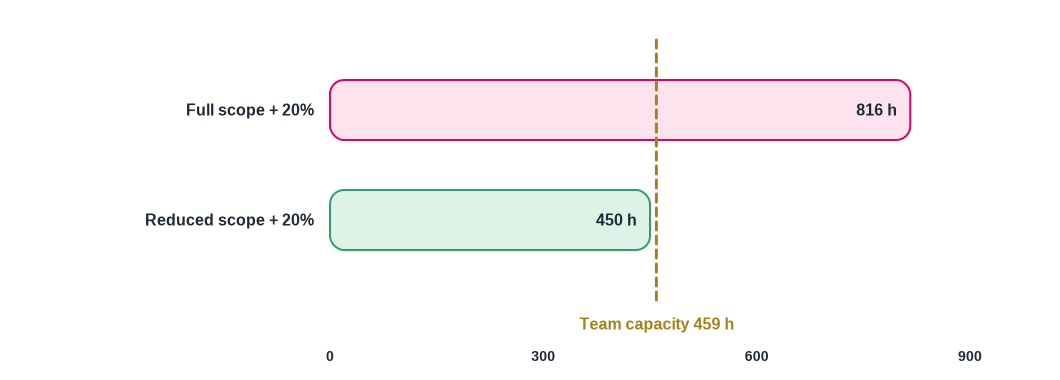
capacity : 459.0 h
full scope + 20% : 816 h -> over by 357 h
reduced scope + 20%: 450 h -> spare 9 hThe full scope overruns the available hours by about 357 hours. The work before contingency must not exceed hours, so the team has to cut 305 hours in total and keep 375. It chose to buy instead of build (a ready-to-fly airframe instead of assembling one), reuse what already exists (adapting the survey mission in the ground station, using a ready-made camera and driver, fine-tuning a pre-trained model instead of training from scratch, and using the course templates for the proposal, requirements and report instead of drafting everything anew) and simplify the outputs (exporting a map and a CSV file instead of writing a full reporting app). With 20% contingency that comes to 450 hours, leaving 9 hours spare. The team did not cut the 90-hour test campaign, because testing is the project’s evidence.
Review gates through the semester
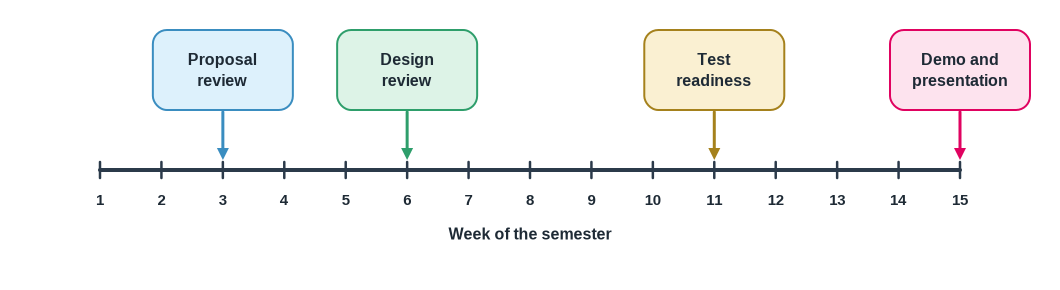
NASA’s systems engineering handbook requires projects to pass life-cycle reviews, such as the preliminary design review (PDR), the critical design review (CDR) and the test readiness review (TRR), before moving to the next phase. A one-semester project condenses these into four gates, each with documents to submit and pass criteria agreed with the advisor in advance.
- Week 3, project proposal: problem statement, baseline figures, literature matrix, scope, weekly plan and main risks
- Week 6, design review: requirements, architecture and design budgets (module 2)
- Week 11, test readiness: an integrated system, a test plan and a risk assessment for the test flights (modules 3–4)
- Week 15, demonstration and presentation: test results against requirements, the report and the reproducibility package (module 5)
The Drone-Hub knowledge units on mission concepts and systems engineering contain question templates that work well for the proposal: who uses it, where, what success looks like, and which constraints cannot change.
Module lab
Lab: a one-page project proposal
- Interview at least two real users, record measurable baseline figures and compute them as in Example 1.
- Write a problem statement that says who, what and why in no more than three sentences.
- Build a literature matrix of at least six real sources, each with a DOI or link.
- Break the work into a WBS, estimate the hours and compare them with team capacity as in Example 2; resize the scope until it fits.
- Submit the one-page proposal with a weekly plan to your advisor before week 3.
Common mistakes
Watch out
- Starting from the technology instead of the user’s problem
- No baseline figures, so you cannot say how much better the project makes things
- Estimating hours by feel and leaving no contingency
- Cutting testing when time runs short, although testing is the evidence of the work
- Citing sources you have not read, or not keeping DOIs from the start
Summary
- The four-year capstone must finish in one semester; 4(0-8-4) means 12 hours per person per week (8 practical and 4 self-study).
- A good problem has a real user, is measurable, fits one semester and can be tested safely.
- A literature matrix shows the gap and the methods you can reuse.
- Compare with and resize the scope by buying instead of building, reusing what exists and simplifying outputs.
- Aim for TRL 5–6 and pass four review gates through the semester.
Check your understanding
- A team of 4, 15 weeks, 12 hours per person per week, 85% productive time. How many working hours does it have?
- The WBS totals 500 hours, contingency is 20% and the team has 459 hours. Is that enough?
- The current inspection uses 3 technicians, 1 day per round, 8 hours a day, 4 rounds a year. How many person-hours per year is that?
- How does a TRL 6 prototype differ from TRL 4?
- If time runs short, why should testing not be the first thing cut?
Answers
- hours
- hours, 141 hours over capacity, so not enough; cut more scope
- person-hours per year
- At TRL 4 several components are first tested together; at TRL 6 there is a fully functional prototype
- Testing is the evidence that the system meets the need; without it the committee cannot judge whether the project succeeded
Key formulas
| Team capacity | |
| Work required with contingency |
Key references
- National Aeronautics and Space Administration. (2016). NASA systems engineering handbook (NASA/SP-2016-6105 Rev 2). link
- National Aeronautics and Space Administration. (2023). Technology readiness levels. link
- Project Management Institute. (2025). A guide to the project management body of knowledge (PMBOK guide) (8th ed.). link
- Dym, C. L., Little, P., & Orwin, E. J. (2013). Engineering design: A project-based introduction (4th ed.). Wiley. link
Further reading
Study the assigned knowledge units in advance, review media and take the module quiz
In class / field
Team project work, advisor meetings and progress presentations
Learning evidence: Project milestone deliverables