CPX: practising decisions and coordination across several agencies
Understand command post exercises, the role of exercise controllers, and the use of drones as part of relief missions
What CPX is used to train
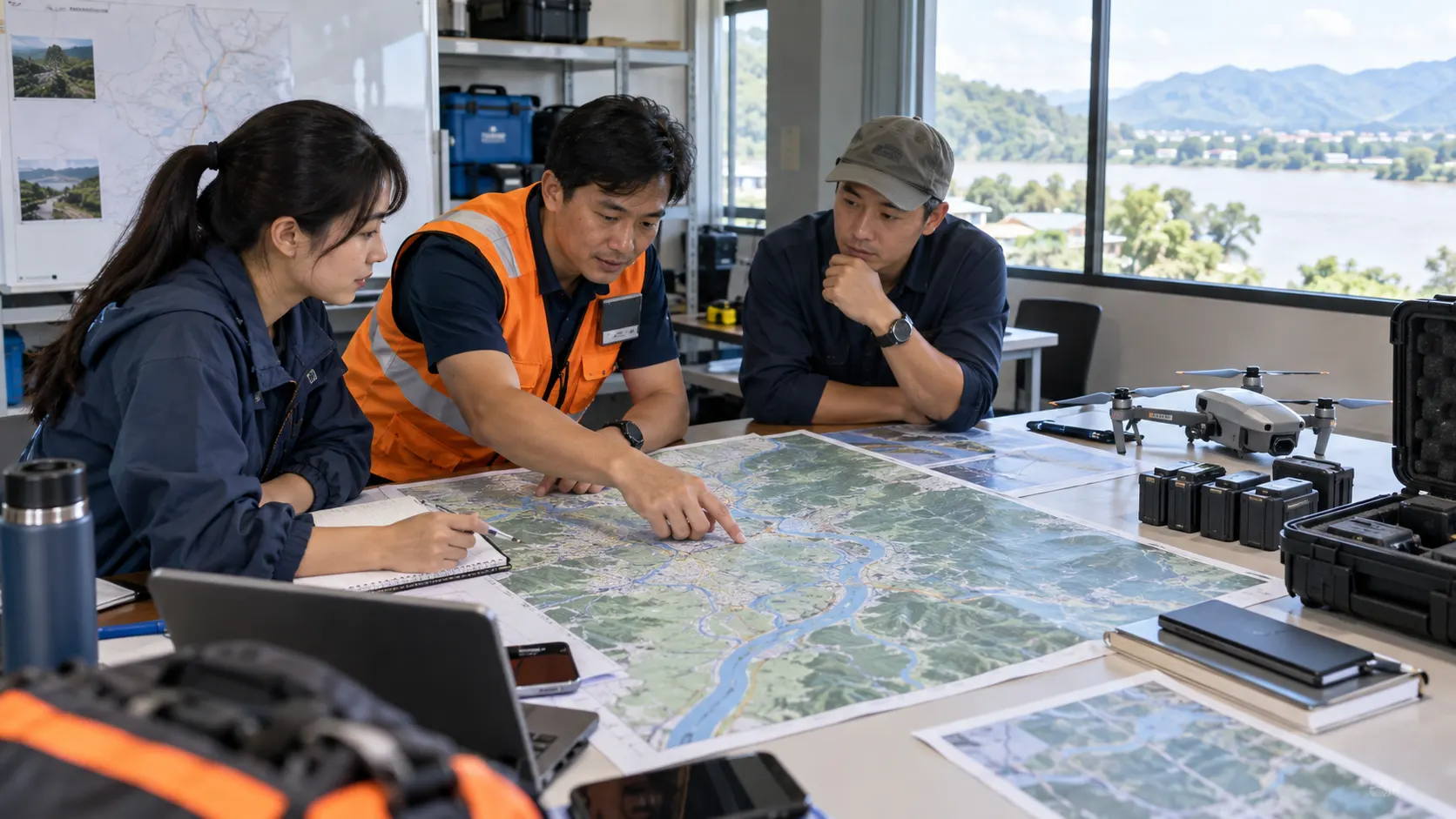
In this pathway, a Command Post Exercise (CPX) is a rehearsal of the work of the coordination centre and the operating parties through a simulated scenario. Participants must receive information, check what is still unknown, make decisions, assign missions and send results back to the parties that need them. We start with floods and assistance to disaster victims, and then prepare to extend the framework to other missions.
Objective: Learners can explain who is responsible for which task, to whom data is sent, and what evidence is needed to confirm that the mission has progressed to that stage. It suits exercise planners, disaster coordinators, drone teams, rescue teams and evaluators. You can start reading without having a drone.
The existing DroneSim is used for practice with a drone simulator, while the CPX Sim now being designed will focus on collaboration between the parties. At present the knowledge and design guidelines have been published, but there is no multi-party exercise room available for use yet.
Each party has its own work
| Party | Work practised | What must be handed on |
|---|---|---|
| Mission coordination | Make the request clear and prioritise it | Objective, area, time and result recipient |
| Drone team | Assess capability, plan flights and report what is found | Observations with time, area and limitations |
| Rescue | Use the data to plan options and request resources | Needs, what must be confirmed, and operational results |
| Airspace coordination | Check for conflicts between the flights of several units | Coordination conditions and acknowledgement by the parties concerned |
| Exercise control (EXCON) | Send party-specific or joint problems | Scenarios matching the objectives and a record of send times |
| Evaluator | Observe decisions based on the information the participants received | Evidence, findings and improvement tasks |
Example data path
Report of an affected community → coordination party requests a survey → drone team proposes a mission and coordinates airspace → images or observations sent → rescue team considers options → report back and joint review
Data that has been “sent” may not yet have reached the recipient, and “message received” is not the same as “mission accepted”. Participants should distinguish these three statuses clearly, recording the time and the data version. An image showing a road does not confirm that the road is still passable; state what is known and what needs further checking.
How to start
- Choose one decision, for example requesting data to plan access to a community
- Identify the requester, the operator, the result recipient and the person responsible for airspace coordination
- Prepare a hypothetical map or diagram, with area names and the time of the data
- Practise sending and receiving requests and results on paper or a test channel, keeping the EXCON role separate from the participants
- Review whether the hold-up was in the data, the decision authority or the acknowledgement, then assign corrective tasks
Start with a small task whose evidence can be traced completely before adding more units, and do not use speed scores alone as the measure of results. Continue to Multi-party exercise design
Sources and scope
- FEMA HSEEP is a source for studying how exercise objectives are linked to evaluation and improvement plans; it is not an endorsement of this course.
- ICAO UTM is a source for studying the coordination of airspace restrictions and flight intent.
- Drone knowledge for disaster management is for mission context and the limitations of the data
This content is a guide for learning and exercise design. It is not a test result of CPX Sim or a certification of readiness for real operations.