Designing a CPX exercise: from objectives to review
Define objectives, roles, injects, evidence, and post-exercise review, while keeping controller information separate from trainee information.
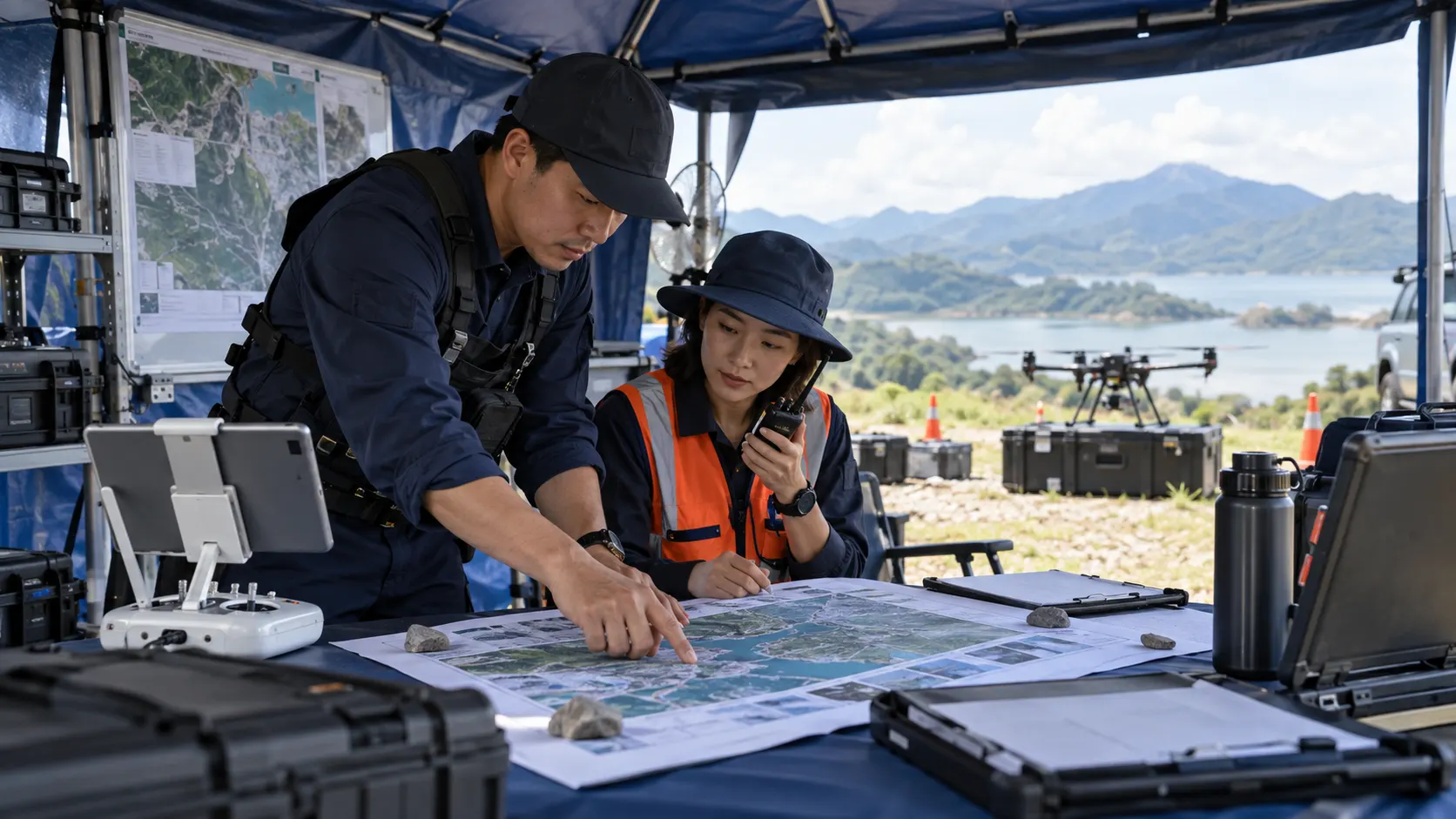
What you need before starting the exercise
Objective of this lesson: Draft a training plan in which the decisions about goals, responsible parties, scenarios, and assessment evidence are consistent with one another. You should read CPX Fundamentals first. Paper or a spreadsheet together with a fictional area map is sufficient.
Start with the sentence “When information is incomplete, which party must do what for whom, under what conditions?” and then define how to check it, for example: the request has a clear recipient of the result, there is a follow-up question about the unknown time, and there is evidence that the recipient received the corrected version.
Design steps
- Define the scope: the flood mission, the fictional area, and the decisions to be practiced. State what is not practiced, such as actually piloting an aircraft.
- Assign roles: coordinator, drone team, rescue team, airspace coordinator, EXCON, and evaluator. Parties without participants may be simulated, with the roles clearly recorded.
- Prepare the starting information: maps, resources, constraints, information sources, and the time at which each party knows each item. Do not let every party see the controllers' confidential information.
- Write the inject: specify the recipient, the condition or time of delivery, the objective, the behavior to observe, and the evidence to collect.
- Walk through the scenario as a trial run: check the information-handoff routes, understanding of terminology, exercise pause points, and how to continue when the network fails.
- Conduct and review: record the events that actually occur, compare them with the objectives, and then assign improvement tasks with a responsible person and a recheck date.
Draft scenario for organizers
| Field | Fictional example for learning exercise design |
|---|---|
| Objective | Check the timing of a report before submitting a survey request |
| Scenario recipient | Coordination team |
| Information provided | A report on area A, but with no observation time |
| What to observe | Ask to confirm the time, mark it as unknown, and state the limitation to the person receiving the task |
| Evidence | The first message, the follow-up question, the corrected version, and the acknowledgment time |
This example is public and is used to teach design methods. It is not a confidential scenario or answer key for a real exercise room. The complete set of EXCON instructions and data must be kept separate from trainees' access.
How to evaluate fairly
Look at what the trainees knew at the time of the decision. Do not use information revealed afterward to judge them retrospectively. Distinguish “the behavior did not occur” from “there was no opportunity to observe it,” and cite supporting evidence for every item. Acknowledging a message is not the same as successfully resolving the situation.
After the exercise, conduct an After-Action Review (AAR): what should have happened, what actually happened, why, and what will be changed. The improvement plan should have an owner, a follow-up date, and a method for retesting, following the evaluation and improvement concept of FEMA HSEEP
Advice before adding complexity
Start with one coordination area and synthetic data. Once you can run the full send-and-receive cycle, add conflicting information, delays, or multiple drone units. Never assume that pausing the exercise clock also stops a real aircraft from flying. Study Drones and Shared Airspace before designing multi-unit flights.
It is currently still in the design phase, with test criteria for the multi-party system being defined. See CPX Sim status