Delivering data to command centres and protecting victims
Create reports that show provenance, time and verification status, and restrict sensitive information to suit each recipient

Recipients must be able to tell how reliable the data is
A report with only pins on a map is not enough. Recipients must know which image a pin came from, when it was taken, who checked it, and whether it represents a fact or a suspicion. WFP describes combining geospatial data to support decision-making in emergencies, so send both the overview and a provenance that can be traced back WFP
Item status prevents data from skipping steps
Use statuses the team understands in the same way. For example, “pending review” means not yet confirmed; “confirmed” must state the reviewer and time; and “closed” must have a reason. Closing an item does not always mean the area is safe; it may mean it has been handed over to another unit, so the reason must be recorded separately.
In the exercise, hypothetical reviewer codes may be used. In real work, permissions and responsible persons are defined by the agency. Do not upload victims’ data into public tools just because they are free to use.
A single image may reveal more than intended
ICRC highlights issues of personal data, data security and community trust in the humanitarian use of drones. Images of faces, homes or the coordinates of gathering points may cause harm if released to the wrong audience ICRC
| Version | Purpose | Approach in the exercise |
|---|---|---|
| Original evidence | Retrospective checking | Stored separately with restricted access |
| Operational | For relevant units to check and provide assistance | Only the data needed for the mission |
| Public | Communicating the overview | Remove personal details and risk points |
Before sending, also check the file name, report version, data cut-off time and recipient group. Redacting names in the text alone may not be enough if images or metadata can still identify a location.
Simple delivery criteria
Recipients should be able to open the file, understand the legend, identify unconfirmed points, and trace back to the evidence according to their access rights. There must be a channel for corrections when errors are found, with a record of which report version supersedes the previous one.
Diagram to aid understanding
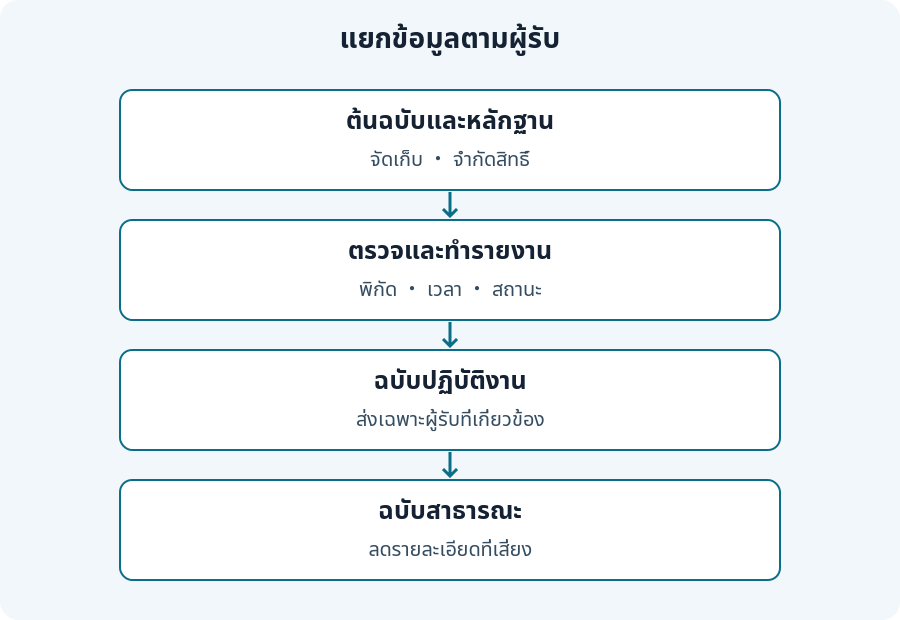
This diagram summarises the chapter’s concepts and accompanies the steps and limitations explained above. Click the image to enlarge it.
Try it on a computer
- Use the synthetic dataset from the practice chapter to produce one operational report.
- Create a public version by reducing unnecessary detail, and explain the reasons.
- Have a peer check that the codes, times, statuses and report version are still understandable.
Deliverables: two reports and a list of the data chosen for different disclosure
Check results: no real personal data is included, and recipients can distinguish pending points from confirmed ones
Further study and practice resources
Open related chapters → · Open scenario practice sets and downloadable files →
Practise the manifest revision, recipient/permissions, and separating received from acknowledged in M06 Disaster situation assessment , with an offline fallback and the B/O/D worksheets
Bibliography and further reading
- WFP: Mapping and geospatial analysis in emergency. Retrieved 8 September 2569 (2026)
- ICRC: Humanitarian drones and data protection. Retrieved 8 September 2569 (2026)
The content and exercises were compiled from the sources above; the realistic images are simulated illustrations, not evidence of mission results or equipment test results.
Connecting knowledge with missions and data
Situation reports should separate evidence-based observations from projections, stating the time, data sources and what is still unknown. Published copies may need to redact information, but the preparation history and access rights to the originals must be kept according to the organisation’s system Read the reference: OHCHR / UC Berkeley, Berkeley Protocol
Check your understanding: write two versions from hypothetical data, a team version and a public version, recording what was redacted and why
Read further: chapters that use this knowledge in simulated work · sources reviewed 26 September 2569 (2026)
Continue practising with the communications mission M10
Try checking for data sent to the wrong recipient, expired, duplicated, or based on an old plan in the M10 offline receiver . A matching hash confirms only the bytes of the announced content; permissions, meaning and the recipient's acknowledgement must be checked separately