M10 Communications: from sending data to evidence the receiver can use
Choose channels from the recipient and the time, separate the evidence at each stage, and practise an offline receiver with 12 cases and KSEC for three roles.

What message does the recipient need, for what purpose, and by when?
A communications team must start from the person who uses the result; for example, a coordinator needs a summary of supply requests that is still fresh and matches the plan version. Seeing an aircraft online or having a count of bytes sent does not answer whether that person received it, understood it and has the right to use the data. This kit helps separate the evidence of each stage, plan for two endpoints, and try out a simulated data receiver on a computer.
Choose B Beginner to explain the task and the reasons for arranging the cases, O Operator/Planner to make a plan for people and channels, or D Developer/Customizer to check the contract and run the offline lab. No drone is needed for studying this chapter.
pending_field_review; specialist=not_assigned; the P3 readiness criteria are still open . This kit provides no radio results, flights, recipient confirmations or learner results. Host results must cite files from actual runs, kept separate from expected. CPX-Sim remains on hold.
Before starting, review UAS fundamentals, communications, emergency communications, data handover, system integration and testing , and read selectively on the points you are not yet familiar with

Image generated with AI to explain the context; it is not a test result or field evidence. Open the full-size image
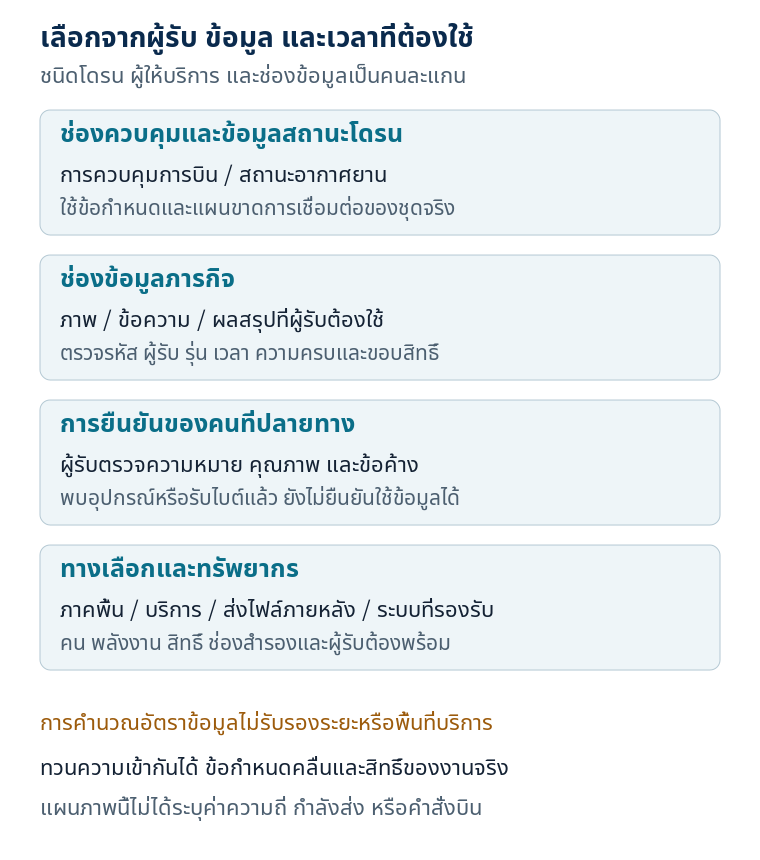
The task shared by every role
TEAM-R is a hypothetical team that needs a summary message of supply requests according to PLAN-1, before it expires and with the right to receive the data. Specify the user of the result, the data product, the deadline, completeness, meaning, plan version and the person authorised to release it before choosing the channel. There are no real persons or coordinates in the fixture.
Keep separate the flight control channel (command/control), aircraft status data (telemetry), mission data from the payload (payload/data), and handover between organisations. Detecting an identification signal, receiving a command, the number of bytes sent, the receiver passing validation, an acknowledgement message, and the recipient using the data are different pieces of evidence; record which part the acknowledgement came from and what it confirms. When the data channel is lost, use the data alternative in the plan. Flight safety must follow the lost-link plan of the aircraft/operator actually approved. This exercise does not command flights or set a universal response.
The selection has three independent axes: aircraft type, such as multirotor/fixed-wing/VTOL; system owner or service provider; and data-transfer architecture. Compare wired/ground networks, offline data couriers, service providers, store-and-forward holding, and tethered airborne relay points according to compatibility, permissions, resources and actual constraints. Having a tether does not confirm that a network is ready for use; it needs a receiving station, power, caretakers, and access rights at both endpoints. A type name does not certify range or continuity.
A fabricated calculation example: uncompressed raw data of 2 MiB = 2 × 1,048,576 bytes = 16,777,216 bits; at an assumed rate of 256 kbit/s = 256,000 bits per second, sending the data content takes at least 16,777,216 ÷ 256,000 = 65.536 seconds , not counting headers, retries and gaps. If the hypothetical task must be completed within 30 seconds, reduce the message or compress it while preserving meaning, adjust the product, or use another channel; do not conclude that more transmit power is needed. Rate (per second) differs from total size; latency is the delay of a process with a specified start and end; age is the current time minus the creation time. Service continuity must also include power, people, services and handover.
Compare methods and resources using the same task
Scroll the table horizontally to read every column. Use the left or right arrow keys when it has keyboard focus
| Option | What must be confirmed | Reason to hold or switch methods |
|---|---|---|
| Ground/wired network | Access points on both sides, recipients, power, services and permissions | The endpoint is unreachable or the data would not arrive in time |
| Offline file courier | Data holder, permitted media, file version, time and handover evidence | Freshness/permissions are insufficient, or the recipient is not yet known |
| Service provider | Service extent, compatibility, responsible parties and support | The request is still requested, or the service does not cover the task |
| Store and forward | Storage/custodian, data age, re-checking after the link returns | Expires or its meaning changes while held |
| Tethered airborne relay point | Actual kit, power, people, area, permissions and the data channels for both segments | No evidence of compatibility or conditions of authorisation |
Also record service charges, preparation time, personnel, continuity, access to recipients and a recovery plan. Do not infer coverage from the picture of the aircraft or the equipment's name. The selection criterion is the result the recipient can use within the time and permissions, including the cost of the whole system.
Teaching diagram, not a test result or field evidence. Open the full-size diagram
When the communication path breaks: choose the data route before choosing a relay drone
Practice card TRAIN-M10-RELAY-01 is a fabricated scenario separate from C01–C12 and TEAM-R/PLAN-1: a hypothetical flood-area team must send a message summarising access limitations to a hypothetical coordination centre before the time the recipient sets. There is no signal measurement data, real installation point, confirmed provider, spectrum/area permission, or delivery result to a person. Start from the question what data does the centre need, by when, and who confirms receipt and then compare the paths through the whole system, rather than starting from the aircraft model.
ITU-T F.749.18 separates devices, networks, services and applications in emergency services that use UAS, explaining that a relay requires communication equipment and an exit to the destination network (COM04). NIST PSCR UAS states that the reliability of telemetry transmission and multi-hop media, including latency, packet loss, link tolerance and interference, is a matter that needs research and measurement (COM05). Neither source tested this practice card or specified coverage for any drone model; international guidance is not permission to use spectrum or fly in Thailand.

Image created for teaching helps show that the team must review several parts of the plan and resources at once. The equipment in the image does not confirm compatibility or readiness. Open the full-size context image
Scroll the table horizontally to read every column. Use the left or right arrow keys when it has keyboard focus
| Options to compare | Evidence to request | Hold points and next steps |
|---|---|---|
| Existing ground/wired network | Destination recipient, usable route, power, permissions and time | If complete and in time, a drone may not need to be added; if unknown, ask the network administrator to check |
| Carry the data, or store and forward | Data holder, file version, permissions, data age, travel time and re-checking on arrival | If the deadline or freshness is insufficient, reduce the deliverable according to the recipient or find another route; queued is not delivered |
| A backup communications service confirmed by its owner | Service area, agreement on people/equipment, entry and exit points and recipient evidence | A service request that is still requested is not a route that is confirmed; a backup plan is needed |
| A relay aircraft as a candidate | Link from field team → aircraft, aircraft exit → centre/backhaul, equipment compatibility, power, people, separation of C2, and permissions across the whole system | If any leg is unknown then hold_path; an aircraft that identifies itself or receives bytes is not the same as the message reaching the receiver and a person |
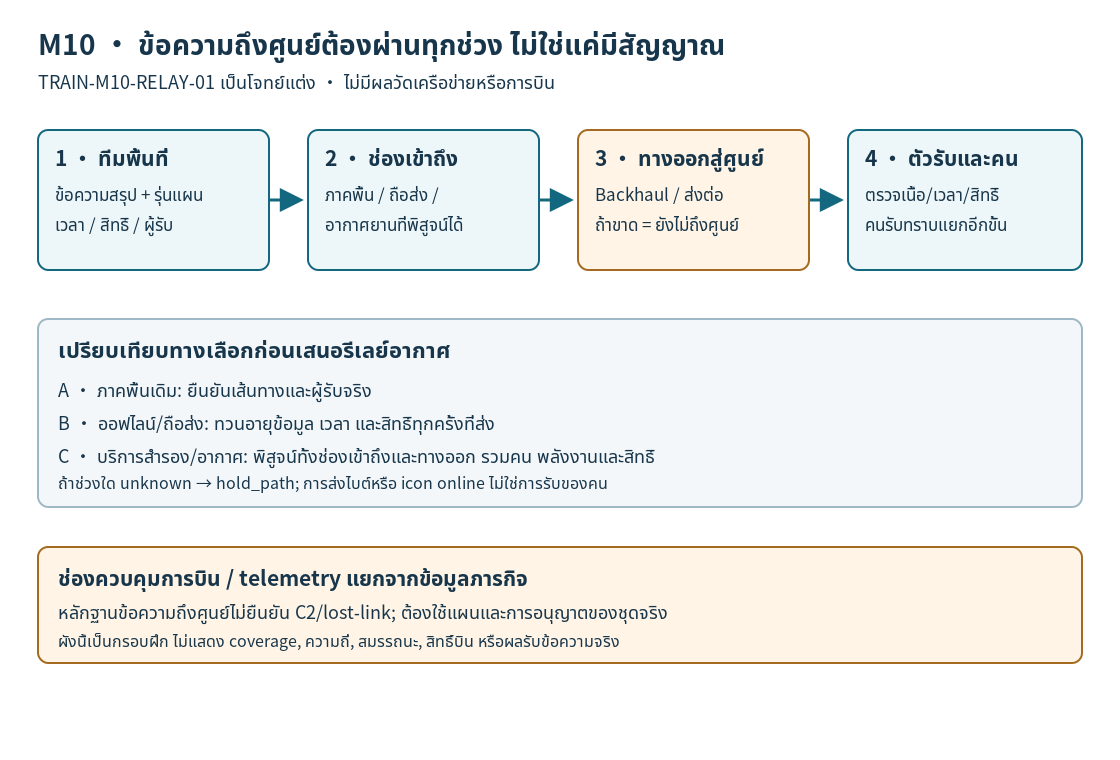
Diagram description: the message must pass through the access channel, the exit, the validating receiver and a person acknowledging; having an aircraft or a signal in only one segment does not close out the data transfer. The flight control channel/telemetry is another boundary that must be checked against the actual kit. Open the full-size flow chart
Before proposing a relay aircraft, the planner must specify a deliverable small enough for a channel that is proven, the owner of each link segment, the measurement point/criteria the recipient sets, power/people continuity, a plan for when the exit breaks, and evidence of received kept separate from a person's acknowledgement. The range, rate and latency values of this card are unknown; do not replace them with images or untested specifications. The flight control channel (C2) and lost-link must be in the plan and the manuals of the actual kit; do not use test results for receiving mission data to judge flight safety. Read S1 Flood assessment and data handover to separate observations from field-confirmed results.
Practise KSEC with the existing M10 codes , using the data-route practice card and rubric M10. This activity is not yet a learner result or a network test result.
Scroll the table horizontally to read every column. Use the left or right arrow keys when it has keyboard focus
| Group and baseline before starting | K · Knowledge | S · Skills/work product | E · Ethics | C · Observable personal character |
|---|---|---|---|---|
B Beginner: knows the recipient and the difference between sent/received |
Explains that an inbound link is not the same as the exit or the recipient (APP-M10-B-K01) |
Draws a four-segment diagram and identifies the unknowns of cards A–D (APP-M10-B-S01) |
Does not write that the centre received it just from seeing an online icon (APP-M10-B-E01) |
Accepts review comments and corrects the diagram while keeping the reasons (APP-M10-B-C01) |
O Planner: can make a requested/confirmed ledger and backup routes |
Separates the options from the conditions for actual use (APP-M10-O-K01) |
Makes a table of link owners, people, power, permissions, deliverables and hold points (APP-M10-O-S01) |
Limits data and does not treat a proposal as permission to use spectrum or fly (APP-M10-O-E01) |
Follows up on open evidence and reviews the plan when the exit changes (APP-M10-O-C01) |
| D Developer: reads the schema/time and separates expected from actual | Explains the contract of hop, backhaul, TTL and receipt (APP-M10-D-K01) |
Proposes negative tests when a hop or permission is missing, without claiming they were run (APP-M10-D-S01) |
Does not fake link values or a human ACK (APP-M10-D-E01) |
Keeps versions/reasons for changes and a retest plan after the route changes (APP-M10-D-C01) |
hold_path is a status in a tabletop planning card , not a new disposition of the C01–C12 receiving program. This card is an activity to prepare for or extend understanding of the existing KSEC; the main work product must still be done and checked against the M10 rubric before any pass is mentioned, especially D's S, which needs an actual offline run result or must be marked NOT_RUN. A demonstration result on the same machine does not confirm an airborne link; P3 specialist reviewer is still not_assigned/pending_field_review, P5 learners B/O/D = 0/0/0 NOT_RUN, field NOT_RUN and CLO/PLO pending_design.
Eight steps from request to version review
- Define the recipient, data product and deadline, with completeness, meaning and the right to use
- Choose the aircraft, service and network, comparing the ground alternative using the same criteria
- Confirm people, power, links and permissions at both endpoints; separate requested from confirmed
- Review the data interface, time, quality and the sharing plan, with the person who has authority to permit
- Prepare and test the channel/receiver within the permitted boundaries. This exercise is tested only on an offline machine
- Carry out the mission and the backup options according to the approved plan, under the responsible operator
- Have the receiver check the data, then ask the recipient to confirm separately; record the origin and meaning of the acknowledgement
- Keep the versions, corrections and lessons; review when conditions change; and notify holders of old copies
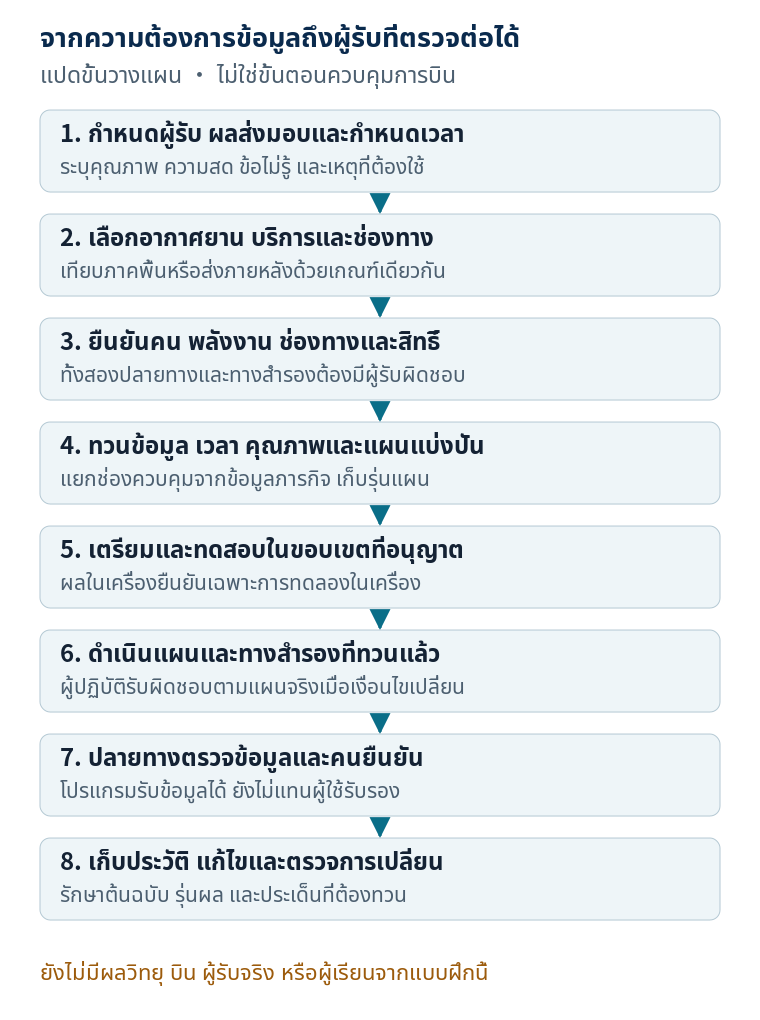
Teaching diagram, not a test result or field evidence. Open the full-size diagram
What each type of evidence can confirm
Scroll the table horizontally to read every column. Use the left or right arrow keys when it has keyboard focus
| Evidence | Can be interpreted as | Evidence still to be requested |
|---|---|---|
| Presence/heartbeat | The component is identifying itself | Mission data that is for the right person, at the right time and complete |
| Command accepted | The command receiver reports acceptance according to that system | The work is complete and the data has reached the user |
| Bytes sent | The sending side counts the data transmitted | The receiving side checks the content and meaning |
| Receiver validation | The receiver checks according to the stated rules | Identity/permissions and the recipient's understanding |
| Acknowledgement | A point that sent an acknowledgement reports one status | The origin of the reply and the boundary that was actually confirmed |
| Recipient use | The person using the result confirms receipt and use according to their role | Edit history and suitability for that decision |
Conceptual sources read only in part: COM01 explains that command acknowledgement and work completion may differ; COM02 explains component announcement and does not set a universal timeout; COM03 gives the concept of store and forward when connectivity is intermittent, with data age and different received/forwarded/delivered statuses. This text cites general concepts only from Command Protocol, Heartbeat and RFC 9171 . The lab below does not use the wire format of any source.
Example of correcting a claim: “C01 passed, so emergency data can be sent” should be corrected to “C01 passed the offline receiver rules in the attached run result, if it was actually run; permissions, the human recipient, the link and the flight still need to be confirmed.” If it has not been run, write only expected accepted and actual NOT_RUN.
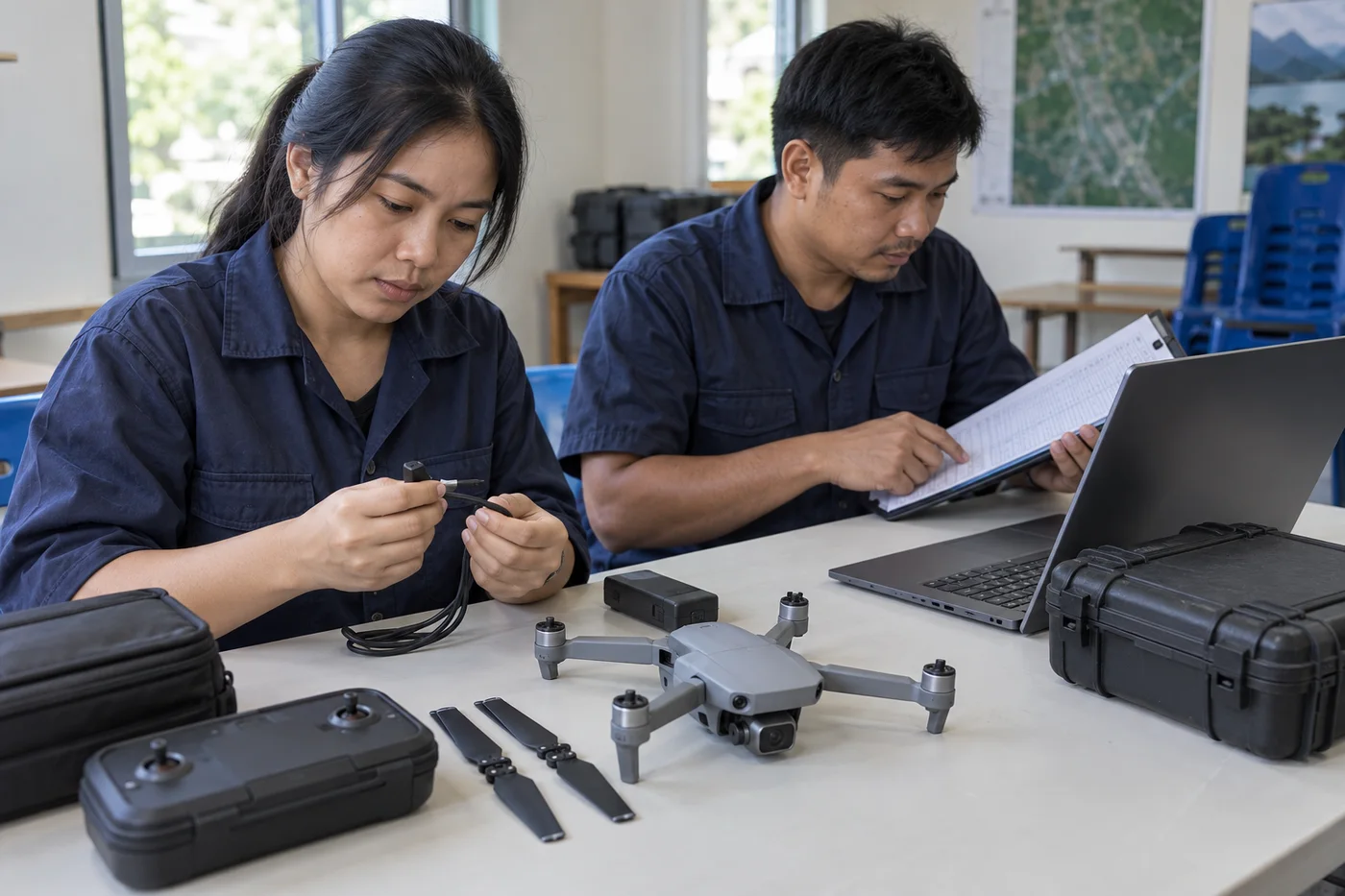
Image generated with AI to explain the context; it is not a test result or field evidence. Open the full-size image
The full data contract
A schema is the specification of the names, types and boundaries of the data; a fixture is a set of fabricated cases for practice; a disposition is the handling result of the receiver; TTL is the age that is acceptable under the fabricated task; a digest is a check value on the content bytes, and SHA-256 does not confirm the sender or permissions; a duplicate is a message repeated with complete content; a collision here means the same ID but different data; a replay is a re-run with the same input, not re-sending into an aircraft.
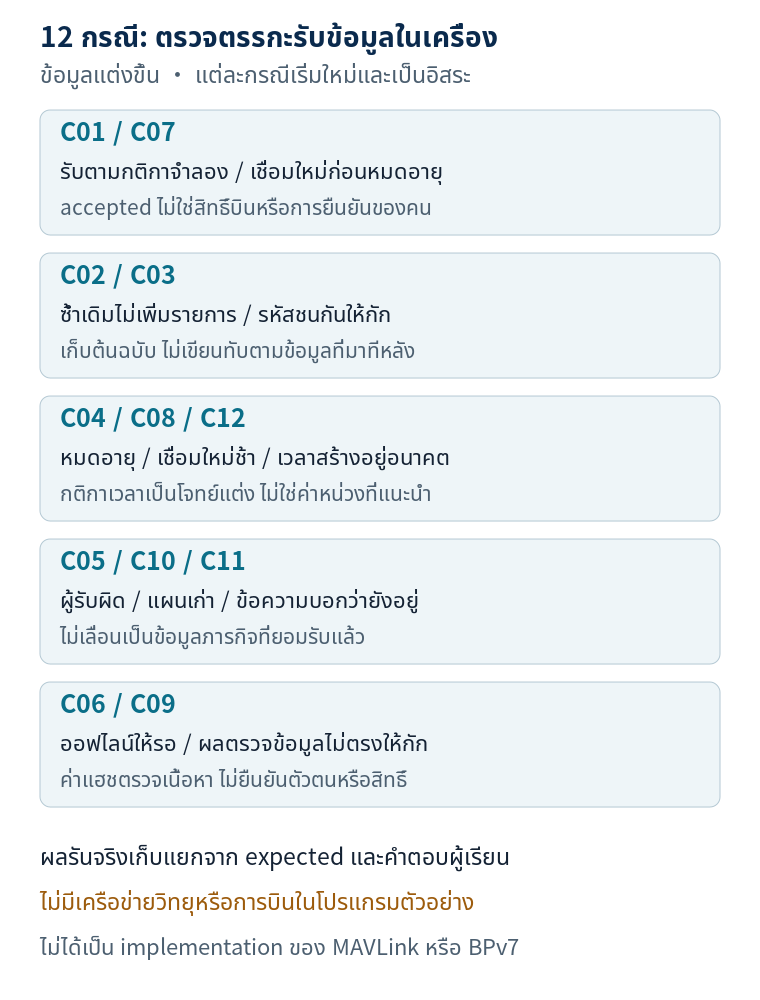
JSON must be UTF-8 and no larger than 64 KiB; reject duplicate key names, NaN/Infinity, and missing or extra keys at every level. The structure supports no more than 16 cases, but this teaching set and expected define C01–C12 exactly once, in order . Every case starts with a fresh state; results are not accumulated across cases.
Scroll the table horizontally to read every column. Use the left or right arrow keys when it has keyboard focus
| Level | All field names and meanings |
|---|---|
| Top level | schema_version = toy-m10-1; evidence_basis = authored_offline_teaching_fixture; cases = list of cases |
| Case | case_id = C01–C12; now_s = integer check time of 0–86400 relative seconds; connected = true/false; message = incoming message; prior_accepted = null or a previous message assumed to have been accepted |
| Message | message_id = message ID; kind = mission_data or heartbeat; recipient = recipient; plan_version = plan version; created_s = creation time; ttl_s = permitted age; payload = content; payload_sha256 = digest declared by the author |
| Message boundaries | IDs use ASCII, starting with a letter or digit, followed by letters/digits/_/-, 1–32 characters in total; created_s is an integer from 0; ttl_s is an integer 1–3600; a boolean may not be used in place of an integer; payload is UTF-8 text of no more than 4096 bytes; digest is 64 lowercase hexadecimal characters |
The teaching receiver is defined as TEAM-R and PLAN-1. All numeric values are teaching boundaries, not radio/flight requirements. The clock is in fabricated relative seconds, not a measured time. The structure of the whole file is checked before producing results; then checks proceed in this order: kind → recipient → plan version → time in the future → age → digest → duplicate/conflicting ID → connection → accepted.
Age = now_s − created_s; when age >= ttl_s the message is rejected, even if exactly equal. The digest check only verifies that the UTF-8 of the payload matches what was declared. Someone who edits a message could also edit the digest to match, so it does not prove source authenticity (the origin's identity), authorization (permissions) or the truth of the content.
prior_accepted is a teaching assumption that the message was accepted at created_s, not a log from a previous run. It must have the correct form, kind mission_data, the current recipient/plan, a matching digest, and created_s no greater than now_s. The current expiry of the incoming message is checked before the duplicate check. If message_id matches and every message field matches then the result is duplicate_ignored; if the ID matches but fields differ then id_conflict, keeping the original. When not connected, the result is queued_offline, which is not accepted. There is no persistent queue or network in the script. A reconnect case is simulated with independent input and re-checked at that time.
Starting values and expected results for all 12 cases
Baseline for every case: message_id MSG-01, kind mission_data, recipient TEAM-R, plan_version PLAN-1, created_s 10, ttl_s 30, payload TRAINING supply request summary, payload_sha256 2e179f75c3337e8c64641e91c7e91e16fc882a8cdc514282b508f7a2f5abd4aa, now_s 20, connected true, prior_accepted null unless stated below. C02/C03 use a prior that is the full baseline message.
Scroll the table horizontally to read every column. Use the left or right arrow keys when it has keyboard focus
| Case | Change from the baseline / reason | expected_disposition |
|---|---|---|
| C01 | A normal message, age 10 | accepted |
| C02 | prior is the baseline, identical to the incoming message in every field | duplicate_ignored |
| C03 | prior is the baseline; new payload TRAINING corrected supply request with a new digest | id_conflict |
| C04 | now_s 40; age 30 equals the TTL | expired |
| C05 | recipient TEAM-X | wrong_recipient |
| C06 | connected false | queued_offline |
| C07 | now_s 25 and connected true; assume reconnection before expiry | accepted |
| C08 | now_s 45 and connected true; assume reconnection after expiry | expired |
| C09 | The declared digest is all 64 zeros | integrity_mismatch |
| C10 | plan_version PLAN-0 | stale_plan |
| C11 | kind heartbeat is a correctly typed envelope but is not mission data | not_mission_data |
| C12 | created_s 30 is greater than now_s 20 | future_timestamp |
The new digest of C03 is 9263c89c28ed47f5fbd062c6c34b6a7cf5f803d90260eed0cd9a0ead731d9d58 . This table is the expected written before the run. C07/C08 are not truly queued from C06. Reusing MSG-01 across cases does not collide because each case is reset independently.
Teaching diagram, not a test result or field evidence. Open the full-size diagram
KSEC: choose work that matches the role
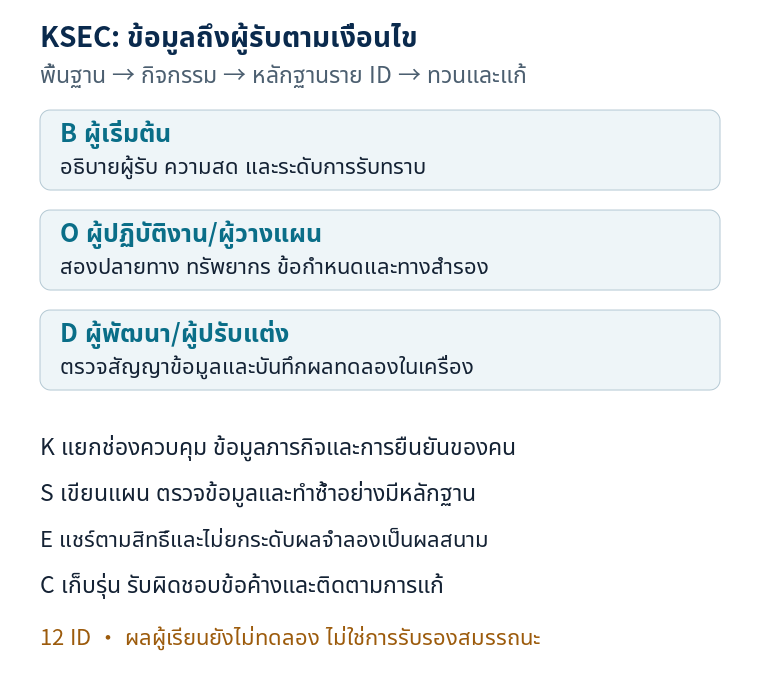
Use K Knowledge, S Skills, E Ethics, C Personal character. Every path has a bridging task before starting and four codes of evidence. Learning results use «evidence meets the criteria / needs more practice / no evidence yet» with reasons, and are not averaged in a way that covers gaps in E/C. CLO/PLO are left blank, pending_design.
Teaching diagram, not a test result or field evidence. Open the full-size diagram
B Beginner: translating a request into evidence
Scroll the table horizontally to read every column. Use the left or right arrow keys when it has keyboard focus
| Code | Before starting and bridging task | Goal | Task/evidence | Check criteria |
|---|---|---|---|---|
| APP-M10-B-K01 | Knows UAS systems and time units; review the fundamentals then give one example separating the user of the result from the equipment | Explain the result the recipient needs and the meaning of the evidence | A brief specifying recipient/product/time/completeness/permissions, with an explanation of 65.536 seconds | Separate rate from size, age from latency, and the six pieces of evidence; no claims about range or flight |
| APP-M10-B-S01 | Can read tables of time and units; review communications then compute the age at now40 | Arrange the cases with reviewable reasons | The C01–C12 table, with reasons and alternatives when the 30-second task cannot be met | Results match expected in all 12 cases, explaining that equal TTL means expired; reconnect is re-checked; no wording is selected without a reason |
| APP-M10-B-E01 | Ready to limit claims and check permissions; review data handover then correct the phrase “received, so usable immediately” | Decide to hold sharing when the recipient or permissions are unconfirmed | The claim statement before/after and an event of requesting more data than necessary | Do not forward without permissions; a digest does not confirm the sender; human receipt is still NOT_RUN |
| APP-M10-B-C01 | Ready to accept review comments; review teamwork then identify one owner of an open item | Adjust the work while keeping a trace of the unknowns | B-v0/B-v1 review comments/replies and owner/evidence pending/conditions for review | Answer every review comment, keep the earlier version, and do not close a request that is still unanswered |
Download Worksheet B Resubmissions use the same code; keep v0/v1, review comments, replies, reasons for changes and evidence. Do not close open items until the owner has answered.
O Operator/Planner: getting both endpoints ready
Scroll the table horizontally to read every column. Use the left or right arrow keys when it has keyboard focus
| Code | Before starting and bridging task | Goal | Task/evidence | Check criteria |
|---|---|---|---|---|
| APP-M10-O-K01 | Knows the roles at both endpoints; review mission brief then separate requested/confirmed | Explain the three axes of selection and the evidence for each segment | A comparison table of ground/offline/service/store-and-forward/tethered using shared criteria | Separate aircraft type, service and network, with actual conditions of use and open items |
| APP-M10-O-S01 | Can read time and incoming data; review testing then compute 65.536 seconds | Plan the eight steps with a fallback and acceptance checks | The eight-step plan, a ledger of people/power/links/permissions at both ends, C01–C12 and a handover log | Every resource has a responsible person and confirming evidence; offline does not close acceptance; flight lost-link uses the actual plan |
| APP-M10-O-E01 | Ready to hold when permissions are incomplete; review law and data transmission then reduce one data item | Define the sharing boundary and the reasons for changing channel | A reduced-data copy, the authoriser, hold/replan conditions and the origin of the ack | No authorization from a script pass; keep the unknowns and separate the human confirmation |
| APP-M10-O-C01 | Ready to follow up open items; review team then identify who notifies holders of the old version | Maintain versions and be responsible for corrections and handover | O-v0/O-v1 issue/recipient/correction log with owner/evidence/conditions for review | Keep the original, notify holders of old copies, and do not change requested to confirmed yourself |
Download Worksheet O Resubmissions use the same code; keep v0/v1, review comments, replies, reasons for changes and evidence. Do not close open items until the owner has answered.
D Developer/Customizer: checking the contract and producing reviewable results
Scroll the table horizontally to read every column. Use the left or right arrow keys when it has keyboard focus
| Code | Before starting and bridging task | Goal | Task/evidence | Check criteria |
|---|---|---|---|---|
| APP-M10-D-K01 | Knows JSON/CSV and data types; review system integration then explain how a boolean differs from an integer | Explain the contract and the order of checks through the interface | A diagram of input→validation→disposition→output with the prior assumption | All boundaries and every step in order; separate a digest from the sender's trustworthiness; no protocol compatibility claim |
| APP-M10-D-S01 | Can read files and run Python, or record the limitation; review testing then write the expected before running | Run the offline lab in a repeatable way, or truthfully record NOT_RUN | C01–C12 actual raw file/command/exit/baseline-current hash/replay and D01–D08 proposals | Actual results compared with the independent expected; repeated runs match byte for byte; if it cannot be run, record the reason, and there is still no evidence for S from running |
| APP-M10-D-E01 | Ready to separate actual from expected; review evidence then correct the claim “safe because of SHA” | Report the evidence level and limit the data and operation | The claim/status with the input/output boundaries and actual NOT_RUN for the parts not tested | No network/flight/human/learner claim; do not execute data; do not claim sandbox security certification |
| APP-M10-D-C01 | Ready to keep a baseline and answer review comments; review system integration then identify the trigger for changing the schema | Control edits and restore files with re-checking | D-v0/D-v1 change log, the edited copy / restored original / hash / recheck / owner | Do not overwrite the original; if the schema/TTL/plan/software changes, review again; notify that old results are no longer relevant |
Download Worksheet D Resubmissions use the same code; keep v0/v1, review comments, replies, reasons for changes and evidence. Do not close open items until the owner has answered.
D01–D08 extension proposals not yet run
Every row is actual NOT_RUN , kept separate from C01–C12; having a plan adds no passing result
Scroll the table horizontally to read every column. Use the left or right arrow keys when it has keyboard focus
| ID | Proposed test condition | expected to be checked | actual |
|---|---|---|---|
| D01 | Duplicate/extra/missing JSON keys | nonzero before creating output | NOT_RUN |
| D02 | Time is a boolean/negative/NaN | Reject the whole fixture | NOT_RUN |
| D03 | payload over 4096 bytes / fixture over 64 KiB | Rejected before any result | NOT_RUN |
| D04 | Every incoming message has an expired age and a wrong digest | expired according to precedence | NOT_RUN |
| D05 | prior has the wrong digest/recipient/version | Reject the assumption before any result | NOT_RUN |
| D06 | Same message_id but a changed recipient/time/TTL that is still valid | conflict when it reaches the duplicate check; identity/time may reject it first | NOT_RUN |
| D07 | Output already exists / symlink ancestor | nonzero without overwriting the existing data | NOT_RUN |
| D08 | expected has duplicate/missing IDs / unknown disposition | nonzero before output | NOT_RUN |
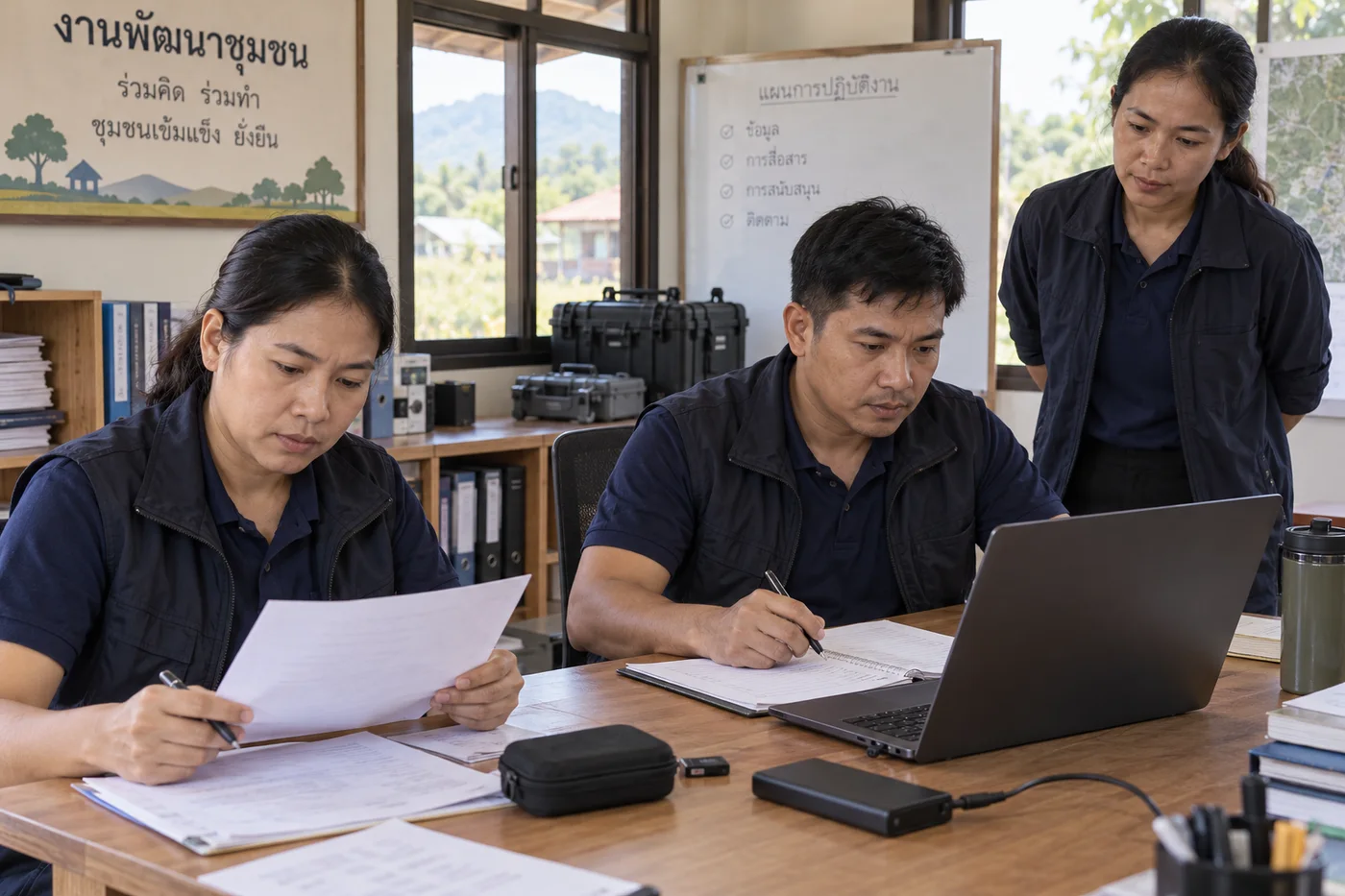
Image generated with AI to explain the context; it is not a test result or field evidence. Open the full-size image
Downloads and a reviewable run
Supplementary evidence from the author's check: the receiver results actually run on the machine and the machine results summary are two files outside the eight learning files, making ten files published in total. Read the evidence level in the files before citing the results. These results are host-only; they are not learner results, radio, flight or human confirmation. Learners remain at NOT_RUN until they do the work and keep their own results.
Keep the eight files in the same folder: beginner, operator, developer, rubric, readme, fixture JSON, expected CSV, Python lab . No Python packages need to be installed; only the standard library is used. If the machine has no Python or you have no permission to run it, make the expected table on paper and enter actual NOT_RUN with the reason.
Inspect the code before running it in a working folder of your own. Example commands when you are in the eight-file folder and run-01/run-02 do not yet exist:
python communications-support-lab.py --output-dir run-01
python communications-support-lab.py --output-dir run-02
The results are created only as receiver-results.csv and summary.json in a new output directory that must be specified; the parent folder must already exist. The script does not overwrite an existing folder, rejects symlink/reparse ancestors, uses no file names from the fixture, has no execute/eval/subprocess/network, and does not connect to radios or aircraft. This path check is a guard against mistakes in a local lab, not a guarantee against an attacker racing to modify the file system.
The Expected CSV has case_id,expected_disposition for all of C01–C12; the result values allowed are only the ten words in the table. The Actual CSV has case_id,expected_disposition,actual_disposition,matched,evidence_level, where matched is true/false and the level is host_offline_simulation. The Summary has schema_version,case_count,matched_count,evidence_level,radio,flight,human_receipt,learner_results; the last four entries are NOT_RUN. Exit 0 means actual matches expected in every case; 1 means there are differences; 2 means the input/output was rejected. A structural error anywhere in the fixture must stop the run before any new result appears. If a file-system write fails, the result folder may be incomplete; record the failure and use a new name.
Keep the SHA-256 hash of the lab/fixture/expected before the run as the baseline and after the run as current. Attach the actual command, stdout/stderr, exit code and time, kept separate from results that have no timestamp. Compare the result files of both runs byte for byte; they must match when the input does not change. Also record the tool and Python version. In PowerShell use Get-FileHash -Algorithm SHA256 <file> and check that the hash values are equal. Do not make up hash values or copy expected as actual.
Do experiments with changes on a copy . State the versions before/after, change one condition at a time and keep the original. When restoring, use the unedited baseline file, check the hash and run into a new output. This restoration restores only the practice files; it is not a firmware or product rollback. Do not conclude authorisation or flight readiness from this result.
References and rights
Concepts used for limited supporting reading in the main chapter: COM01 MAVLink Command Protocol, COM02 MAVLink Heartbeat, COM03 RFC 9171, COM04 ITU-T F.749.18 and COM05 NIST PSCR UAS; read the M10 source register and claim boundaries. We do not claim that the standards were fully checked, nor errata/security, nor compatibility with the protocols. The Schema/TTL/mathematics/cases in this set are fabricated work, not a MAVLink or RFC 9171 wire implementation.
Teaching work newly compiled by PK-Research / Drone-Hub uses CC BY 4.0 . Credit the name of the set, the version, the source and what was changed. Media and documents of external owners retain their original rights; this licence does not extend rights to those materials.
If the data sent to the centre will be used to communicate with the public, read S1: The publication gate for media from disaster data. The evidence sent/received/acknowledged in M10 confirms the transmission within its own boundary; it does not confirm that a message or image has passed rights checking and publication.