S1 Floods and relief: from data of different times to a hand-over the receiver can check
A tabletop case study connecting M06/M07/M10/M01 with 13 rows of made-up flood data, practising selecting observations, allocating resources and testing a data contract without citing field results
Questions to answer before the deadline
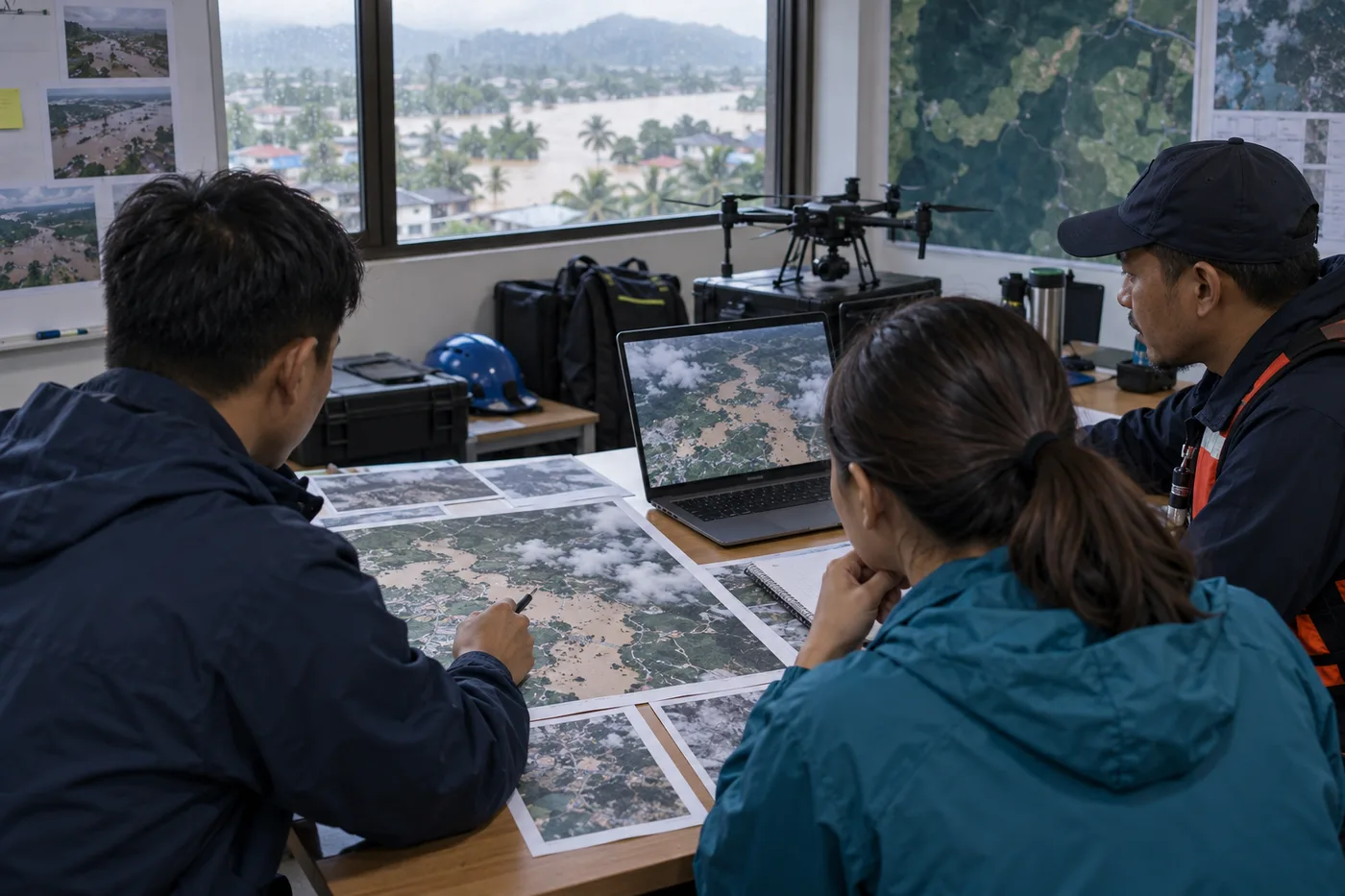
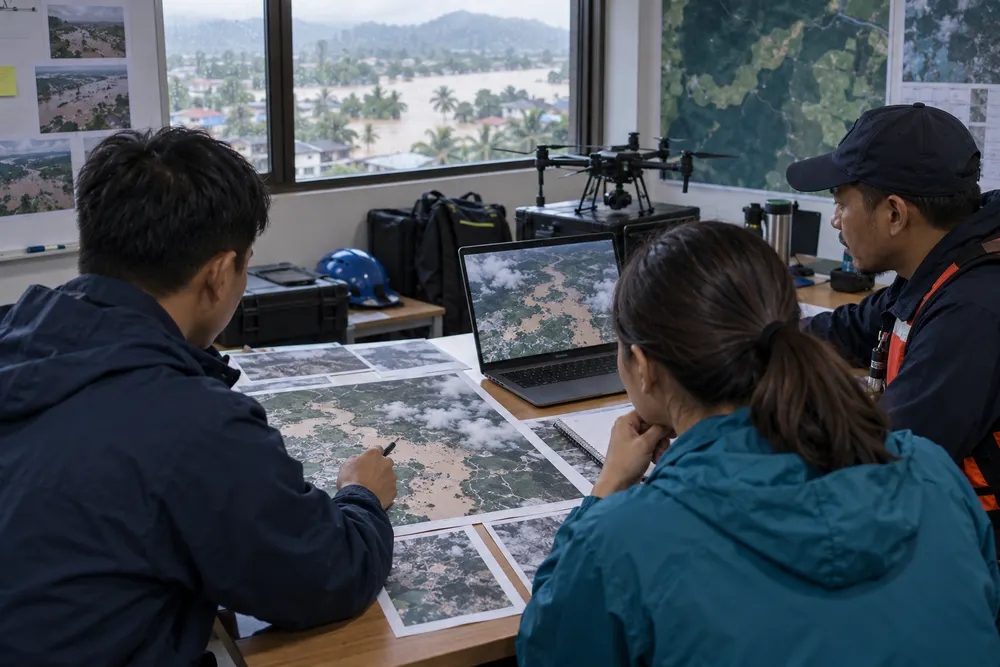
Image created for teaching shows the atmosphere of reviewing data. It is not evidence that any area has water, people or passable routes. Open the full-size image
A coordination centre (hypothetical) INCIDENT has received the request REQ-CSF-01: 'Before 2026-10-13T10:40:00+07:00 , which point/area should we ask the responsible officers to check next, and what can we still not answer?' The other recipient group is PUBLIC , who must receive a summary with detail reduced according to permissions. The first round of data closes at 10:20:00+07:00. Z-A–Z-D are paper cells with no size or world coordinates; there is no actual flood event, source image, water level, coordinate map or evidence of finding people.
What can be sent is the follow-up check queue together with the history/unknowns/owners, not a certification of flooding, safe points, passable routes or the discovery of people. The practice set contains scenario.csv and expected.csv. Read the readme and v1 rules before comparing results; the expected values are the authors' model answers, not run results or learner results.
Why combine M06, M07, M10 and M01
M06 Situation assessment teaches separating time and coverage; M07 Search support separates a candidate from a confirmation; M10 Communications separates sending a file, receiving it and acknowledging it; and M01 Maps warns that the frame, time and reference system must match before anything is placed on a map. This case applies those principles to a single request: when the data is timely but only partial, how do you propose a follow-up check without letting the recipient read it as a certification?
If the area's network is interrupted before the data is sent, try the M10 practice card: choose a data route and consider an aerial relay , which is a made-up exercise separate from the 13-row data of S1. Use it to compare ground, offline, backup-service and relay-drone routes, without treating seeing a signal as the centre having received the observation.
The work of NCDOT in Hurricane Florence according to the FHWA report shows that a US agency used UAS to monitor flooding and road conditions and to deliver images/data through a dashboard to the relevant agencies to support decisions (claim F-03/F-04). This is a US example from 2018 / an article from 2020; it is not evidence that this exercise has the same system or team, and it is not a rule or practice in Thailand. The USGS training dataset separates water, not water, maybe water, cloud and no data, with a QA step for the labelling (F-01/F-02); we use it as inspiration for preserving 'maybe water / obscured / no data', and we did not copy USGS data or images and do not treat satellite labels as drone results.
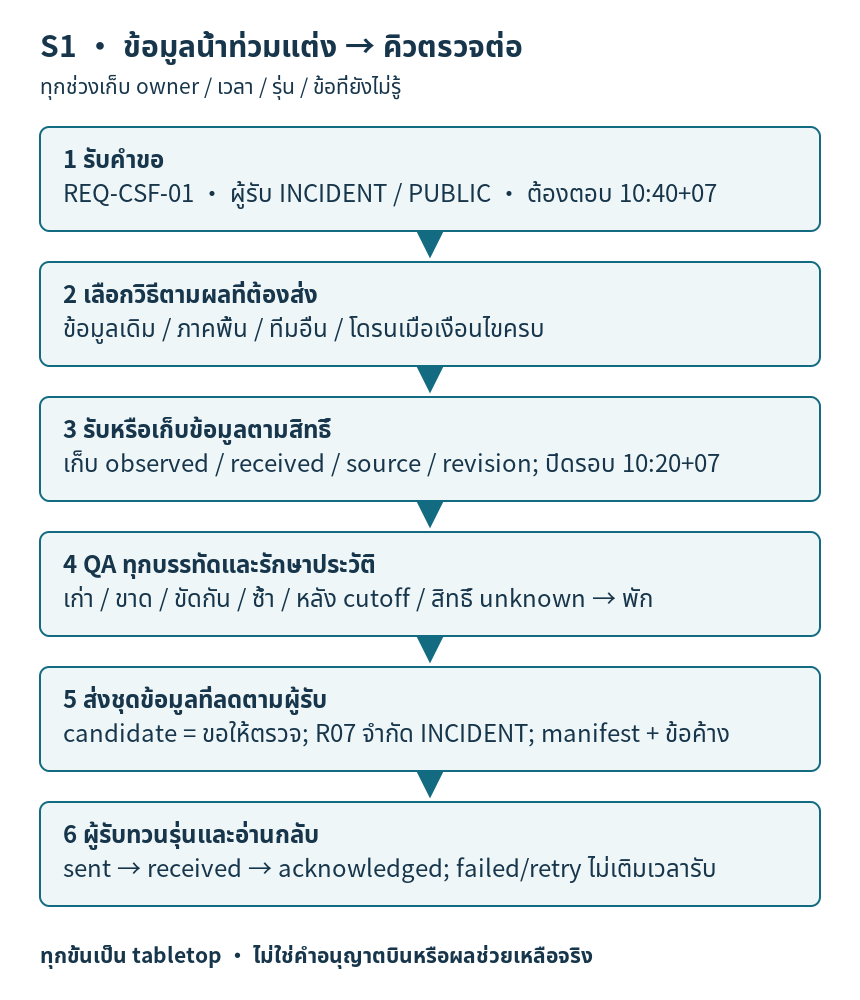
The diagram shows decision points and reasons to pause; it is not a flight operations order. Open the full-size sequence diagram
Choose the method from the result the recipient can use
Compare every route with the same question: is it in time for 10:40+07 , which parts does it cover, what are the usage/onward-transfer rights, who does QA and who is responsible, which resources are requested or confirmed, and the costs/risks actually known. The fixture has no real prices, travel times or model performance, so mark them unknown and ask for evidence; do not fill in guessed values.
Scroll the table horizontally to see every column. When the table has keyboard focus, use the left or right arrow keys
| Method | What may be sent in the first round | Conditions and reasons to pause |
|---|---|---|
| Existing data that we are permitted to use | Context / points where new images or reports must be requested | R03 is old; the time of the existing data must be stated and it must not substitute for the current status |
| Reports or ground checks by the responsible officers | Confirmation for a specific point when there is a responsible person and a safe method | No confirmed team/access; R05/R06 cannot yet be compared by footprint; do not order anyone into the area from the CSV |
| Request other teams/services that are authorised | Data or readback that answers the gaps | The team request is requested until the authority replies with time limits/evidence; if not confirmed, pause |
| Drone, when all real conditions are met | Partial context images and a list of follow-up checks | People, the actual kit, manuals, mass/power, area, airspace, permissions/authorisations, the data channel and QA must be checked; the fixture has none of these values |
If a real kit must be chosen, compare multirotor, fixed-wing and VTOL against the take-off/landing area, the work boundary, the angles that must be seen, and support for the actual model; RGB, thermal and other sensors answer different questions and carry different limitations. Do not infer endurance, range, ability to see through obstructions or flight readiness from the type name. A no-flight option can still answer the request when the outstanding items are sent honestly. The responsible officer must check the Thai requirements that apply to the actual day/area/aircraft before operating; this status pending_field_review.
Reading multi-date data while keeping problem rows
The teaching rule CSF-RULE-v1 keeps the observation time within 45 minutes, including the boundary, before the cutoff 10:20+07; the receive time must not be later than the cutoff and not before the observation time. The 45-minute criterion is only a practice condition, not an emergency SLA. The value unknown is not zero. A duplicate key (scenario_id,record_id,revision) must pause every occurrence; a new revision of R01 is a checkable history, not a duplicate.
Scroll the table horizontally to see every column. When the table has keyboard focus, use the left or right arrow keys
| Row | Expected result | Reason and what remains unanswerable |
|---|---|---|
| R01v0 → R01v1 | history → candidate_check | Description corrected; v0 kept, and v1 still sees only part of Z-A |
| R02v0 | candidate_check | maybe_water_cloud_edge: obscured/uncertain; images or ground readback must be requested to confirm Z-B |
| R03v0 / R04v0 | hold_stale / hold_missing_time | 89 minutes exceeds the teaching rule; the other row has an unknown observation time and coverage none |
| R05v0 + R06v0 | both hold_conflict | The Z-B descriptions appear to conflict, but there is no footprint confirming they are the same point; ask for the position boundary / independent readback before choosing |
| R07v0 | candidate_check for INCIDENT only | The signal 'possibly related to a person' is unconfirmed; restrict the data and ask the responsible officers to check |
| R08v0 / R09v0 | hold_rights / hold_recipient | Unknown permissions or recipient: must not be exported as a row |
| R10v0 / R11v0 two lines | hold_late / hold_duplicate for both | Arrived after the cutoff; the duplicate key must be kept and its root cause fixed |
Total: 3 candidate_check and 10 history/hold out of 13 lines , not 3 safe points or 10 points with real problems. Z-D has no usable candidate yet. The screening diagram ties the reason groups to recipients and follow-up checks.
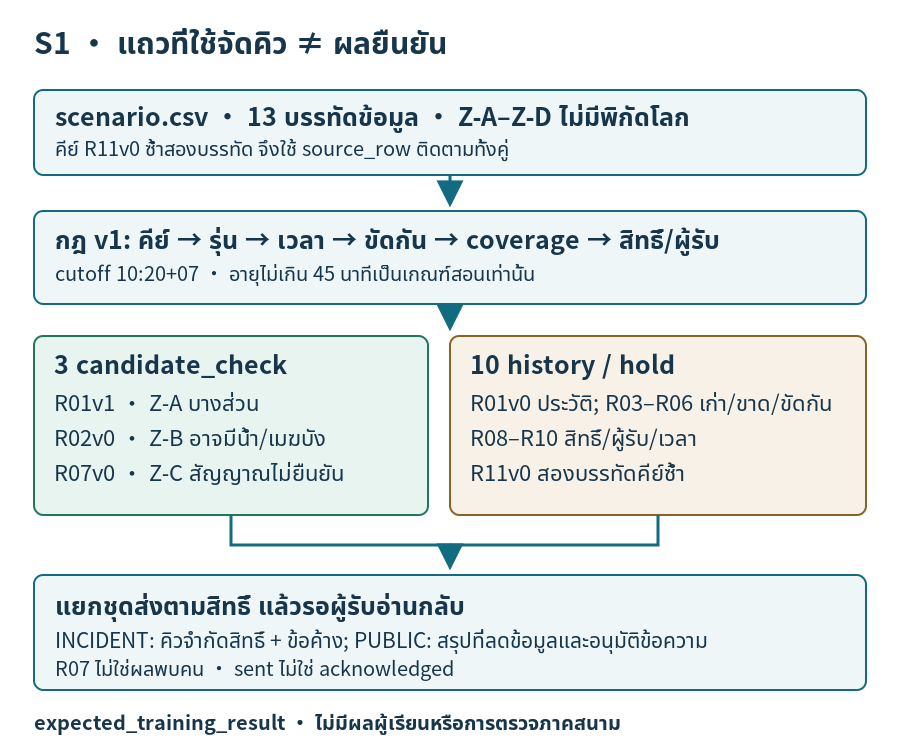
The diagram keeps both R11 lines and separates screening rows from onward-transfer permissions. Open the full-size screening diagram
Send to the recipient for readback without inventing a status
Package INCIDENT with restricted permissions contains a list of candidate/hold items within the limits of the hypothetical data; R07 must stay in the unconfirmed follow-up queue and must not be turned into 'found person'. The package PUBLIC is a limited summary after the responsible officer approves the wording; it does not send raw rows or the restricted R07. R08 / unknown permissions and R09 / unknown recipient must pause. The original CSV files are published for download because they are entirely made-up data; the code rights is a rule for filtering the learner's package, not website access control. The manifest states request_id, cutoff, local frame, data/rule revision, row IDs, unknowns, owner, permissions, the sender/recipient role names, and status.
not_sent → sent → received → acknowledged are events at different steps; each step needs its own time and actor. sent does not prove that a person received it. If offline, keep failed/queued, owner, package ID/revision and the retry log. The recipient reads back the revision, outstanding items and limitations before acknowledged; an acknowledgement does not certify safety or professional results. If a previously sent version is corrected, keep the old version, notify the original recipients and have them read back which version they opened.
How to hand over assessment → search → logistics
Situation assessment helps the responsible officers frame questions and prioritise follow-up checks, but an assessment result does not automatically open a search or transport mission. Logistics Operational Guide: Assessment Cycle . Start from the users of the result and their information needs, state the source/gaps, then share the result with the decision-makers (H-01); Logistics Assessments and Planning separates assessing needs, feasibility and available capacity (H-02). The boundary of the claims is in the source register. The diagram below is an exercise designed by the compilers from this principle , not a workflow certified by any agency or a real data-integration system.
The arrows in the diagram show the order of learning ; they do not require a real event to wait until the search is finished before logistics begin. When the responsible officers have confirmed an urgent need, search coordination and supply planning may proceed in parallel according to each party's role and evidence; do not wait for a complete report before handing an urgent matter to the responsible officers.
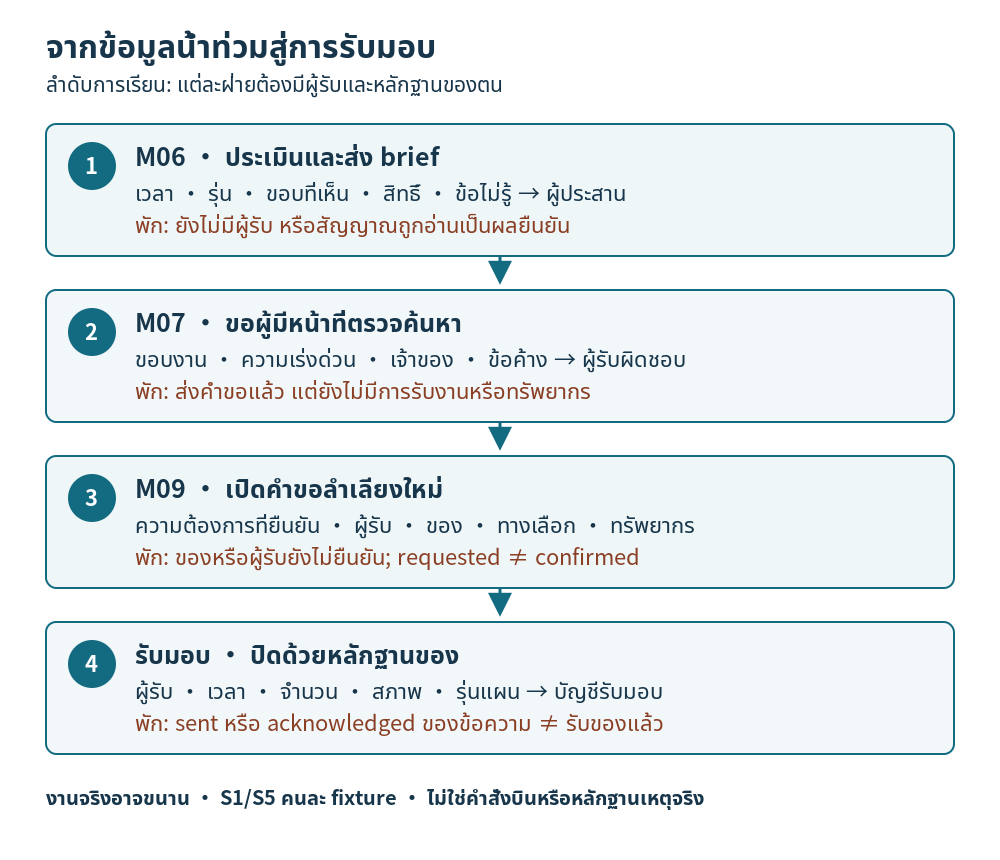
The diagram shows handovers that need a responsible person and new evidence at each stage. Open the full-size diagram. The realistic context image above shows only a coordination desk; it is not a confirmed image of flooding or people.
Scroll the table horizontally to see every column. When the table has keyboard focus, use the left or right arrow keys
| Stage and lesson to read next | What to send to whom | Evidence required / what to do if missing |
|---|---|---|
| M06 Assessment → incident coordinator | A brief stating the source, observation/receive time, revision, visible boundary, permissions, conflicts and unknowns | The recipient reads back which version they used; R07 is only a restricted signal that may need urgent onward transfer, not a finding of a person. If there is no recipient with the duty, keep the queue and follow up; do not publish widely |
| M07 Search support → person responsible for search | A follow-up check request with the work boundary, time, urgency, what is still unconfirmed, and the reporting-back channel | There must be a person who takes the task and their own resource/safety plan; a suspicious point or sending a request is not a finding / an accepted task. If it cannot be accepted, the coordinator finds another recipient or keeps the queue with an owner |
| M09 Logistics → owner / recipient of the goods | A new request after the responsible officers confirm the need, stating the type/quantity/condition, recipient, permissions and time, then comparing ground/service/drone routes | The resource owner confirms availability and time window; requested is not yet confirmed. If the recipient or the goods are not confirmed, pause and ask for support or a change of method; do not claim a brief of images is an order to deliver goods |
| Handover → recipient of goods and coordinator | The plan revision and the receipt evidence tied to the recipient, time, quantity and condition | sent/acknowledged of a message is not a goods receipt. Separate handover evidence is required; if it is missing, keep the status outstanding and follow up |
Try R07v0 from S1 only as the question 'who should check this signal next' and write a check request that preserves the permissions and unknowns. Then, hypothetically and separately , suppose the responsible officers confirm that general equipment must be sent, so a new request is started and S5 Logistics and handover is used to practise comparing resources. S5 has the codes Q-A/Q-B/Q-C and times in a different fixture; do not cite Q-A as arising from R07 or merge the two CSV sets into one event.
KSEC practice continuing from the earlier lesson: B uses APP-CSF-B-K/S/E/C01 to write sentences that separate 'a signal was seen' from 'a need was confirmed' and to name the recipient / unknowns; O uses APP-CSF-O-K/S/E/C01 to make a ledger of owners, support requests and task-acceptance evidence before moving between stages; D uses APP-CSF-D-K/S/E/C01 to propose a data contract that stores source ID/revision, referral ID, owner, rights, and event/receipt separately, with a test case that unconfirmed R07 data must not automatically create a logistics request. Write the result in the S1 worksheet linked below; use the existing rubric, and do not add outcome IDs or claim that any learner has passed.
From images for incident coordination to public media
Suppose there is a new request to publish a drone image with the message 'The water has receded; the road is passable' before the news update time. TRAIN-CSF-01 There are no source images for R01–R11 , no water-level measurements and no road-safety confirmation; the package PUBLIC in the exercise is only a summary form with detail reduced after the responsible officer approves the wording , not permission to post the operational files. The task M10 Sending data shows the evidence of sending, receiving and acknowledgement among recipients, but publishing through a public channel is a separate job that must start with the brief of M11 Media production , separately.
This reasoning is consistent with OCHA Data Responsibility Guidelines 2025 , which discusses handling operational data safely and ethically, and ICRC Handbook on Data Protection in Humanitarian Action , which ties data protection to the lives and dignity of those affected (P-01/P-02). These sources are lesson-design ideas; they do not approve publication in Thailand, do not set the legal basis for the exercise, and do not verify the made-up S1 data. The person actually responsible must check the permissions and the requirements that apply to that data / person / area / channel.
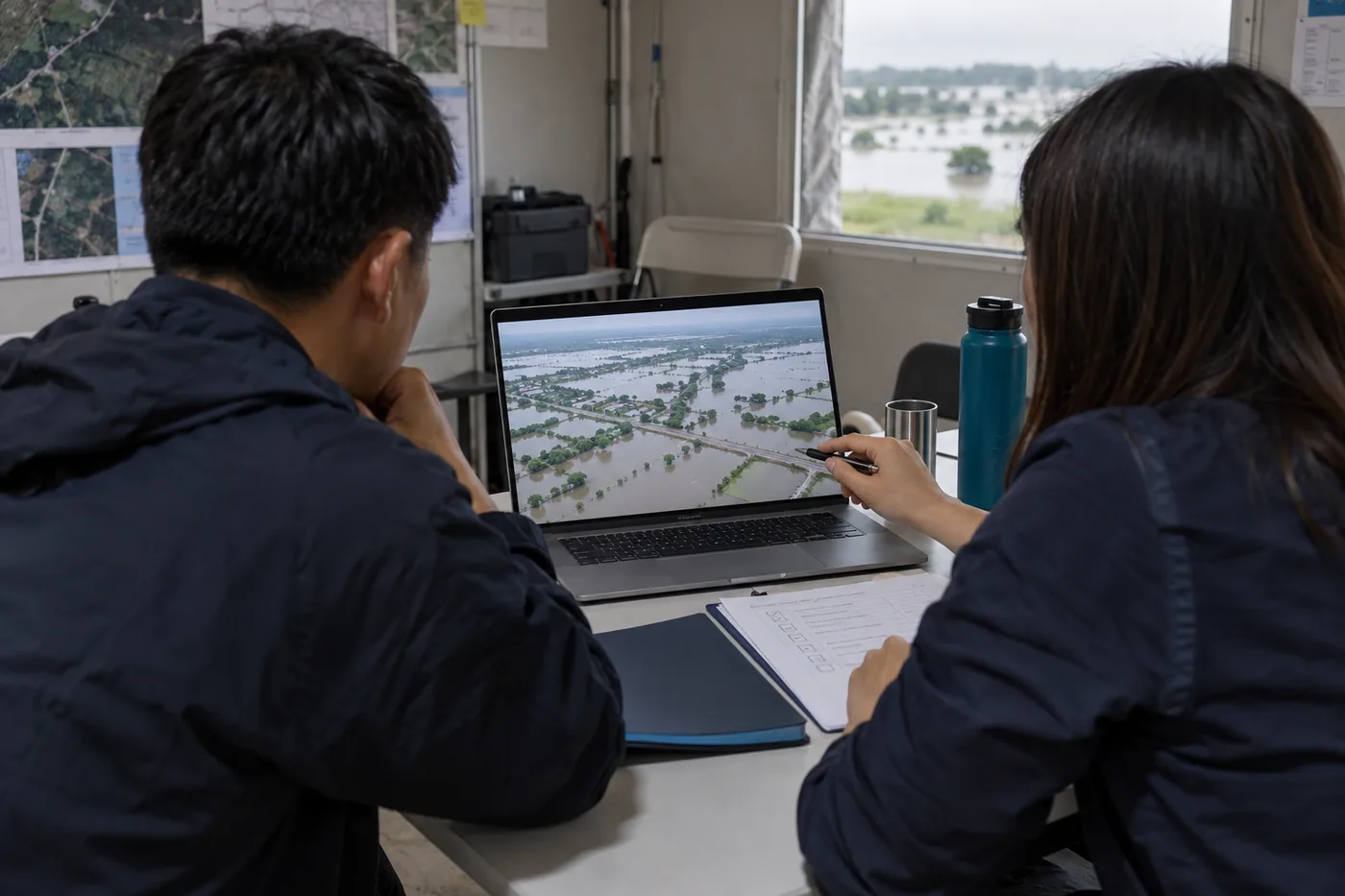
Realistic image created for teaching shows a media-review desk with a simulated flood image on screen; it is not an image of an event, area, time, victims or the files R01–R11. Do not use this image in news as if it were evidence of a real flood. Open the full-size media-review context image
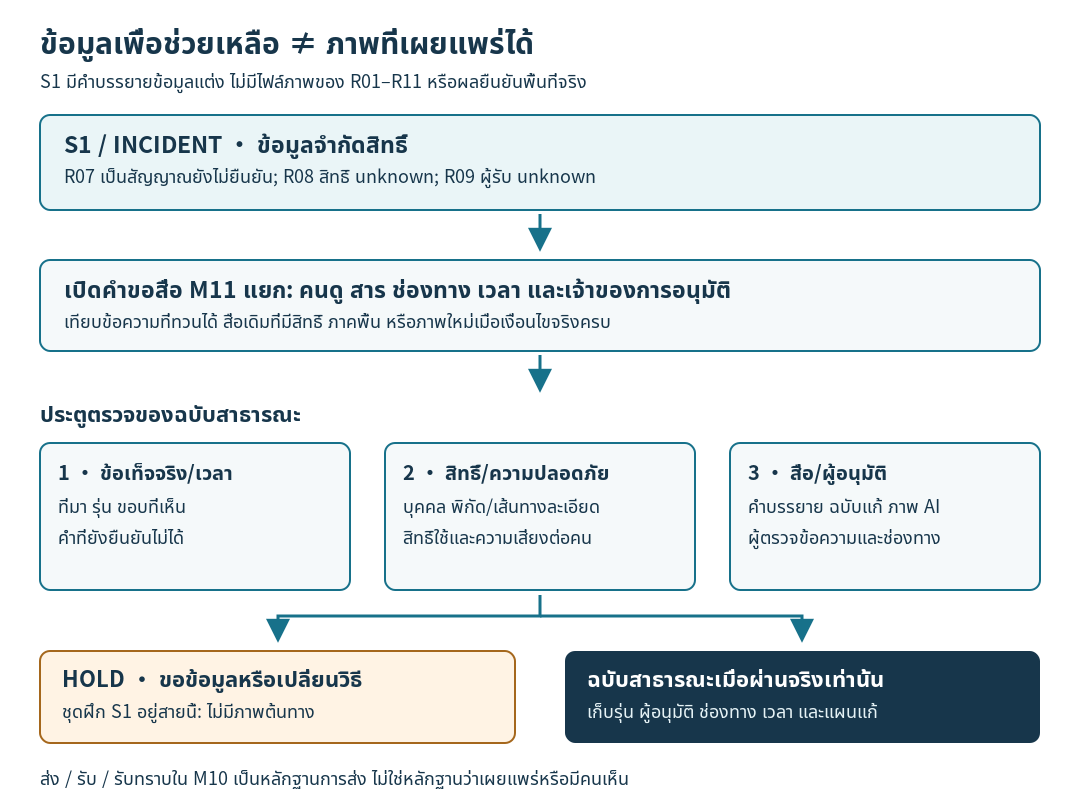
Diagram description: there is no shortcut arrow from the package INCIDENT to a public channel. The S1 exercise ends at HOLD because there are no source images and the claim 'the road is passable' has not been confirmed by anyone; the right-hand path is a condition for a future real job, not a result that occurred in the fixture. Open the full-size publication-gate diagram
Scroll the table horizontally to see every column. When the table has keyboard focus, use the left or right arrow keys
| What the exercise asks for | Practice result faithful to the evidence | Work / owner to add |
|---|---|---|
| Post R07 'person found' or detailed images/position | HOLD: R07 is only an unconfirmed, restricted signal; do not send the raw row / position to the public | The person responsible for search checks through the restricted channel; the data custodian assesses the risk before any disclosure |
| Say that Z-B's water has receded or the road is passable, based on R02, R05/R06 | HOLD that message: R02 is still maybe_water_cloud_edge; R05/R06 still conflict, and it is not known whether they share a footprint |
The responsible officers confirm the current condition and time; the communicator drafts a message that preserves the uncertainty and has the approver review it |
Use the package PUBLIC of S1 as a post or news image |
DRAFT_FOR_REVIEW only: the exercise has no approval evidence, published URL or original image | Open the M11 brief stating the audience, message, channel, permissions/safety, caption and approver; check the reduction of detail from the operational version |
| Use the realistic image in this lesson | TRAINING_ILLUSTRATION with the label 'image created for teaching'; do not use it in place of an image of the event | If a real event must be communicated, request images/text from an authorised source and check the time/context, or use text that can be confirmed without images |
| Request a new shoot for public media | NEW_REQUEST is not approval to fly from S1 | Compare existing media / ground / service / drone using the kit-selection criteria , then check people, kit, area, airspace, data rights and the handover method for that new job |
If there is a real media item, record public_request_id, the source/revision used, the claimed message, audience/channel, reason for reducing detail, permissions checked, reviewer/approver, media revision, and publication evidence (URL/time), separately from the sent/received/acknowledged of M10. When a message is corrected or withdrawn, keep the original version, the reason, the list of channels and the holders of copies who must be notified. This practice set has no approval, publication or real audience results: every result cell stays NOT_RUN.
KSEC practice continuing from the earlier criteria: B separates facts from persuasion among five options (K/S) and does not open R07 (E); note the reason for correcting the version after a challenge (C). O compares no-flight / ground / authorised media options with a drone, then makes a ledger of message reviewers, permissions and the publication-correction plan (K/S/E/C). D proposes a data contract and a negative test that rights=unknown, review=missing or source=unverified must not be promoted to published, while keeping the revision and the withdrawal route (K/S/E/C). Use the S1 worksheet and rubric together with KSEC of M11 as the basis, in different fixtures; this activity adds no outcome IDs and claims no learner passes.
Choose route B/O/D
Scroll the table horizontally to see every column. When the table has keyboard focus, use the left or right arrow keys
| Role | Prerequisites | Work product and outcome ID |
|---|---|---|
| B Beginner | M06, M07, M01; time/permissions/what the images cannot answer | brief B-v0→v1, a table covering every row, four options, two recipients, the challenge and owner; APP-CSF-B-K/S/E/C01 |
| O Planner | M06, M07, M10, M01; QA/handoff | plan O-v0→v1, requested/confirmed, six stages, fallback, manifest/redaction/receipt; APP-CSF-O-K/S/E/C01 |
| D Developer | M06, M10, C02; schema/time/offline | contract D-v0→v1, test matrix duplicate/time/version/rights/offline-retry, expected/actual, rollback; APP-CSF-D-K/S/E/C01 |
B Beginner
Make a brief that states what is seen, what is not known, and the two recipients with permission boundaries, from the B worksheet , then revise B-v0 into B-v1 after the challenge.
O Planner
Use the O worksheet to make a requested/confirmed ledger, a six-stage QA plan, and a manifest the recipient can read back.
D Developer
Use the D worksheet to write a data contract and test duplicate/time/version/rights/offline-retry, with expected and actual results kept separate.
Read the rubric for the 12 outcomes and the practice-set rules before giving results. The new S1 codes are separate from the M06/M07 lesson codes whose criteria are tied to the earlier fixture; the mapping adds codes while keeping the existing 188 codes and CLO/PLO pending_design.
Evidence status: fixture/expected are synthetic/expected only; local run results may exist only as a separate log when actually run; learner results NOT_RUN (B/O/D = 0/0/0), field results NOT_RUN. Subject-specific reviewers not_assigned; authorisations / safety / real assistance pending_field_review. The P3/P5 work remains open and CPX-Sim remains on hold. Claims F-01 to F-04 and the limits of use are recorded in research/drone-applications-case-studies-source-register.md; US sources do not replace checking the requirements and field conditions in Thailand.