Calibrating cameras and IMUs
Separate image parameters, mounting positions and timing to find the causes of error systematically
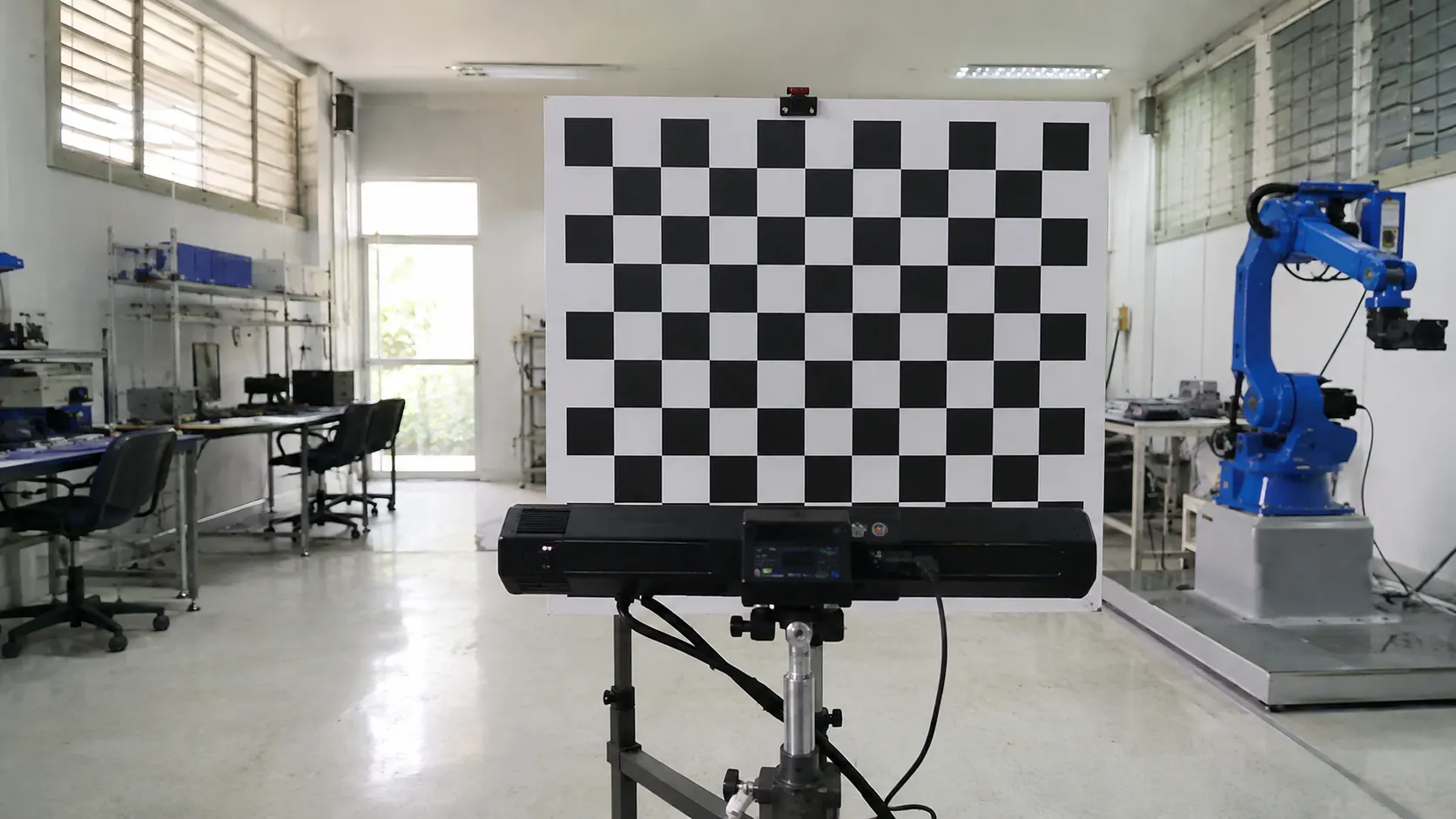
Calibration is not a single value
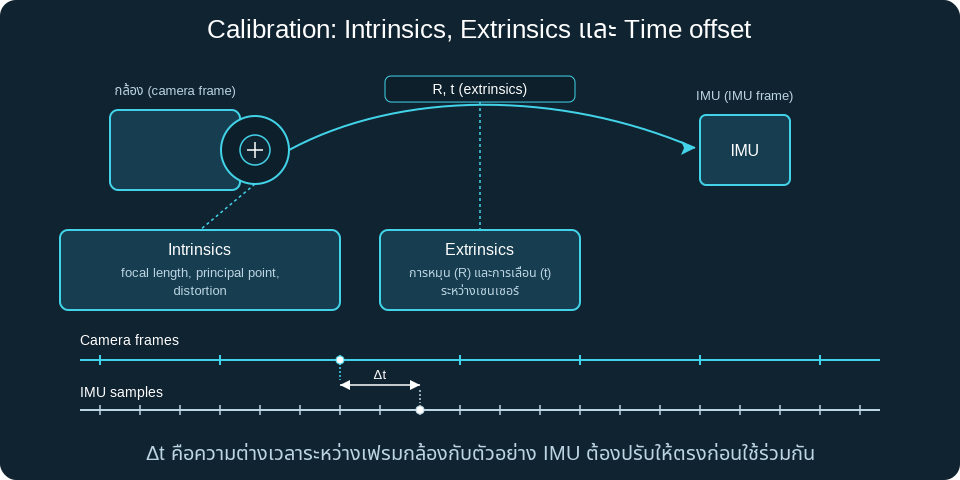
Intrinsics describe the camera model, such as focal length, principal point and distortion, while extrinsics describe the rotation and translation between sensors. Time offset is a time difference that must be handled separately. A number that looks small can matter when motion is fast
Use Kalibr with evidence
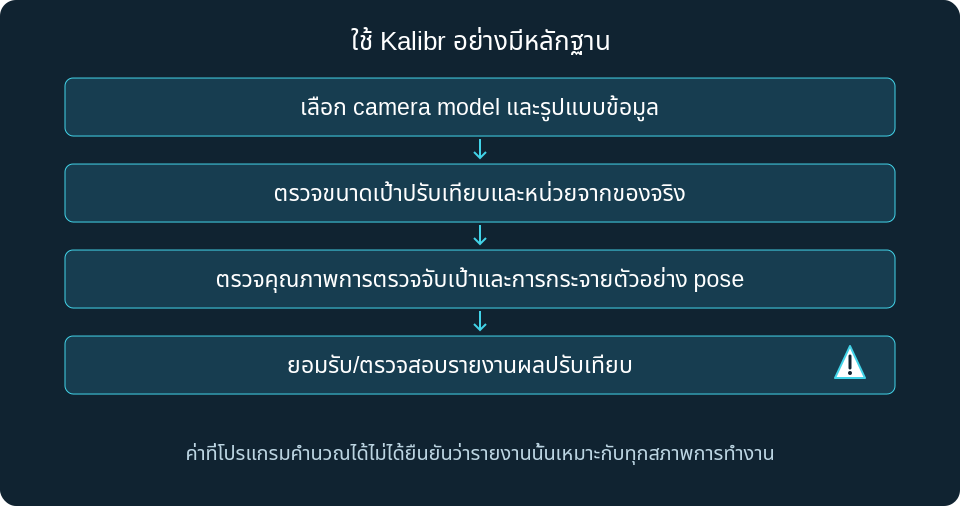
Choose a camera model and data format supported by the tool, check the calibration target size and units against the real object, and look at target detection quality and the spread of samples before trusting the result. A value computed by the program does not confirm that the report suits every operating condition
| What to check | What could happen if it is wrong |
|---|---|
| frame / units | Positions or orientations do not correspond |
| Target size / camera model | Geometric values estimated incorrectly |
| Timing and data order | Camera and IMU represent different moments |
| Mounting and vibration | The relationship between sensors changes |
Try camera calibration with OpenCV
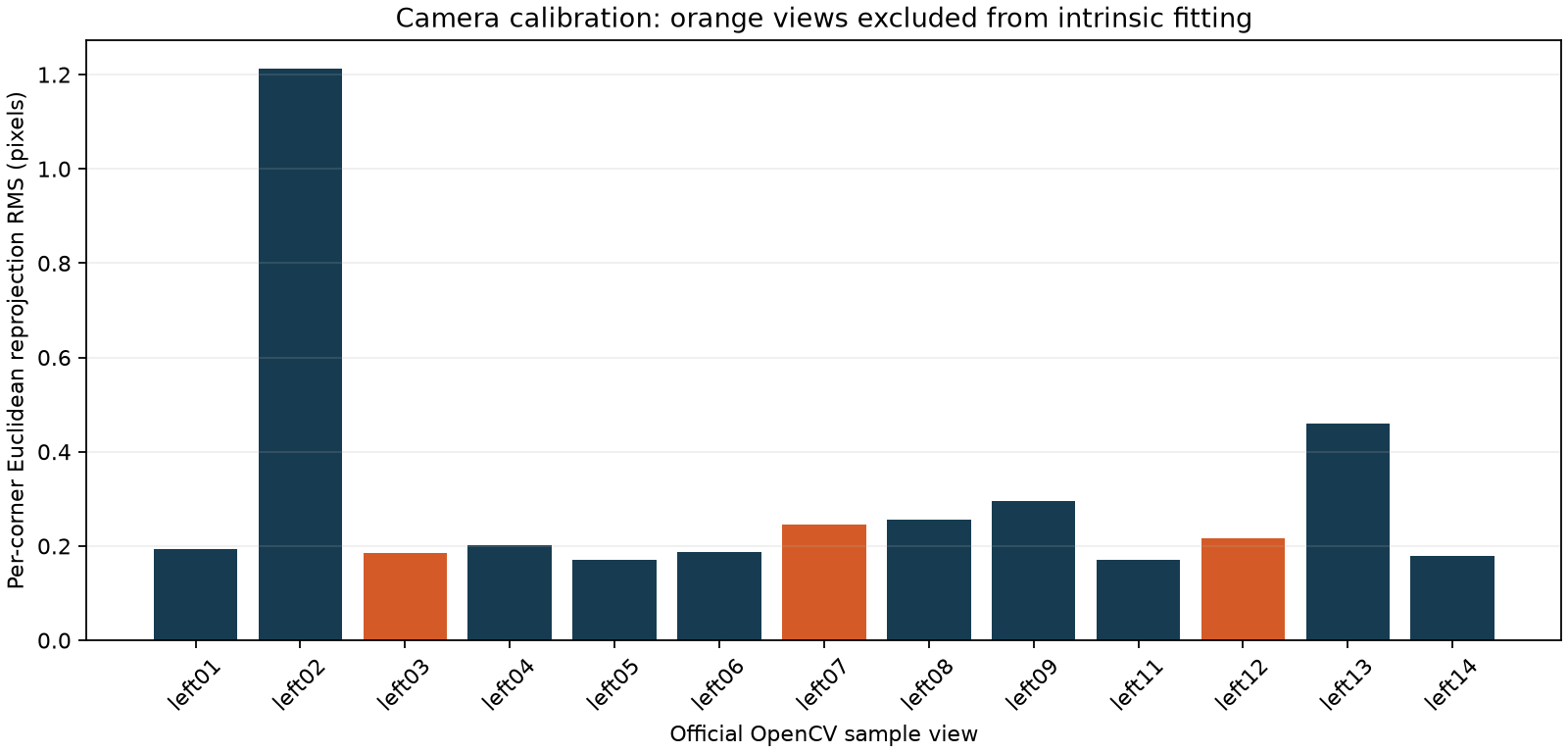
The actual experiment used 13 OpenCV sample chessboard images, with 54 inner corners detected per image. 10 images were selected to estimate the camera parameters, and left03, left07 and left12 were held out before calibration started. The RMS per-point error for the calibration set was about 0.4514 pixels while the three held-out images were about 0.2178 pixels
When checking the latter three images, we fixed the camera and distortion parameters but still estimated the board pose in each image with solvePnP. This score therefore measures the consistency of point projection in the image, not a measurement of pose against true position. A score lower than the calibration set does not prove the camera is accurate in every scene
The exercise sets the chessboard square side to 1 unit because there is no measured target size, so the resulting translation is in chessboard-square units, not metres , and camera–IMU calibration has not yet been done. Read the guide with reproducible steps and camera parameters/per-image results/data provenance , then use your own images and target size when you need to calibrate real equipment
Separate the calibration set from the test set
Keep the report together with the config and version, then check with data from another period. Change one factor at a time to find causes. Do not report only the lowest number from many trials without explaining how it was chosen
Kalibr has its own LICENSE that must be read, including acknowledgment conditions in some cases. The examples on this website are study guidance, not a certification of calibration values for learners' hardware
Practise evaluating results and timestamps →
References and scope
Sources checked 7 September B.E. 2569 (2026); compiled to accompany knowledge kindly contributed by DTI
F16: reprojection RMSE divided by the number of points or the number of axes
| Variable | Meaning and units in → out | Range/source of values |
|---|---|---|
| dx_i,dy_i | observed − projected on the image axes, px (in) | finite; match the same points and use images of the same size |
| n | Total number of 2D points (in) | Integer > 0; includes every declared view |
| RMSE_point | RMS of the 2D distance per point, px (out) | ≥ 0; divide by n |
| RMSE_component | RMS per scalar component, px (out) | ≥ 0; divide by 2n, a different definition from the value above |
Applied level · Question: overall, how far are the points projected by the model from the points detected in the image?
RMSE_point = √[Σ(dx_i² + dy_i²)/n]
RMSE_component = √[Σ(dx_i² + dy_i²)/(2n)]
Pin the meaning to monocular calibrateCamera in OpenCV 4.10.0: the source returns sqrt(reprojErr/total) where total is the number of points, not 2n. The second equation is there to show the effect of changing the definition, not to be used interchangeably. Reporting a global metric requires summing the squared errors and point counts over all views; do not average per-view RMSE with equal weights and call it the global RMS
This example is computed from the given residuals; no calibration solver was run. A small value on the fit set does not confirm results on new images. Resolution, lens/focus, distortion model, flags, pattern dimensions and test views must be kept separately. NoData or mismatched point pairs must be fixed first; for n=0, report that there is no data rather than giving 0
Worked substitution example
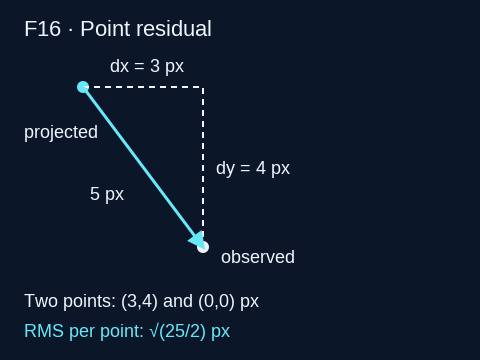
Two points have residuals (3,4) px and (0,0) px. The sum of squares = 3²+4²+0+0 = 25 px², so RMSE_point = √(25/2) = 3.535534 px and RMSE_component = √(25/4) = 2.5 px, not the mean distance (5+0)/2
Exercise: change the values
Change the second residual to (3,4) px, keep the first unchanged, and compute both definitions
Show F16 answer
Sum = 50 px²; RMSE_point = √(50/2) = 5 px; RMSE_component = √(50/4) = 3.535534 px. Tolerance ±0.000001 px; the denominator must be written with the answer
Reference: OpenCV 4.10.0, Camera Calibration and 3D Reconstruction (P3E06) · OpenCV 4.10.0, calibration.cpp, cvCalibrateCamera2Internal (P3E07); checked 26 September B.E. 2569 (2026)
Connecting knowledge with missions and data
Record the camera parameters, the camera–IMU relationship and timing, including the version of the data used for calibration. Keep calibration results separate from trajectory evaluation results, because values that fit the calibration set do not confirm performance on other data Read the reference: ETH Zürich, Kalibr
Practice check: List the camera model, units, timestamp convention and calibration file name before replaying data. Do not adjust values without a record
Read more Lessons that apply this knowledge in simulated work · sources reviewed 26 September B.E. 2569 (2026)
Download the engineering and sensor formula practice set (CSV/JSON with answers) · synthetic data for practising calculations and checking assumptions