Regulations, readiness and checklists
UAT 201 Fundamentals of Unmanned Aircraft Systems
Lesson
By the end of this module you will be able to
- Identify which body oversees what in a mission, among CAAT, NBTC, aeronautical information and the landowner
- State the main flight conditions of the 2015 Ministry of Transport announcement and outline Specific-category flight under the 2026 CAAT announcement
- Assess pilot readiness with IMSAFE and mission risk with PAVE
- Write and evaluate a checklist with PASS, FAIL, UNKNOWN and N/A states to decide go or no-go
Why this matters
Even the most skilful team can break the law by flying in a restricted area, using unregistered radio equipment, or flying after a sleepless night. Checking the law and readiness before flight is as much a flying skill as handling the sticks. This course covers the basics; detail comes later in the law and safety courses.
Who oversees what
The team’s building photo mission involves several matters. Registration with one body does not mean permission on every front.
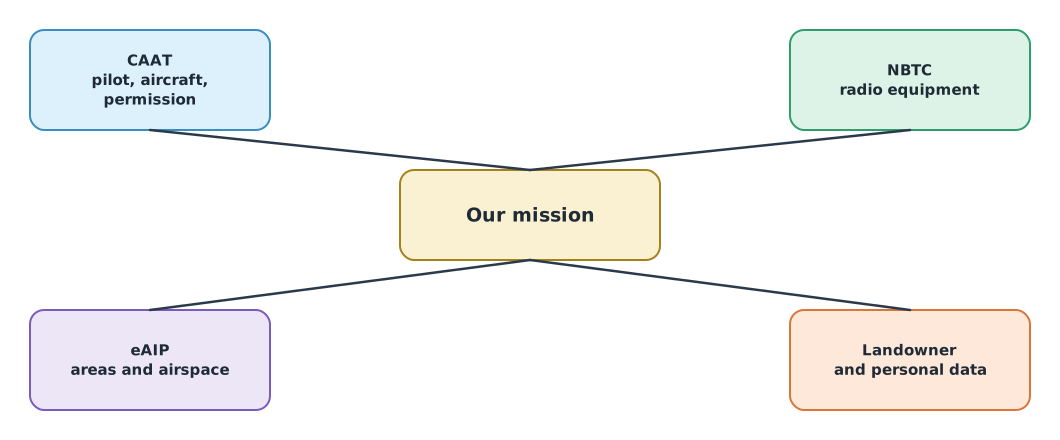
| Matter | Body or source to check |
|---|---|
| Pilot, aircraft and flight permission | The Civil Aviation Authority of Thailand (CAAT), through the UAS Portal |
| Radio equipment on the drone | The NBTC office, with online registration at anyregis.nbtc.go.th since 1 April 2021 |
| Restricted areas and aeronautical information | The electronic Aeronautical Information Publication (eAIP) and specific CAAT notices |
| The site and personal data | The site’s owner or manager, and personal data protection law |
The NBTC’s frequency rules are being revised in 2026, so check the announcement in force on the day of every flight.
Main flight conditions
The 2015 (B.E. 2558) Ministry of Transport announcement sets general conditions for pilots. Key examples:
- Keep the aircraft in sight at all times; do not fly by camera view alone
- Fly between sunrise and sunset, and do not approach or enter cloud
- Stay no higher than 90 m (300 ft) above the ground
- Stay at least 9 km from airports unless permitted
- Keep a horizontal distance from people, vehicles and buildings of at least 30 m for recreational drones up to 2 kg, and 50 m for registered pilots
- Do not fly over communities or gatherings, and do not invade privacy
Pilots register through CAAT’s UAS Portal, which includes an online knowledge test; registration is valid for 2 years. Flights outside the general conditions, such as at night or above 90 m, fall under the 2026 (B.E. 2569) CAAT announcement on Specific-category flight, which requires a pilot rating, aircraft registration and per-flight permission. The building photo mission on campus also needs the university’s permission and must keep the required distance from buildings, or seek further permission.
Pilot and mission readiness
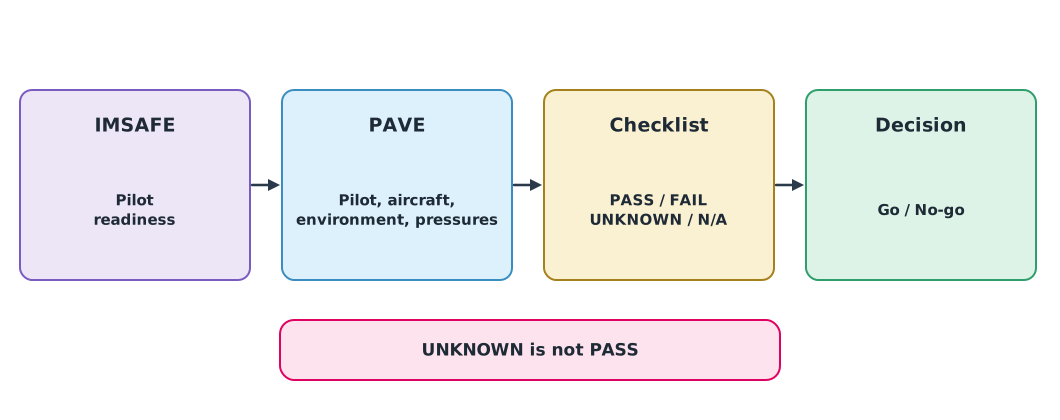
The FAA remote pilot study guide (FAA-G-8082-22) offers two memory aids. They help avoid overlooking issues; they are not scores certifying fitness to fly.
- IMSAFE assesses the pilot: Illness, Medication, Stress, Alcohol, Fatigue, Emotion
- PAVE assesses the flight’s risk: Pilot-in-command, Aircraft, enVironment, External pressures (such as a delivery deadline)
A checklist that means something
An item “battery OK” does not say what was checked. A good checklist states the item, criterion, evidence, checker and time, and separates four states:
| State | Use when |
|---|---|
| PASS | Checked and meets the criterion, with evidence |
| FAIL | Checked and does not meet the criterion |
| UNKNOWN | Not yet checked, or not enough information |
| N/A | Genuinely irrelevant to this mission, with a reason |
Example 1 Evaluating a pre-flight checklist
checklist = [
    ("pilot registration valid", "PASS", "UAS Portal record checked"),
    ("radio equipment registered with NBTC", "PASS", "registration number on file"),
    ("site permission from the university", "PASS", "letter dated this week"),
    ("area not restricted (eAIP and CAAT notices)", "UNKNOWN", "notices not yet checked today"),
    ("IMSAFE: pilot rested", "FAIL", "slept 4 hours"),
    ("battery charged and not swollen", "PASS", "4.18 V per cell, no swelling"),
    ("RTL altitude above the building", "PASS", "RTL set to 35 m"),
    ("night-flight lighting", "N/A", "daytime mission"),
]
counts = {s: sum(1 for _, st, _ in checklist if st == s) for s in ("PASS", "FAIL", "UNKNOWN", "N/A")}
print(counts)
blocking = [(item, st, note) for item, st, note in checklist if st in ("FAIL", "UNKNOWN")]
print("decision:", "GO" if not blocking else "NO-GO")
for item, st, note in blocking:
    print(f"  {st:<7} {item} ({note})")
{'PASS': 5, 'FAIL': 1, 'UNKNOWN': 1, 'N/A': 1}
decision: NO-GO
UNKNOWN area not restricted (eAIP and CAAT notices) (notices not yet checked today)
FAIL IMSAFE: pilot rested (slept 4 hours)Although 5 items pass, one fails and one is not yet checked, so the decision is no-go. The fix is to change pilot or postpone, and finish checking the area notices. UNKNOWN is never PASS, and a state must never be changed to PASS without actually checking.
Module lab
Lab: a readiness file for the building photo mission
- Build a table of the four matters in Figure 1 for the team’s mission, with body, source, date checked and what still needs confirming (no real personal data).
- Open CAAT’s UAS Portal and the NBTC registration page, read the procedures and documents required, and summarise them as a list.
- Check the campus location against the eAIP and the latest no-fly notices, recording the issue and date checked.
- Write a pre-flight checklist of at least 12 items, each with a criterion and evidence, and evaluate it with the code in Example 1.
- Role-play: the pilot slept badly but there is a deadline. Using IMSAFE and PAVE, write the decision and the alternatives.
Common mistakes
Watch out
- Thinking the landowner’s permission means you can fly straight away
- Using legal figures from old slides or other countries instead of checking the announcement in force
- Marking PASS on items not yet checked
- Using N/A to skip awkward items
- Letting deadline pressure override the pilot’s readiness
Summary
- One mission involves CAAT, NBTC, aeronautical information and the landowner, each checked separately
- The main 2015 conditions include keeping the aircraft in sight, flying in daylight, staying below 90 m and 9 km from airports
- IMSAFE assesses the pilot; PAVE assesses the flight
- A checklist separates PASS, FAIL, UNKNOWN and N/A, and it is go only with no FAIL and no UNKNOWN
Check your understanding
- Under the 2015 announcement, how high above the ground may you fly?
- Which body handles registration of a drone’s radio equipment?
- What do F and E stand for in IMSAFE?
- A checklist has 10 PASS, 1 UNKNOWN and 0 FAIL. What should you decide?
- How long is pilot registration under the 2015 announcement valid?
Answers
- 90 m (300 ft)
- The NBTC office
- Fatigue and Emotion
- Do not fly until the UNKNOWN item is checked and becomes PASS with evidence
- 2 years
Key formulas
| Go decision rule |
Key references
- กระทรวงคมนาคม. (2558). ประกาศกระทรวงคมนาคม เรื่อง หลักเกณฑ์การขออนุญาตและเงื่อนไขในการบังคับหรือปล่อยอากาศยานซึ่งไม่มีนักบิน ประเภทอากาศยานที่ควบคุมการบินจากภายนอก พ.ศ. 2558. ราชกิจจานุเบกษา, 132(86 ง), 6–12. link
- สำนักงานการบินพลเรือนแห่งประเทศไทย. (2569). ประกาศ กพท. เรื่อง หลักเกณฑ์และวิธีการในการอนุญาตให้ผู้บังคับหรือปล่อยอากาศยานซึ่งไม่มีนักบิน ประเภทอากาศยานที่ควบคุมการบินจากภายนอก ที่มีน้ำหนักไม่เกิน 25 กิโลกรัม ปฏิบัติแตกต่างไปจากเงื่อนไขที่กำหนด พ.ศ. 2569 (มีผล 17 พฤษภาคม 2569). link
- สำนักงานการบินพลเรือนแห่งประเทศไทย. (2568). แนวทางการขอรับบริการสำหรับผู้รับบริการ UAS. link
- สำนักงาน กสทช. (2564). ประกาศสำนักงาน กสทช. เรื่อง การยื่นคำขอขึ้นทะเบียนเครื่องวิทยุคมนาคมสำหรับอากาศยานซึ่งไม่มีนักบิน สำหรับใช้งานเป็นการทั่วไป. link
- Federal Aviation Administration. (2016). Remote pilot – small unmanned aircraft systems study guide (FAA-G-8082-22). link
- สำนักงานการบินพลเรือนแห่งประเทศไทย. (2565). รูปแบบคู่มือปฏิบัติการบินของอากาศยานซึ่งไม่มีนักบิน (CAAT-GM-UAS-001, Issue 01 Rev 00). link
Further reading
Study the assigned knowledge units in advance, review media and take the module quiz
Who regulates drones
Remote pilot readiness
Checklists tied to people, aircraft and manuals
Preparing information before registration
In class / field
Lab or field practice from worksheets with a safety checklist
Learning evidence: Checked worksheets and quiz results