System selection and lifecycle cost
UAT 301 Unmanned Aircraft Systems Technology
Lesson
By the end of this module you will be able to
- Screen options with must requirements before weighted scoring
- Score options with weights and test the sensitivity of the result to the weights
- Compute annual cost and the break-even point between owning a system and contracting a service
- Compare commercial off-the-shelf (COTS) and custom-built systems
Why this matters
The first four modules gave numbers for each subsystem. This module uses them to answer management’s question: which system should we buy, or should we buy one at all? The provincial disaster prevention centre in this case wants to map 4 km² of flooding and to search for people at night. The drone knowledge base’s unit on choosing drone missions recommends comparing three routes, doing it in-house, contracting a service or improving the existing method, and writing reasons that can be checked. All numbers are hypothetical.
Screen with must requirements first
The NASA Systems Engineering Handbook describes trade studies as starting from criteria that must be met and only then comparing the remaining options with weighted criteria. If every option is scored without screening, an option that cannot meet a must requirement may win on other scores.
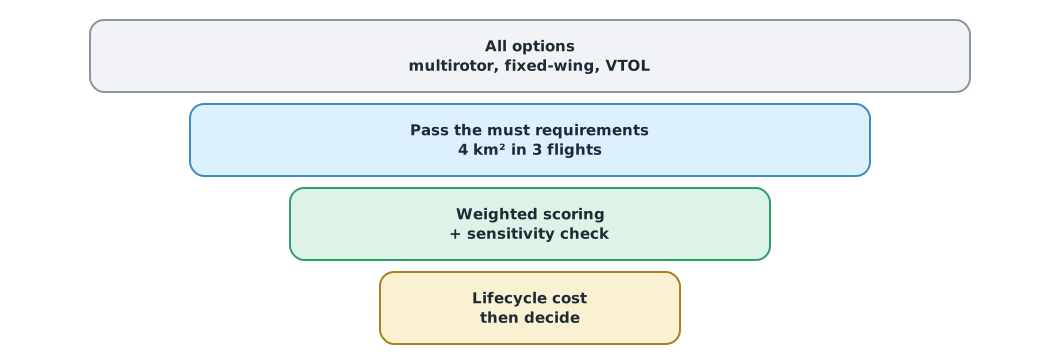
Example 1 Screen first, then score
The must requirement is mapping 4 km² within 3 flights. Area per flight comes from Module 2, and the 1–5 scores come from the team’s assessment (hypothetical).
import math

area_per_flight = {"multirotor": 0.73, "fixed-wing": 3.99, "VTOL": 2.42}   # km² per flight
AREA, MAX_FLIGHTS = 4.0, 3
W = {"coverage": 0.30, "night search": 0.25, "launch space": 0.15, "cost": 0.20, "ease of use": 0.10}
S = {
    "multirotor": {"coverage": 2, "night search": 5, "launch space": 5, "cost": 4, "ease of use": 5},
    "fixed-wing": {"coverage": 5, "night search": 2, "launch space": 1, "cost": 4, "ease of use": 2},
    "VTOL": {"coverage": 4, "night search": 4, "launch space": 5, "cost": 2, "ease of use": 3},
}

def score(w, names):
    return {k: round(sum(w[c] * S[k][c] for c in w), 2) for k in names}

print("without screening:", score(W, S))
passed = [k for k, a in area_per_flight.items() if math.ceil(AREA / a) <= MAX_FLIGHTS]
for k, a in area_per_flight.items():
    print(f"{k:<11} needs {math.ceil(AREA / a)} flights")
print("after screening:  ", score(W, passed))
without screening: {'multirotor': 3.9, 'fixed-wing': 3.15, 'VTOL': 3.65}
multirotor needs 6 flights
fixed-wing needs 2 flights
VTOL needs 2 flights
after screening: {'fixed-wing': 3.15, 'VTOL': 3.65}Without screening, the multirotor wins, but it needs too many flights, which in a flood means data arriving hours late. After screening, VTOL beats fixed-wing because it can take off and land in small spaces and search better at night.
Sensitivity testing
Criterion weights are the team’s judgement. The design text by Dym and colleagues warns that decision matrices give numbers that look more precise than they are, so test whether small changes in the weights change the result.
Example 2 Raising or lowering one weight at a time by 0.10
S = {
    "fixed-wing": {"coverage": 5, "night search": 2, "launch space": 1, "cost": 4, "ease of use": 2},
    "VTOL": {"coverage": 4, "night search": 4, "launch space": 5, "cost": 2, "ease of use": 3},
}
W = {"coverage": 0.30, "night search": 0.25, "launch space": 0.15, "cost": 0.20, "ease of use": 0.10}

def winner(w):
    tot = {k: sum(w[c] * v[c] for c in w) for k, v in S.items()}
    best = max(tot, key=tot.get)
    return best, round(tot["VTOL"] - tot["fixed-wing"], 2)

for c in W:
    for d in (-0.10, 0.10):
        w = dict(W)
        w[c] = max(0.0, w[c] + d)
        total = sum(w.values())
        w = {k: v / total for k, v in w.items()}          # renormalise to sum to 1
        best, gap = winner(w)
        print(f"{c:<13} {d:+.2f} -> {best:<10} (VTOL - fixed-wing {gap:+.2f})")
coverage -0.10 -> VTOL (VTOL - fixed-wing +0.67)
coverage +0.10 -> VTOL (VTOL - fixed-wing +0.36)
night search -0.10 -> VTOL (VTOL - fixed-wing +0.33)
night search +0.10 -> VTOL (VTOL - fixed-wing +0.64)
launch space -0.10 -> VTOL (VTOL - fixed-wing +0.11)
launch space +0.10 -> VTOL (VTOL - fixed-wing +0.82)
cost -0.10 -> VTOL (VTOL - fixed-wing +0.78)
cost +0.10 -> VTOL (VTOL - fixed-wing +0.27)
ease of use -0.10 -> VTOL (VTOL - fixed-wing +0.44)
ease of use +0.10 -> VTOL (VTOL - fixed-wing +0.55)VTOL wins in every case tested, even when the weight on cost or coverage, where the fixed-wing is stronger, is raised. The result is fairly robust, but the margin is narrowest (+0.11) when the launch space weight is lowered, so the team should confirm that take-off sites in the flooded area really are small. If the result flips with a weight change of only 0.10, report to management that the decision depends on that weight.
Lifecycle cost
The drone knowledge base’s unit on lifecycle cost divides cost into initial cost, fixed costs and costs per job, and stresses checking that every option delivers the same kind of output before comparing prices. IEC 60300-3-3 gives guidance on life cycle costing from acquisition through operation and maintenance to disposal.
Example 3 Own the system or contract a service?
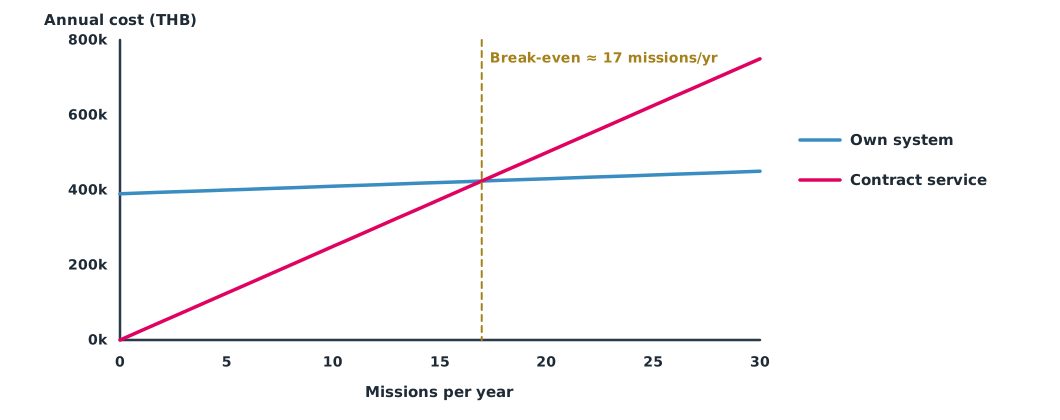
A VTOL system with a thermal camera costs 1,200,000 THB with a 5-year life, fixed costs of 150,000 THB per year (insurance, training, maintenance, software) and 2,000 THB per mission. A contractor charges 25,000 THB per mission (hypothetical).
CAP, LIFE, FIXED, VAR, SVC = 1_200_000, 5, 150_000, 2_000, 25_000

def own(n):
    return CAP / LIFE + FIXED + VAR * n

break_even = (CAP / LIFE + FIXED) / (SVC - VAR)
print(f"break-even {break_even:.1f} missions per year")
for n in (6, 12, 17, 24):
    o, s = own(n), SVC * n
    print(f"{n:>2} missions/yr: own {o:>9,.0f}  contract {s:>9,.0f}  -> {'own' if o < s else 'contract'}")
break-even 17.0 missions per year
6 missions/yr: own 402,000 contract 150,000 -> contract
12 missions/yr: own 414,000 contract 300,000 -> contract
17 missions/yr: own 424,000 contract 425,000 -> own
24 missions/yr: own 438,000 contract 600,000 -> ownIf the province has about 12 missions per year, contracting is cheaper. But cost is not the only reason. Disaster work needs flights within a few hours; if the contractor cannot arrive in time, owning a system may be worthwhile even at a higher cost. Management should see both the numbers and the response-time terms in the contract.
COTS or custom-built?
Fahlstrom and colleagues and Barnhart and colleagues explain that commercial off-the-shelf (COTS) systems win on availability, warranty, spare parts and documentation, but often limit customisation and access to raw data, and depend on the maker’s policies. Custom-built systems can be tailored to the mission and keep the data under your control, but need a team to maintain, test and document them. Questions to ask before choosing:
- For how many more years will the maker support spare parts and software?
- Where is mission data stored, and can it be exported in open formats?
- Does the team have people to maintain a custom system when the original developers move on?
- How easily can the system be approved, or flights authorised, by the regulator?
Module lab
Lab: a system selection proposal
- Choose one real mission in your province and write at least three measurable must requirements
- Find at least three options from real manufacturer documents, including “contract a service” and “improve the existing method”
- Screen with the must requirements, score with weights and test sensitivity using Examples 1–2
- Compute annual cost and the break-even point with Example 3, including insurance, training and spare batteries
- Write a one-page proposal for management in which every number can be traced back
Common mistakes
Watch out
- Scoring without screening the must requirements first
- Trusting totals to two decimal places without a sensitivity test
- Comparing purchase price only and forgetting fixed and per-mission costs
- Comparing options that deliver different outputs
- Forgetting response time when comparing with a contracted service
Summary
- Screen options with must requirements first, then use weighted scoring
- Test how sensitive the result is to the weights, and report when it flips easily
- Annual cost includes the initial cost spread over the life, fixed costs and per-mission costs; the break-even point shows how many missions make owning worthwhile
- COTS and custom-built systems differ in availability, customisation, data control and maintenance burden
Check your understanding
- Why screen with must requirements before scoring?
- With weights 0.6 and 0.4, option A scores 3 and 5. What is its total?
- Initial cost 1,000,000 THB, 5-year life, fixed costs 100,000 THB per year, 5,000 THB per mission, and a service at 25,000 THB per mission. What is the break-even point in missions per year?
- What does a sensitivity test tell you?
- What are the advantages of a COTS system?
Answers
- An option that cannot meet a must requirement could win on other scores even though it would not work in practice
- missions per year
- Whether the choice changes when criterion weights change slightly
- Availability, warranty, spare parts and documentation
Key formulas
| Weighted score | |
| Annual cost of owning | |
| Break-even point |
Key references
- National Aeronautics and Space Administration. (2016). NASA systems engineering handbook (NASA/SP-2016-6105 Rev 2). link
- Dym, C. L., Little, P., & Orwin, E. J. (2013). Engineering design: A project-based introduction (4th ed.). Wiley. link
- International Electrotechnical Commission. (2017). Dependability management – Part 3-3: Application guide – Life cycle costing (IEC 60300-3-3:2017, Ed. 3.0).
- Fahlstrom, P. G., Gleason, T. J., & Sadraey, M. H. (2022). Introduction to UAV systems (5th ed.). Wiley. link
- Barnhart, R. K., Marshall, D. M., & Shappee, E. (Eds.). (2021). Introduction to unmanned aircraft systems (3rd ed.). CRC Press. link
Further reading
Study the assigned knowledge units in advance, review media and take the module quiz
In class / field
Lab or field practice from worksheets with a safety checklist
Learning evidence: Checked worksheets and quiz results