Inspection and records
UAT 303 UAS Inspection and Maintenance
Lesson
By the end of this module you will be able to
- Distinguish pre-flight, periodic and conditional inspections
- Track defect rates per aircraft with a u-chart
- Check maintenance records for completeness with a program
- Write records that others can trace back
Why this matters
The drone knowledge base’s unit on inspection and maintenance records stresses that a good record tells others what was checked, when, how and what was found, and that no visible damage does not mean ready to fly; the manufacturer’s list and criteria for that model must be used. This module goes further and uses records as data, to find abnormal aircraft in the fleet and to check that records are complete.
Types of inspection
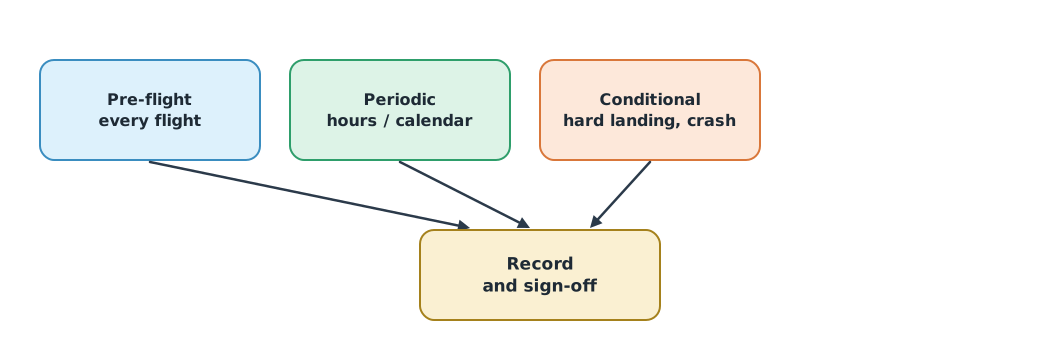
- Pre-flight, every flight, using the manufacturer’s and the organisation’s checklists
- Periodic, by flight hours, number of flights or calendar time, whichever comes first, following the maintenance programme (Module 1)
- Conditional, after events that may cause hidden damage, such as a hard landing, a crash, rain exposure or improper transport
ASTM F2909-19 sets out continued airworthiness for lightweight UAS as a whole system, not just the aircraft.
Finding the abnormal aircraft
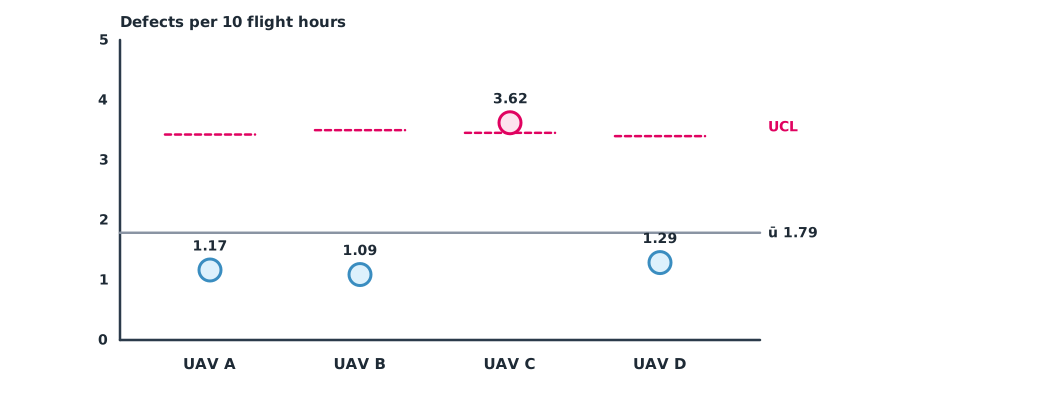
Counting only the number of defects per aircraft penalises the aircraft that fly most. Compare defects per unit of use, such as per 10 flight hours, with a u-chart. Following NIST’s Dataplot manual, the control limits are , which narrow as an aircraft flies more. An aircraft above its upper limit has a special cause worth finding.
Example 1 A u-chart for a four-aircraft fleet over one quarter
import math

fleet = {"A": (60, 7), "B": (55, 6), "C": (58, 21), "D": (62, 8)}   # flight hours, defects
UNIT = 10                                                           # hours per unit
ubar = sum(d for _, d in fleet.values()) / (sum(h for h, _ in fleet.values()) / UNIT)
print(f"u-bar {ubar:.2f} defects per {UNIT} h")
for k, (h, d) in fleet.items():
    n = h / UNIT
    u = d / n
    ucl = ubar + 3 * math.sqrt(ubar / n)
    lcl = max(0.0, ubar - 3 * math.sqrt(ubar / n))
    flag = "ABOVE UCL - investigate" if u > ucl else "in control"
    print(f"UAV {k}: u {u:.2f}, limits [{lcl:.2f}, {ucl:.2f}] -> {flag}")
u-bar 1.79 defects per 10 h
UAV A: u 1.17, limits [0.15, 3.42] -> in control
UAV B: u 1.09, limits [0.08, 3.50] -> in control
UAV C: u 3.62, limits [0.12, 3.45] -> ABOVE UCL - investigate
UAV D: u 1.29, limits [0.18, 3.40] -> in controlUAV C is above its upper limit, and not because it flew more than the others. The next step is to break down UAV C’s defects by type; for example, if most are loose screws on the same arm, there may be a crack or a worn mount. Aircraft inside the limits are not necessarily problem-free; they are just not significantly different from the fleet.
Records that can be verified
US regulation 14 CFR 43.9 requires maintenance records to contain at least: a description of the work or a reference to acceptable data, the completion date, the name of the person who did the work (if not the approver), and, if the work is satisfactory, the approver’s signature, certificate number and certificate type, which constitutes approval for return to service of that work only. Although it applies to crewed US aircraft, the same principle serves drone records well. Thai organisations should use the forms and authorised persons in their own manuals and the CAAT requirements.
Example 2 Checking records for completeness
from datetime import date

REQUIRED = ["uav", "work", "reference", "done_on", "performed_by", "approved_by"]
AUTHORISED = {"Somchai K.", "Nida P."}           # persons authorised to approve return to service per the organisation's manual
records = [
    {"id": "R-101", "uav": "C", "work": "replace arm 2 screws", "reference": "MM 5-3", "done_on": date(2026, 9, 3),
     "performed_by": "Anan T.", "approved_by": "Nida P.", "found_on": date(2026, 9, 2)},
    {"id": "R-102", "uav": "C", "work": "replace motor 2", "reference": "", "done_on": date(2026, 9, 10),
     "performed_by": "Anan T.", "approved_by": "Anan T.", "found_on": date(2026, 9, 9)},
    {"id": "R-103", "uav": "A", "work": "propeller set", "reference": "MM 4-1", "done_on": date(2026, 9, 5),
     "performed_by": "Mali S.", "approved_by": "Somchai K.", "found_on": date(2026, 9, 6)},
]
for r in records:
    problems = [f"missing {f}" for f in REQUIRED if not r.get(f)]
    if r["approved_by"] and r["approved_by"] not in AUTHORISED:
        problems.append(f"{r['approved_by']} is not authorised to approve")
    if r["done_on"] < r["found_on"]:
        problems.append("work completed before the defect was found")
    print(r["id"], "OK" if not problems else "; ".join(problems))
R-101 OK
R-102 missing reference; Anan T. is not authorised to approve
R-103 work completed before the defect was foundRecord R-102 has no manual reference, and the technician approved their own work without authority. Record R-103 was completed before the defect was found, which is impossible and probably a typing error. Both must be corrected without deleting the original, by recording the correction with a reason.
Module lab
Lab: inspect and review records
- Inspect a training drone against the manufacturer’s list and record every item, including those that are normal
- Simulate a hard landing and write a conditional inspection list for that model
- Collect the defects of every training drone and build a u-chart with Example 1
- Check the programme’s maintenance records with Example 2 and correct them the right way
- Propose a record form with every field this lesson requires
Common mistakes
Watch out
- Skipping conditional inspections because nothing looks damaged outside
- Comparing raw defect counts without dividing by use
- Recording only abnormal findings, so nobody knows what was checked
- Approving your own work without authority
- Deleting or overwriting original records instead of recording corrections
Summary
- There are three types of inspection: pre-flight, periodic and conditional
- A u-chart compares defects per unit of use, with limits
- Records need the work, reference, date, performer and authorised approver, following 14 CFR 43.9
- Correct records while keeping the original and the reason
Check your understanding
- An aircraft flew 40 hours and had 6 defects. How many per 10 hours?
- and . What is the upper control limit?
- What type of inspection follows a hard landing?
- What must a maintenance record contain following 14 CFR 43.9?
- How should an incorrect record be fixed?
Answers
- A conditional inspection
- A description of the work or a reference, the completion date, the performer’s name, and the approver’s signature with certificate details
- Record the correction with a reason and keep the original; never delete or overwrite it
Key formulas
| Defects per unit | |
| Control limits |
Key references
- ASTM International. (2019). Standard specification for continued airworthiness of lightweight unmanned aircraft systems (ASTM F2909-19). link
- Code of Federal Regulations. 14 CFR § 43.9 Content, form, and disposition of maintenance, preventive maintenance, rebuilding, and alteration records. link
- Federal Aviation Administration. (2023). Aviation maintenance technician handbook – General (FAA-H-8083-30B). link
- NIST. (1997). U control chart. Dataplot reference manual (chapter 2). link
- National Aeronautics and Space Administration. (2008). Reliability-centered maintenance guide for facilities and collateral equipment. link
Further reading
Study the assigned knowledge units in advance, review media and take the module quiz
In class / field
Lab or field practice from worksheets with a safety checklist
Learning evidence: Checked worksheets and quiz results