Repair and post-repair checks
UAT 303 UAS Inspection and Maintenance
Lesson
By the end of this module you will be able to
- Compute the force from propeller and motor imbalance and the acceptable specific unbalance
- Repair from a job card that references the manual, and record the parts replaced
- Design a post-repair test that compares against that aircraft's baseline
- Separate document status from equipment status in return to service
Why this matters
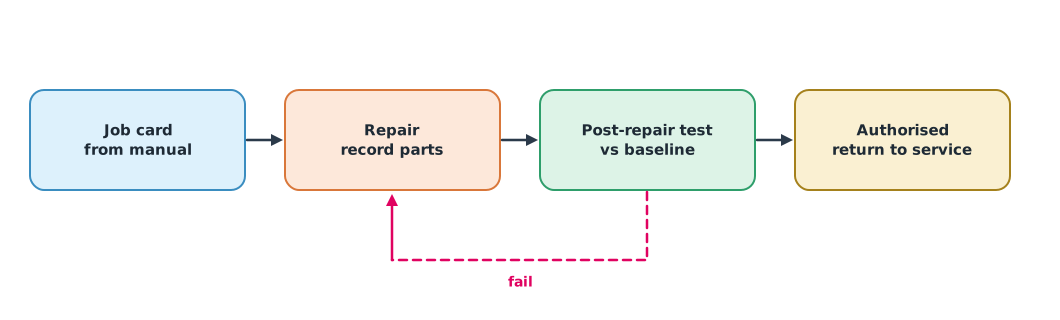
A repair without a confirming test is only a part swap. The drone knowledge base’s unit on maintenance work and post-repair checks explains that a job card links the assigned task, the steps from the manual, the inspection results and the person responsible for approval, and warns that a complete job card is not the same as a skill actually observed, so document status must be kept separate from equipment status. This module continues from Module 3, which found imbalance on UAV 3 after a hard landing.
Imbalance in rotating parts
An excess mass at radius on a propeller creates an unbalance (in g·mm). Spinning at angular speed , it produces a rotating force by the principle of centripetal force (OpenStax University Physics). This force rotates with the propeller and shakes the aircraft at the frequency seen in Module 3. ISO 21940-11:2016, on balancing rotors with rigid behaviour, sets the permissible unbalance , where is the specific unbalance, and bases its balance quality grades on the product being constant. Propeller and motor makers often set their own balancing methods and criteria, and those come first.
Example 1 How much force does a small chip create?
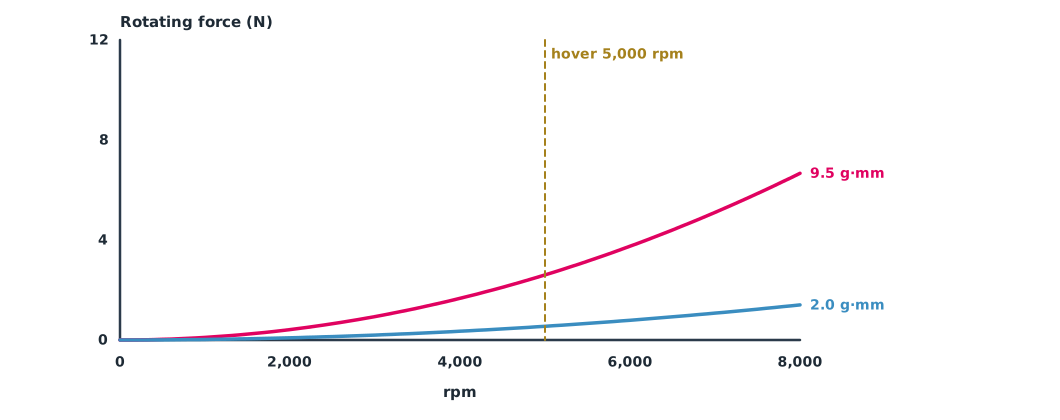
A chipped blade tip loses mass on one side, equivalent to an unbalance of 9.5 g·mm; after rebalancing, 2.0 g·mm remains. The propeller and hub weigh 60 g and turn at 5,000 rpm in hover, where each motor carries about 7.85 N of lift (from UAT 302).
import math

RPM, M_ROTOR, HOVER_THRUST = 5000, 60, 7.85     # rpm, g, N
omega = 2 * math.pi * RPM / 60
for label, u_gmm in (("chipped", 9.5), ("after balancing", 2.0)):
    force = u_gmm * 1e-6 * omega ** 2           # g·mm -> kg·m
    e_um = u_gmm / M_ROTOR * 1000               # µm
    print(f"{label:<16} U {u_gmm} g·mm: F {force:.2f} N ({force / HOVER_THRUST:.0%} of hover thrust), "
          f"e {e_um:.0f} um, e*Omega {e_um / 1000 * omega:.1f} mm/s")
chipped U 9.5 g·mm: F 2.60 N (33% of hover thrust), e 158 um, e*Omega 82.9 mm/s
after balancing U 2.0 g·mm: F 0.55 N (7% of hover thrust), e 33 um, e*Omega 17.5 mm/sA chip too small to notice creates a rotating force of about a third of that motor’s lift. It rotates 83 times a second, speeding up fatigue in mounts, screws and sensors. Rebalancing cuts the force about five times, but a chipped or cracked propeller should be replaced as the manufacturer directs, not rebalanced and reused, because damaged material may break in flight.
Post-repair tests against a baseline
A post-repair test must prove two things: the original problem is gone and no new problem has appeared. An effective method is to record a baseline for each aircraft while it is healthy, such as VIBE vibration, RCOU motor outputs and BAT current in hover, and to set acceptance criteria in advance.
Example 2 Acceptance criteria after replacing a motor and propeller
Averages from 2 minutes of hover, compared with UAV 3’s baseline (simulated values). The organisation’s criteria: vibration below 30 m/s² per the ArduPilot documentation, each motor output within 5% of the mean, and hover current within 5% of the baseline.
baseline = {"vibe_max": 14.0, "hover_current": 21.0}
after = {"vibe_max": 16.5, "hover_current": 22.6, "rcou": [1512, 1498, 1571, 1505]}   # m/s², A, µs

checks = []
checks.append(("vibration < 30 m/s²", after["vibe_max"] < 30))
mean_out = sum(after["rcou"]) / len(after["rcou"])
spread = max(abs(o - mean_out) / mean_out for o in after["rcou"])
checks.append((f"motor outputs within 5% of mean (max {spread:.1%})", spread <= 0.05))
dcur = (after["hover_current"] - baseline["hover_current"]) / baseline["hover_current"]
checks.append((f"hover current within 5% of baseline ({dcur:+.1%})", abs(dcur) <= 0.05))
for text, ok in checks:
    print(f"{'PASS' if ok else 'FAIL'}  {text}")
print("return to service" if all(ok for _, ok in checks) else "not released: investigate")
PASS vibration < 30 m/s²
PASS motor outputs within 5% of mean (max 3.3%)
FAIL hover current within 5% of baseline (+7.6%)
not released: investigateVibration passes, but hover current is above the baseline beyond the limit, even though motor 3’s output is only about 3% above the others. The new propeller set may not match the original model, or the replacement motor may have a different KV; this must be checked before return to service. Looking only at vibration would release a drone with shorter endurance without anyone noticing.
Return to service
Following 14 CFR 43.9, the authorised approver’s signature in the record constitutes approval for return to service of the work performed. A complete job card is document status; a test that passes its criteria is equipment status. Both are required. If the test fails, the aircraft must be tagged “do not use” until it is fixed and retested.
Module lab
Lab: repair and return to service
- Record a baseline for a training drone (VIBE, RCOU, BAT in hover) while it is healthy
- Replace one propeller set from a job card that references the manufacturer’s manual, and record the model and part numbers
- Balance the propellers on a balancer and estimate the unbalance before and after with Example 1
- Hover to test, and check against criteria like Example 2
- Have an authorised person sign the release, or tag the aircraft “do not use” if it fails
Common mistakes
Watch out
- Treating a part swap as a finished repair
- Rebalancing a chipped or cracked propeller and reusing it
- Having no baseline, so nobody knows whether post-repair values are normal
- Checking only the original problem and not whether a new one appeared
- Signing the release before testing is complete
Summary
- Unbalance creates a force that grows with the square of speed
- ISO 21940-11 sets permissible unbalance from specific unbalance, but manufacturer criteria come first
- Post-repair tests compare against that aircraft’s baseline using criteria set in advance
- Return to service requires both document status and equipment status
Check your understanding
- What unbalance does an excess mass of 0.1 g at 100 mm radius create?
- With the same unbalance and double the speed, by what factor does the force rise?
- An unbalance of 6 g·mm on a 60 g rotor gives what specific unbalance?
- What two things must a post-repair test prove?
- How do document status and equipment status differ?
Answers
- g·mm
- 4 times, because force scales with
- g·mm/g = 100 µm
- That the original problem is gone and that no new problem has appeared
- Document status means the records and job card are complete; equipment status means real tests pass the criteria
Key formulas
| Unbalance and rotating force | |
| Specific unbalance |
Key references
- International Organization for Standardization. (2016). Mechanical vibration — Rotor balancing — Part 11: Procedures and tolerances for rotors with rigid behaviour (ISO 21940-11:2016). link
- Ling, S. J., Sanny, J., & Moebs, W. (2016). University physics volume 1. OpenStax. link
- ArduPilot Dev Team. Measuring vibration. ArduPilot Copter documentation. link
- Code of Federal Regulations. 14 CFR § 43.9 Content, form, and disposition of maintenance, preventive maintenance, rebuilding, and alteration records. link
- Federal Aviation Administration. (2023). Aviation maintenance technician handbook – General (FAA-H-8083-30B). link
- ArduPilot Dev Team. Onboard message log messages. ArduPilot Copter documentation. link
Further reading
Study the assigned knowledge units in advance, review media and take the module quiz
In class / field
Lab or field practice from worksheets with a safety checklist
Learning evidence: Checked worksheets and quiz results