Project management
UAT 316 Technology Project Management, Innovation and Entrepreneurship
Lesson
By the end of this module you will be able to
- Tell projects from operations, and choose a predictive, agile or hybrid life cycle to suit the work
- Write a project charter and break the work into a work breakdown structure (WBS)
- Calculate the critical path and float with CPM, and make three-point time estimates
- Describe the accountabilities, events and artifacts of Scrum
Why this matters
Many graduates of this programme will be more than pilots or technicians: they will set up drone service units, submit project proposals to agencies or start businesses of their own. Most failed drone projects fail not because of the technology but because the scope was vague, the schedule was unrealistic, or nobody knew which work could not slip. This course follows one hypothetical case through all five modules: setting up a drone survey service unit for a municipality. Every number is made up for practice, not real prices or data.
What a project is
A project is temporary work that creates a unique result, with a clear start and end. It differs from operations, which repeat continuously. Setting up the survey unit is a project; the weekly survey flights after it is running are operations.
There are two main references. The PMBOK Guide from the Project Management Institute (PMI), whose 8th edition was published in November 2025, organises knowledge into six principles and seven performance domains and brings process guidance back. ISO 21502:2020 is ISO’s guidance on project management.
| Life cycle | Character | Suits |
|---|---|---|
| Predictive | Scope, time and budget set up front; work done in sequence | Work with clear requirements, such as buying and installing a system |
| Agile | Delivers in short increments, adapting to feedback | Work whose needs are unclear, such as image-analysis software |
| Hybrid | Uses each where it fits | Most drone projects, which mix procurement with service development |
Project charter and WBS
A project charter authorises a project to start. It states the goal, scope, deliverables, sponsor, project manager, rough budget, main risks and success criteria. The drone knowledge hub’s unit on project governance and monitoring stresses naming the work owner, approver, reviewer and data users in this document from the start.
A work breakdown structure (WBS) breaks large deliverables into manageable pieces in a hierarchy. The lowest-level pieces (work packages) must be small enough to estimate in time and cost and to assign to a single owner.
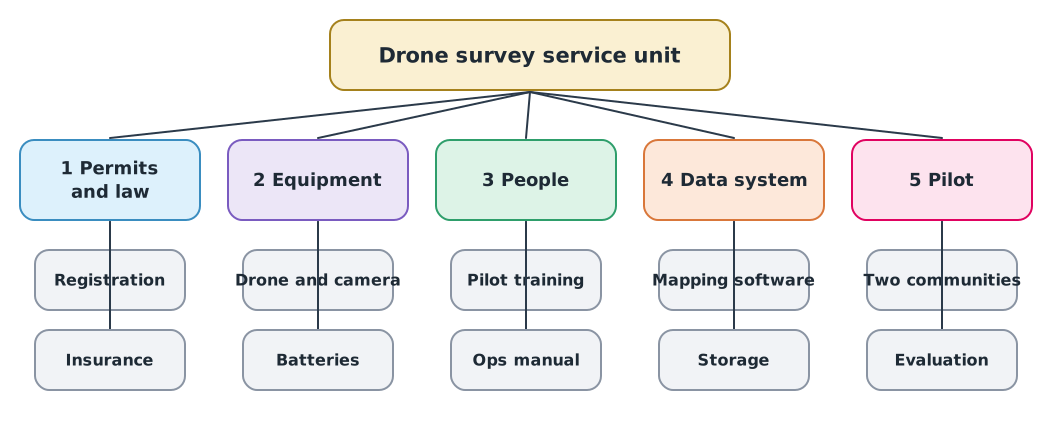
A WBS is organised by deliverable, not by department or by time, and must cover all the work in scope. Work that is not in the WBS is out of scope.
The critical path
The Critical Path Method (CPM), published by Kelley and Walker in 1959, finds the work that cannot slip at all. It uses two passes. The forward pass finds the earliest start (ES) and earliest finish (EF); the backward pass finds the latest start (LS) and latest finish (LF). The difference LS − ES is the float. Tasks with zero float are on the critical path: if they slip, the whole project slips.
tasks = {
    "A": ("permits and registration", 4, []),
    "B": ("procure drones and equipment", 6, []),
    "C": ("train pilots", 3, ["A"]),
    "D": ("set up data system", 2, ["B"]),
    "E": ("test flights", 2, ["B", "C"]),
    "F": ("operations manual", 1, ["C"]),
    "G": ("pilot service", 3, ["D", "E", "F"]),
}
es, ef = {}, {}
for key, (name, weeks, pred) in tasks.items():
    es[key] = max((ef[p] for p in pred), default=0)
    ef[key] = es[key] + weeks
finish = max(ef.values())
ls, lf = {}, {}
for key in reversed(list(tasks)):
    successors = [k for k, (_, _, pred) in tasks.items() if key in pred]
    lf[key] = min((ls[s] for s in successors), default=finish)
    ls[key] = lf[key] - tasks[key][1]

print("task  ES  EF  LS  LF  float")
for key in tasks:
    print(f"  {key}   {es[key]:>2}  {ef[key]:>2}  {ls[key]:>2}  {lf[key]:>2}  {ls[key] - es[key]:>4}")
print("project duration:", finish, "weeks   critical path:", " -> ".join(k for k in tasks if ls[k] == es[k]))
task ES EF LS LF float
A 0 4 0 4 0
B 0 6 1 7 1
C 4 7 4 7 0
D 6 8 7 9 1
E 7 9 7 9 0
F 7 8 8 9 1
G 9 12 9 12 0
project duration: 12 weeks critical path: A -> C -> E -> GThe tasks in the code are ordered so that predecessors always come first, which the forward pass needs.
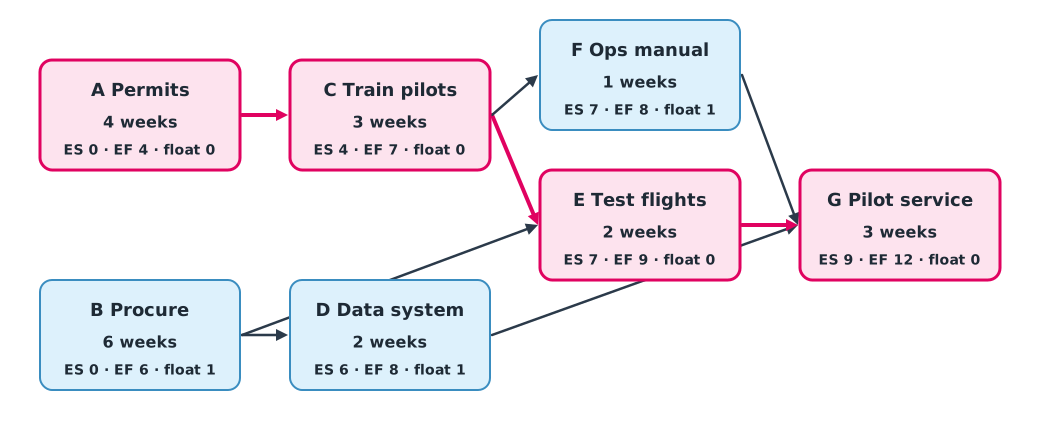
The project takes 12 weeks, and the critical path is permits, pilot training, test flights and pilot service. If permits slip one week, the project slips one week at once, but procurement can slip a week without moving the end date. The project manager should therefore push permits before procurement, even though procurement takes longer.
Example 1 A three-point estimate for procurement
Procurement time is uncertain. An expert gives an optimistic (o) 4 weeks, a most likely (m) 6 weeks and a pessimistic (p) 11 weeks. The PERT method, developed for the US Navy’s Polaris submarine programme (Malcolm et al., 1959), uses a weighted average.
o, m, p = 4, 6, 11
expected = (o + 4 * m + p) / 6
sd = (p - o) / 6
print(f"expected {expected:.2f} weeks   standard deviation about {sd:.2f} weeks")
print(f"float of task B is only {ls['B'] - es['B']} week, so B could become critical")
expected 6.50 weeks standard deviation about 1.17 weeks
float of task B is only 1 week, so B could become criticalThe expected 6.5 weeks is longer than the most likely value, because running late is more likely than running early. Half a week late is still within the one week of float, but at the pessimistic 11 weeks procurement would be 5 weeks late and become critical at once.
Agile and Scrum
Parts of the work whose needs are unclear, such as a dashboard showing survey results to the municipality, suit an agile approach. The Agile Manifesto (2001) values individuals and interactions over processes and tools, working software over comprehensive documentation, customer collaboration over contract negotiation, and responding to change over following a plan.
Scrum, as defined in the 2020 Scrum Guide, is the most widely used agile framework. It has:
- Three accountabilities: Product Owner, Scrum Master and Developers
- Five events: the Sprint (a cycle of one month or less), Sprint Planning, Daily Scrum, Sprint Review and Sprint Retrospective
- Three artifacts: Product Backlog, Sprint Backlog and Increment
Class activity
Activity: planning the service-unit project
- Write a one-page project charter for the survey unit, stating the goal, scope, what is out of scope, deliverables and measurable success criteria.
- Extend the WBS in Figure 1 by one more level, and check that every piece has a single owner.
- Suppose permits slip by two weeks. Recalculate the critical path with the code in this lesson and propose one way to recover.
- Discuss which parts of the project should be predictive and which agile.
Common mistakes
Watch out
- Starting without a charter, so nobody has authority when scope conflicts arise
- Breaking the WBS down by department instead of deliverable, so work falls between departments
- Speeding up the longest task instead of the critical path
- Using the most likely estimate as the deadline, ignoring uncertainty
- Calling everything agile without real delivery cycles and reviews
Summary
- A project is temporary work with a unique result; choose predictive, agile or hybrid by how clear the requirements are
- The charter authorises and scopes the project; the WBS breaks deliverables into manageable pieces
- CPM finds the critical path and float; PERT uses three estimates for uncertain durations
- Scrum has three accountabilities, five events and three artifacts, suiting work whose needs can change
Check your understanding
- Are the weekly survey flights after the unit is set up a project or operations?
- A task has ES = 5, EF = 9 and LS = 7. What is its float?
- A task has o = 2, m = 3 and p = 10 weeks. What is its PERT expected time?
- If a critical-path task slips by 3 days, how late will the project be?
- Who in Scrum is accountable for ordering the Product Backlog?
Answers
- Operations, because they repeat continuously rather than being temporary work with an end
- weeks
- 3 days late, because critical-path tasks have no float
- The Product Owner
Key formulas
| Earliest start and finish | |
| Total float | |
| Three-point estimate (PERT) |
Key references
- Project Management Institute. (2025). A guide to the project management body of knowledge (PMBOK guide) (8th ed.). link
- Kerzner, H. (2025). Project management: A systems approach to planning, scheduling, and controlling (14th ed.). Wiley. link
- ISO. (2020). ISO 21502:2020 Project, programme and portfolio management — Guidance on project management. link
- Kelley, J. E., & Walker, M. R. (1959). Critical-path planning and scheduling. Papers presented at the Eastern Joint IRE-AIEE-ACM Computer Conference (pp. 160–173). link
- Malcolm, D. G., Roseboom, J. H., Clark, C. E., & Fazar, W. (1959). Application of a technique for research and development program evaluation. Operations Research, 7(5), 646–669. link
- Schwaber, K., & Sutherland, J. (2020). The Scrum guide. link
- Beck, K., et al. (2001). Manifesto for agile software development. link
Further reading
Study the assigned knowledge units in advance, review media and take the module quiz
Technology project management
Brief: questions, deliverables and team roles
Receiving the brief and setting survey criteria
In class / field
Lecture, case discussion and in-class problem solving
Learning evidence: Quiz results and submitted exercises