Search and rescue
UAT 364 Unmanned Aircraft Systems Technology for Public Safety and Emergency Management
Lesson
By the end of this module you will be able to
- Choose a search pattern suited to the last known position and the area
- Compute coverage and probability of detection (POD) from track spacing
- Compute probability of success (POS) and update the probability of containment (POC) after an unsuccessful search
- Read RGB and thermal images in search work with an understanding of their limits
Why this matters
A 1 × 0.6 km riverside forest is too large to search every square metre in the time available. The team must decide where to search first, how densely, and, after searching without success, whether to search the same place again or move on. The search theory long used by coast guards and rescue services gives answers as numbers that can be explained, instead of decisions by feel.
Search patterns
The IAMSAR Manual (IMO and ICAO, 2025 edition) and AMSA’s search and rescue manual describe the common search patterns.
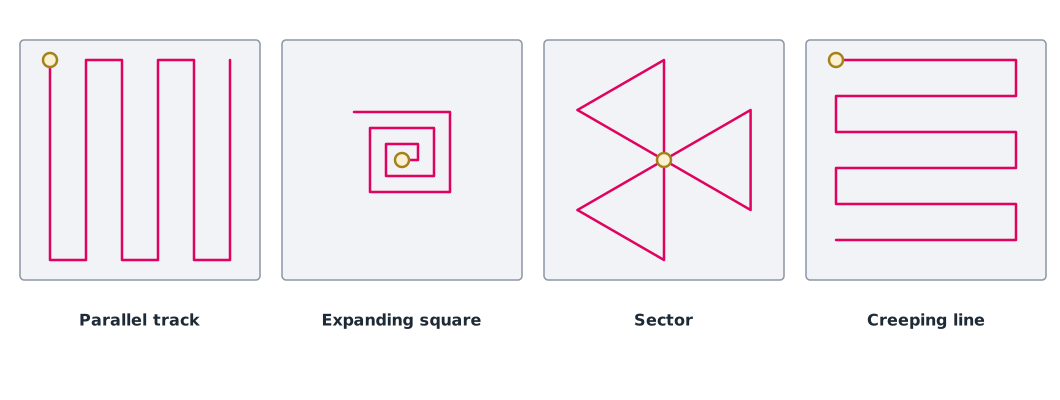
- Parallel track covers a wide area evenly when the location is uncertain
- Expanding square starts at the most likely point and spirals outward, suited to a fairly well-known last position
- Sector passes over a centre point from several directions, suited to a small area around a well-known point
- Creeping line flies across a long axis and creeps along it, suited to searching along a route such as a riverbank
Coverage and probability of detection
The US Coast Guard’s The Theory of Search, based on Koopman’s work, defines the effective sweep width () as a width reflecting the sensor’s ability to detect a target under given conditions; it is not the image width. Coverage is ; for parallel tracks with spacing , , and for random search POD = 1 − e^(−C).
Example 1. POD by track spacing
Assumed values: 1,000 × 600 m area, thermal camera at night with = 20 m (which must come from trials with the real target, sensor and conditions), 5 m/s.
import math

AREA_M2, SWEEP_W, SPEED = 1000 * 600, 20.0, 5.0
for spacing in (40, 20, 10):
    coverage = SWEEP_W / spacing
    pod = 1 - math.exp(-coverage)
    track_km = AREA_M2 / spacing / 1000
    print(f"spacing {spacing:>2} m: C {coverage:.1f}, POD {pod:.0%}, "
          f"{track_km:.0f} km of track, {track_km * 1000 / SPEED / 60:.0f} min")
spacing 40 m: C 0.5, POD 39%, 15 km of track, 50 min
spacing 20 m: C 1.0, POD 63%, 30 km of track, 100 min
spacing 10 m: C 2.0, POD 86%, 60 km of track, 200 minHalving the spacing doubles the time, but POD rises by less each time: from 39% to 63% to 86%. Searching one area very densely may be less worthwhile than covering several areas adequately.
POS and updating POC
POC (probability of containment) is the probability that the missing person is in an area, judged from the last known position, behaviour and terrain. POS = POC × POD is the probability that this search finds them. After searching an area without success, that area’s POC is reduced by the factor , as in the Coast Guard document, and after normalising in the Bayesian way (Kratzke, Stone and Frost, 2010) the POC of the other areas rises.
Example 2. Area A searched without success: where next?
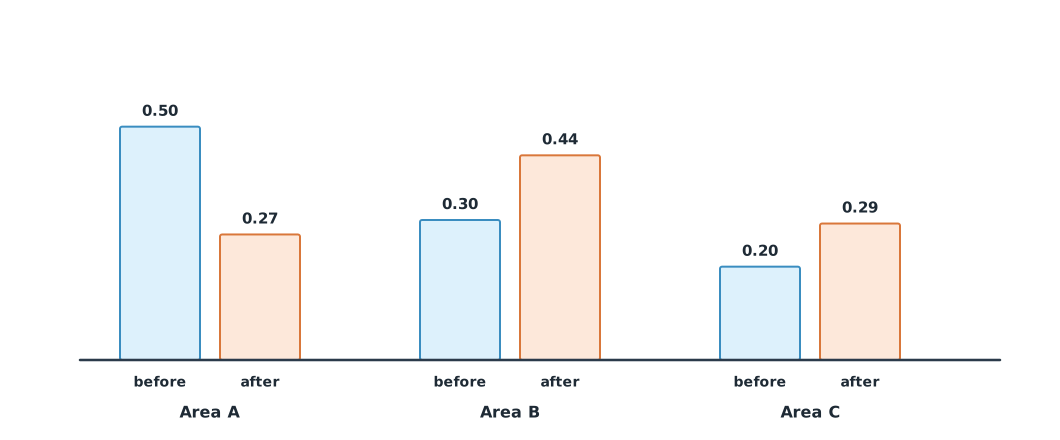
Assumed initial POC: A 0.5, B 0.3, C 0.2. A is searched with C = 1.
import math

poc = {"A": 0.5, "B": 0.3, "C": 0.2}
pod_a = 1 - math.exp(-1.0)
print(f"POS of searching A: {poc['A'] * pod_a:.3f}")

not_found = 1 - poc["A"] * pod_a
updated = {k: (v * (1 - pod_a) if k == "A" else v) / not_found for k, v in poc.items()}
for k in poc:
    print(f"area {k}: POC {poc[k]:.2f} -> {updated[k]:.3f}")
print("search next:", max(updated, key=updated.get))
print(f"searching A twice at C=1 gives cumulative POD {1 - (1 - pod_a) ** 2:.0%}")
POS of searching A: 0.316
area A: POC 0.50 -> 0.269
area B: POC 0.30 -> 0.439
area C: POC 0.20 -> 0.292
search next: B
searching A twice at C=1 gives cumulative POD 86%After searching A without success, area B now has the highest probability, so the team should move to B rather than search A again. The US Coast Guard’s search planning system (SAROPS) applies the same principle to thousands of cells.
Reading images in search work
The knowledge unit on search and rescue warns that a bright spot in a thermal image is not always a person; it may be a sun-warmed rock, hot equipment or an animal. FLIR explains that thermal cameras cannot see through walls, only surface temperatures; glass reflects infrared like a mirror, though thermal cameras can see through smoke. Therefore not finding someone in an image does not mean nobody is there, especially under trees or roofs. Reports of suspected sightings must include the image ID, time, location with its uncertainty and the reason, and go to a reviewer; victims’ locations are never published on public channels.
Module lab
Lab: tabletop search planning
- Divide the training map into three areas and estimate POC from the hypothetical missing-person information, with reasons
- Measure for the lab camera against a mock target in one condition, then use Example 1 to choose track spacing
- Choose a search pattern for each area and plan the lines in QGroundControl
- Simulate an unsuccessful search, update POC with Example 2, and decide on the next area
- Have two students read a training image set separately, and count false alarms and misses
Common mistakes
Watch out
- Using image width as sweep width
- Searching the same place again when another area now has higher POC
- Declaring an area empty because nothing was seen in the images
- Calling a hot spot a person without checking the context
- Publishing victims’ coordinates publicly
Summary
- Choose a search pattern by how certain the last position is and the shape of the area
- C = W/S and POD = 1 − e^(−C); denser searching raises POD by less and less
- POS = POC × POD; after an unsuccessful search that area’s POC falls and the others rise
- Not seen does not mean not there; thermal cameras cannot see through walls
Check your understanding
- W = 30 m and track spacing 30 m. What is POD?
- POC 0.4 and POD 0.6. What is POS?
- An area is searched twice with POD 0.5 each time. What is the cumulative POD?
- Why does B’s POC rise after A is searched without success?
- Can a thermal camera see a person behind a wall?
Answers
- , POD
- The total probability is still 1; as A becomes less likely, the other areas take a larger share
- No; it sees only the wall’s surface temperature
Key formulas
| Coverage | |
| POD for random search | |
| Probability of success | |
| POC after an unsuccessful search (normalised) |
Key references
- International Maritime Organization & International Civil Aviation Organization. (2025). IAMSAR manual: Volume II – Mission co-ordination (2025 ed.). IMO. link
- Soza & Company & U.S. Coast Guard Office of Search and Rescue. (1996). The theory of search: A simplified explanation. U.S. Coast Guard. link
- Australian Maritime Safety Authority. (2026). National search and rescue manual (February 2026 ed.), Volume 2. link
- Kratzke, T. M., Stone, L. D., & Frost, J. R. (2010). Search and rescue optimal planning system. In Proceedings of the 13th International Conference on Information Fusion. link
- Teledyne FLIR. (2019, October 4). Can thermal imaging see through walls? And other common questions. link
- Murphy, R. R. (2014). Disaster robotics. MIT Press. link
Further reading
Study the assigned knowledge units in advance, review media and take the module quiz
Searching for victims with RGB and thermal imagery
Search patterns and probability of detection
In class / field
Intensive lab and field practice recorded in a lab notebook
Learning evidence: Lab notebook signed by the instructor